Sometimes the problem is not that you are lazy or not good at something. Sometimes the problem is that your plan needs an update. You might set a goal to read every night, save money for a game, finish chores faster, or practice a skill online, and then realize after a week that things are not going the way you hoped. That is where reflection becomes powerful. Reflection helps you pause, look honestly at what happened, and make a better next move instead of just guessing.
Reflection means thinking back on what you did, what happened, and what you learned. It is not the same as worrying. Worrying can feel like going in circles. Reflection helps you move forward. When you reflect, you ask useful questions such as: What worked? What got in the way? What should I keep doing? What should I change?
This skill matters in real life because goals do not always go exactly as planned. Maybe you decided to clean your room in one afternoon, but you underestimated how long it would take. Maybe you wanted to save $20 in two weeks, but you kept spending small amounts on snacks or game add-ons. Maybe you planned to message a group leader about a club activity, but you kept forgetting. Reflection helps you be responsible without being too hard on yourself.
Goal is something you want to achieve.
Strategy is the method or plan you use to reach that goal.
Timeline is the amount of time you give yourself and the schedule you follow.
Here is a simple way to think about it: the goal is where you want to go, the strategy is how you plan to get there, and the timeline is when you expect to make progress or finish. If one part is not working, you do not always need to throw out the whole plan. Often, you only need to revise one part.
You already reflect more than you may realize. If you try a new way to organize your homework, and then decide to keep it because it helps, that is reflection. If you notice that doing chores right before bedtime makes you too tired, and you switch to doing them earlier, that is reflection too. Reflection is a life skill because it helps you make decisions based on real results instead of hope alone.
Good reflection is honest, calm, and specific. Saying, "Everything went badly," is not very helpful. Saying, "I finished only two days of practice because I forgot on the weekend and my plan had no reminder," is much more useful. Specific reflection gives you clues about what to change.
The big idea: Reflection is not about proving whether you succeeded or failed. It is about collecting information. When you understand what happened, you can make a smarter plan. That is how responsible people improve over time.
Think of reflection like using a map app. If you miss a turn, the app does not say, "You are terrible at traveling." It checks where you are now and gives you a new route. Reflection works the same way. It helps you reroute.
A useful strategy for reflection follows a simple cycle, as [Figure 1] shows: set a goal, take action, check the result, reflect, and adjust. This cycle matters because one try does not tell the whole story. You learn by noticing patterns over time.
Step 1: Stop and notice what happened. Look at facts, not just feelings. Did you do the task? How often? How long did it take? Did you meet your target?
Step 2: Ask helpful questions. What worked well? What was hard? Did I forget, get distracted, run out of time, or choose a plan that was too big?
Step 3: Decide what to change. Will you revise the goal, change the strategy, or adjust the timeline?
Step 4: Try the new plan and check again later. Reflection is not a one-time event. It is a cycle.
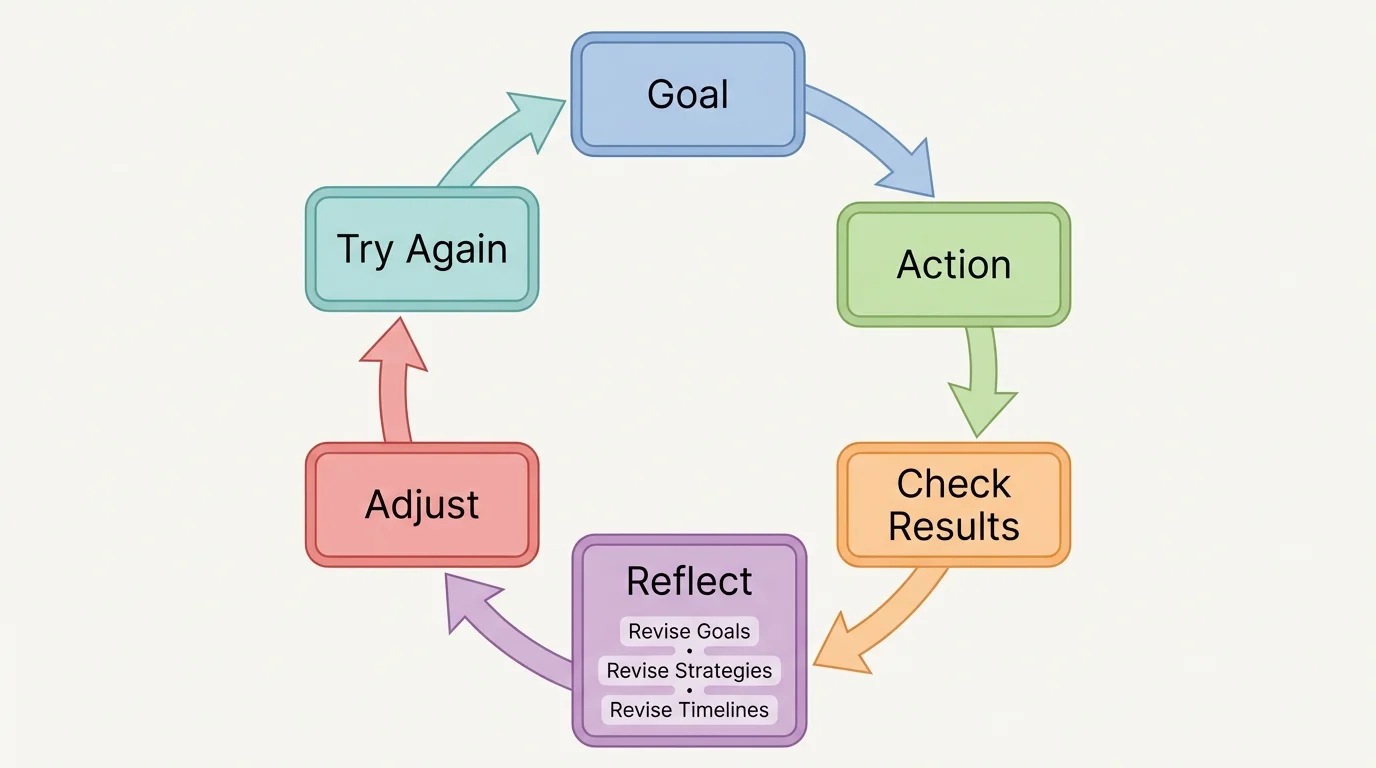
If you skip the reflection step, you might keep repeating a plan that is not working. If you reflect too much but never act, you also get stuck. The goal is balance: act, check, think, adjust, repeat.
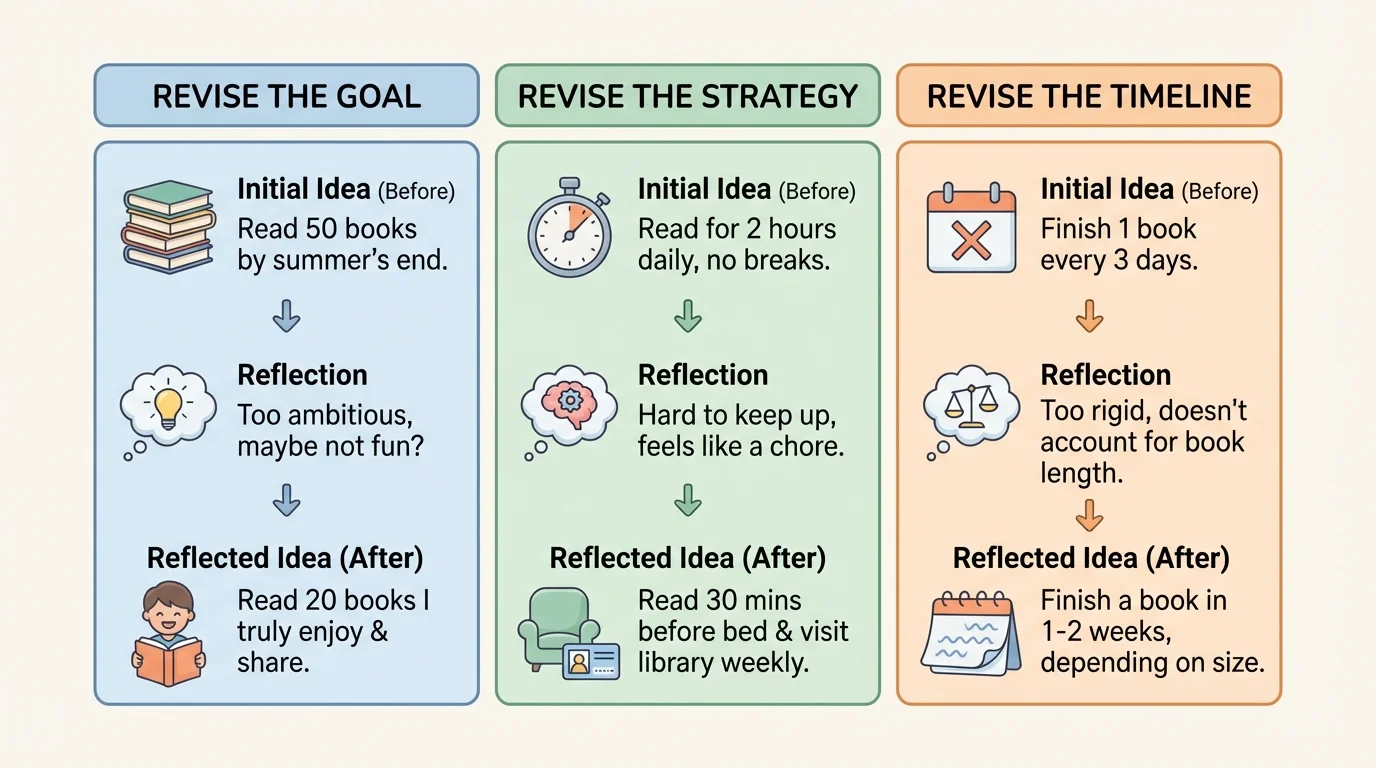
Sometimes the goal itself needs to change. This does not mean you are giving up. It means you are making the goal fit real life better. As [Figure 2] explains, revising the goal is different from changing the method or changing the schedule. You revise the goal when it is too big, too unclear, or no longer important to you.
A goal often needs revision if it sounds like this: "I will become amazing at drawing this week," or "I will never forget any chore again." Those goals are hard to measure and may be unrealistic. A better goal would be: "I will practice drawing for 15 minutes on four days this week," or "I will complete my pet care routine every morning for the next five days."
When you revise a goal, make it clearer and smaller if needed. Ask yourself: Can I actually do this? Do I know what success looks like? Is this goal important to me right now?
Example: Revising a goal
Original goal: "I will read a chapter book in three days."
Step 1: Reflect on the result
You read for one day, then stopped because the book was longer than expected and you had other responsibilities.
Step 2: Find the problem
The goal was too big for the time you had.
Step 3: Revise the goal
New goal: "I will read for 20 minutes each evening for one week."
The new goal is more realistic and easier to follow.
Notice that the new goal still supports the same general dream of reading more. You did not quit reading. You just made the target more workable.
Sometimes the goal is fine, but your method is not helping enough. That means you need to change the strategy. This is common. Many people think, "If I really cared, I would just do it." But often the real issue is that the plan does not match how life works.
Here are signs your strategy may need revision: you forget often, the task takes too long, you feel confused about the next step, or your plan depends on perfect conditions. For example, if your goal is to water a plant every three days, but you keep forgetting, the goal is not the problem. The strategy might be. A better strategy could be setting a reminder on a device or placing the watering can where you will see it.
The reflection cycle from [Figure 1] helps here too. You check the result, look for the obstacle, and then adjust the method instead of blaming yourself.
| Situation | Goal | Old strategy | Better strategy |
|---|---|---|---|
| Saving money | Save $15 in three weeks | Keep money loose in a drawer | Use a labeled envelope and put in $1 each day |
| Exercise | Move your body four times a week | Do a long workout whenever you feel like it | Follow a 10-minute routine after lunch on set days |
| Chores | Keep your space tidy | Clean everything once a week | Spend 5 minutes tidying each evening |
| Online communication | Reply responsibly to messages | Hope you remember later | Check messages at the same time each day |
Table 1. Examples of goals with weak strategies and stronger replacement strategies.
A strong strategy is simple, repeatable, and easy to remember. It often includes a cue, like a reminder, a checklist, a note, or a habit connected to something you already do.
Sometimes your goal and strategy are both good, but the schedule is too rushed or too loose. That is when you revise the timeline. A timeline should challenge you enough to keep you moving, but not so much that it makes success unlikely.
If your plan says you will clean and organize your whole room in 30 minutes, but the room is very messy, your timeline may be unrealistic. If your plan says you will eventually work on it "sometime this month," your timeline may be too vague. Good timelines are clear and manageable.
It is responsible to adjust time when needed. Changing a timeline is not the same as making excuses. The difference is that a thoughtful revision is based on what you learned from real effort.
You can revise a timeline by adding more time, breaking the task into smaller time blocks, or setting mini-deadlines. For example, instead of "Finish my room by tonight," try "Pick up clothes by 4:00, clear the desk by 4:15, and make the bed by 4:25." Breaking time into parts can make a big task feel less overwhelming.
Example: Revising a timeline
Original plan: "Save $12 in one week by setting aside $2 each day."
Step 1: Reflect on what happened
You managed to save on three days, so you saved $6.
Step 2: Ask why
You had some days when you could not set money aside.
Step 3: Revise the timeline
Keep the same goal of $12, but extend the plan to two weeks.
Step 4: Add a checkpoint
Check your progress after one week to see whether the new timeline fits better.
This change keeps the goal but gives you a more realistic amount of time.
When you revise a timeline, be careful not to stretch it so far that the goal loses energy. You still want a clear finish line.
When a plan is not working, ask these three questions in order. First: Is the goal clear and realistic? If not, revise the goal. Second: Is my method helping me succeed? If not, revise the strategy. Third: Do I have enough time, and is my schedule clear? If not, revise the timeline.
This order helps because people often change the wrong thing. For example, a student may say, "I guess I should stop trying to learn guitar," when the real issue is that the practice plan had no set time. Or someone may think, "I need a new reminder app," when the real issue is that the goal was much too large for one week.
Smart revision means changing the smallest thing that solves the problem. If the goal still matters, keep it. If the method is the issue, change the strategy. If time is the issue, revise the timeline. You do not need to rebuild everything every time.
Suppose your goal is to help more at home by doing dishes four evenings each week. After reflecting, you notice you forgot twice because you were busy with another task online. The goal is still reasonable, so you revise the strategy: set an alarm and ask a family member to remind you during the first week.
Or maybe your goal is to walk for 20 minutes every day. After a few days, you realize bad weather and family plans make daily walks difficult. You reflect and decide to revise the goal to five days each week, or keep the goal but revise the strategy by doing an indoor movement video on rainy days.
If you are working on improving online communication, you might set a goal to reply to important messages within one day. If you reflect and notice you miss messages because notifications are off, the strategy needs revision. If you see that weekends are harder for you to check, you may revise the timeline to "reply within one day on weekdays and by Sunday evening on weekends."
People who improve steadily are often not the people with perfect plans. They are the people who notice problems early and make useful adjustments before the problem grows.
That is why reflection connects to responsibility. Responsible people do not pretend everything is fine when it is not. They notice, adjust, and keep going.
One common mistake is changing everything at once. If your goal is not working, and you change the goal, the strategy, and the timeline all at the same time, it becomes hard to tell what actually helped. A smarter approach is to change one main thing, then check again.
Another mistake is using reflection only when something goes wrong. Reflection also helps when something goes well. If a plan worked, ask why. Maybe a reminder helped. Maybe doing the task at the same time every day made it easier. Keep the parts that work.
A third mistake is turning reflection into self-criticism. Reflection should sound like a coach, not an insult. Instead of saying, "I am terrible at this," say, "My plan did not match my schedule." That sentence leads to action. Self-criticism usually does not.
The comparison in [Figure 2] can guide you when you feel stuck. If you know whether the problem is the target, the method, or the timing, you can make a calm and useful change.
"Mistakes are proof that you are trying, but reflection is what helps you improve."
The best time to reflect is not only at the end of a big failure. It is better to reflect regularly. You can do a quick check-in every day or every few days. It does not need to take long. Even three minutes can help.
Try using the same short questions each time: What did I plan to do? What did I actually do? What helped? What got in the way? What will I change next? You can answer these in a notebook, a notes app, or even by saying them quietly to yourself.
Some students like a simple rating system. For example, you can rate your progress from 1 to 5, where 1 means "not started" and 5 means "went very well." If you choose a number below 3, ask what needs revision. If you choose 4 or 5, ask what you should keep doing.
Quick weekly reflection routine
Step 1: Name your goal
Say exactly what you were trying to do.
Step 2: Look at the facts
How many times did you do it? When did it go well? When did it not?
Step 3: Find the biggest obstacle
Choose one main reason, such as forgetting, limited time, distractions, or unclear steps.
Step 4: Pick one revision
Revise the goal, the strategy, or the timeline.
Step 5: Set your next check-in
Decide when you will reflect again.
A habit of reflection helps you in the future too. As you grow older, you will use this skill for bigger things: managing money, learning new skills, keeping promises, balancing responsibilities, and planning long-term goals. The habit starts with small, honest check-ins now.
