A question can make someone feel seen, or it can make them feel small. That is the key difference in this lesson. The same topic—someone's language, culture, appearance, family, religion, disability, or identity—can be approached in a kind, respectful way or in a hurtful, unfair way. In online spaces especially, where tone is harder to read and messages can spread fast, knowing the difference matters a lot.
You interact with people in many places: group chats, gaming servers, video calls, neighborhood activities, clubs, sports, community events, and social media. In all of these spaces, people want to feel safe and respected. When people show respect, conversations become more honest and friendly. When people show bias, trust drops quickly.
Think about two outcomes. In one, you ask a classmate from your art club, "If you want to share, what holiday traditions are important in your family?" That gives them choice. In another, someone types, "People from your group always do that." That message makes a huge assumption. One opens a door. The other puts a label on someone.
Respectful behavior helps people feel included. Harmful bias can lead to embarrassment, arguments, exclusion from groups, and long-lasting hurt feelings. It can also damage your reputation. People remember whether you made room for them or judged them too fast.
First impressions happen fast, but they are not always accurate. Your brain likes shortcuts, which can be useful sometimes, but social shortcuts can turn into unfair assumptions if you do not slow down and check them.
That is why this skill is not just about being "nice." It is about being fair, thoughtful, and responsible in how you treat real people.
Respectful curiosity means wanting to learn about another person in a way that honors their feelings, privacy, and choice. It is guided by kindness. You are not trying to prove something, joke at their expense, or make them explain an entire group.
Respectful curiosity usually sounds like this: asking gently, accepting "no," listening carefully, and not acting shocked or rude about the answer. It also means understanding that some questions are too personal unless the other person invites the topic.
Respectful curiosity is interest in another person that is kind, open-minded, and considerate of their comfort.
Harmful bias is unfair thinking or behavior based on assumptions about a person or group rather than getting to know the individual.
Stereotype is an oversimplified belief that treats all people in a group as if they are the same.
For example, if a friend mentions they speak another language at home, a respectful response might be, "That's interesting. If you want, I'd love to hear a word or phrase sometime." That response gives choice and shows interest without pressure.
Respectful curiosity also pays attention to timing. If someone is upset, busy, or clearly uncomfortable, even a polite question may not be the right question at that moment. Good social awareness means noticing more than your own curiosity.
Bias can be loud and obvious, or quiet and subtle. Sometimes it appears as teasing, insults, or exclusion. Other times it shows up as assumptions, awkward comments, repeated jokes, or treating one person like they represent everyone in a group.
A harmful comment might sound like, "You don't look like you'd be good at that game," or "People like you are always so strict," or "Say something in your language for us right now." These statements may come across as jokes or curiosity, but they pressure, label, or reduce a person to one trait.
Another common form of bias is the stereotype. A stereotype ignores individual differences. Even if someone says, "I didn't mean it badly," the impact can still hurt. Intent matters, but impact matters too.
Bias can also appear through silence. If a group chat keeps ignoring one person's ideas, leaving them out of calls, or reacting with laughing emojis when they talk about their background, that is also harmful. Unfair treatment is not only about words. It is also about patterns of behavior.
Intent and impact are not always the same. You may mean to be funny or curious, but if your words embarrass, pressure, or isolate someone, the impact is harmful. Social awareness means checking both what you meant and how it landed.
This matters because people are more than one visible trait, one label, or one part of their identity. When bias takes over, you stop seeing the full person.
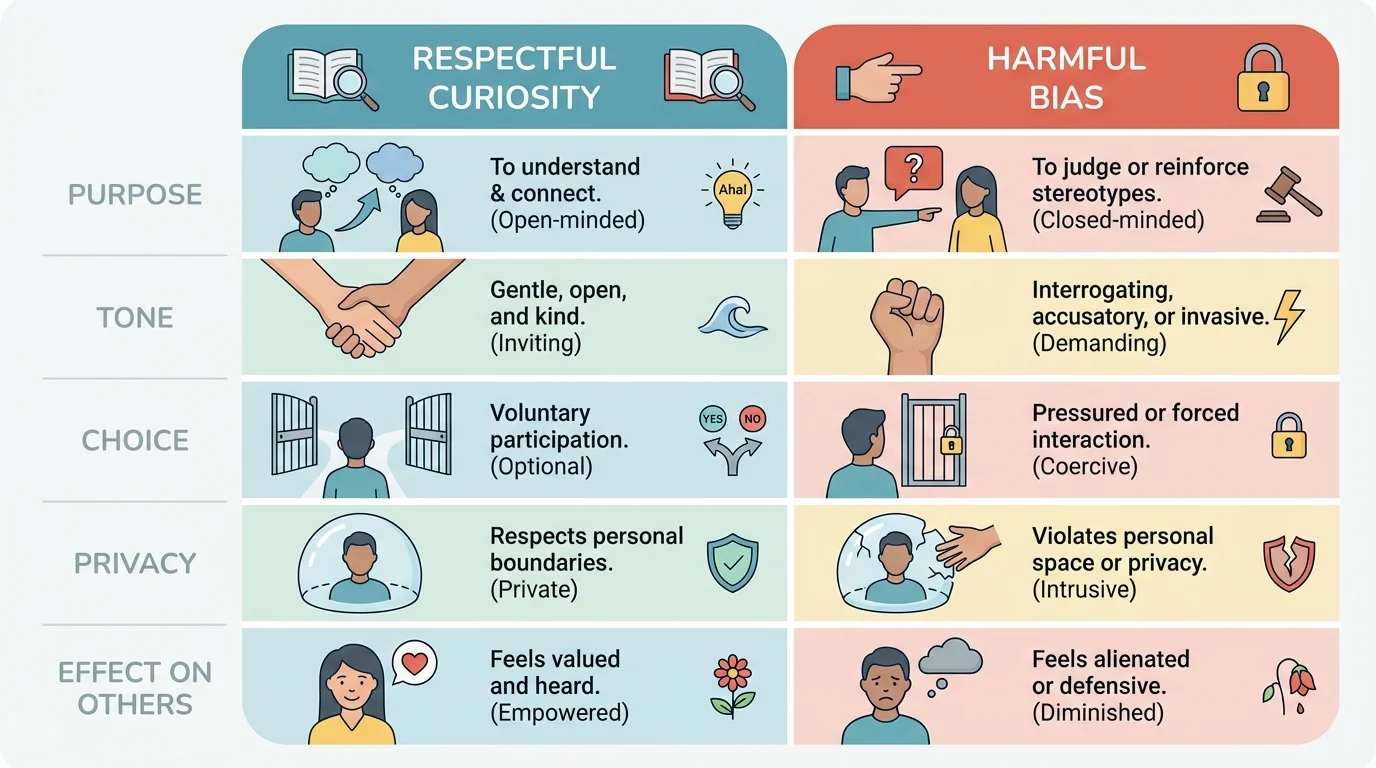
You can often tell the difference by checking purpose, tone, privacy, and impact, as shown in [Figure 1]. Ask yourself: Am I trying to understand this person better, or am I making them explain themselves? Am I being kind, or am I being nosy, pushy, or judgmental?
Another clue is whether the person has a real choice. Respectful curiosity leaves space for "no," "not now," or "I'd rather not talk about that." Harmful bias often corners someone. It demands answers, laughs at differences, or acts like the person owes an explanation.
Notice whether your comment focuses on the individual or on a whole group. "What do you like about that tradition?" is different from "Why do your people do that?" The first is specific and personal. The second sounds like a label.
| Check | Respectful Curiosity | Harmful Bias |
|---|---|---|
| Purpose | To understand and connect | To judge, label, joke, or satisfy nosiness |
| Tone | Gentle and calm | Mocking, rude, demanding, or shocked |
| Choice | Allows the person to decline | Pressures the person to answer |
| Privacy | Respects personal boundaries | Pushes into private topics |
| Effect | Helps the person feel respected | Makes the person feel singled out or reduced |
Table 1. Comparison of respectful curiosity and harmful bias in social situations.
If you are unsure, test your words with one more question: "Would I say this to someone if I truly saw them as an equal?" If the answer is no, stop and rethink.
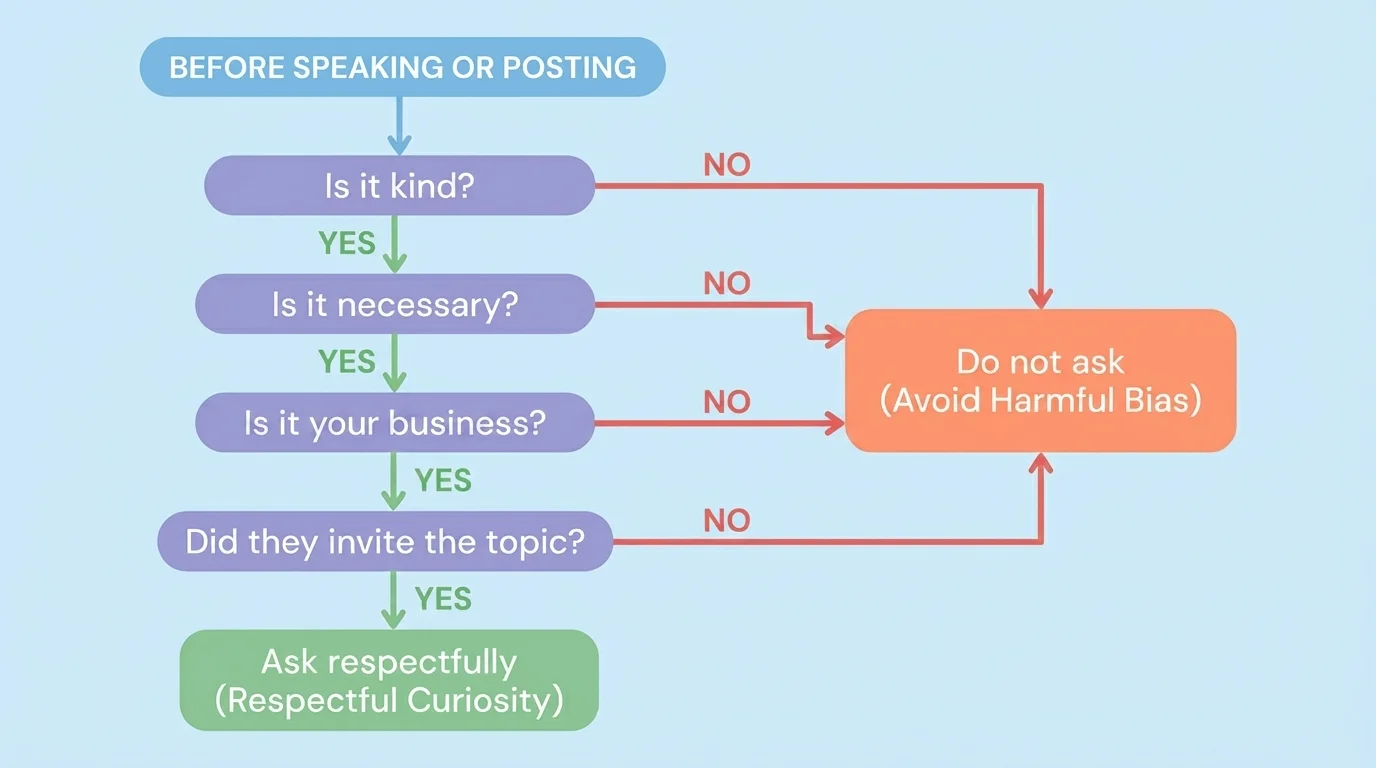
[Figure 2] shows a simple decision path to use when you are about to ask a question, react to a post, or make a joke, and a quick mental checklist helps. You do not need a long speech in your head. Just pause for a few seconds and check your next move.
Step 1: Stop before you type or speak. Step 2: Ask, "Why am I saying this?" Step 3: Ask, "Is this kind and necessary?" Step 4: Ask, "Is this private or sensitive?" Step 5: Ask, "Did they invite this topic?" If the answer to any of those checks is no, do not say it that way.
This pause matters because social mistakes often happen when people react quickly. Fast reactions can turn curiosity into pressure. Slowing down gives your empathy time to catch up.
Using the pause-and-check method
You notice that someone in a gaming voice chat has an accent you have not heard before, and you want to ask about it.
Step 1: Check your purpose.
You ask yourself whether you want to connect respectfully or whether you are just blurting out something because it sounds different to you.
Step 2: Check privacy and choice.
You realize asking in front of everyone might put them on the spot. A better option is to wait or not ask at all unless the topic comes up naturally.
Step 3: Choose kind wording.
If a natural moment comes and the person seems open, you could say, "I hope this is okay to ask, but are you from another region or country?"
Step 4: Accept the answer.
If they say, "I'd rather not talk about it," you simply respond, "No problem."
The goal is not to get information at all costs. The goal is to treat the person well.
A useful rule is this: if a question is mostly about someone's body, identity, family situation, money, health, religion, or private history, be extra careful. Those topics can be important, but they are not yours to demand.
Sometimes the easiest way to avoid harm is to swap your wording. Instead of saying the first thing that pops into your head, choose words that are more respectful.
Here are some better options:
You do not have to ask every question you have. Sometimes the most respectful choice is silence, especially when your question is personal and the other person did not bring it up.
As we saw in [Figure 1], tone and choice matter just as much as the topic itself. A respectful sentence usually gives the other person control over what happens next.
"Be curious, not careless."
— A strong rule for conversations
That short rule works in texts, comments, direct messages, and face-to-face community interactions.
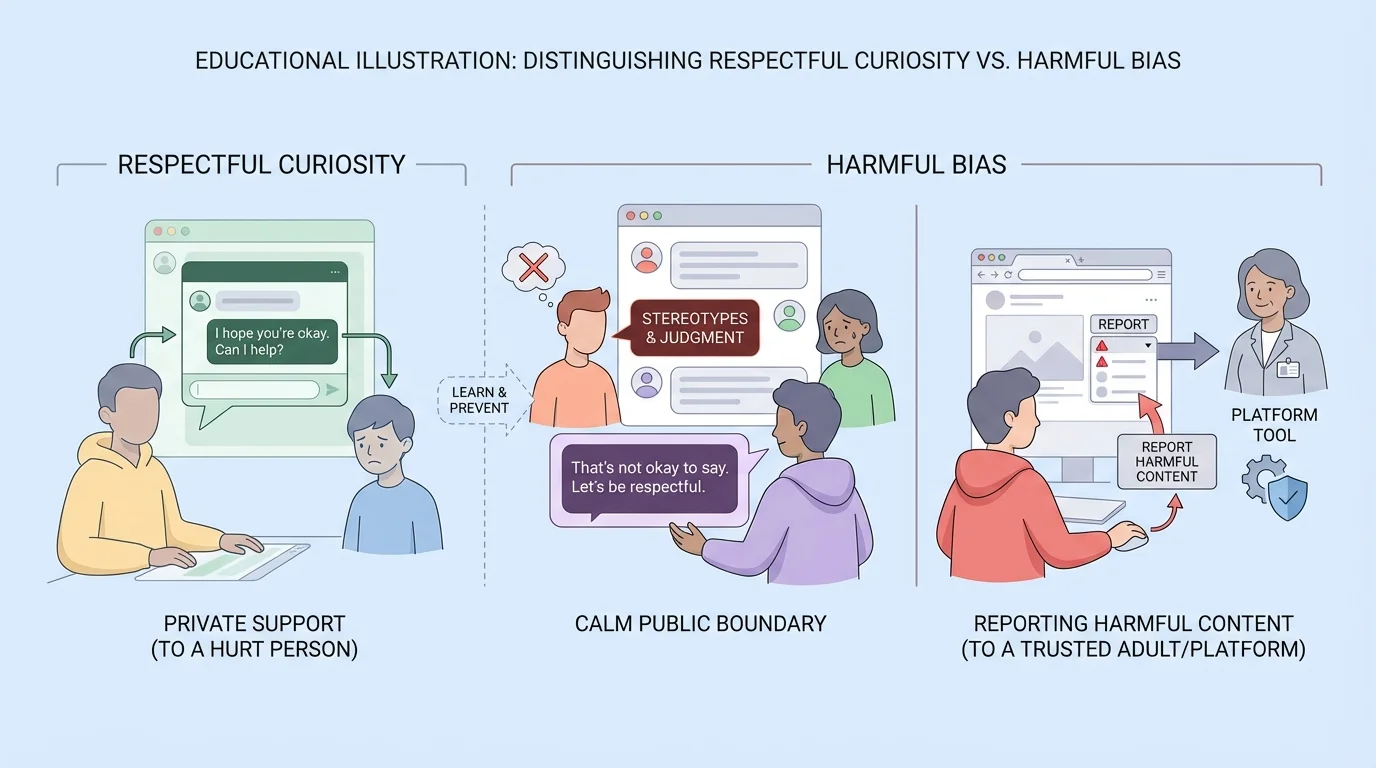
[Figure 3] illustrates three common choices when someone else says something biased, and you have more than one safe response option. You do not always need to make a big speech. The best response depends on safety, the setting, and your relationship with the people involved.
One option is a calm question: "What do you mean by that?" Sometimes people hear their own words differently when they have to explain them. Another option is a simple boundary: "That comment is not okay." A third option is support for the person affected: "Hey, I'm sorry that happened. Are you okay?"
If the situation is public and becoming mean, do not argue forever. You can leave the conversation, mute or block the person, use platform reporting tools, save evidence if needed, and tell a trusted adult. If there is bullying, threats, or repeated targeting, adult help is the right move.
Safety comes first. If speaking up might put you in danger, choose a safer action such as privately supporting the person, reporting the behavior, or getting help. Being brave does not mean being reckless.
Later, these choices still apply outside screens too. In a community activity or team setting, you can redirect the conversation, support the person targeted, or get an adult leader if the behavior continues.
Three response examples
Here are realistic ways to respond.
Example 1: In a group chat, someone says, "People from that country are all rude."
You reply, "That is a stereotype. People are individuals."
Example 2: During a video call, someone keeps pressuring another student to explain their religion.
You say, "They do not have to answer personal questions."
Example 3: A person is mocked for the way they speak.
You send a private message: "That was unfair. I'm here if you want support."
Small actions matter. Even one respectful voice can lower harm and help someone feel less alone.
Almost everyone makes social mistakes at some point. The important part is what you do next. If you notice that your words were unfair, do not hide behind "I was just joking" or "You took it wrong." Listen, learn, and repair.
A strong apology is simple. Say what you did, admit the harm, and do better. For example: "I made an unfair assumption. I'm sorry. That was disrespectful." Then stop talking and let the other person react. They may forgive you quickly, slowly, or not right away.
Assumption is a big part of this lesson. An assumption is something you decide is true without enough information. Assumptions can feel small in your head, but they can sound very big when they come out of your mouth.
Good apologies do not include excuses. "I'm sorry, but..." usually weakens the apology. A better path is: admit, apologize, adjust.
After apologizing, change the habit that caused the problem. Maybe you need to stop making identity-based jokes. Maybe you need to stop asking personal questions in public chats. Maybe you need to learn more from reliable sources instead of expecting people to teach you on demand.
This is where self-awareness matters. Self-awareness means noticing your own thoughts, habits, and reactions honestly. It helps you catch bias before it turns into behavior.
Respect grows in communities where people feel they belong. Belonging does not mean everyone is the same. It means differences are treated with care instead of turned into targets.
Inclusion is the practice of making people feel welcomed, valued, and able to participate fully. Inclusion shows up in simple actions: using respectful names and pronouns, not interrupting people's stories, not forcing private topics, and making room for different experiences.
You can build inclusion by practicing a few everyday habits:
These habits make online spaces, teams, clubs, and neighborhoods feel safer and stronger. They also make you someone people can trust.
Try This: Before your next message or comment about someone's difference, pause and ask yourself, "Am I honoring this person's dignity?" If not, rewrite it or leave it unsent.
Try This: If someone shares something personal, practice a response that does not grab control. Say, "Thanks for sharing," or "I appreciate you telling me," instead of instantly asking for more details.
Try This: If you catch a stereotype in your thoughts, replace it with a more accurate sentence: "I do not know this person's full story yet." That one line can stop unfair behavior before it starts.
