One short message can change everything. A text like "Whatever" can start an argument, while "I think I misunderstood you" can help calm it down. That is the power of empathy in action. Empathy does not magically erase problems, but it changes how you respond to them. When you understand that another person has feelings, stress, and reasons for acting the way they do, you are more likely to solve problems fairly, support others wisely, and help create a space where people feel they belong.
In daily life, you deal with people in group chats, video calls, gaming spaces, family conversations, community activities, and friendships. In all of those places, people can feel left out, misunderstood, embarrassed, or frustrated. Empathy matters because it helps you notice those feelings instead of only focusing on your own point of view.
When empathy is missing, small problems often get bigger. A joke may turn hurtful. Advice may sound bossy. A disagreement may become personal. But when empathy is present, people are more likely to pause, listen, ask questions, and respond with respect. That makes a huge difference in conflict resolution, peer support, and helping everyone feel a stronger sense of belonging.
Empathy is the ability to understand and care about how someone else may be feeling. Conflict resolution means solving a disagreement in a respectful and fair way. Peer support is help given by someone close in age or experience, such as a friend, teammate, or classmate in an online learning space. Belonging is the feeling that you are accepted, included, and valued.
Empathy is not the same as agreeing with everything someone says. You can understand why a person feels upset and still think they made a poor choice. Empathy is also not "fixing" everyone's problems for them. Sometimes the most empathetic action is listening carefully, checking in, and encouraging the person to get help from a trusted adult.
Empathy often starts with perspective-taking. That means asking yourself, "What might this situation feel like from the other person's side?" You do not need to guess perfectly. You just need to be curious rather than assume.
For example, suppose a friend in a group project online stops replying. Without empathy, you might think, "They do not care." With empathy, you might think, "Something may be going on. I should check before I judge." That second response keeps the door open for understanding. Maybe the friend was sick, confused, or worried about making a mistake.
Empathy has two parts. One part is understanding another person's point of view. The other part is responding in a caring way. You need both. If you understand someone but act cold, they may still feel hurt. If you care but do not try to understand, your help may miss the real problem.
Empathy also includes paying attention to clues. In online spaces, you cannot always see facial expressions clearly, so you may need to notice changes in tone, silence, short replies, repeated "I'm fine" messages, or someone suddenly leaving a call or chat. These clues do not always mean the same thing, but they tell you to slow down and check in.
Disagreements happen because people have different needs, expectations, and feelings. Empathy changes the direction of those disagreements, as [Figure 1] illustrates through two very different kinds of online conversations. Without empathy, conflict often grows through blaming, interrupting, sarcasm, and assumptions. With empathy, conflict is more likely to move toward understanding and problem-solving.
Think about a gaming team argument. One player says, "You ruined the match." If the other player responds, "You're always blaming me," the conflict gets hotter. Each person is defending themselves, not trying to understand. But if one person says, "I can tell you're frustrated. I felt pressured too. Can we talk about what went wrong?" the tone changes. The problem is still real, but the conversation becomes safer.
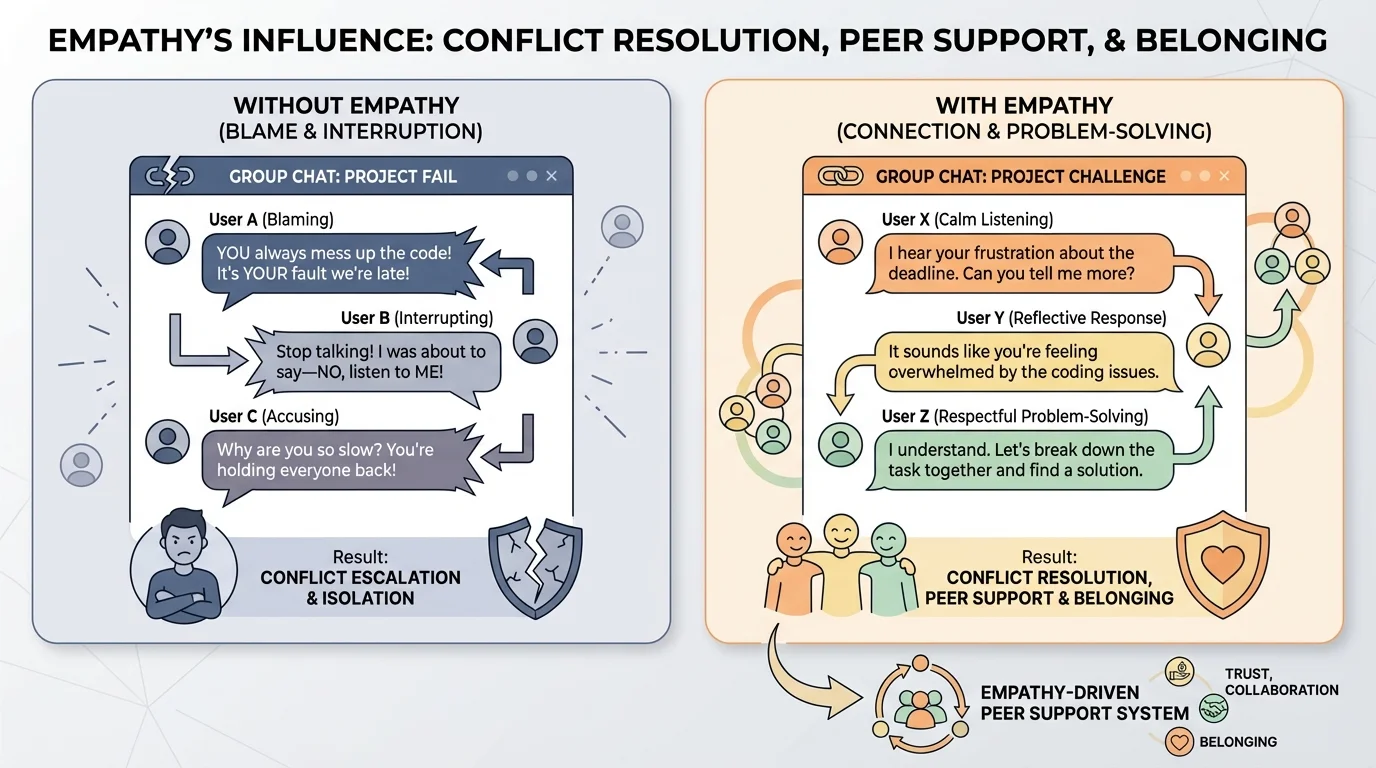
Empathy helps conflict resolution in several ways. First, it lowers defensiveness. When people feel attacked, they usually protect themselves instead of listening. Second, empathy makes it easier to find the real issue. Sometimes the argument is not truly about the missed message or rude comment. It may be about feeling ignored, disrespected, or stressed. Third, empathy makes solutions more likely to last, because people are more willing to follow a plan they helped create.
Here is another example. Suppose your sibling uses your headphones without asking. You are annoyed. If you say, "You never respect my stuff," they may feel accused and respond angrily. If you say, "I felt upset when I couldn't find my headphones. Did you use them? Next time please ask first," you still speak honestly, but you leave room for a better response. Empathy does not hide your feelings. It helps you express them without turning the problem into a personal attack.
As the contrast in [Figure 1] shows, the goal is not to "win" the argument. The goal is to understand what happened, protect the relationship when possible, and solve the problem in a respectful way.
When emotions are high, empathy is easier to use if you follow a clear process. The sequence in [Figure 2] breaks conflict resolution into manageable steps so you do not have to guess what to do in the moment.
Start by remembering one important truth: a strong feeling is not a bad thing. Anger, disappointment, embarrassment, and frustration are normal. What matters is what you do next. If you react too fast, you may say something you regret. If you slow down, you give empathy a chance to work.
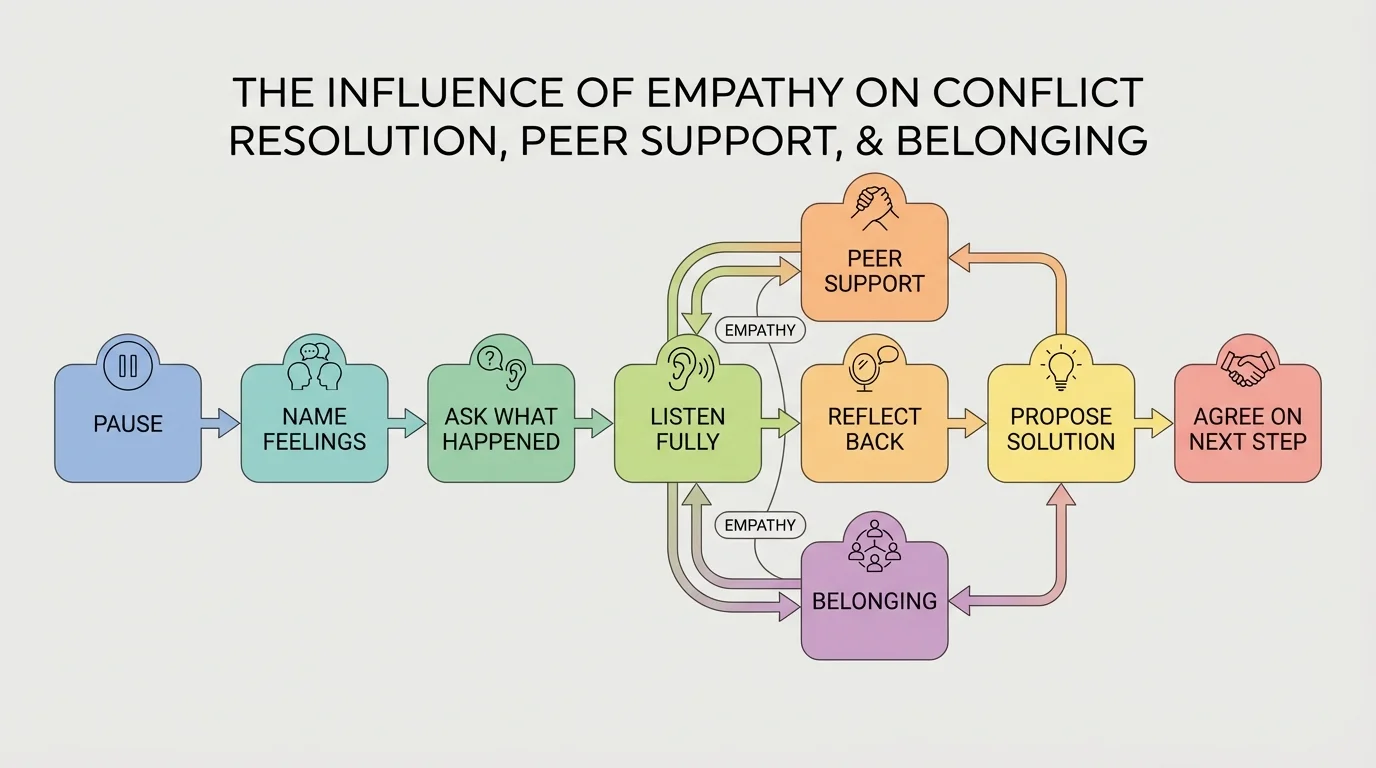
Step 1: Pause. If possible, do not answer right away when you are upset. Take a breath. Put the device down for a minute. Count slowly. Give your brain time to shift from reacting to thinking.
Step 2: Name your feeling. Instead of saying, "You're so annoying," try, "I feel frustrated," or "I felt left out." Naming your own feeling helps you speak clearly and reduces blame.
Step 3: Ask before assuming. Use questions like, "What happened from your side?" or "Did I understand that correctly?" This is empathy in action. You are making room for information you may not have.
Step 4: Listen for the feeling under the words. A person who sounds rude may actually feel embarrassed. A person who goes silent may feel overwhelmed. Listening for the feeling does not excuse hurtful behavior, but it helps you respond wisely.
Step 5: Reflect back what you heard. You might say, "So you thought I was ignoring you," or "It sounds like you felt pressured." This simple move shows that you are listening, and it often lowers tension.
Step 6: Work on a solution together. Ask, "What would help next time?" or "How can we make this fair?" Good conflict resolution usually includes one clear next step.
Case study: Group chat misunderstanding
A student posts an idea for a club project. Another student replies, "That makes no sense." The first student feels embarrassed and wants to leave the chat.
Step 1: Pause before replying.
Instead of firing back with "You're rude," the student waits and takes time to calm down.
Step 2: Respond with honesty and empathy.
The student writes, "That comment felt hurtful. Did you mean that my idea needs more detail?"
Step 3: Invite clarification.
The other student explains, "I meant I didn't understand it. I wrote that too harshly."
Step 4: Solve the real problem.
They agree to ask questions more respectfully and explain ideas more clearly in the future.
The conflict does not disappear because of magic. It improves because empathy helps both students move from attack to understanding.
Sometimes empathy also means noticing when a conversation is not safe or productive. If someone keeps insulting, threatening, or manipulating you, you do not need to stay and "be more empathetic." You can set a boundary, leave the conversation, save evidence if needed, and tell a trusted adult.
Peer support matters because young people often talk to friends first when something feels wrong. A friend may tell you they are stressed, excluded, embarrassed after posting online, worried about family issues, or overwhelmed by schoolwork. Your response can either help them feel seen or make them feel more alone.
Empathy makes peer support stronger because it helps you respond to the person's actual need. Sometimes they need advice. Sometimes they need comfort. Sometimes they need help reaching out to an adult. If you skip empathy and jump straight to "Here's what you should do," your support may feel pushy, even if you mean well.
Supportive phrases often sound like this: "That sounds really hard." "Do you want advice or just someone to listen?" "I'm glad you told me." "You didn't deserve that." "Would it help if I stayed on the call with you while you message an adult?" These responses show care without taking control.
Being supportive does not mean becoming responsible for another person's whole situation. If a peer talks about being unsafe, being harmed, or wanting to hurt themselves or someone else, the right move is to tell a trusted adult immediately. Keeping a dangerous secret is not true support.
Empathy also helps you avoid common mistakes in peer support. One mistake is making the conversation about yourself too quickly: "That happened to me too, and mine was worse." Another is minimizing: "It's not a big deal." Another is forcing positivity: "Just cheer up." These responses can make a person feel unheard. Empathy sounds more like, "I want to understand," than "I want this problem to go away fast."
A strong sense of belonging grows through repeated small actions, as [Figure 3] shows in an online learning and club setting. People feel they belong when others notice them, respect them, include them, and respond to them as if they matter. Empathy helps you do those things on purpose.
Belonging does not come only from having lots of friends. It comes from feeling accepted. A person can be in a busy chat and still feel invisible. Empathy helps prevent that by pushing you to notice who is left out, who has not spoken, who may be confused, or who may be nervous about joining in.
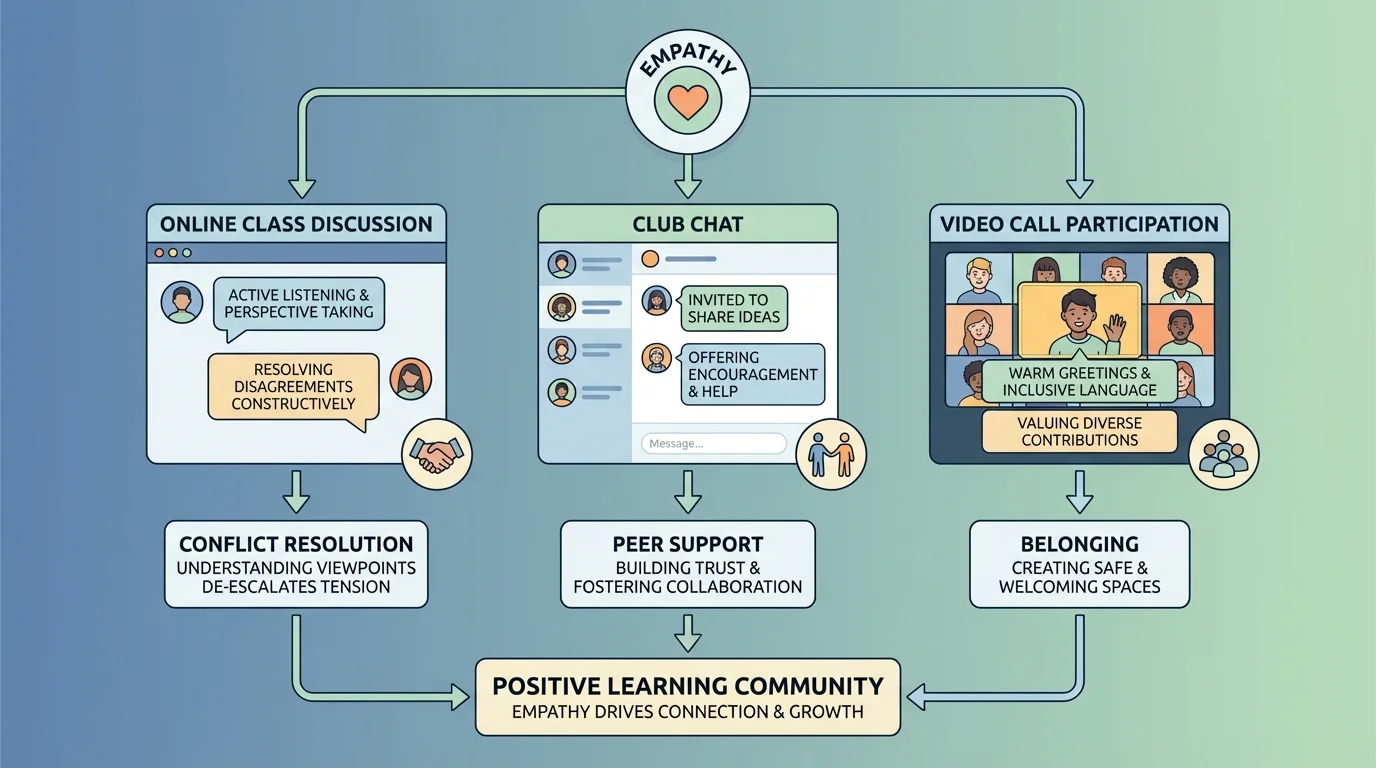
For example, if a new student joins an online club meeting, empathy may lead you to greet them, explain how the group works, ask for their ideas, and avoid inside jokes that make them feel excluded. If someone shares an opinion on a discussion board and gets ignored, empathy may lead you to respond respectfully so they know their voice matters.
In this way, empathy supports inclusion. Inclusion means people are not just present; they are welcomed and able to participate. That matters in families, teams, clubs, faith communities, neighborhood groups, and online spaces. As we see in [Figure 3], belonging is built through visible actions, not just kind thoughts.
| Situation | Low-Empathy Response | High-Empathy Response |
|---|---|---|
| Someone is quiet on a video call | Ignore them | Check in and invite them to speak if they want to |
| A friend posts something embarrassing | Share it or joke about it | Ask if they are okay and avoid adding to the embarrassment |
| A new person joins a group | Keep talking only to people you know | Welcome them and explain what is happening |
| Someone seems upset in chat | Assume they are overreacting | Ask what happened before judging |
Table 1. Comparison of low-empathy and high-empathy responses in everyday situations.
When empathy becomes part of a group's culture, people are more likely to participate, ask questions, apologize honestly, and recover from mistakes. That creates trust. And trust is one of the strongest foundations of belonging.
Empathy is powerful, but it can be used poorly if you are not careful. One mistake is validation without honesty. Validation means showing that someone's feelings are real and important. But validating feelings does not mean approving harmful actions. You can say, "I understand that you were angry," without saying, "So it was fine to insult people."
Another mistake is pretending to listen while planning your answer. Real empathy requires attention. Put differently, if your goal is only to defend yourself or prove you are right, you will miss what the other person is actually saying.
People often calm down faster when they feel understood. Even a simple sentence like "I see why that upset you" can lower tension because it signals respect and attention.
A third mistake is over-helping. If a friend is struggling, you may want to solve everything for them. But good support respects the other person's choices and limits. Offer help, do not take over. Ask, "What kind of support would help right now?"
There is also a difference between empathy and agreeing with peer pressure. If a group is excluding someone or making fun of them, empathy helps you notice the harm. It may push you to speak up, leave the chat, or privately support the person being targeted. In those moments, empathy is not just a feeling. It becomes courage.
Empathy is not something you either have or do not have. It is a skill you can strengthen with practice. The more you slow down, pay attention, and think beyond your own point of view, the better you get at it.
Try This: When a message annoys you, wait before answering. Ask yourself, "What are three possible reasons this person said that?" This keeps you from acting on your first assumption.
Try This: In your next conversation, listen long enough to name the feeling behind the words. Was the person disappointed, worried, embarrassed, excited, or confused? You do not have to say it out loud every time, but noticing it builds empathy.
Try This: During an online group discussion or community activity, look for one person who has not been included. Invite them in with a respectful message or question. Small actions like that grow belonging over time.
"People may forget what you said, but they usually remember how you made them feel."
— A widely shared reminder about the power of human connection
You can also build empathy by being curious about experiences different from your own. Read stories, listen carefully, and ask respectful questions. The goal is not to become an expert on everyone else's life. The goal is to remember that your experience is not the only one that exists.
Over time, empathy helps you become someone people trust. It makes conflict easier to solve, makes support more useful, and makes communities feel safer and warmer. That does not mean you will always say the perfect thing. It means you will keep choosing to understand before reacting, and to include rather than ignore.
