A relationship does not have to be romantic to affect your life in a big way. The people you text, play games with, call, work with on projects, spend time with in your neighborhood, or talk to in clubs and activities can make you feel safe and supported—or stressed and uncomfortable. Learning to notice the difference is a real-life skill that protects your feelings, your time, your privacy, and your safety.
At your age, relationships are changing. You may be making closer friendships, spending more time online, and getting more independence. That can be exciting, but it also means you need strong judgment. Not every mean moment is abuse, and not every disagreement means a relationship is bad. The key is to notice patterns: how someone usually treats you, how you feel around them, and whether your boundaries are respected.
Relationships shape your daily life. A healthy friend may encourage you before a music performance, check in when you are upset, or respect your time when you say you need to log off. An unhealthy friend may pressure you to answer instantly, make fun of you in a group chat, or act nice only when they want something. An unsafe person may threaten you, scare you, spread private information, or try to control you in ways that make you feel afraid.
When relationships are healthy, you often feel respected, calmer, and more like yourself. When they are unhealthy, you may feel confused, guilty, drained, or worried. When they are unsafe, you may feel fear, panic, shame, or the need to hide what is happening. Those feelings are signals worth paying attention to.
Relationship behavior means the way people act toward each other over time. Healthy behavior supports respect, trust, and safety. Unhealthy behavior causes harm, stress, or unfairness but may not always involve immediate danger. Unsafe behavior creates fear, danger, threats, or serious violations of safety and privacy.
No relationship is perfect. People can make mistakes, get annoyed, or have misunderstandings. What matters is how they handle those moments. In a healthy relationship, problems can usually be talked through and repaired. In an unhealthy or unsafe relationship, the harmful behavior often repeats, gets denied, or becomes worse.
The three categories are different in important ways, as [Figure 1] illustrates through everyday examples. Think of them like three zones. Healthy behaviors help both people feel respected. Unhealthy behaviors are warning signs that something is off. Unsafe behaviors cross a serious line and need protection and help.
A healthy friend says, "I can't talk right now, but I'll text you later," and still treats you kindly. An unhealthy friend says, "If you were a real friend, you would answer me right now." An unsafe person says, "Answer me now or I'll post your secret." Each example gets more serious because it moves from respect, to pressure, to threat.
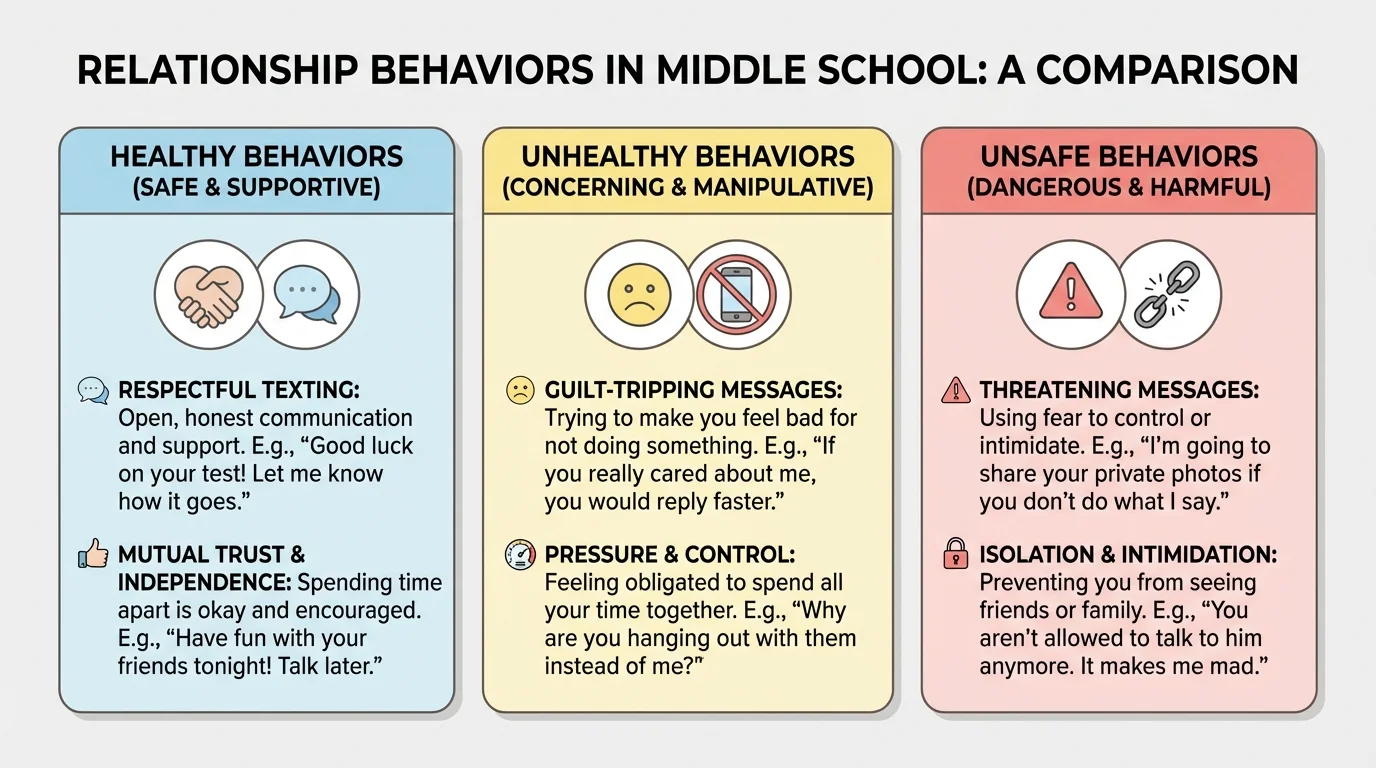
It helps to look for patterns instead of judging only one moment. Someone might be grumpy once and still be a healthy person overall if they apologize and fix it. But if they often insult you, control you, or scare you, that pattern tells you much more than one single message does.
| Category | Common Signs | How You May Feel | Best Response |
|---|---|---|---|
| Healthy | Respect, honesty, listening, fairness, support | Safe, calm, valued | Keep building the relationship |
| Unhealthy | Pressure, jealousy, put-downs, guilt, control | Confused, stressed, small, drained | Set boundaries, notice patterns, get advice |
| Unsafe | Threats, fear, harassment, stalking, sharing private info, physical harm | Afraid, panicked, trapped | Get help right away, protect yourself, tell a trusted adult |
Table 1. Comparison of healthy, unhealthy, and unsafe relationship behaviors, feelings, and responses.
A boundary is a limit that protects your comfort, time, body, feelings, and privacy. Healthy relationships respect boundaries. If you say, "I don't want to be on video right now," a healthy person does not make fun of you or pressure you. They accept your answer.
Trust grows when people are reliable. They do what they say they will do, tell the truth, and do not use your secrets against you. Trust does not mean sharing everything. It means you feel reasonably safe that the other person will treat you with care.
Communication in a healthy relationship is clear and respectful. You can disagree without being cruel. You can ask questions. You can say, "That bothered me," and the other person listens instead of attacking you. Healthy communication includes listening, not just talking.
Healthy relationships also have balance. One person does not get all the attention, power, or decision-making. Both people matter. Both people get to have feelings. Both people get to say no. If only one person's wants count all the time, the relationship is not balanced.
Example: A healthy friendship in action
You and a friend planned to play an online game together, but you have a family event.
Step 1: You communicate clearly.
You text, "I can't play tonight. I still want to play tomorrow if that works."
Step 2: Your friend respects your situation.
They reply, "Okay, thanks for telling me. Tomorrow works."
Step 3: The relationship stays respectful.
No guilt, no insults, and no pressure. That is healthy behavior.
Healthy relationships help you grow. You feel encouraged to be honest, have other friends, spend time with family, and do your own activities. You do not have to shrink yourself to keep the other person happy.
Manipulation happens when someone tries to control your choices by using guilt, fear, or tricks instead of respect. This can sound like, "If you cared about me, you would tell me your password," or "Everyone else agrees with me, so you have to do this."
Unhealthy behavior often shows up as pressure. The person may demand fast replies, get upset when you spend time with others, make jokes that hurt your feelings, or act like your needs do not matter. They may apologize but keep doing the same thing again and again.
Another warning sign is disrespect disguised as humor. If someone embarrasses you on purpose and then says, "Relax, it was just a joke," the problem is not your reaction. The problem is that they used humor to excuse hurtful behavior.
Some unhealthy relationships are very one-sided. You always listen to their problems, but they ignore yours. You always give in, but they never compromise. You feel nervous about upsetting them because they overreact. These are warning signs, even if the person sometimes acts kind.
People can have both good moments and unhealthy patterns at the same time. A person does not need to be mean all day, every day, for a relationship to be harmful.
Jealousy can also become unhealthy. Wanting to feel included is normal. But checking who you talk to, getting angry because you have other friends, or demanding proof of where you are goes beyond care and becomes control.
As seen earlier in [Figure 1], unhealthy behavior often sits in the warning zone between healthy respect and unsafe danger. That does not mean you should ignore it. Warning signs matter because they can grow stronger if no one addresses them.
Coercion happens when someone pressures, threatens, or forces you to do something you do not want to do. This is more serious than ordinary pressure because it takes away your freedom to choose.
Unsafe behaviors include threats, blackmail, repeated harassment, stalking online, sharing private photos or messages, pretending to be you online, or making you afraid to say no. Unsafe behavior can happen in friendships, dating relationships, family relationships, teams, clubs, or online communities.
Fear is a major clue. If you are scared of what someone will do when you do not obey them, the situation is unsafe. If someone says they will hurt you, hurt themselves to control you, expose your secrets, or show up where you are to scare you, do not try to handle it alone.
Unsafe behavior is not your fault. Some students stay quiet because they worry they will get in trouble, or because they answered a few messages at first, or because they shared something private before things got bad. None of that makes the unsafe behavior okay. The person choosing to threaten or harm is responsible for that choice.
"Feeling afraid around someone is a signal to take seriously."
If there is immediate danger, your first job is safety, not politeness. Leave the conversation, block the person if needed, move to a safer place, and contact a trusted adult right away. Keeping yourself safe is more important than explaining yourself perfectly.
Setting boundaries follows a simple pattern. You name the limit, notice the response, and then decide what to do next. This helps because it turns a confusing moment into a clear choice.
[Figure 2] Consent means a clear, free, and real yes. It is not silence, pressure, fear, or "I guess so." Consent matters for personal space, sharing photos, private information, joining calls, physical contact, and many everyday interactions.
Boundaries can sound simple: "Please don't spam me when I'm offline." "Don't post pictures of me." "I'm not sharing that." "I need a break." "Do not call me that nickname." You do not need a long speech to set a boundary. Short and clear works well.
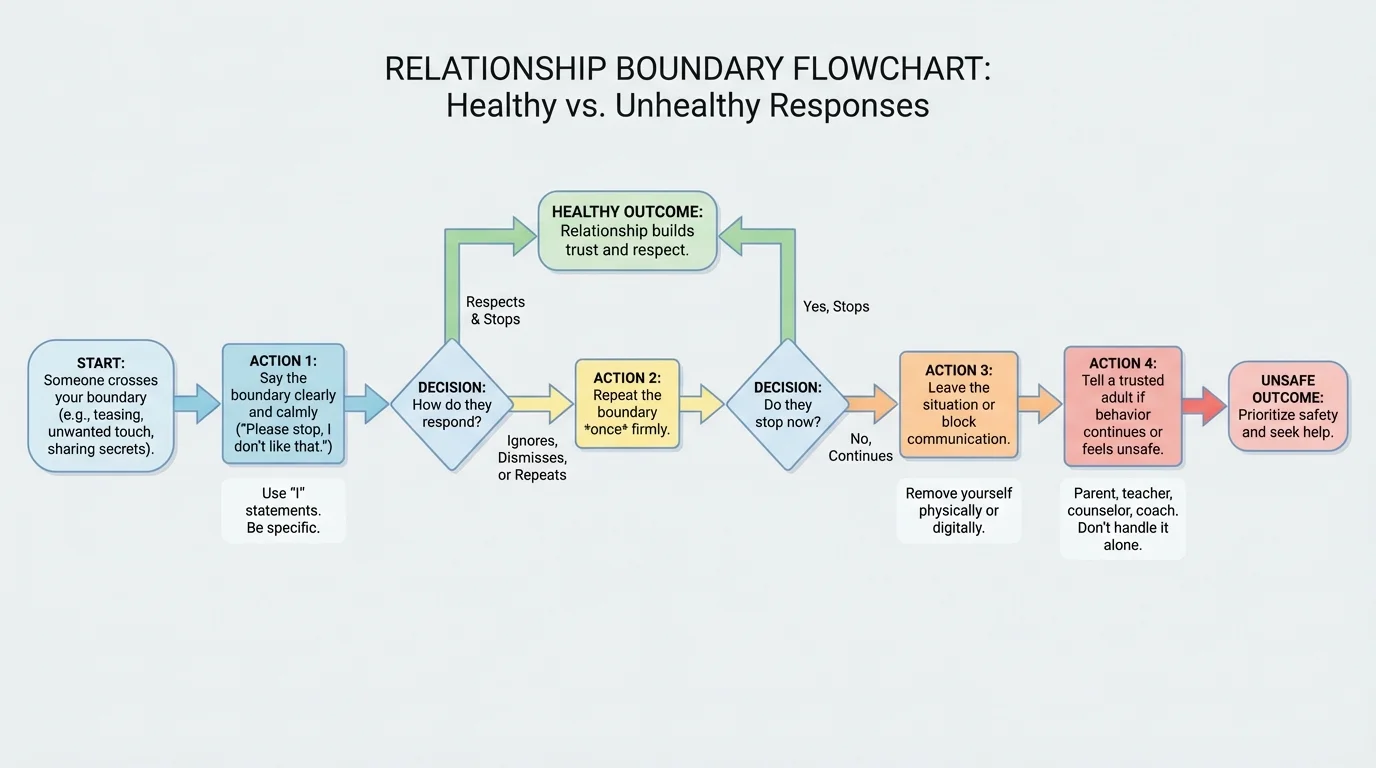
What matters next is the other person's response. A healthy person may not love your boundary, but they respect it. An unhealthy person may argue, roll their eyes, mock you, or keep pushing. An unsafe person may threaten you for having the boundary at all.
You are also responsible for respecting other people's boundaries. If someone says no, stop. If someone says they do not want to talk, post, share, hug, join, or continue, respect that. Healthy relationships work both ways.
Example: Setting a boundary in a group chat
A classmate from an activity keeps sending messages late at night and gets angry when you do not answer.
Step 1: State the limit.
"I don't answer messages after my bedtime. I'll reply tomorrow."
Step 2: Watch the response.
If they say, "Okay," that shows respect. If they say, "Wow, rude," that is a warning sign.
Step 3: Protect your boundary.
Mute, pause notifications, or stop replying at that time.
Step 4: Get help if it escalates.
If they threaten, spam, or harass you, save the messages and tell a trusted adult.
Later in the lesson, the same pattern from [Figure 2] helps with bigger situations too: say the limit, notice the response, and take stronger safety steps when the response is disrespectful or threatening.
When a relationship seems healthy, keep practicing the habits that make it strong: honesty, kindness, listening, fairness, and respect. Thank people when they respect your boundaries. Speak up early when something feels off. Small conversations can prevent bigger problems.
When a relationship seems unhealthy, try this basic plan. First, name the behavior: "I don't like being made fun of in front of other people." Second, set a boundary: "If it keeps happening, I'm leaving the chat." Third, notice whether the person changes. Fourth, get advice from a trusted adult if the pattern continues.
When a relationship seems unsafe, do not try to solve it by yourself. Save evidence if that can be done safely, such as screenshots, usernames, dates, or messages. Block or report the person on the app or platform. Tell a trusted adult as soon as possible. If there is immediate danger, contact a trusted adult right away or call emergency services in your area.
A simple safety check
Ask yourself three questions: Do I feel respected? Do I feel pressured? Do I feel afraid? If you mostly feel respected, the relationship is likely healthy. If you often feel pressured, the relationship may be unhealthy. If you feel afraid, treat the situation as unsafe and get help.
It can be hard to trust your own feelings when someone keeps saying, "You're overreacting." But your discomfort matters. Feeling confused once is different from feeling uneasy all the time. Repeated discomfort is useful information.
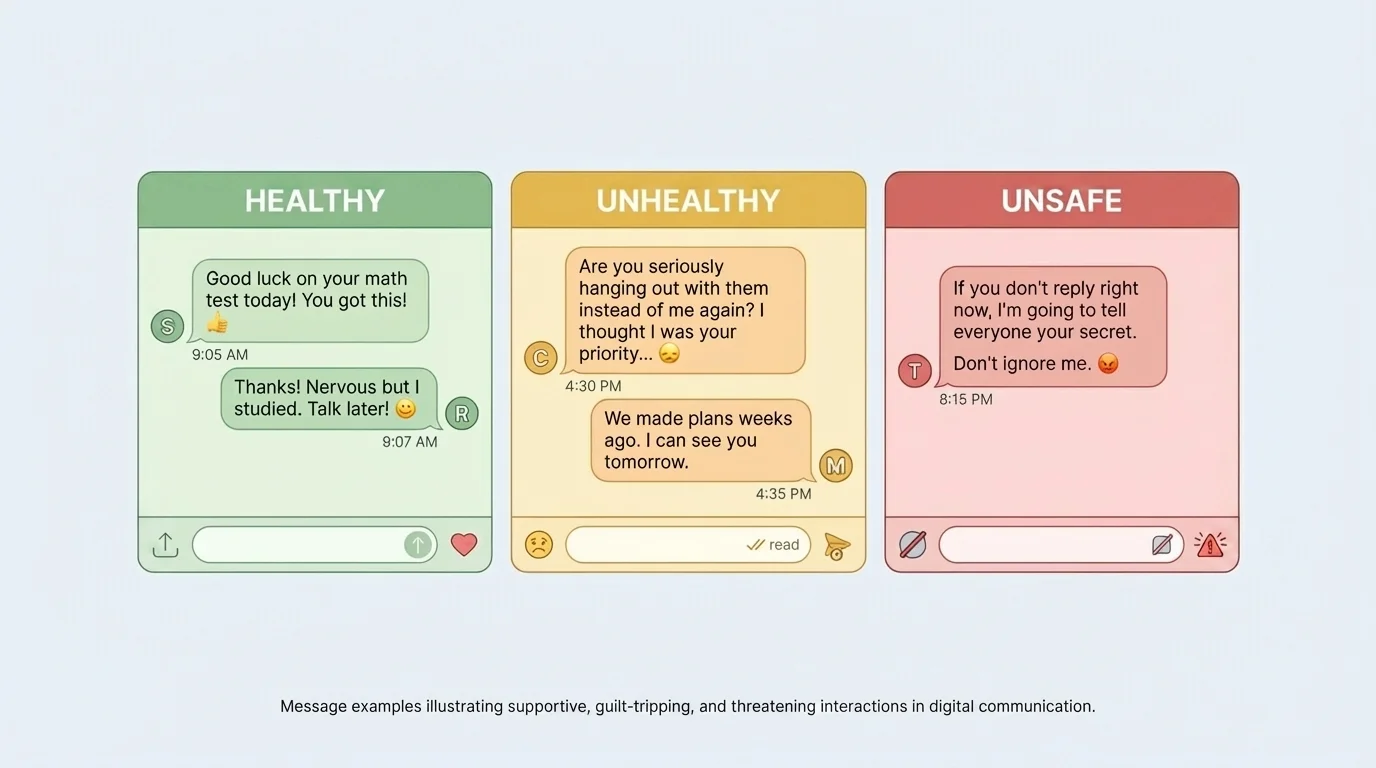
Online messages leave clues, as [Figure 3] illustrates with different kinds of chats. Because you may not hear someone's voice or see their face, the words, timing, and pattern matter even more. Pay attention to messages that feel respectful, pushy, or scary.
Healthy digital behavior includes asking before posting someone else's photo, respecting offline time, using kind words, and accepting "no" without drama. Unhealthy digital behavior includes spam texting, guilt-tripping, checking up on you constantly, or demanding private details. Unsafe digital behavior includes threats, impersonation, doxxing, sexual pressure, blackmail, and repeated harassment.
Protecting your privacy is part of relationship safety. Do not share passwords, home address, school schedule, or private images with someone just because they ask. A person who respects you does not need secret access to prove closeness.
If someone asks you to keep a harmful secret, that is a red flag. Healthy surprises, like a birthday gift, are different from harmful secrets, like "Don't tell anyone I said I'd ruin your life if you blocked me." Harmful secrets should be told to a trusted adult.
Much later, when you are comparing a confusing message to a clear one, [Figure 3] helps you notice the difference between support, manipulation, and threat. The exact words may change, but the pattern is what matters.
Privacy settings, blocking tools, and reporting features are not rude. They are safety tools. Using them when needed is a smart way to protect yourself online.
Also remember that screenshots can help adults understand what happened. If a message is threatening or harassing, saving evidence can be useful before blocking, as long as doing so does not put you in more danger.
When you are not sure how to label a behavior, use this checklist. Ask: Is it respectful? Is it repeated? Does it ignore my boundary? Does it isolate me from others? Does it make me feel afraid? The more warning signs you notice, the more serious the situation is.
You can also sort behaviors into three quick groups. Green light: respectful, honest, safe. Yellow light: pressure, put-downs, control, guilt. Red light: threats, fear, stalking, harassment, forced secrecy, or harm. Green means continue. Yellow means slow down, set boundaries, and get advice. Red means get help now.
Example: Using the decision tool
A person from a gaming community says, "If you leave our group, I'll tell everyone your private messages."
Step 1: Ask if it is respectful.
No. It uses pressure and power.
Step 2: Ask if it ignores your choice.
Yes. The person is trying to stop you from leaving.
Step 3: Ask if it creates fear.
Yes. It is a threat.
Step 4: Decide the category.
This is unsafe, not just unhealthy.
Step 5: Take action.
Save evidence if safe, block or report, and tell a trusted adult immediately.
The more you practice spotting these patterns, the faster you can protect yourself and support others. Good judgment is a skill. It gets stronger with use.
A trusted adult might be a parent, guardian, older family member, coach, club leader, counselor, neighbor, or another adult who takes safety seriously. Pick people who listen, stay calm, and help you make a plan.
If you need to tell someone, keep it simple: "Someone is making me feel unsafe online." "A friend keeps threatening me." "I said no, but they won't stop." "I need help figuring out if this is normal." You do not need perfect words to deserve support.
If the first person does not help enough, tell another adult. Keep telling until someone acts. You deserve relationships that are respectful, safe, and honest. Being careful is not being dramatic. It is being wise.
