Have you ever spent more time thinking about starting your work than actually doing it? That happens to a lot of students. Usually, the problem is not that they are lazy or bad at learning. The real problem is that they do not have a clear routine. When you study online from home, no hallway bell tells you when to switch tasks. No teacher is standing nearby every minute. That means your own habits matter even more.
A good study routine is like a path you walk so often that it becomes easier every time. Instead of deciding over and over when to study, where to sit, or what to do first, you already know. This saves mental energy. You can use that energy to solve problems, read carefully, and remember what you learn.
Strong routines also help with independent learning, which means learning independently and responsibly. In online school, this is a big life skill. You may need to check your assignments, watch lesson videos, read directions, and ask questions through messages or video calls without someone reminding you every second.
Study routine means a repeated plan for when, where, and how you study. Test preparation means getting ready for quizzes, tests, or exams over time instead of waiting until the last minute.
When routines are weak, schoolwork can pile up fast. You might forget an assignment, rush through a lesson, or stay up too late cramming. When routines are strong, you feel more in control. You finish more on time, remember more, and feel less panicked before a test.
Think of two students. One says, "I'll study later," but later keeps moving. The other studies at the same time each weekday, checks upcoming deadlines, and reviews a little every few days. The second student is not magically smarter. That student is using a system.
A routine is not a super strict schedule where every minute is controlled. It is a pattern that helps you stay steady. Your routine should fit your real life, including chores, family time, hobbies, and rest. A routine that looks perfect but is impossible to follow will not help.
Good routines support executive functioning, which is the set of mental skills you use to plan, organize, start tasks, manage time, and stay focused. If your routine handles some of those jobs for you, school feels less overwhelming.
Why repeated habits work
When you repeat the same helpful actions, your brain starts expecting them. If you usually sit down at a certain time, open your planner, and begin with one short task, getting started becomes easier. The goal is not to feel motivated every day. The goal is to make starting so normal that you do it even when you are not in the mood.
Your routine should answer three basic questions: When will I study? Where will I study? What will I do first? If those answers are clear, you are much more likely to begin.
Your environment affects your focus more than you may realize. A prepared study area, as shown in [Figure 1], helps your brain switch into work mode. You do not need a fancy desk or a perfect room. You just need a spot that is as calm and ready as possible.
Choose one main study place if you can. Put your device, charger, notebook, pencils, and water nearby. If noise is a problem, use headphones or soft background sound that does not pull your attention away. Keep only what you need for the task in front of you.
Study signals are small actions that tell your brain, "It is time to focus." Your signal might be clearing your desk, opening your planner, setting a timer, or putting your phone across the room. These repeated actions can become a starting routine.
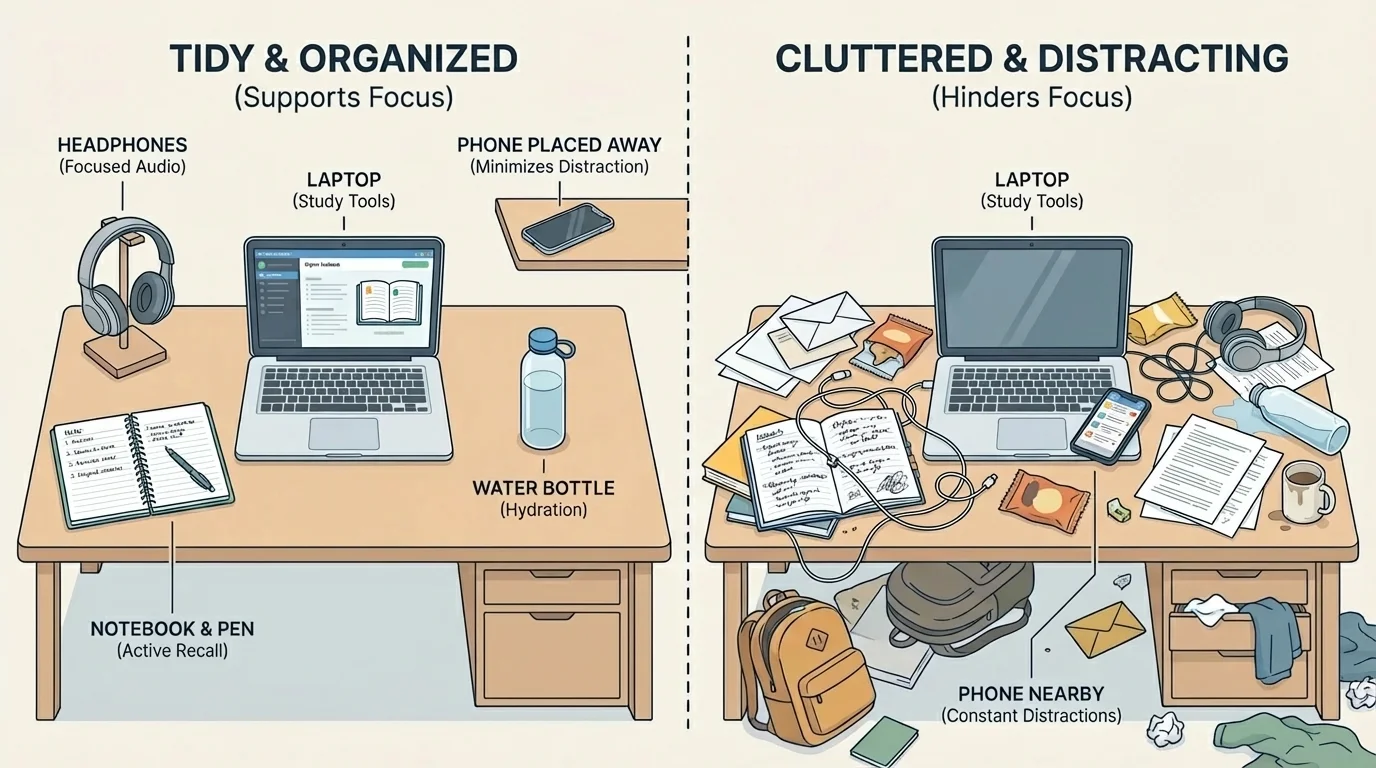
Distractions are easier to prevent than to fight. If your phone keeps drawing your attention, move it away before you start. If certain tabs distract you, close them. If family activity is noisy at one time of day, choose another study time when possible.
You do not need a perfect space. You need a usable space. A kitchen table can work. A corner desk can work. Even a small basket with your school supplies can help if you study in different spots. What matters is making the good choice easy.
Later, when your focus starts slipping, think back to the tidy setup in [Figure 1]. The point is not decoration. The point is removing little obstacles that make studying harder to start.
One of the best ways to stay on track is to see your week clearly, as [Figure 2] shows with a balanced schedule. When you can see classes, assignments, review time, and breaks in one place, your week feels more manageable.
Start by choosing regular study times. Maybe you work best in the morning. Maybe you focus better after lunch. Try to keep these times consistent on most days. For example, you might study from 4:00 to 4:45 on Monday through Thursday and do a longer review on Saturday morning.
Next, check all your due dates and upcoming tests. Put them on a calendar. Then work backward. If a science test is on Friday, do not wait until Thursday night. Plan smaller review sessions across the week.
A weekly plan should include more than homework. It should also include review. Review means going back over what you learned so it stays in your memory. Even a short review block of about 10 to 15 minutes can make a big difference.
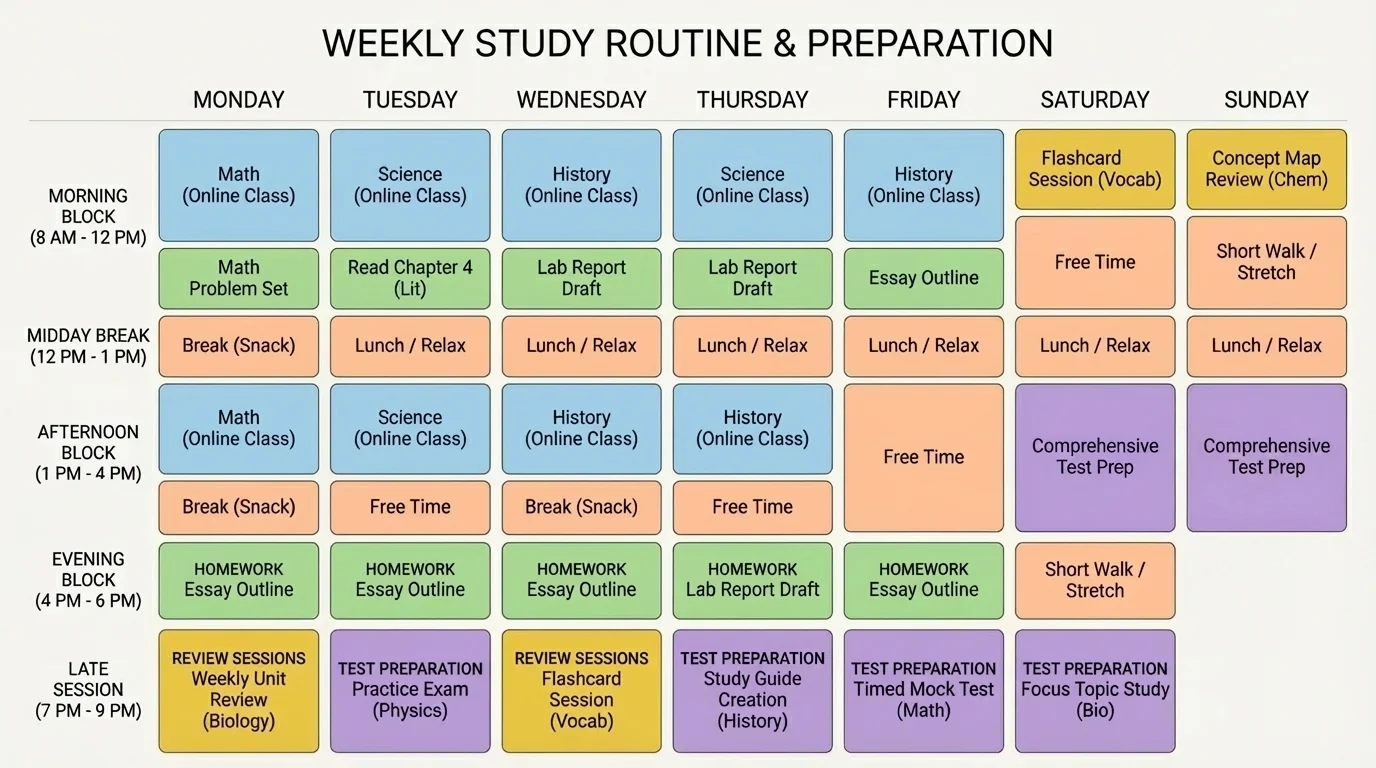
Example weekly planning routine
Step 1: On Sunday evening, open your school platform and list all assignments and tests for the week.
Step 2: Mark fixed times first, such as live classes, sports practice, music lessons, or family responsibilities.
Step 3: Add study blocks for homework and separate review blocks for subjects that need extra practice.
Step 4: Leave a little open space in your week in case something takes longer than expected.
Step 5: Check the plan each morning and adjust if needed.
If you estimate a reading assignment will take about 20 minutes and practice questions will take about 25 minutes, you can plan a block of about 45 minutes. Estimating is not exact. It is just a helpful guess so your day does not become too crowded.
A planner can be digital or paper. Use the one you will actually check. A beautiful planner that stays closed is less useful than a simple checklist you open every day.
Big assignments can feel scary until you chunk them into smaller parts, as [Figure 3] illustrates. Chunking means breaking a large task into smaller, clearer actions. This helps you start instead of freezing.
For example, "study social studies" is too big and unclear. A better plan is: review notes for 10 minutes, make 5 flashcards, answer 8 practice questions, and check mistakes. Small steps are easier to begin and easier to finish.
If a task feels heavy, make the first step tiny. Open the document. Read the directions once. Write the title. Find one missing source. Often, starting is the hardest part. Once you begin, continuing gets easier.
Turning one project into manageable parts
Step 1: Write the full assignment at the top of your page.
Example: "Complete the history slideshow by Friday."
Step 2: Split it into actions.
Possible actions: choose topic, gather facts, find images, write slides, practice speaking, submit.
Step 3: Put the actions on different days.
Monday: choose topic and gather facts. Tuesday: write slides. Wednesday: revise. Thursday: practice. Friday: submit.
Step 4: Check off each part as you finish.
Checking off progress helps you see that the project is moving forward.
Another smart move is to estimate how long each chunk might take. If you think one part will take about 15 minutes and another will take about 20 minutes, then together you can expect about 35 minutes of work, since \(15 + 20 = 35\). Planning in chunks makes time feel more real and less mysterious.
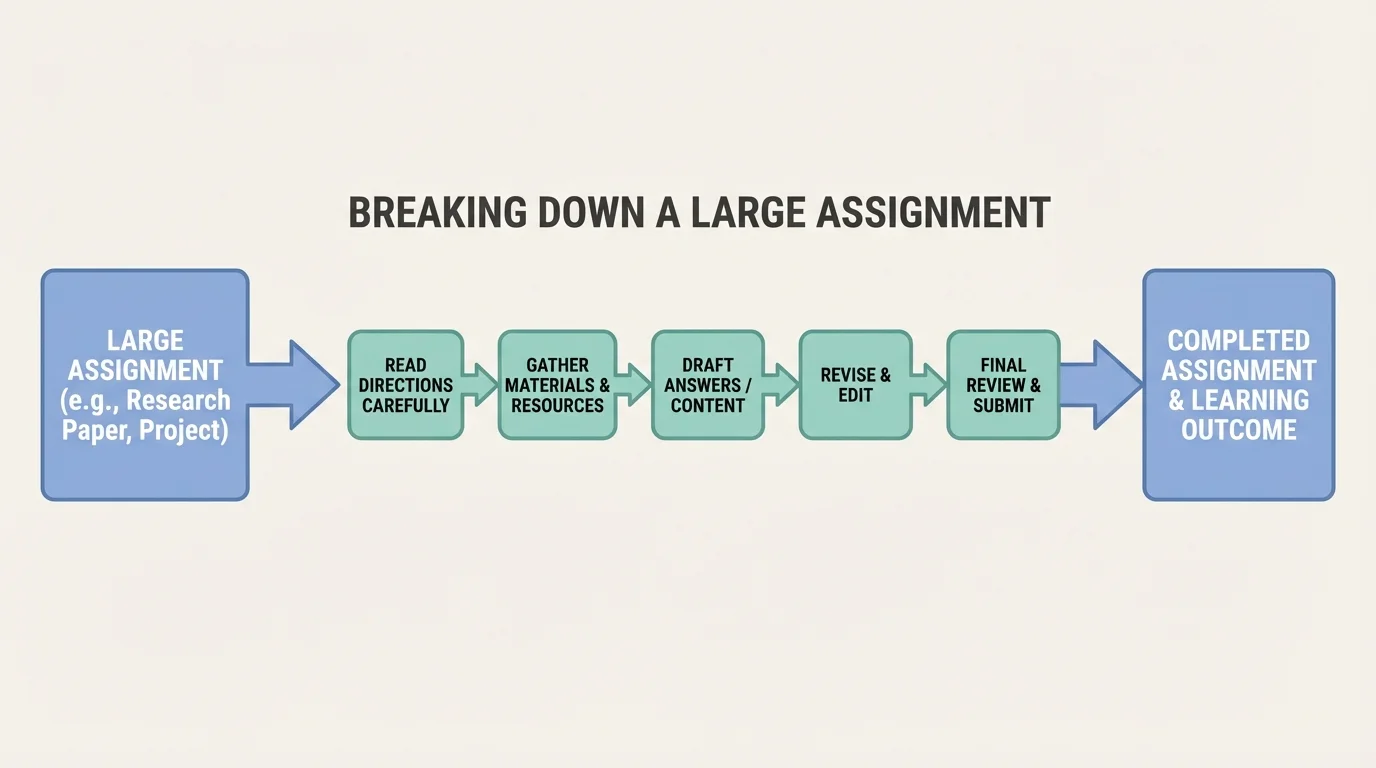
When you feel overwhelmed later, return to the step-by-step path in [Figure 3]. A project is rarely one giant action. It is usually a chain of smaller actions.
Not all studying works equally well. Some students spend a lot of time looking at notes but remember very little later. Better studying is active, not just passive.
One powerful method is active recall, as [Figure 4] makes clear by comparing it with simple rereading. Active recall means pulling information out of your memory without looking first. You might cover your notes and explain a topic out loud, answer practice questions, or use flashcards.
Another strong method is spaced practice. This means reviewing information over several days instead of all at once. For example, reviewing vocabulary on Monday, Wednesday, and Friday usually works better than doing it all in one long session on Thursday night.
You can also mix subjects in a smart way. If you study math for a while, then switch to reading or science review, your brain has to notice what is different between tasks. That can help sustain attention. Just do not switch so often that you never settle in.
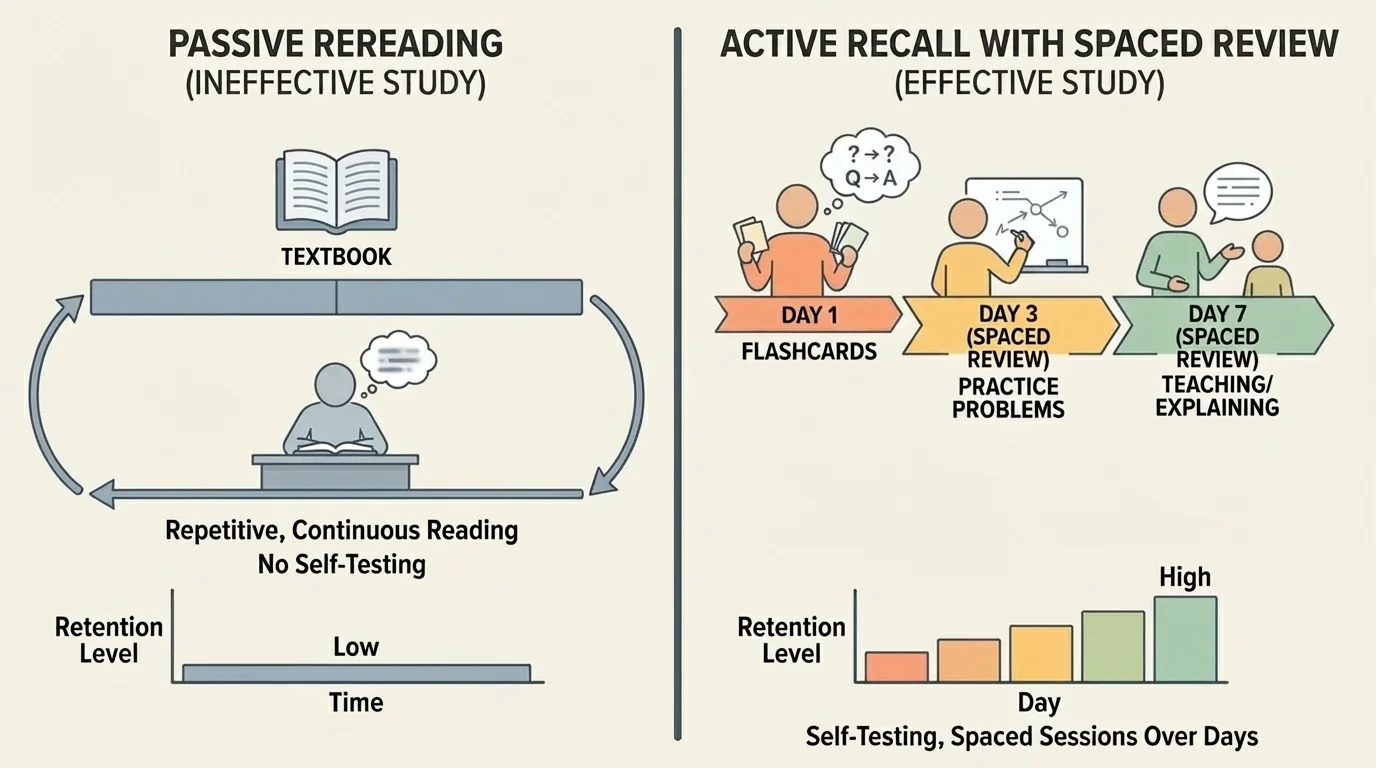
Your brain remembers more when it has to work a little to retrieve information. That is why a short self-quiz often helps more than reading the same page over and over.
Here are practical study methods you can use right away:
If you only reread, you may feel familiar with the material but not actually know it. The contrast in [Figure 4] shows why stronger studying involves trying to remember, checking mistakes, and returning to the material later.
Test preparation works best when you spread it out over time, and [Figure 5] shows a simple countdown that keeps review calm and organized. Cramming can sometimes help you remember a few things for a very short time, but it usually leads to stress, poor sleep, and fast forgetting.
A good test plan starts several days before the test. First, find out exactly what will be on it. Then gather your notes, assignments, study guides, and practice questions. Review in short sessions across the week instead of trying to do everything at once.
About a week before a test, start reviewing the oldest or hardest material first. A few days before the test, quiz yourself and find your weak spots. The day before the test, review lightly, organize what you need, and stop early enough to rest.
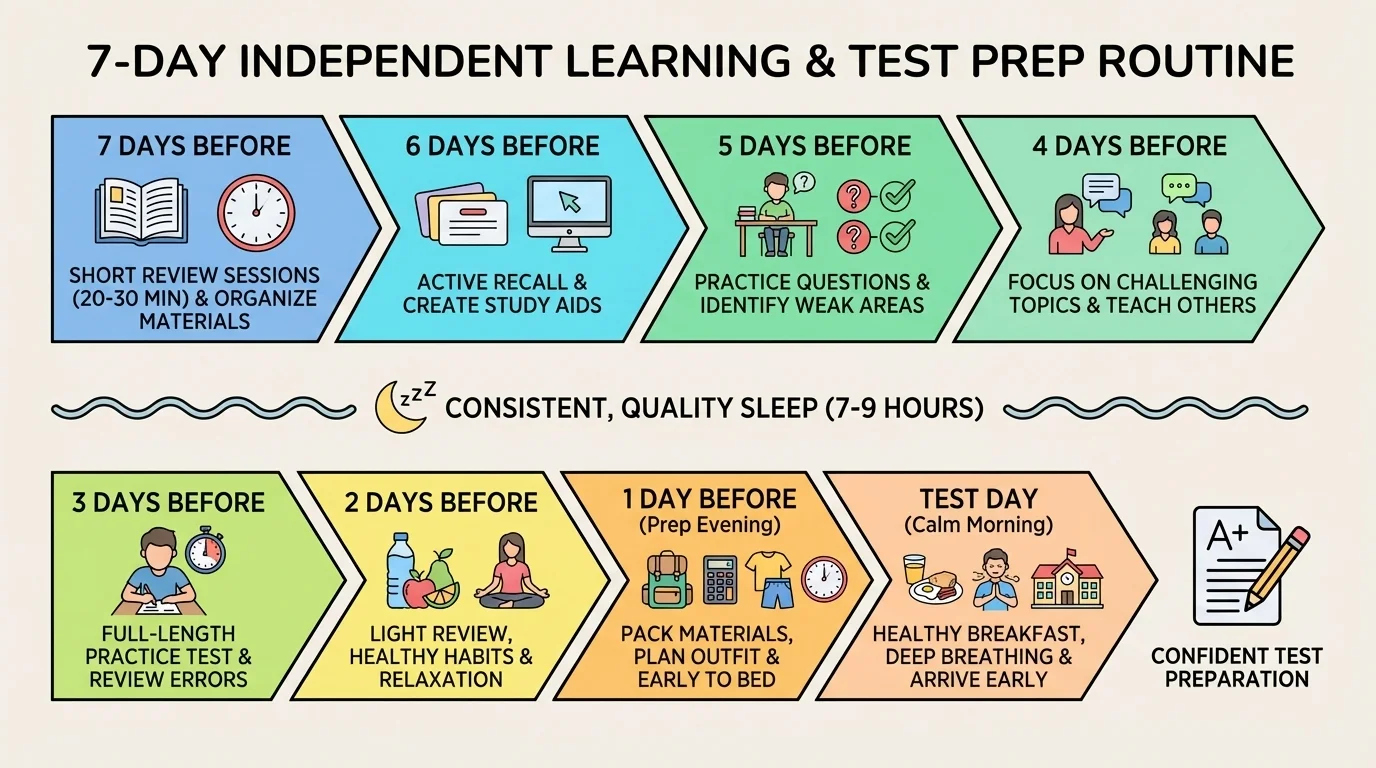
A simple test-prep countdown
Step 1: Seven to five days before, review notes in short parts and make a list of topics you still need to practice.
Step 2: Four to three days before, do practice questions and correct mistakes.
Step 3: Two days before, focus on the topics that are still hardest.
Step 4: One day before, do a short review, pack materials, and go to sleep on time.
Step 5: On test day, eat, breathe, and trust the work you already did.
Sleep matters more than many students realize. Your brain needs rest to organize and store what you studied. Staying up very late can make you feel like you studied more, but your thinking may be slower the next day.
Later, when a test feels close and pressure rises, look back at the sequence in [Figure 5]. Calm preparation beats last-minute panic.
Even a good routine will not work perfectly every day. That is normal. The goal is not perfection. The goal is recovery.
If you miss a study session, do not decide the whole week is ruined. Restart at the next planned time. Missing one session is a small problem. Quitting the whole routine makes it a bigger one.
If you keep getting distracted, ask what is causing it. Are you tired? Hungry? Bored? Confused by the assignment? Pulling out a different app may be a sign that the task feels too hard or too unclear. In that case, make the task smaller or ask for help through your school platform, email, or a teacher video meeting.
You do not need to solve every learning problem alone. Independent learning includes knowing when to reach out for support, ask a clear question, and use available resources wisely.
If motivation is low, rely on your routine more than your feelings. Start with just 5 minutes. Often, 5 minutes turns into more. If it does not, you still made progress. Small action is better than waiting for the perfect mood.
If your week becomes crowded, protect the most important parts first: due dates, test review, sleep, and basic organization. Some tasks can move. Those cannot.
| Problem | What it can look like | Helpful fix |
|---|---|---|
| Forgetting tasks | Missing assignments or surprise deadlines | Check planner every morning and evening |
| Getting overwhelmed | Not starting because the task feels huge | Use chunking and begin with one tiny step |
| Distracted by devices | Switching apps or checking messages often | Move phone away and close extra tabs |
| Cramming | Studying everything the night before | Use spaced practice across several days |
| Giving up after a bad day | Thinking one mistake ruined the plan | Restart at the next study block |
Table 1. Common study routine problems and practical ways to fix them.
The best routines are not copied exactly from someone else. They are tested, adjusted, and improved by you. After a week, ask yourself: What worked? What did not? Which time of day felt best? Which subject needed more review?
This kind of self-monitoring helps you become more independent. You start noticing patterns instead of guessing. Maybe you learn that short study blocks work better than long ones, or that reviewing right after class helps you remember more.
"You do not rise to the level of your goals. You fall to the level of your systems."
— James Clear
A strong study system also helps in real life outside school. Planning ahead, breaking tasks into steps, and following routines are useful when you prepare for sports, practice music, manage chores, or learn a new skill online.
Try this: choose one small routine you can begin today. It might be setting out your supplies before bed, checking your planner after breakfast, or doing a 10-minute review after each online class. Start small, repeat it, and let it grow.
Independent learning does not mean doing everything alone with no support. It means learning how to manage your time, effort, and choices in a responsible way. A steady routine gives you that power.
