Some adults work at jobs they never even knew existed when they were your age. A person might help design video games, care for animals, repair wind turbines, edit online videos, protect computer systems, or plan events. The world of work is much bigger than just a few famous jobs. That is why learning about careers now is not about picking one job forever. It is about starting to notice what kind of work might fit you.
When people choose work that matches their strengths, they often feel more confident and more motivated. When there is a poor match, work can feel frustrating, boring, or stressful. You do not need to know your whole future right now. But if you start paying attention to what you enjoy, what you do well, and what matters to you, you will make smarter choices later about classes, hobbies, volunteering, and jobs.
Think about everyday life. Do you like solving problems when a device is not working? Do you enjoy helping younger children learn something? Are you good at organizing your room, your sports gear, or your digital files? Do you stay calm in emergencies? These clues matter. Future work is often built from the same patterns you already show in real life.
Career cluster means a broad group of jobs that involve similar skills, interests, or types of work.
Strengths are the positive qualities, skills, habits, and interests that help you do things well.
Career readiness means building the attitudes and skills that help you explore work, prepare for jobs, and act responsibly.
Knowing yourself does not mean putting yourself in a tiny box. It means collecting clues, as [Figure 1] helps show. A student who loves drawing today might later become an architect, animator, fashion designer, or graphic designer. A student who likes helping people might become a nurse, coach, therapist, teacher, or community organizer. The point is not to lock in one answer. The point is to learn how to spot possible matches.
A career cluster is a way to organize many jobs into bigger families of work. Instead of trying to study thousands of job titles one by one, you can look at groups. That makes career exploration feel less confusing.
For example, jobs in health science often involve caring for people's health. Jobs in information technology often involve computers, software, networks, or digital problem-solving. Jobs in arts, audio/video technology, and communications often involve creativity and sharing messages. These jobs are different from each other, but they belong in the same cluster because they share common tasks and skills.
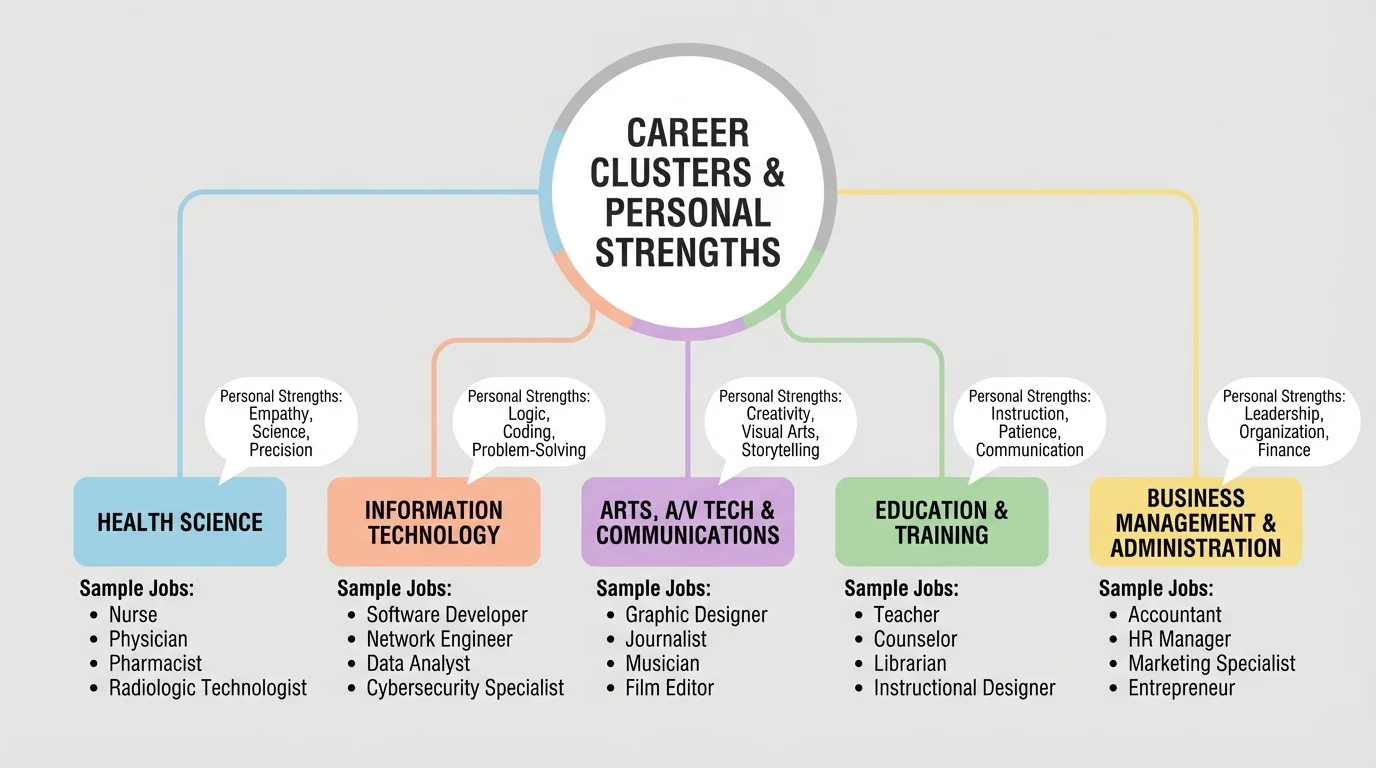
Career clusters help you ask better questions. Instead of saying, "What job should I have?" you can ask, "What kind of work sounds interesting?" or "Which cluster matches the way I like to solve problems?" That is a much easier place to start.
Clusters also help because many people change jobs over time. Someone may stay in the same cluster but do different work. A person in business might begin as a store assistant, later become a manager, and eventually run a small company. A person in technology might start by learning coding, later test software, and then become a cybersecurity specialist. The cluster gives you a direction without forcing one exact path.
Here are a few clusters you may already see in daily life, online spaces, and your community. You do not need to memorize all of them. The goal is to recognize patterns.
| Career cluster | What people often do | Examples |
|---|---|---|
| Health Science | Care for health and wellness | Nurse, dentist, physical therapist, medical assistant |
| Information Technology | Work with computers and digital systems | Programmer, web designer, cybersecurity analyst |
| Education and Training | Teach or support learning | Teacher, tutor, trainer, librarian |
| Arts, Audio/Video Technology, and Communications | Create, design, perform, or share messages | Animator, video editor, writer, photographer |
| Business Management and Administration | Organize, plan, lead, and manage work | Manager, office assistant, entrepreneur |
| Human Services | Help people with daily life needs | Counselor, social worker, cosmetologist |
| Agriculture, Food, and Natural Resources | Work with plants, animals, food, or the environment | Veterinary technician, farmer, park ranger |
| Science, Technology, Engineering, and Mathematics | Investigate, design, build, and solve technical problems | Engineer, scientist, lab technician |
Table 1. Examples of career clusters, common types of work, and sample jobs.
You might already be trying out parts of these clusters without thinking about it. Editing short videos connects to communication and media. Caring for a pet connects to animal and health-related work. Helping a family member set up a phone or app connects to technology. Selling handmade crafts online connects to business, design, and customer service.
Many jobs combine more than one cluster. A game designer may use art, storytelling, and technology. A sports trainer may use health science, communication, and business skills.
That is why it is okay if you seem to fit more than one cluster. As [Figure 2] suggests, most people do. Real work is often a mix of skills.
Your strengths are more than just what you score well on or what other people praise. Strengths can include your interests, your skills, your values, your personality, and your habits. When you look at all of these together, you get a fuller picture of yourself.
Start with interests. Interests are things you enjoy learning about or doing. You might be interested in drawing, sports, coding, cooking, animals, music, fixing things, fashion, science videos, or helping people. Interest matters because it helps you stay motivated.
Next are skills. Skills are things you can do. Some skills are technical, like editing a video, using a spreadsheet, or caring for a garden. Some are people skills, like listening well, explaining clearly, or working in a team. Interests and skills are not exactly the same. You can enjoy something and still be learning it. You can also be good at something you do not enjoy very much.
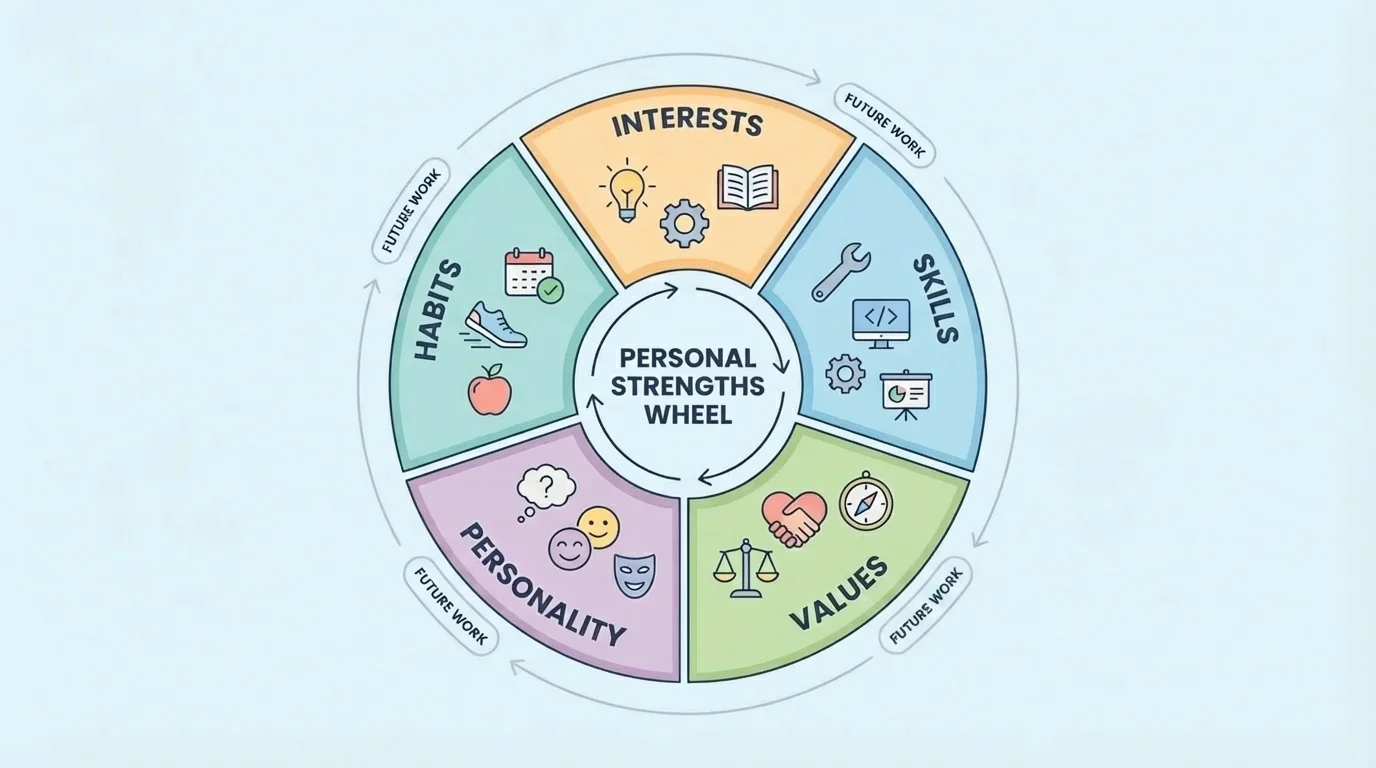
Another important clue is your values. Values are what matters to you. You might care about helping others, being creative, earning money, having a stable schedule, working outdoors, solving hard problems, or having independence. Two people can both be good at the same task but want different futures because their values are different.
Your personality matters too. Maybe you love meeting new people, or maybe you prefer quiet focus. Maybe you like leading, or maybe you enjoy supporting from behind the scenes. Neither is better. They just point toward different work environments.
Finally, pay attention to habits. Habits are powerful because work depends on them every day. Being on time, finishing what you start, staying organized, asking for help when needed, and speaking respectfully online are habits that fit almost every career. If you are still building these habits, that is normal. The good news is that habits can improve with practice.
Your strengths are a pattern, not a single label. One strength alone rarely tells the whole story. A student who likes animals, stays calm, and notices details may fit animal care. A student who enjoys storytelling, technology, and teamwork may fit media production. Looking for patterns gives better career clues than looking for one "perfect talent."
You can collect evidence about your strengths by noticing daily life. As [Figure 3] suggests, ask yourself: What tasks do I do without giving up quickly? What do people trust me to help with? What kinds of videos, articles, or channels do I choose for fun? When do I lose track of time because I am focused? Those moments are useful signals.
Matching your strengths to possible work is a process, not a one-time guess. You do not need a perfect answer. You are building a short list of possibilities to explore.
Step 1: List your strengths. Write down at least a few interests, skills, values, and habits. For example: "I like making digital art, I am patient, I notice details, and I like learning new apps."
Step 2: Look for repeated themes. In that list, the theme might be creativity, technology, and focus. Repeated themes are often more helpful than random one-time activities.
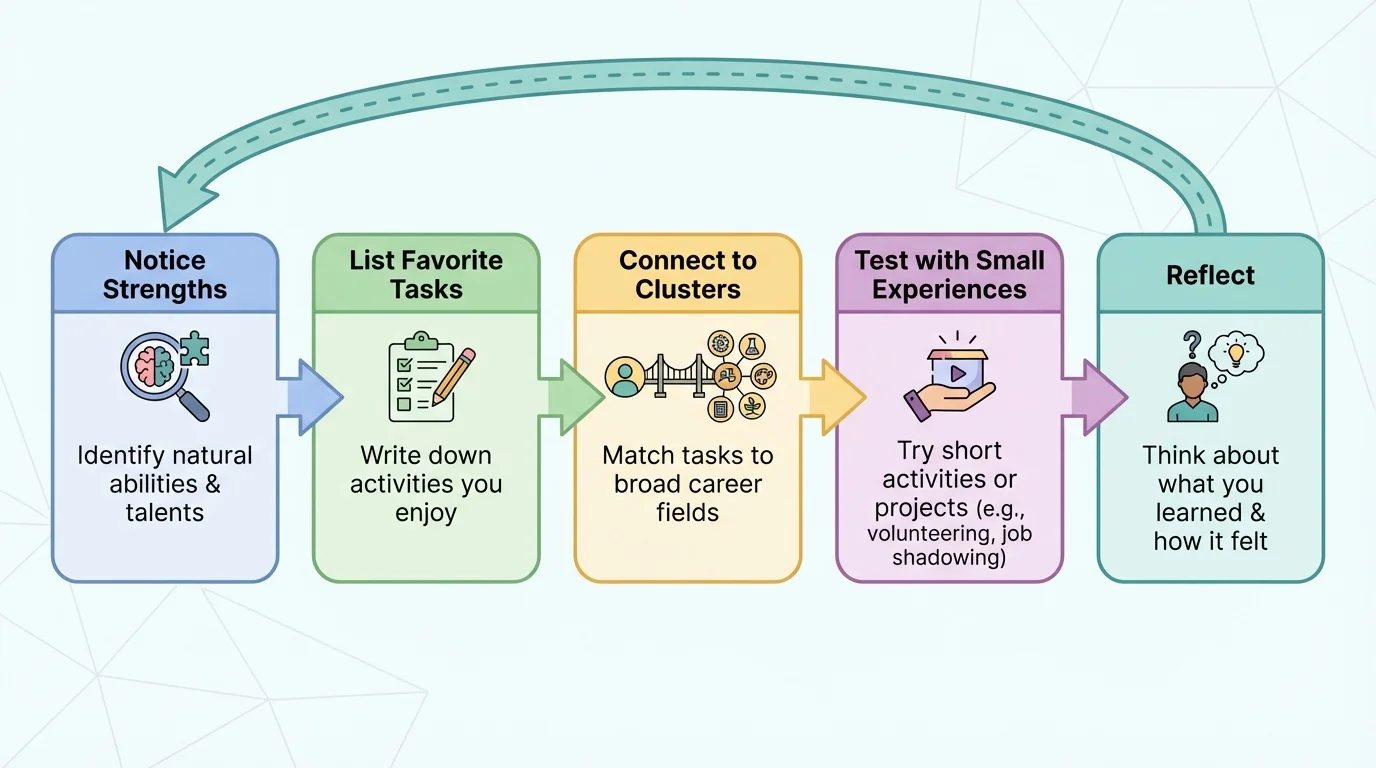
Step 3: Connect those themes to clusters. Creativity plus technology might connect to arts and communications, information technology, or design-related jobs. Patience and attention to detail might also connect to health science, engineering, or lab work.
Step 4: Test the match with small experiences. Watch an interview with someone in that field. Try a beginner project. Ask an adult about their work. Join an online club or community activity. Read job descriptions written for beginners. Notice whether your interest grows or shrinks after learning more.
Step 5: Reflect honestly. Ask: Did I enjoy the tasks? Did I like the tools used? Did I care about the purpose of the work? Could I imagine doing more of this?
Real-world matching example
Maya likes organizing details, helping people, and staying calm when others are stressed.
Step 1: She lists her strengths.
She writes: "organized, patient, helpful, responsible, good at explaining steps."
Step 2: She finds themes.
The themes are support, communication, and responsibility.
Step 3: She connects them to clusters.
Possible matches include education and training, health science, human services, and business support roles.
Step 4: She tests the ideas.
She helps a younger cousin with homework on a video call, watches a day-in-the-life video from a medical assistant, and practices making a simple schedule for a family event.
Maya does not have to choose one career now. She learns which clusters are worth exploring more.
This process works even if your list is unusual. Suppose you love being outside, like taking care of plants, and enjoy science videos about weather. That combination might connect to agriculture, environmental work, or science careers. As we saw earlier in [Figure 1], clusters contain many job options, so one set of strengths can connect to several paths.
You do not need to wait until you are an adult to begin exploring work. You can do small, safe, practical things now.
Talk to adults about their jobs. Ask what they do each day, what skills they use, what they like, and what is difficult. You may discover that a job title only tells part of the story.
Use trusted online career videos and websites. Look for short clips where workers explain their jobs. Pay attention to tasks, tools, schedule, teamwork, and work setting, not just salary or cool titles.
Try mini-projects. If you are curious about technology, build a simple webpage or try beginner coding. If you are curious about health, learn basic first-aid skills from a trusted source. If you are curious about business, track how a small craft or snack sale might be organized. If you are curious about media, create a short informational video.
Volunteer or help in your community. Helping at an animal shelter event, community garden, library program, neighborhood cleanup, or family business can teach you a lot about work habits and preferences.
Exploring a career is not the same as promising to do it forever. Exploration means learning through safe, small experiences so you can make better choices later.
Notice the skills behind the activity. A project is not only about the final result. It also shows whether you like planning, creating, fixing, explaining, or leading. Those are career clues. The same way the strengths wheel in [Figure 2] separates different parts of who you are, your activities can reveal more than one strength at a time.
Sometimes students believe jobs are only for certain kinds of people. That is not true. A quiet person can become a strong leader. A creative person can also be great at science. A student who struggles now can still build excellent job skills over time. Do not let stereotypes decide your future.
Your interests may change, and that is normal. You might care a lot about sports today and become interested in nutrition, physical therapy, coaching, sports media, or event management later. The exact path can change while the bigger theme stays connected.
"You do not have to know everything about your future. You only need to keep learning about yourself and the world of work."
It is also okay to discover that something is not a match. That is useful information. If you thought you wanted to edit videos but learn that you dislike sitting at a computer for long periods, that helps you narrow your path. Exploration saves time by helping you rule things out as well as rule things in.
A good plan for future work at your age is simple: notice, explore, reflect, and repeat. You can keep a note-taking app, journal, or document with three short lists:
Here is a practical checklist you can use:
Over time, these small actions build career readiness. You become more aware of yourself, more informed about work, and more prepared to make choices. The matching process in [Figure 3] still matters later because older students and adults also revisit their strengths and interests when planning next steps.
One more important truth: almost every job values some of the same core habits. Being dependable, communicating clearly, treating people respectfully, managing time, and staying willing to learn will help you in nearly any cluster. Even if your future job changes, those habits stay useful.
