People often think job skills start when you get your first paycheck, but they really start much earlier. Every time you finish a task when you promised, send a respectful message, or notice a problem and fix it without being asked, you are building habits that adults use at work every day. These habits matter in jobs, but they also matter at home, in clubs, in sports, in volunteering, and in online groups.
Workplace habits are the behaviors that help people trust you and enjoy working with you. If someone sees that you are prepared, honest, calm, and responsible, they are more likely to give you important tasks. If someone sees that you disappear, forget deadlines, or answer rudely, they may stop depending on you.
Even before you have a job, workplace habits show up in real life. You might help with a family project, work on a community team, babysit a younger child for a short time, care for a pet, join an online club, or create something with other people. In all of those situations, people notice whether you can be counted on.
Reliability means people can count on you to do what you said you would do. Initiative means you notice what needs to be done and take helpful action without always waiting to be told. Professional communication means speaking or writing in a clear, respectful, and responsible way.
These three habits work together. Reliability helps people trust you. Initiative helps you become useful and helpful. Professional communication helps others understand you and feel respected. When you use all three, you look mature and ready for more responsibility.
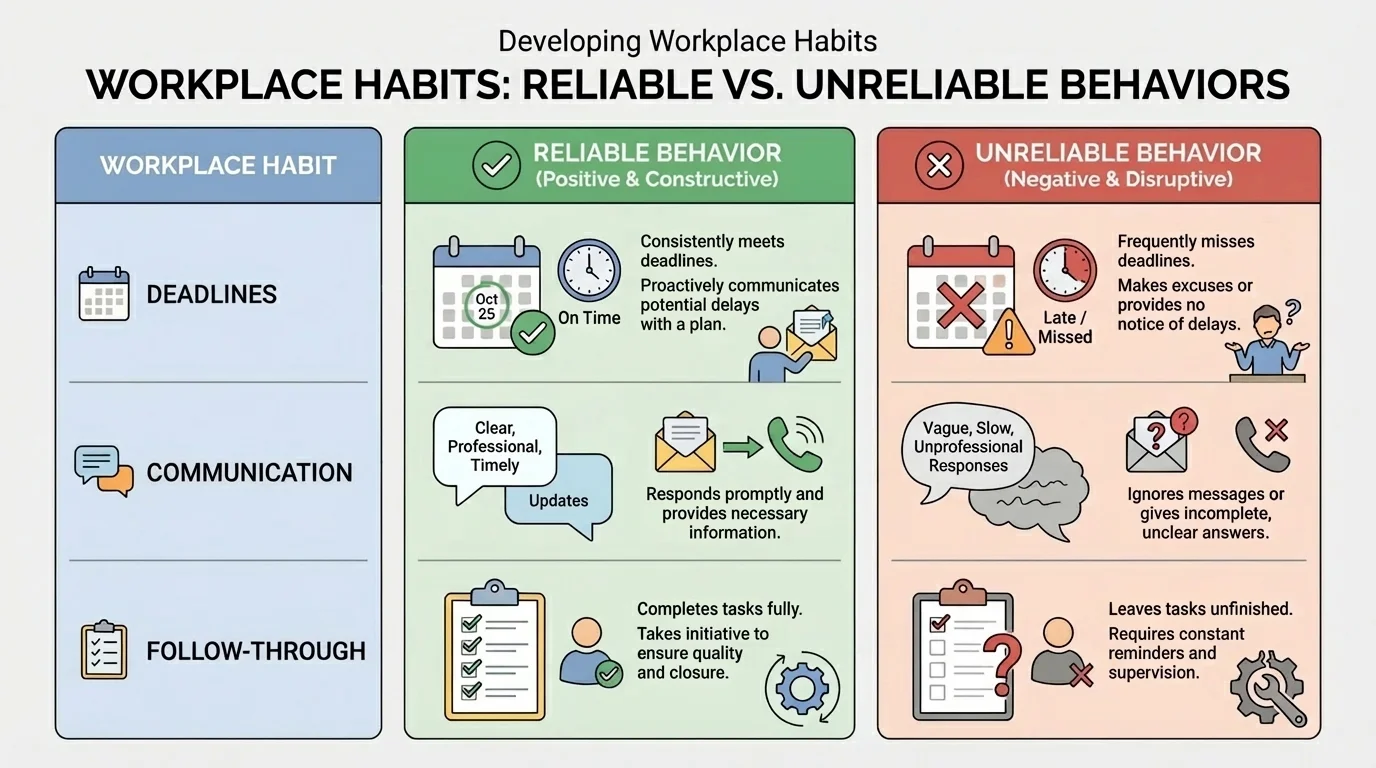
Reliability means your actions match your words. If you say you will join a video meeting at a certain time, you show up prepared. If you say you will finish a task by tomorrow, you finish it by tomorrow or give notice early if there is a real problem. The comparison in [Figure 1] makes it clear that reliability is not about being perfect. It is about being responsible, honest, and consistent.
A reliable person does a few simple things again and again: remembers tasks, plans ahead, tells the truth, and follows through. An unreliable person may mean well, but often forgets, makes excuses, answers late, or leaves others guessing.
Think about two students helping with the same online community project. One says, "I'll send my part by deadline time," and sends it before the due time. The other says, "I'll do it later," then disappears and responds hours later with no explanation. Which person would you choose next time? Most people choose the one they can trust.
Reliability includes being on time, but it is bigger than punctuality. It also includes bringing what you need, reading directions carefully, checking your work, and asking for help before a problem gets too big. When you act this way, you save other people time and stress.
Sometimes reliability means saying "I can't do that" instead of promising too much. That may sound strange, but it is true. If you agree to five tasks and finish only two, people feel disappointed. If you honestly agree to two tasks and complete both well, people see you as dependable.
Real-life reliability example
You promised to help your aunt organize digital photos on Saturday afternoon, but you realize Friday night that your internet connection at home may be unstable.
Step 1: Notice the problem early.
Do not wait until the last minute and hope it works out.
Step 2: Communicate clearly.
Send a message such as, "I still plan to help on Saturday on time, but my connection may be weak. If needed, I can switch to phone audio or start by sorting files offline."
Step 3: Offer a solution.
Showing a backup plan proves you are trying to keep your promise.
Step 4: Follow through.
Be ready at the agreed time and use the backup plan if necessary.
This is reliability in action: honest, prepared, and responsible.
If you miss a deadline, reliability is not destroyed forever. What matters next is how you respond. A reliable person admits the mistake, apologizes briefly, fixes what they can, and changes their system so it does not keep happening. As we saw earlier in [Figure 1], reliable behavior is built through patterns, not one single moment.
Good habits do not usually happen by magic. They happen because you create systems. A system is a simple routine that helps you remember what to do. Adults use systems at work all the time: calendars, alarms, notes, checklists, and preparation routines.
You can do the same. Put deadlines in a calendar right away. Set a reminder for the day before and another reminder for the same day. Keep materials in one place. If you have a meeting online, charge your device early, test your microphone, and open the needed files before it starts.
A strong routine can be as simple as this: every evening, check tomorrow's tasks; every morning, choose the top three; every afternoon, mark what is done; every night, send any needed updates. This routine turns reliability from a wish into a repeated behavior.
Why small routines matter
People often fail at responsibility not because they are lazy, but because they rely only on memory. Memory is useful, but systems are stronger. A checklist or reminder takes pressure off your brain and helps you stay consistent even on busy days.
Try using a "prepare early" rule. If something is due on Friday, act like it is due on Thursday. That extra day protects you from surprises like a dead battery, lost file, family schedule change, or slow internet.
Another helpful habit is to estimate time honestly. If a task seems like it will take around 30 minutes, plan for 45 or 60 minutes. Extra time gives you room to think carefully instead of rushing. At work, people often trust the person who finishes well more than the person who promises impossible speed.
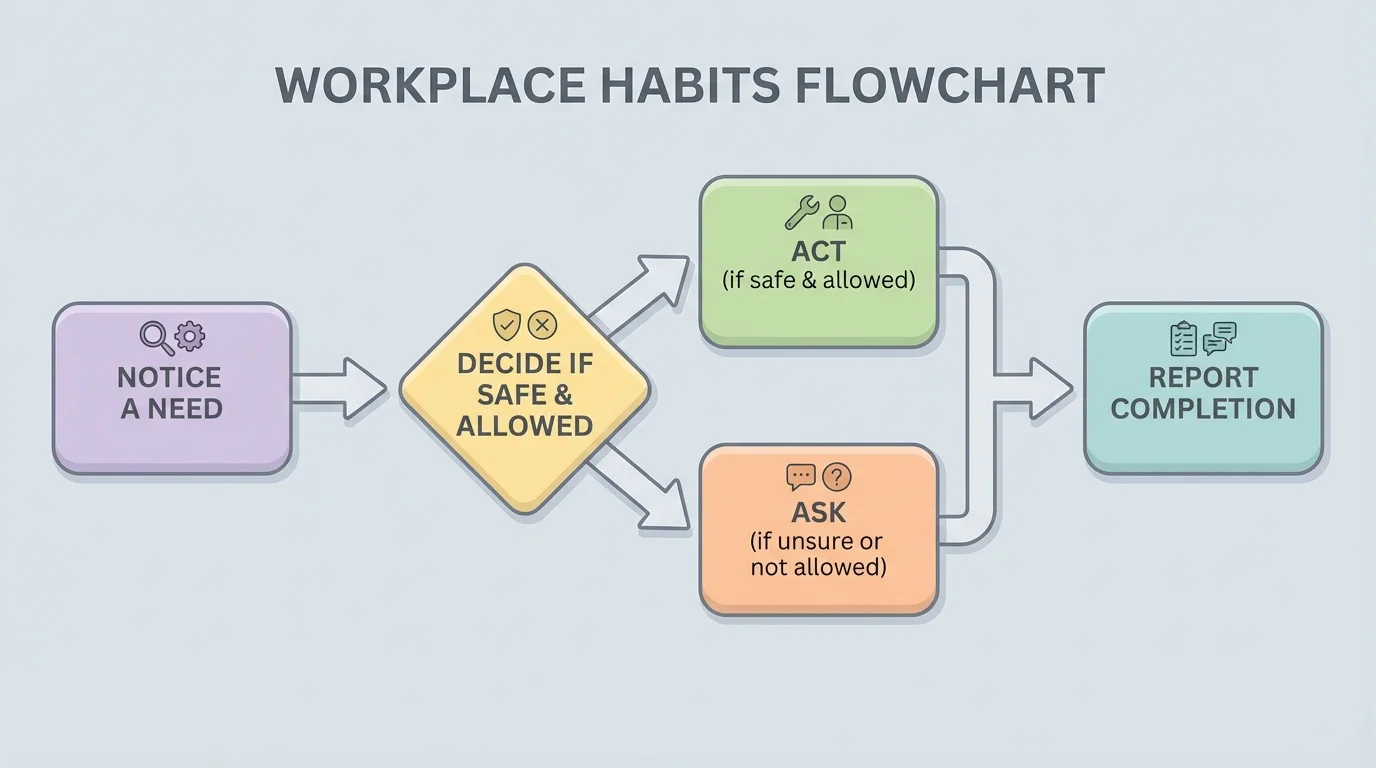
Initiative is powerful because it shows that you do not need to be guided through every little step. It means you look around, notice what needs attention, and take useful action in a safe and respectful way. The decision path in [Figure 2] shows a smart way to use initiative: notice a need, decide whether it is safe and allowed, act if appropriate, and communicate what happened.
Initiative is not bossing people around or doing random things. It is thoughtful action. For example, if you are helping with an online event and notice the sign-up document has unclear labels, initiative might mean politely asking, "Would it help if I renamed the sections so they are easier to follow?"
It also includes asking good questions. Some people think initiative means never asking for help, but that is not true. Sometimes the smartest action is to ask a clear question early instead of making a big mistake later.
Here are good examples of initiative: refilling supplies at home before someone asks, checking instructions before starting a task, organizing your notes for a group call, or noticing that a message might confuse people and rewriting it to be clearer. These actions save time and make you helpful.
Here are poor examples that may look like initiative but are not: changing important plans without permission, touching private files, interrupting constantly, or taking over someone else's job. Real initiative respects roles, safety, and boundaries.
Safe initiative checklist
Step 1: Ask yourself, "What needs to be done?"
Step 2: Ask, "Is this safe, allowed, and appropriate for me to handle?"
Step 3: If yes, do the small helpful action.
Step 4: If not, ask a responsible person or team leader.
Step 5: Report what you did so others are informed.
Using initiative well can make you stand out. It tells others, "I pay attention. I care about the result. I do not wait to be rescued from every small problem." That attitude is valuable in almost every future job.
Professional communication means expressing yourself in a way that is clear, respectful, and appropriate for the situation. It matters in text messages, emails, group chats, comments, shared documents, and video calls. The examples in [Figure 3] show how the same basic message can sound careless or professional depending on the words you choose.
Professional does not mean cold or stiff. It means polite, understandable, and responsible. You can still sound friendly. For example, "Hi, I'm running about 10 minutes late because of a family schedule change. I'll join as soon as I can. Sorry for the delay," sounds much better than "late lol."
A strong message usually includes four things: who you are if needed, what the issue is, what action you took or will take, and what the other person needs to know next. This structure keeps your message helpful instead of confusing.
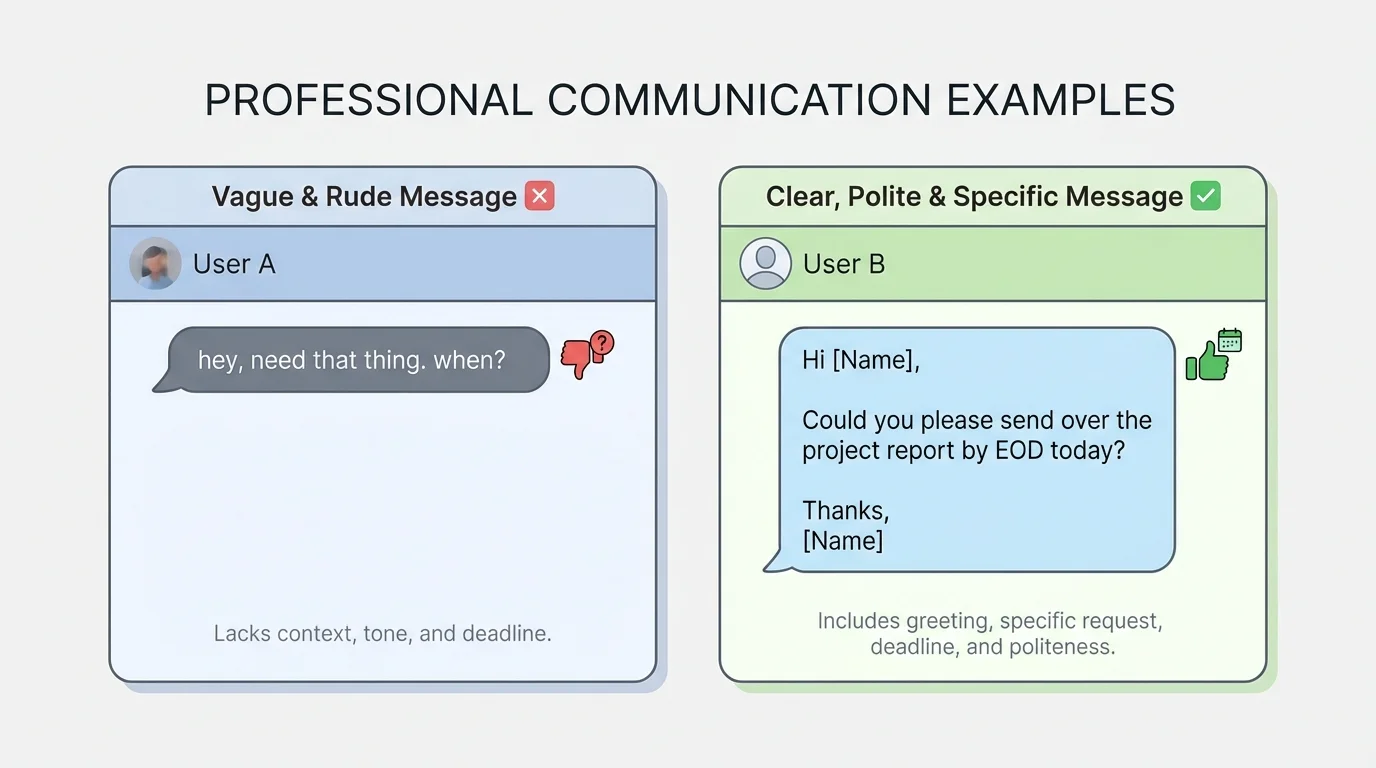
Tone matters too. Tone is the feeling your words create. Online, people cannot always hear your voice, so short messages can sound rude even when you did not mean that. Writing "Need this now" may sound demanding. Writing "Can you send this by tonight if possible? Thank you" sounds respectful.
Professional communication also means choosing the right time and place. A quick update may fit in a chat. A more detailed explanation may belong in an email. A confusing problem may be easier to solve on a video call where people can ask questions right away.
Many conflicts online start not because people disagree, but because a short message sounds harsher than the sender intended. Adding a greeting, a complete sentence, and a polite closing can completely change how your message is received.
Response time matters. You do not have to answer instantly every second of the day, but ignoring messages for a long time can make you seem careless. If you need more time, send a short update: "I saw this and I'm working on it. I'll respond fully by this evening." That helps people know they are not being ignored.
When you disagree, stay calm. Focus on the issue, not the person. Say, "I see it differently because…" instead of "That makes no sense." Respectful disagreement is a major part of sounding mature.
| Situation | Less professional | More professional |
|---|---|---|
| Missing a meeting | "cant come" | "I'm sorry, I can't attend today. I'll read the notes and catch up." |
| Need help | "I don't get it" | "I'm confused about step 2. Could you explain that part?" |
| Sending work late | "here" | "Here is my file. Thank you for waiting." |
| Disagreeing | "you're wrong" | "I have a different idea. Can I explain my reasoning?" |
Table 1. Examples comparing less professional and more professional communication in common situations.
Later, when you are part of teams, clubs, or jobs, the habits in [Figure 3] still matter: clear words, respectful tone, and enough detail to be useful.
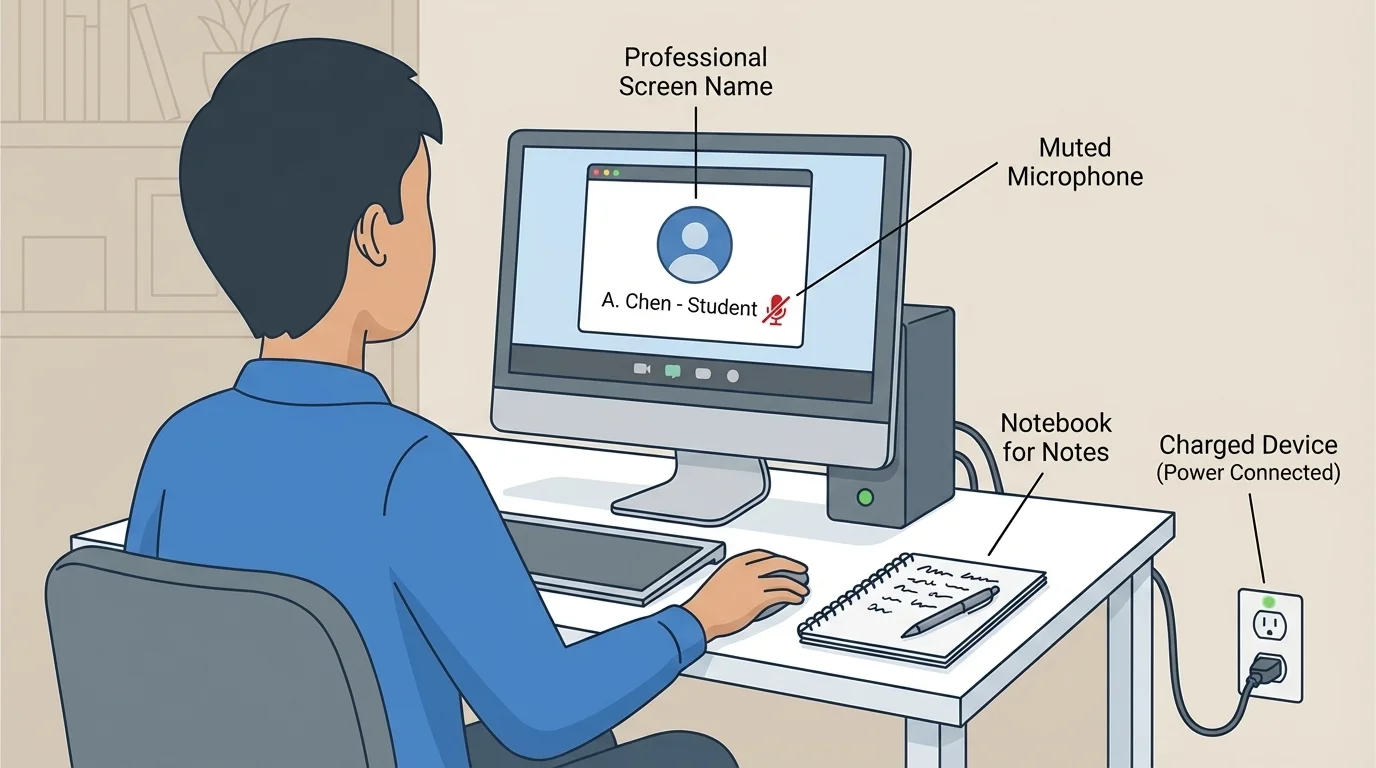
[Figure 4] Today, a lot of responsibility happens through screens. That means online behavior is part of professionalism. Being prepared for a video call means having your device charged, your microphone checked, an appropriate screen name, a notebook ready, and distractions reduced.
Your online name should be appropriate. A silly nickname might be funny with friends, but it may not fit a volunteer project, internship, tutoring session, or community group. A simple name helps people take you seriously.
Your background and surroundings matter too. If your camera is on, choose a place that is as neat and quiet as possible. If your microphone is on, avoid chewing, side conversations, or noisy distractions. If you are not speaking, mute when appropriate.
Professional online behavior also includes your digital footprint. A digital footprint is the trail of comments, posts, usernames, photos, and messages connected to you online. Even when something feels temporary, screenshots and saved records can last much longer.
Before posting, ask yourself three questions: Is it true? Is it respectful? Would I be okay if a future coach, mentor, or employer saw it? If the answer to the last question is no, pause before posting.
"Your habits shape your reputation, and your reputation shapes your opportunities."
That quote matters online and offline. People may not remember every single thing you said, but they often remember patterns: respectful or rude, prepared or careless, honest or excuse-making.
No one is perfect. At some point, you will forget something, misunderstand directions, or send a message that comes out wrong. Professional behavior is not about never making mistakes. It is about responding well when mistakes happen.
First, admit the problem clearly. Second, apologize briefly without making a huge dramatic speech. Third, fix what you can. Fourth, learn from it. This approach protects trust much better than denying, blaming, or disappearing.
Feedback is another important part of working well with others. Feedback is information someone gives you to help you improve. It can feel uncomfortable, but it is useful. If someone says your message was unclear or your task was late, try not to get defensive right away. Listen for the helpful part.
How trust grows
Trust usually grows through repeated small actions. One honest update, one finished task, one respectful reply, and one well-handled mistake may seem small, but together they create a reputation. People often give more responsibility to those who repeatedly show good judgment.
Teamwork also means sharing credit. If a group project goes well, do not act like you did everything alone. Thank people for their help. This makes others more willing to work with you again.
If someone else makes a mistake, you can still act professionally. Avoid mocking them in a chat or gossiping about them. Focus on solving the problem. Professional people help the group move forward.
You do not need to wait years to build these skills. You can start now with small actions in daily life. Try this: choose one task this week that matters to someone else. Write down when it is due, prepare early, complete it on time, and send a clear update when you finish.
Try this too: before you send any important message, reread it once and check three things. Is it clear? Is it respectful? Does it include the needed details? This takes less than a minute, but it can prevent confusion and conflict.
Another useful habit is a daily check-in with yourself. Ask: What do I need to finish today? What could go wrong? Who needs an update from me? Those simple questions build reliability and initiative together.
One-week habit plan
Day 1: Set one reminder for a responsibility you already have.
Day 2: Send one message using a greeting, clear details, and a polite closing.
Day 3: Notice one useful task and complete it without being asked.
Day 4: Prepare early for one online meeting, call, or responsibility.
Day 5: Ask for feedback on something you did.
Day 6: Fix one small mistake quickly and honestly.
Day 7: Reflect on which habit felt easiest and which needs more practice.
These are not giant changes. They are small, repeatable actions. But small actions repeated often are exactly how strong habits are built.
When adults say they want someone who is "responsible" or "professional," they often mean these same core things: show up, do the work, communicate clearly, solve small problems, and treat people with respect. You can practice all of that right now.
