Sometimes unsafe situations do not start with something obvious. They can begin with a joke, a dare, a private message, or someone saying, "Come on, it's not a big deal." That is what makes this topic important. A person does not have to look scary to act in a way that is unsafe. Pressure, control, and boundary violations can slowly make a situation feel confusing, uncomfortable, or even dangerous.
Your safety is not only about avoiding strangers or obvious danger. It is also about how people treat you in everyday life. This can happen in a group chat, during an online game, on social media, at a sports practice, in a club, at a neighbor's house, or even with someone you already know. A person might push you to share something private, agree to something you do not want, keep a secret that feels wrong, or ignore you when you say stop.
When people respect you, you usually feel heard, calm, and free to choose. When someone uses pressure or control, you may feel nervous, trapped, guilty, or afraid of what will happen if you say no. Those feelings matter. They are important clues that your safety may be affected.
Pressure is when someone pushes you to do something by begging, repeating, teasing, guilting, or making you feel left out.
Coercion is when someone tries to force your choice using fear, threats, intimidation, or serious control.
Boundary means a limit that protects your body, feelings, privacy, time, and personal space.
Consent means a clear, real, and willing yes. If someone feels scared, trapped, or forced, that is not true consent.
It helps to think of these situations as different levels of seriousness. A simple request is okay because you can answer freely. Pressure is stronger because someone keeps pushing after you hesitate or say no. Coercion is more serious because it uses fear, threats, or power to take away your real choice, as [Figure 1] shows.
Pressure can be obvious, like repeated messages saying, "Do it now," or it can be sneaky, like "If you were a real friend, you would." Repeated asking can turn a normal request into an unfair push. The problem is not only what is being asked. The problem is that the other person is trying to wear down your answer.
Here are some common pressure tactics: begging again and again, acting hurt to make you feel guilty, daring you to prove yourself, saying everyone else is doing it, calling you boring or weak, or trying to rush you so you cannot think clearly.
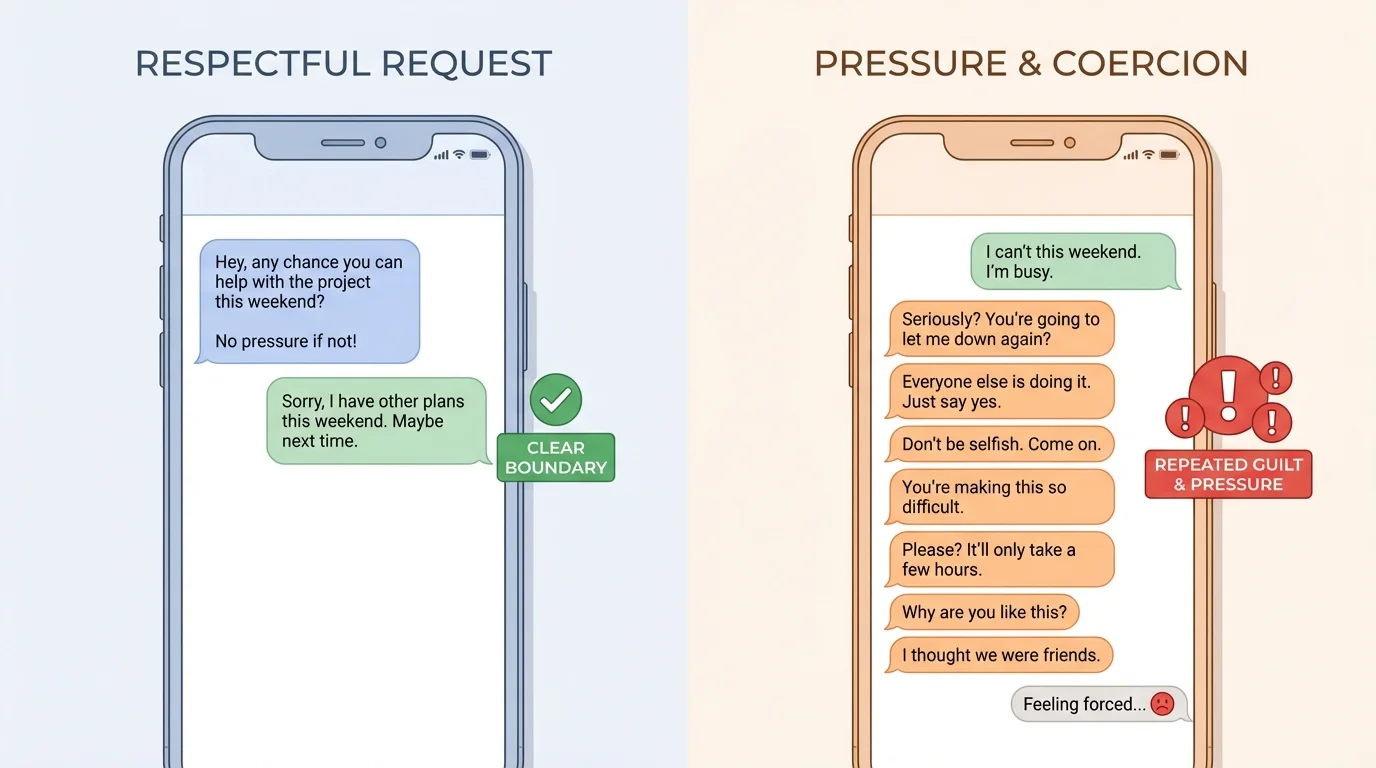
Pressure can happen online very easily. Someone might ask for a photo, your password, your location, or private details about your family. If you say no and they keep pushing, joke about it, or tell you not to be dramatic, that is a warning sign. A healthy person respects your answer the first time.
Pressure can also be stronger when there is a power difference. For example, an older kid, team captain, babysitter, relative, or popular person in a group may seem harder to say no to. You may worry about getting in trouble, being embarrassed, or being excluded. That does not make their behavior okay. In fact, using their role or popularity to push you makes the situation more concerning.
Many unsafe situations start with a small test. A person may first see whether you will stay quiet, ignore your own discomfort, or keep a secret before they push for something bigger.
One useful question is Do I feel free to choose? If the answer is no, then the situation is not respectful. Even if the other person says they are "just kidding," the impact on your safety is real.
Coercion is not just annoying pressure. It is a serious attempt to control your decision. A person may threaten to embarrass you, share your secrets, end a friendship, hurt you, damage something, or get you in trouble unless you do what they want. They may use fear, anger, silence, or their power over you.
For example, if someone says, "Send me that picture or I'll post something embarrassing about you," that is coercion. If someone says, "Don't tell anyone or bad things will happen," that is coercion too. If someone blocks the doorway, grabs your arm, takes your device, or will not let you leave a conversation, that can also be coercive behavior.
Coercion affects safety because fear changes how people make choices. When someone is scared, they may freeze, stay quiet, or agree just to get away. That does not mean they truly wanted what happened. A scared "fine" is not the same as a free and willing yes. Boundaries can also be physical, emotional, digital, or related to privacy, as [Figure 2] shows.
Why fear matters
When your brain senses danger, it may react quickly with fight, flight, freeze, or fawn. That means you might argue, run, go still, or try to please the other person to stay safe. These are normal safety reactions. They are not signs that you "allowed" the situation.
If a person tries to make you responsible for their feelings or actions, be careful. Statements like "You made me do this," "You owe me," or "If you tell, you'll ruin everything" are manipulative. They are meant to shift blame away from the person causing harm.
A boundary is a limit that protects you, and boundaries come in several forms. You have the right to boundaries even if someone else does not like them. You do not need a "perfect" reason to want space, privacy, or respect.
There are different kinds of boundaries. Physical boundaries protect your body and space. Emotional boundaries protect your feelings and what topics you want to discuss. Digital boundaries protect your accounts, messages, images, and online time. Privacy boundaries protect your room, belongings, journal, passwords, and personal information.
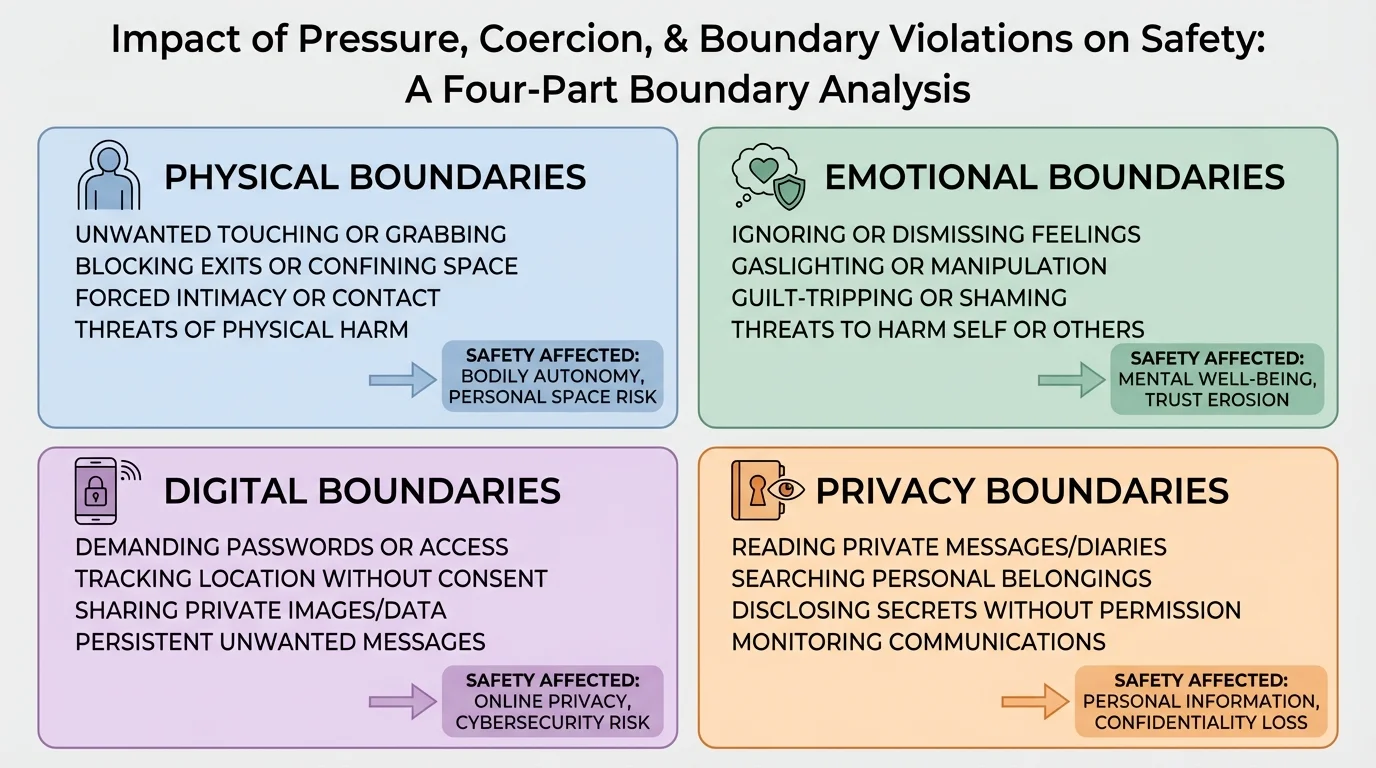
A boundary violation happens when someone ignores, pushes past, or breaks one of those limits. Examples include touching you after you moved away, reading your messages without permission, posting your image without asking, forcing you into a private chat, demanding constant replies, spreading personal information, or making fun of your feelings after you said a topic was off-limits.
Sometimes the violation is obvious. Other times it is disguised as "joking," "being helpful," or "showing you care." But if the behavior ignores your comfort, your answer, or your privacy, it is still a problem. As you can see from the categories in [Figure 2], not all unsafe behavior is physical. Digital and emotional violations matter too.
Watch for patterns. One mistake can be corrected if the person listens, apologizes, and stops. A pattern is different. If someone keeps crossing the line after being told no, tries to isolate you, wants secrets, gets angry at your boundaries, or makes you feel like you are overreacting, those are stronger warning signs.
| Behavior | Respectful | Unsafe Warning Sign |
|---|---|---|
| Asking for private information | Accepts "no" right away | Pushes, guilts, or threatens |
| Physical closeness | Notices your comfort and steps back | Moves closer after you pull away |
| Online messages | Respects your time and privacy | Demands instant replies or constant access |
| Secrets | Keeps normal surprises like gifts | Insists on secrets that feel wrong or unsafe |
| Your "no" | Listens and stops | Argues, laughs, or keeps going |
Table 1. Comparison of respectful behavior and unsafe warning signs in common situations.
Pressure, coercion, and boundary violations can affect more than one kind of safety at the same time. They can affect your safety emotionally, physically, socially, and digitally.
Emotional safety means you feel respected, able to speak up, and not afraid of being mocked or controlled. When this kind of safety is harmed, you may feel stress, shame, confusion, or fear. You might stop trusting your instincts because someone keeps telling you that your feelings do not matter.
Physical safety is affected when someone blocks your movement, touches you without permission, damages your belongings, follows you, or creates a setting where you cannot leave easily. Even if nobody gets hurt right away, the risk becomes higher because your control over the situation is being reduced.
Digital safety is affected when someone pressures you to share passwords, images, your location, or personal details. Screenshots, saved messages, and shared posts can spread quickly. A single unsafe choice online can become hard to take back.
These situations can also affect decision-making. Under pressure, people often act faster and think less clearly. They may focus on escaping embarrassment right now instead of considering what happens later. That is why slowing down is a powerful safety skill, as [Figure 3] shows.
"If you do not feel free to say no, then the situation is not truly respectful."
Another important point: harm is not measured only by whether others think it was serious. If a behavior makes you feel unsafe, trapped, panicked, or deeply uncomfortable, it deserves attention. Trusting that signal can help protect you earlier.
When something feels off, it helps to follow a clear plan instead of trying to think of everything at once. There is a step-by-step response path. You do not need to be rude to protect yourself. You need to be safe.
Start by noticing your body and feelings. A tight stomach, racing heart, frozen feeling, or strong urge to get away can be important clues. Those signs do not prove danger by themselves, but they tell you to pause and check the situation carefully.
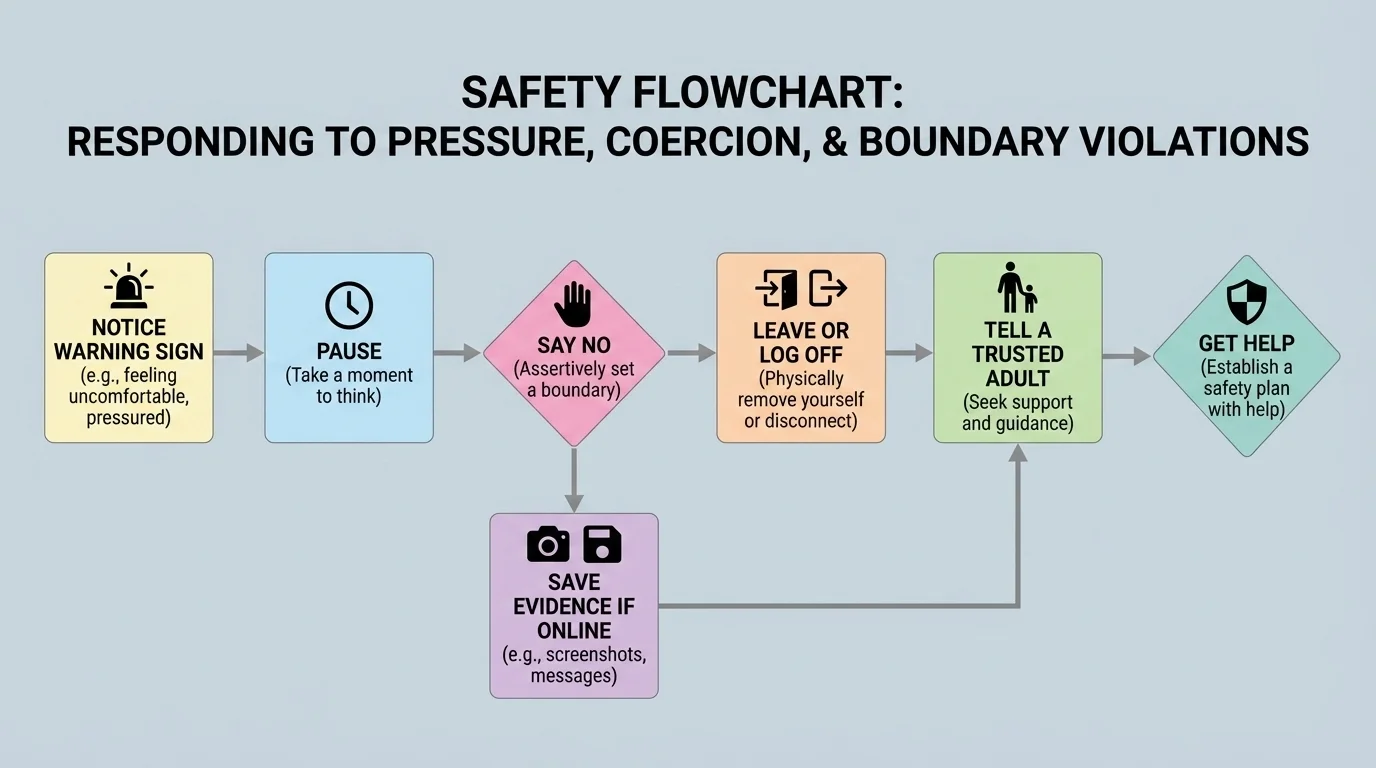
Step 1: Pause. Do not let someone rush your answer. You can say, "I need a minute," "I'm not doing that," or "I have to go now."
Step 2: Use clear words. Short sentences work well: "No." "Stop." "Do not send that." "I'm not sharing that." "Back up." "I'm leaving the chat."
Step 3: Make space. Leave the room, move toward other people, end the call, log off, block the account, or put distance between you and the person. The safety steps in [Figure 3] are useful because they focus on action, not argument.
Step 4: Save evidence if it is online. If there are threatening messages, pressure for images, or harassment, take screenshots if it is safe to do so. Do not keep arguing. Evidence can help a trusted adult support you.
Step 5: Tell a trusted adult. This could be a parent, guardian, counselor, coach, club leader, older sibling, or another adult who takes your safety seriously. Be direct: "Someone pressured me," "I think my boundary was crossed," or "I do not feel safe because of these messages."
Step 6: Get immediate help when needed. If someone is threatening you, touching you, trying to isolate you, demanding images, or making it hard for you to leave, contact a trusted adult right away. If you are in immediate danger, call emergency services.
Real-life response example: gaming chat pressure
You are in a gaming chat, and another player keeps demanding your social media account. You say no, but they keep messaging and say they will tell others you are fake if you do not share it.
Step 1: Name the problem.
This is not a normal request anymore. It has become pressure and may be moving toward coercion because the person is using a threat.
Step 2: Use a clear response.
You can say, "I'm not sharing that. Stop asking."
Step 3: Protect yourself.
Leave the chat, block the user, and take screenshots of the messages.
Step 4: Tell a trusted adult.
Show the screenshots and explain exactly what happened.
This keeps the focus on safety instead of trying to win the argument.
Sometimes students worry about being dramatic or getting someone in trouble. But getting help is not tattling when safety is involved. It is a smart response to unsafe behavior.
Here are a few situations that show how these problems can appear in real life.
Scenario 1: A friend keeps asking you to reveal another person's secret. You say it is not yours to share. They say, "If you were loyal, you would tell me." That is pressure using guilt.
Scenario 2: Someone in a group activity stands too close, keeps touching your shoulder after you move away, and laughs when you step back. That is a physical boundary violation.
Scenario 3: An older teen says you should keep your chats secret because "other people won't understand." They ask for personal photos or private details. This is a major warning sign. Secrets plus pressure plus age or power differences can be very unsafe.
Scenario 4: A person says they will share an embarrassing screenshot unless you do what they want. That is coercion and a digital safety issue.
Scenario 5: A friend gets upset every time you do not respond immediately and sends dozens of messages asking where you are. That may seem like attention, but it can also be controlling behavior and a digital boundary issue.
Respectful relationships leave room for your thoughts, your feelings, and your no. You do not have to earn basic respect by proving loyalty, sharing private information, or ignoring your discomfort.
These examples are different, but the pattern is similar: one person is trying to reduce your freedom to choose. Once you notice that pattern, it becomes easier to respond sooner.
Good boundaries are easier to use when you practice them before a stressful moment. You can decide ahead of time what is private, what topics are off-limits, what photos you will not share, and who you trust with personal information.
Try short boundary scripts you can remember: "I'm not comfortable with that." "No, thanks." "Don't ask me again." "That's private." "I'm ending this call." "I need to check with my adult first." These simple lines can help when your brain feels stressed.
You can also make safety habits. Keep accounts private when possible, do not share passwords, avoid one-on-one secret chats with people who make you uneasy, and let a trusted adult know if someone online or in your community starts acting controlling. A small action early can prevent a bigger problem later.
Try This: create your personal safety phrases
Choose three sentences that feel natural to you. Practice saying them out loud in a calm, clear voice.
Step 1: Pick a phrase for pressure.
Example: "I already answered. Stop asking."
Step 2: Pick a phrase for privacy.
Example: "I don't share my passwords, photos, or location."
Step 3: Pick a phrase for leaving.
Example: "I'm done with this conversation. Bye."
Practicing when you are calm makes it easier to speak when a real situation happens.
Notice how this relates to the earlier warning signs. The kinds of pushing shown in [Figure 1] often work best when a person is caught off guard. Strong boundary habits make that harder.
Some situations should go to a trusted adult right away, not later. Get help immediately if someone threatens you, asks you to keep unsafe secrets, pressures you for images, touches you in a way that is unwanted, follows you, blocks your path, takes your device, or makes you fear what will happen if you say no.
You should also get immediate help if the person is older, has authority over you, or knows where you live, where you spend time, or how to contact you privately. These details can raise the level of risk.
If you ever feel unsure, remember this: it is better to tell a safe adult and find out it was serious than to stay silent and handle it alone. You deserve support, and safety is more important than someone else's excuses.
