Sometimes the most powerful safety skill is just two letters: no. But in real life, saying no can feel hard. What if the person is older? What if they keep asking? What if they say you are being rude, dramatic, or "no fun"? Learning how to refuse, leave, and get help is part of protecting your safety, your feelings, and your boundaries.
Uncomfortable situations do not always look dangerous at first. They can start as a weird text, a pushy video call, a joke that goes too far, a request to keep a secret, or pressure to share a photo, location, password, or personal information. Sometimes the person is a stranger online. Sometimes it is someone you know from your neighborhood, a club, sports, a family friend, or even a relative.
You have the right to feel safe. You have the right to set limits. You have the right to change your mind. You do not have to stay in a conversation, answer a question, send a picture, or agree to physical contact just because someone asks.
Boundary means a limit that protects your body, feelings, personal space, time, and private information.
Consent means a clear, willing, and freely given yes. If someone feels pressured, scared, confused, or unable to say no, that is not real consent.
Trusted adult means a grown-up who listens, takes your concerns seriously, and helps keep you safe.
These skills are not about being mean. They are about being safe and respected. A person who respects you will accept your no. A person who keeps pushing after you say no is showing that the problem is pressure, not you.
An uncomfortable situation often gives warning signs, as [Figure 1] shows through both body clues and pushy behavior. You might notice your stomach feels tight, your heart beats faster, your face gets hot, or you suddenly want to leave or stop replying. Those feelings matter. They are signals to pay attention.
Warning signs can also come from the other person. They may ask for secrecy, ignore your answer, make you feel guilty, ask for private pictures, pressure you to talk when you do not want to, keep messaging after you stop responding, or try to separate you from other safe people.
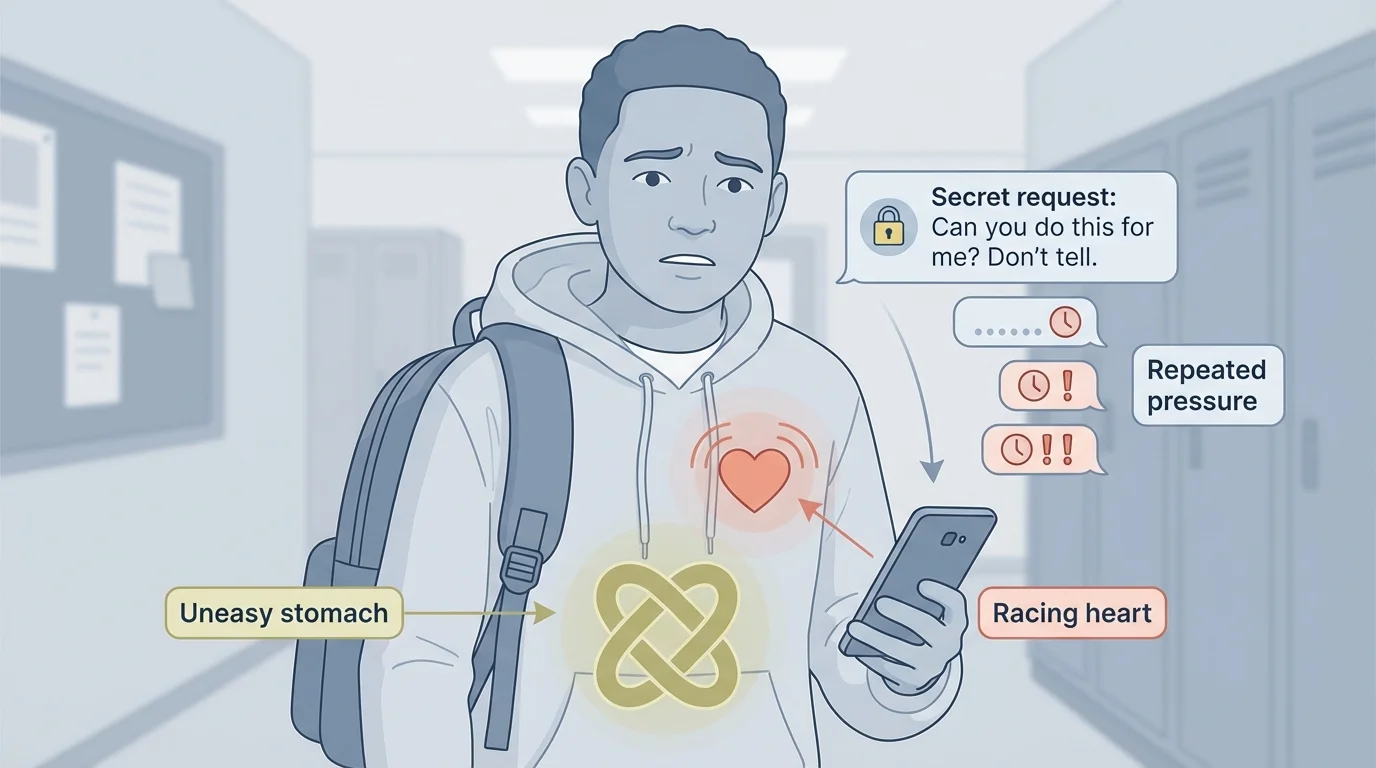
Not every awkward moment is unsafe, but you should still take your discomfort seriously. If something feels wrong, too personal, too fast, too secret, or too pushy, you can act right away. You do not need to wait until a situation becomes worse.
Here are common signs a situation may be unsafe or unhealthy:
Sometimes students think, "Maybe I'm overreacting." But protecting yourself is not overreacting. Your safety matters more than someone else's opinion.
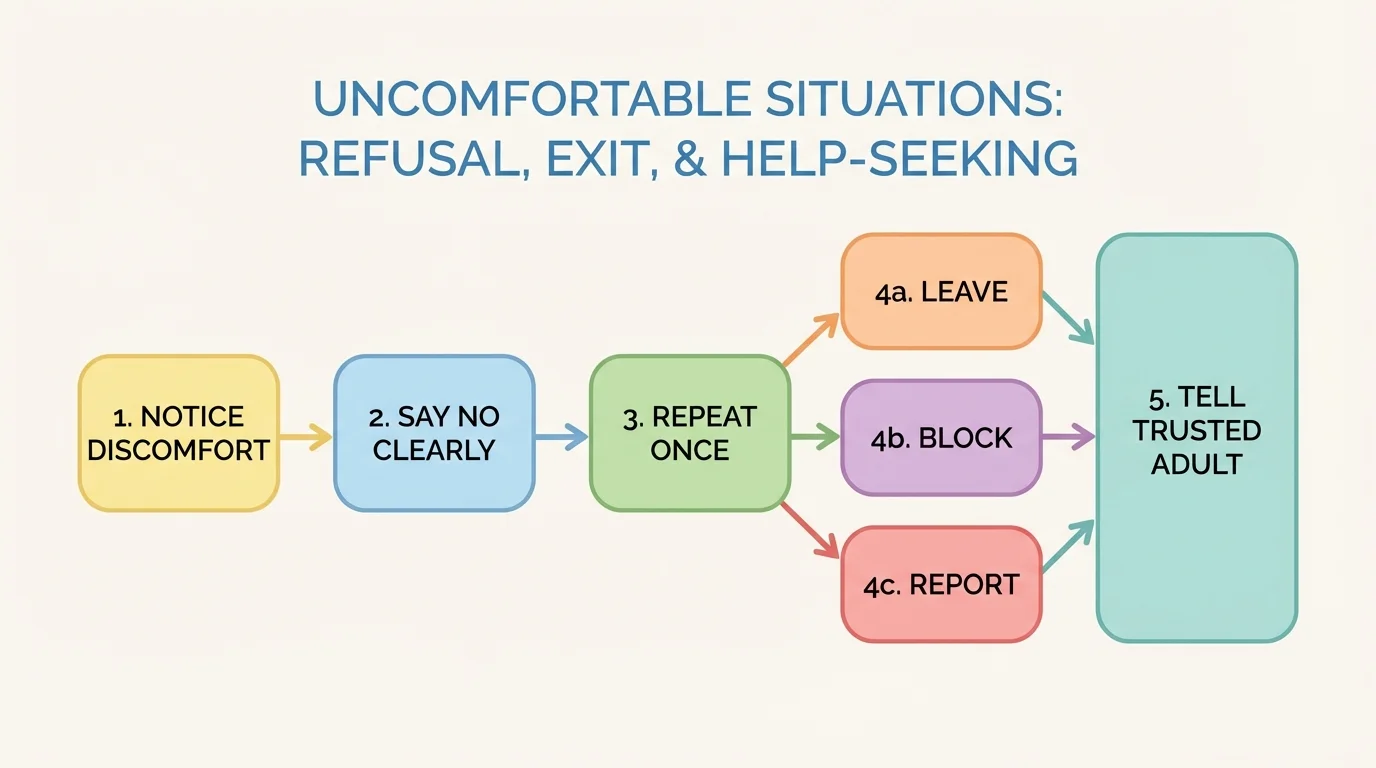
A refusal strategy is a plan for saying no in a way that is clear, firm, and safe, and [Figure 2] lays out one simple path to follow when someone does not respect your first answer. The goal is not to win an argument. The goal is to protect yourself.
The best refusals are usually short. You do not need a long excuse. In fact, too much explaining can give a pushy person more chances to argue. Try clear statements like these:
One useful skill is the broken-record technique. That means you calmly repeat your answer instead of getting pulled into a long back-and-forth. For example: "No." Then, "I already said no." Then, "I'm ending this chat."
Refusal can sound different depending on the situation:
| Situation | Clear refusal |
|---|---|
| Someone asks for a private photo | "No. I do not share pictures like that." |
| Someone wants your password | "No. My accounts are private." |
| Someone keeps joking in a way that bothers you | "Stop. That is not funny to me." |
| Someone wants a hug or touch you do not want | "No thanks. I do not want that." |
| Someone asks you to keep an unsafe secret | "I'm not keeping that secret." |
Table 1. Examples of short refusal statements for different uncomfortable situations.
Your tone can be calm, serious, and firm. You do not need to smile, laugh, or make the other person feel better. If being direct feels unsafe, you can use a shorter line and leave quickly. Safety comes first.
Example: A pushy online chat
A person in a gaming chat keeps asking you to switch to private messages and send a picture.
Step 1: Refuse clearly.
You say, "No. I'm not sending a picture."
Step 2: Repeat once if needed.
When they ask again, you say, "I said no. Stop asking."
Step 3: Exit.
Leave the chat, block the user, and stop replying.
Step 4: Seek help.
Take screenshots if possible and show a trusted adult.
If the person respects your boundary, great. If they do not, that tells you even more clearly that leaving and getting help is the right choice.
An exit strategy is what you do to end the interaction and get to safety. Sometimes refusal is enough. Sometimes you also need to leave, log off, close the app, move to another area, or contact a trusted adult right away.
Exit strategies can be simple. Online, you can stop replying, leave the game or chat, block the account, report the message, turn off the device, or show the screen to a caregiver. In person, you can step away, move toward safe adults or other families, go to a public area, call home, or say you need to check in with your adult and then go.
Here are practical exit lines you can use:
Notice that these lines do not ask for permission. They simply state what you are doing.
Sometimes a quick exit is better than a perfect speech. If you feel unsafe, you do not need to explain. Close the laptop. Walk away. Find your adult. Call someone. Go where other safe people are. If you are online and the person keeps contacting you, save evidence if you can do it safely, then block and report.
Earlier, [Figure 1] showed that discomfort often appears in your body before your mind has fully sorted out what is wrong. That is one reason fast exits can be smart. You do not need to debate with someone when your body is telling you something is off.
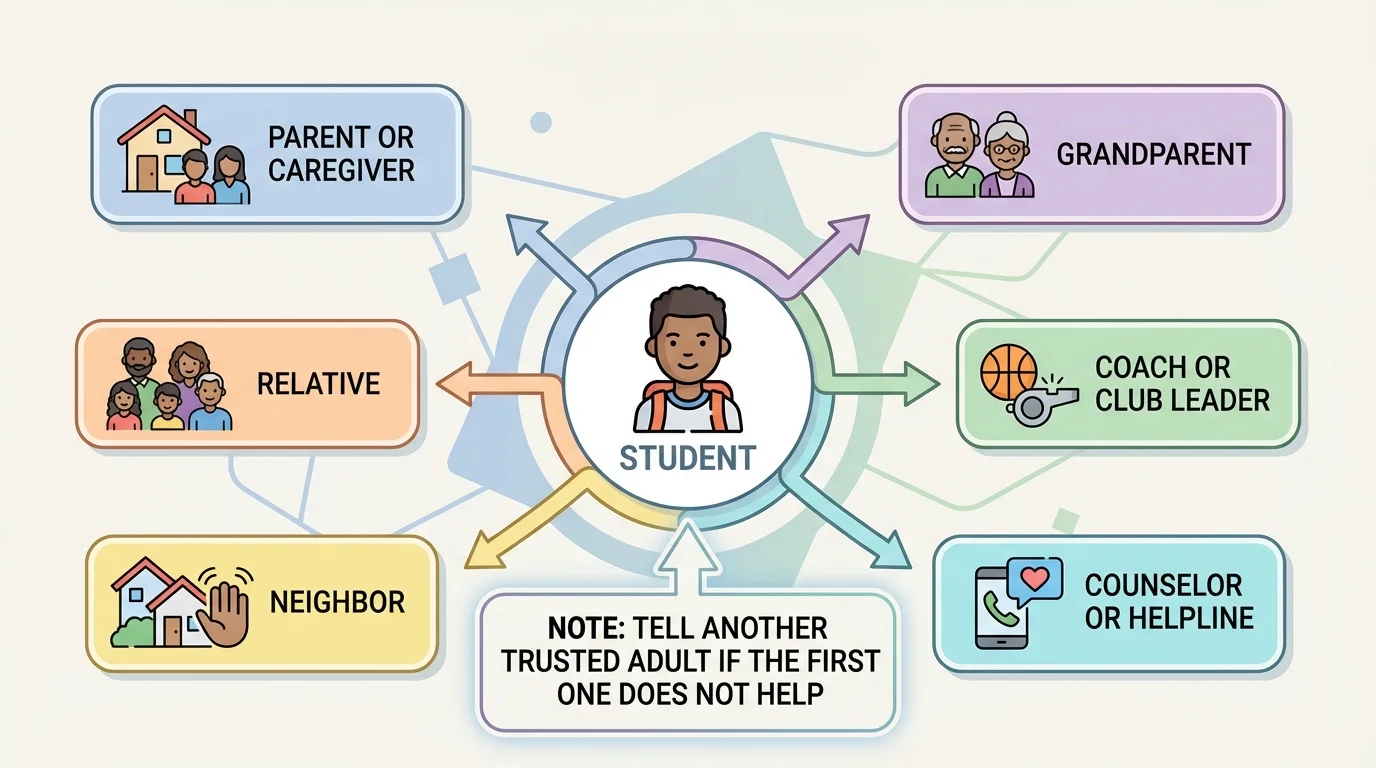
Help-seeking means reaching out to safe people when something feels wrong, and [Figure 3] shows that support can come from more than one trusted adult. You are not tattling when you report pressure, threats, unsafe secrets, unwanted touch, or requests for private pictures or information. You are protecting yourself.
A trusted adult might be a parent, guardian, grandparent, aunt, uncle, older sibling who is an adult, neighbor you know well, coach, club leader, or another caregiver who listens and helps. The key is not just that they are older. The key is that they take your concern seriously and act to help.
When you tell someone, be clear and specific. You can say:
If it happened online, show the messages, usernames, screenshots, or account details if possible. If it happened in person, describe who, what, when, and where as best as you can remember. You do not have to remember everything perfectly to deserve help.
Keep telling until someone helps
Sometimes the first adult you tell may not understand right away. That does not mean your concern is unimportant. Tell another trusted adult. Keep going until someone listens, believes you, and helps make the situation safer.
You might worry that telling will cause drama or get someone in trouble. But unsafe behavior needs adult attention. A safe adult's job is to protect you, not to blame you.
Let's look at a few situations you might actually face.
Situation 1: Private photo request. Someone online says, "If you trust me, send me a picture. Don't tell anyone." This includes pressure, secrecy, and a personal request. Refuse: "No. I'm not sending that." Exit: leave, block, and report. Seek help: show a trusted adult right away.
Situation 2: Repeated jokes that cross a line. A person in a group call keeps making comments about your body, clothes, or appearance after you tell them to stop. Refuse: "Stop. That is not okay." Exit: mute, leave the call, or remove yourself from the chat. Seek help if it continues or if you feel targeted.
Situation 3: Unwanted touch from someone you know. A family friend, neighbor, or relative wants hugs, tickling, sitting too close, or touching that makes you uncomfortable. You can say, "No thanks," "Stop," or "I don't want that." Then move away and tell a trusted adult. Knowing the person does not make the behavior okay.
Situation 4: Pressure to share your location or meet. Someone says, "Tell me where you are," or "Let's meet up, but keep it between us." Say no. Do not share your location. Leave the conversation and tell an adult immediately.
Situation 5: A dare or challenge that feels wrong. A friend or group online pushes you to do something embarrassing, dangerous, or private on video. Refuse clearly. You do not owe anyone proof, screenshots, or content to stay included.
People who use pressure often test small boundaries first. If they can get away with one uncomfortable request, they may try a bigger one next. Saying no early can stop the situation from growing.
As we saw in [Figure 2], the order can be simple: notice, say no, repeat once if needed, leave, and tell. You do not have to do every step perfectly. What matters is protecting yourself and getting support.
This can be one of the hardest parts. Sometimes the person has more power because they are older, more popular, related to you, or in charge of an activity. You might freeze, laugh nervously, or not know what to do in the moment. That reaction is common. Freezing does not mean you agreed.
A person may say things like, "You're so mature," "Don't be a baby," "This is our secret," or "No one will believe you." These are warning signs. They are trying to control the situation.
If someone uses guilt, fear, or threats, remember:
Many unsafe situations involve someone the young person already knows. That is why it is so important to trust your feelings and tell a safe adult, even if you worry others will be surprised.
"A boundary is not a punishment. It is a line that protects your safety and respect."
Your support network matters especially in these situations. If one adult is connected to the person who made you uncomfortable and does not respond well, go to another trusted adult immediately.
A personal safety plan works best when it is written down and easy to use quickly, and [Figure 4] organizes the main pieces in one place. You do not need a complicated plan. You just need one you can remember.
Your plan can include the names of trusted adults, phone numbers you can access, a family code word, apps or accounts you would block, your privacy settings, and the exact words you can use to refuse or exit.
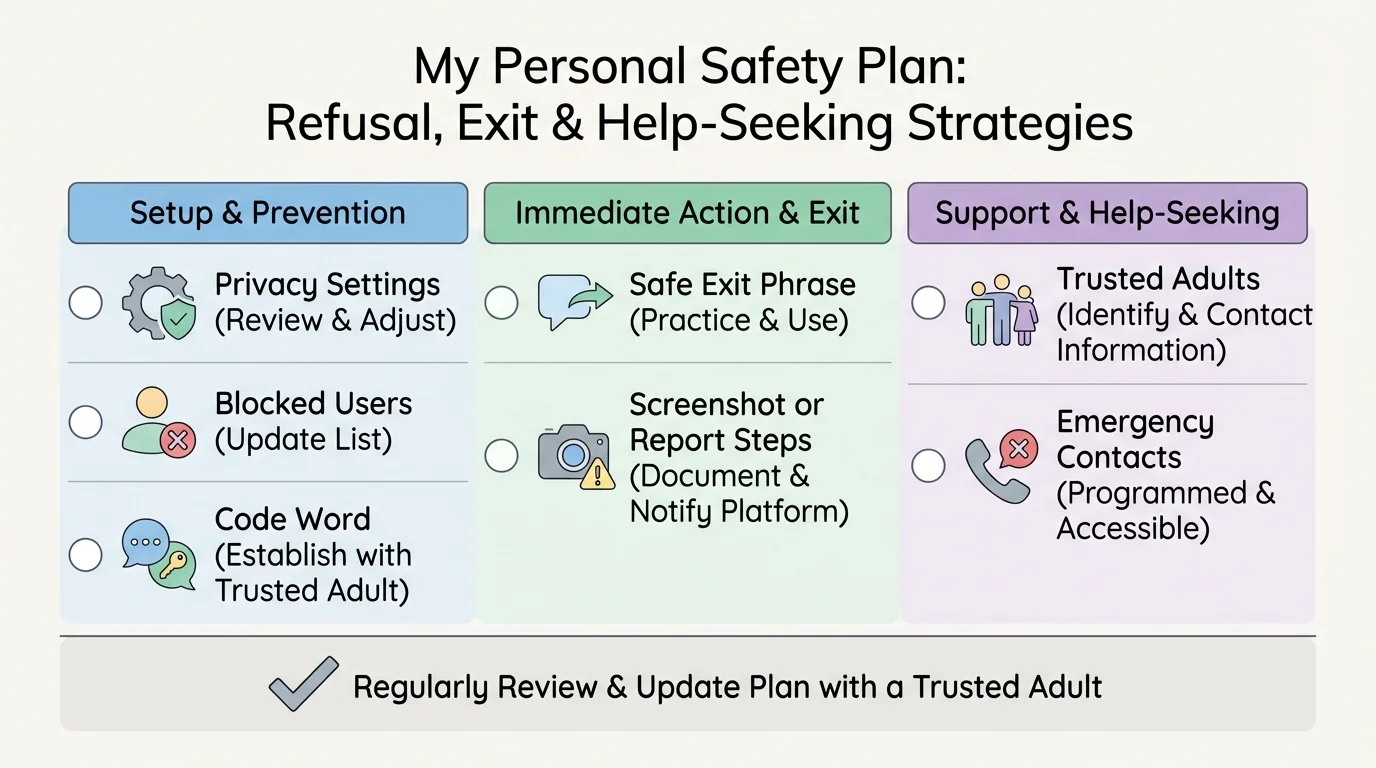
Here is a simple safety plan checklist:
Example: A quick personal safety plan
Step 1: Pick trusted adults.
You choose your caregiver, your grandma, and your soccer coach.
Step 2: Choose your code word.
Your family uses "blue notebook" to mean, "Call me or come get me."
Step 3: Write your phrases.
Refusal phrase: "No. I'm not doing that." Exit phrase: "I need to go now."
Step 4: Practice your tech steps.
You learn how to block a user, report a message, and take a screenshot on your device.
Practicing helps. Saying the words out loud may feel awkward at first, but it makes it easier to use them when you need them.
You have the right to say no to unwanted touch, unsafe secrets, pressure, personal questions, private photo requests, and conversations that cross your boundaries. You have the right to leave. You have the right to ask for help.
You do not have to be polite to someone who is ignoring your safety. You do not have to answer immediately. You do not have to handle serious situations alone. And if something already happened, it is still okay to tell. It is never too late to ask for help.
When you remember one thing, let it be this: if a situation feels uncomfortable, use your voice if you can, leave if you need to, and tell a trusted adult until someone helps. Safety plans work best when they are simple, clear, and ready before a problem happens.
Try This: Write down two refusal lines, two exit lines, and the names of three trusted adults you can contact. Save them somewhere easy to find.
