Have you ever been in a group where one person did everything, one person disappeared, and everyone else got confused? That kind of project usually becomes stressful quickly. But when people work together well, a project can move faster, feel fairer, and even be more fun. Learning how to work with others is not just a school skill. It helps when you plan a family event, join a club, volunteer in your neighborhood, work on a team sport, or help organize something online.
Collaboration means working with other people to reach a shared goal. Leadership means helping a group move in a useful direction. A leader is not just the person who talks the most or gives orders. A real leader helps people stay organized, listens well, solves problems, and encourages everyone to contribute.
These skills matter because very few important things are done alone. Think about making a short video with friends, organizing a pet-supply donation drive, helping plan a community clean-up, or creating a shared presentation online. If people do not communicate well, tasks get repeated, forgotten, or rushed. If people do work well together, the result is usually stronger than what one person could do alone.
Teamwork is people combining their effort, ideas, and skills to complete something together.
Initiative is noticing what needs to be done and taking useful action without waiting to be told every step.
Responsibility means doing your part, being dependable, and owning your choices.
Accountability means being answerable for your actions and following through on promises.
Good teamwork also builds trust. If people know you will show up, answer messages, and finish your part, they are more likely to trust you with bigger jobs later. That matters now and in the future. Whether you join a teen advisory group, volunteer at a community event, or someday work at a job, people remember who is reliable.
Strong groups usually have a few things in common. First, they know their goal. Second, they understand who is doing what. Third, they keep communicating as the work moves forward. Fourth, they solve problems without blaming people right away.
You do not have to be the oldest or loudest person in a group to show leadership. You can lead by asking, "What is our next step?" You can lead by making a checklist, inviting quieter people to share ideas, or noticing that someone needs help. Leadership often looks calm, steady, and helpful.
Leadership is action, not a title. In many projects, different people lead at different times. One person may be best at planning, another at creating, another at checking details, and another at encouraging the group when energy drops. Good teams allow leadership to be shared in useful ways.
At the same time, collaboration does not mean everyone does exactly the same amount of the same task. Fair teamwork means people contribute in ways that match the plan and their strengths. One student may design slides, another may research, another may edit, and another may manage the timeline. Fair does not always mean identical.
A lot of group problems begin before the work even starts. People are excited, they rush in, and nobody stops to plan. A simple structure, as shown in [Figure 1], helps everyone know the goal, the tasks, the deadlines, and who is responsible for each part.
Start by making the goal clear. If your group is creating a video about recycling, "finish the project" is too vague. A better goal is: create a two-minute video with three recycling tips, record it by Friday, and edit it by Sunday. Clear goals make it easier to divide the work.
Next, list all the tasks. For a video project, tasks might include writing the script, gathering facts, recording clips, editing, making a title screen, and checking the final version. When tasks are visible, the project feels more manageable.
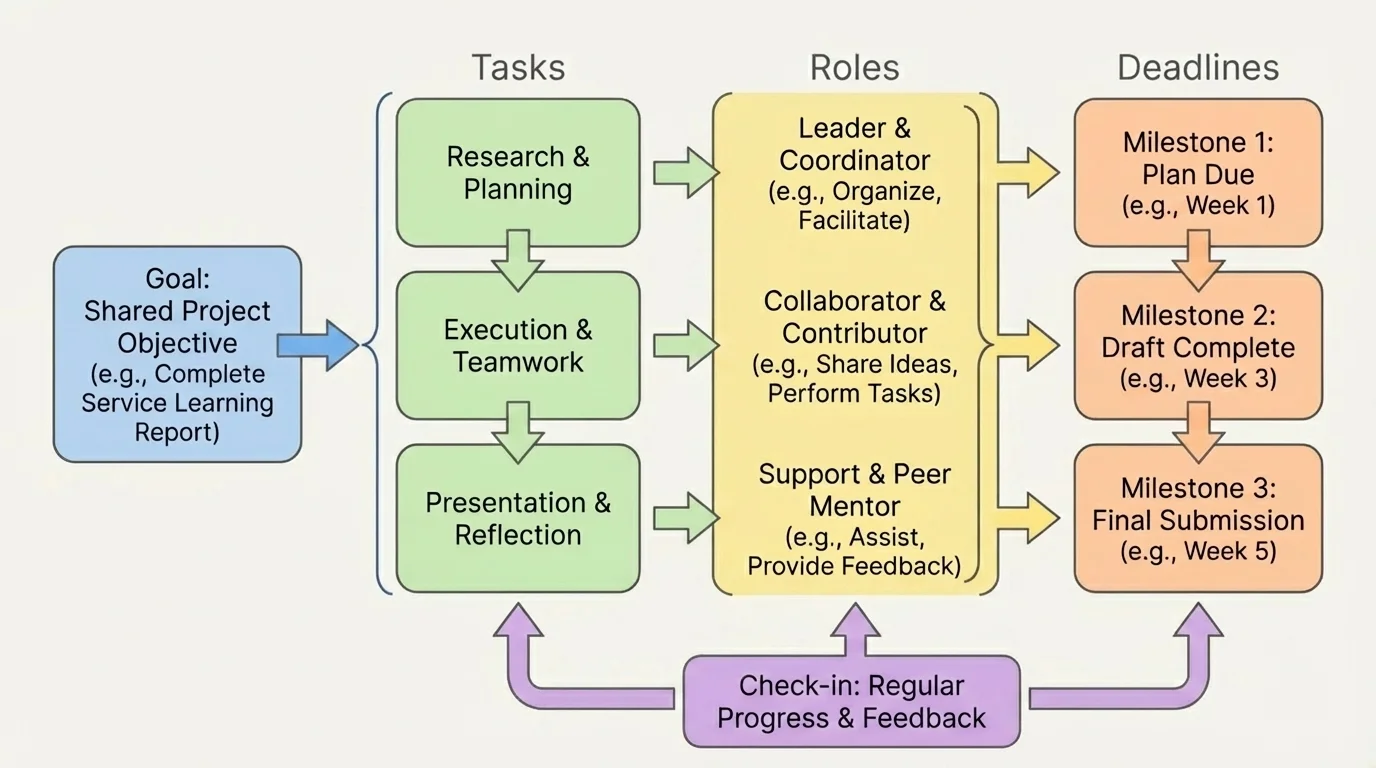
Then assign roles. A role is the job or responsibility a person has in the group. Roles can be simple: organizer, researcher, designer, editor, speaker, timekeeper, or checker. You can have more than one role, but every task should clearly belong to someone.
After that, set deadlines. Big projects become easier when broken into smaller parts. If a project is due in one week, do not plan to do everything on the last day. You might set one deadline for research, one for a rough draft, one for editing, and one for the final check. This is basic time management: using time in a smart way so you are not rushed later.
A team check-in is also important. A check-in can be a short message, a shared document comment, or a quick video call. The point is to ask: What is done? What still needs work? Does anyone need help? Teams that check in early can fix problems before they get bigger.
Example: planning a community pet-supply drive
Step 1: Set the goal.
The team decides to collect pet food, blankets, and toys for a local shelter over two weeks.
Step 2: Break the goal into tasks.
The tasks include making a digital flyer, writing a message for neighbors, tracking donations, reminding people about the deadline, and arranging drop-off.
Step 3: Assign roles.
One person designs the flyer, one writes the message, one updates the donation list, and one contacts the shelter.
Step 4: Set check-ins.
The team agrees to send updates every three days in a group chat.
This plan makes the work visible and fair.
Notice how this kind of planning prevents common problems. People know what to do. They know when it should be done. They know who to ask if there is a question. Later, when your team needs to adjust the plan, you can return to the basic structure we saw in [Figure 1].
Many group issues are really communication issues. In online teamwork, tone and clarity matter a lot, as [Figure 2] shows through strong and weak message examples. Since people cannot always hear your voice or see your face, your words need to be clear and respectful.
Helpful communication has a few simple traits. It is clear, polite, honest, and specific. Instead of saying, "I'll do it later," say, "I can finish the first draft by 6:00 tonight." Instead of saying, "This is bad," say, "I think the title needs to be bigger and the facts need one source listed." Specific messages help people act.
Active listening matters too, even online. Active listening means paying close attention, checking that you understood, and responding to the real point. On a call, that may sound like, "So you're saying we should shorten the intro so the video moves faster, right?" In messages, it may look like repeating the plan clearly before moving on.
It also helps to give updates without being chased. If you finish early, say so. If you are behind, say so. Honest updates are not signs of failure. They are signs of maturity. When you hide a problem, the group loses time. When you tell the truth early, the team can adjust.
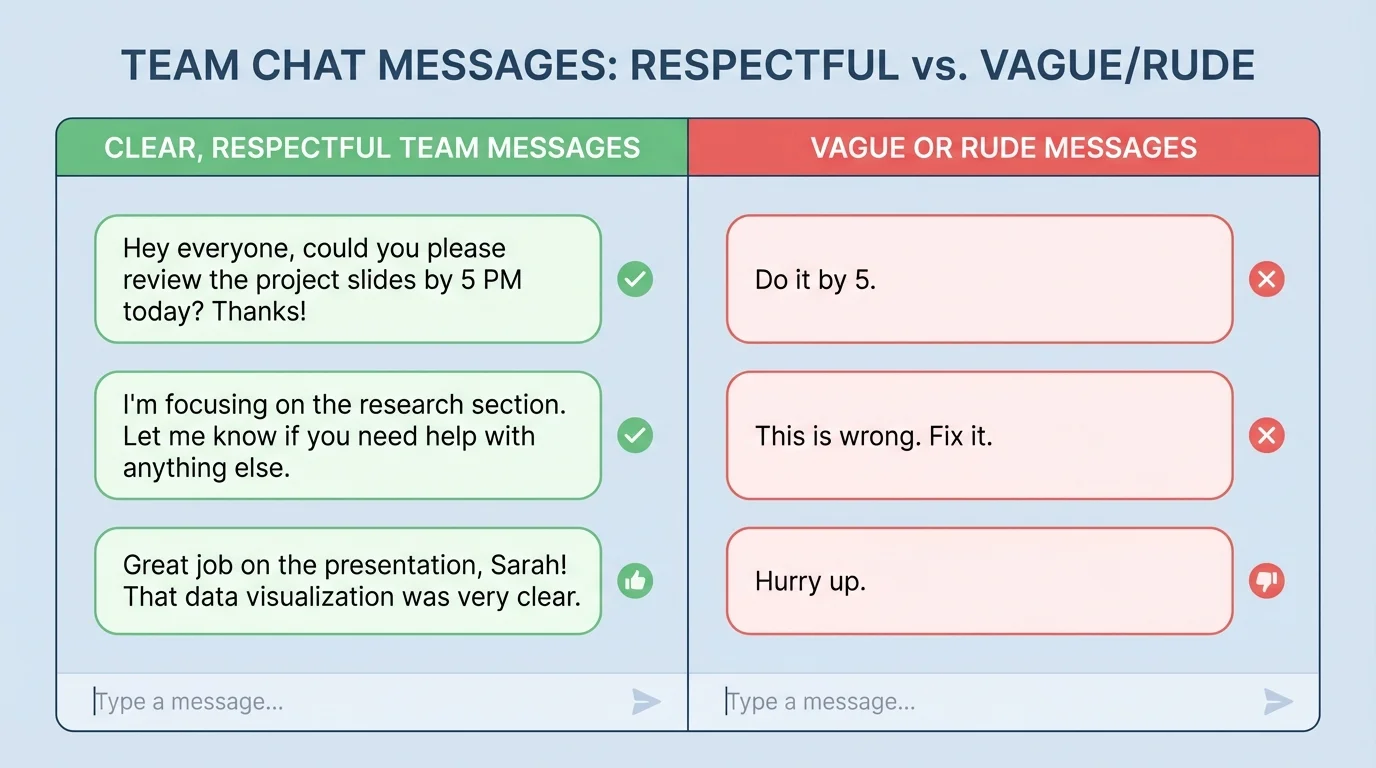
Respectful disagreement is part of teamwork. You do not have to agree with every idea. You do need to disagree kindly. Try sentence starters like, "I see your idea, and I wonder if this option is simpler," or "I agree with part of that, but I think we still need…" This keeps the conversation about the work instead of turning it into a personal attack.
Digital communication also needs care. Read your message before sending it. Short messages can sound rude if they are too sharp. Using full thoughts, greetings when needed, and a calm tone can make a big difference. The contrast we saw in [Figure 2] is not about sounding fancy. It is about making teamwork easier.
Groups often waste more time from confusion than from difficulty. A task may be easy, but if nobody knows who is doing it, the team still gets stuck.
A useful habit is to end group conversations with a quick recap: who is doing what, and by when. That one small step prevents many misunderstandings.
Some people think leadership means telling everyone what to do. Usually, that just frustrates people. Strong leadership is more like guiding, organizing, and serving the team. You help the group succeed, not just yourself.
One powerful leadership skill is noticing what is needed. Maybe the team is stuck choosing between two ideas. A leader might say, "Let's list the pros and cons of each." Maybe one teammate has not spoken. A leader might ask, "What do you think?" Maybe the team forgot the deadline. A leader might post a reminder and suggest a short check-in.
"The best leaders make other people better."
— Leadership principle
Another leadership skill is modeling the behavior you want from others. If you want people to be on time, be on time. If you want people to share updates, share yours. If you want people to stay calm during problems, stay calm yourself. Your actions teach as much as your words.
Leadership also includes making room for others. If you control every choice, the group stops acting like a team. Good leaders ask questions, share credit, and let others use their strengths. That creates a stronger peer support system, where team members help each other succeed instead of competing for attention.
Sometimes leadership means making a decision when the group cannot move forward. In that case, be fair. Listen first, explain your reasoning, and choose the option that best serves the goal, not just your personal favorite.
Even strong groups run into trouble. Someone misses a deadline. Two people disagree. Instructions are unclear. A calm process, like the one in [Figure 3], helps you solve the problem without turning it into drama.
First, notice the real problem. Is the issue that someone is lazy, or is the task confusing? Is the person ignoring messages, or are they overwhelmed? Try not to guess too fast. Ask questions before making accusations.
Second, talk directly and respectfully. You might say, "We noticed the draft wasn't added yet. Are you having trouble with that part?" This sounds very different from, "You never do your work." The first opens a conversation. The second starts a fight.
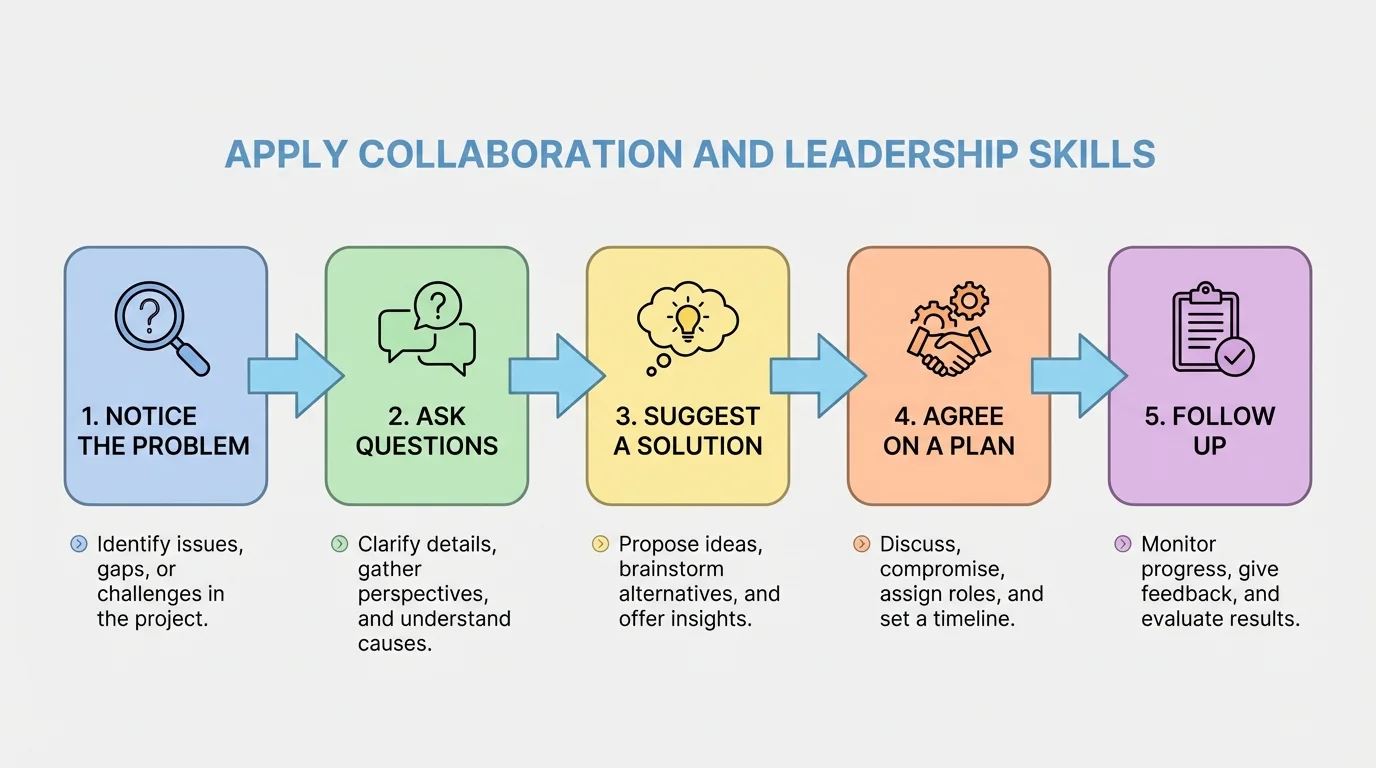
Third, suggest a solution. Maybe the deadline needs to be adjusted. Maybe the task should be split. Maybe someone needs help understanding the instructions. The best solution is usually the one that gets the work moving again while still being fair.
Fourth, agree on the next step and follow up. A solution is only useful if everyone knows what happens next. Write it down in the group chat or shared notes if needed. Later, check whether the plan worked. That follow-up step is one reason the problem-solving sequence in [Figure 3] is so useful.
Example: one teammate stops replying
Step 1: Stay calm.
Do not immediately assume they do not care.
Step 2: Send a clear message.
"We're checking in because the outline is due tonight. Are you able to finish your part, or do you need help?"
Step 3: Make a fair adjustment if needed.
If the teammate is having trouble, split the outline into smaller pieces or move one task to someone else temporarily.
Step 4: Protect the group goal.
If there is still no response, the team should reassign the task so the project can continue.
This approach is kind, but it is also responsible.
Conflict is not always bad. Sometimes disagreement helps the team choose a better idea. The goal is not to avoid all conflict. The goal is to handle it in a respectful, useful way.
These same skills matter in service projects, neighborhood efforts, clubs, and volunteer work. Service projects also need teamwork and leadership, as [Figure 4] illustrates with different people taking different helpful roles. Good intentions are not enough by themselves. A service project still needs planning, communication, and follow-through.
Suppose you and others want to collect books for a local reading center. One person can contact the organization, one can design a digital poster, one can track donations, and one can send reminders. If no one tracks who is doing each part, the project can become messy even though everyone wants to help.
Community work also calls for respect. You are not trying to look impressive. You are trying to meet a real need. That means listening to what people actually need instead of making assumptions. It also means being dependable, especially when other people are counting on your team.
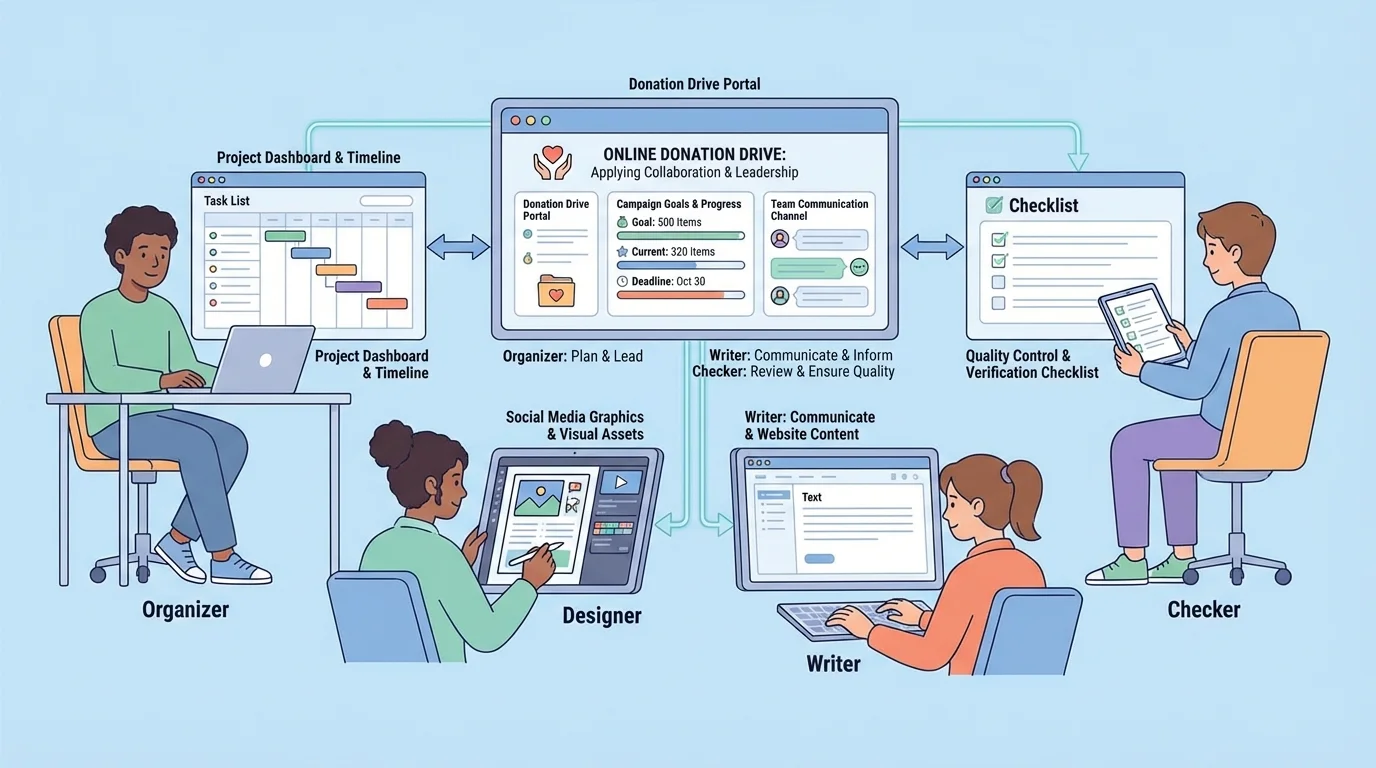
In service settings, leadership often looks quiet. It may mean showing up on time, keeping records organized, noticing missing supplies, thanking volunteers, or checking that instructions are understood. These actions may not be flashy, but they are valuable.
The role-sharing we saw in [Figure 4] works because each person contributes something useful while still staying connected to the group goal. That is how communities get stronger: not from one hero doing everything, but from many people doing their part well.
When you join your next group task, use this simple checklist.
Before you start: know the goal, list the tasks, choose roles, set deadlines, and decide how the group will communicate.
While working: send updates, ask questions early, finish your part on time, and help solve problems without blaming.
At the end: check the final result, make sure all parts fit together, and thank people for their work.
A strong teammate balances independence and cooperation. You should be able to complete your own tasks without constant reminders, but you should also stay connected to the team so your work fits the shared goal.
Here are some practical phrases you can actually use:
Try This: The next time you work with another person, send one clear update before anyone has to ask. That one habit makes you easier to trust.
Try This: If your group is quiet or awkward, ask one organizing question such as, "Who is doing each part?" Simple questions often create leadership.
Try This: If a teammate seems left out, invite them in: "Do you want to take the design part, or would you rather help edit?" Inclusion is a leadership skill too.
You do not become great at collaboration and leadership in one day. You build these skills project by project. Each time you work with others, ask yourself a few honest questions. Did I do my part? Did I communicate clearly? Did I make the group stronger or harder to manage?
Feedback can help too. You might ask a teammate, family member, coach, or group leader, "What is one teamwork skill I already do well, and one I should improve?" That kind of reflection helps you grow faster.
You already use parts of teamwork and leadership in everyday life when you share chores, plan events, help siblings, join activities, or work toward a common goal with others. This lesson builds those same habits in a more intentional way.
Mistakes will happen. Maybe you forget a message, underestimate how long a task will take, or speak too sharply when stressed. The important thing is to notice it, fix it, and improve next time. Responsible people are not perfect. They are honest, willing to learn, and committed to doing better.
When you collaborate well and lead wisely, you help more than just the project. You help build trust, fairness, and community. Those are life skills that matter far beyond any single assignment or event.
