Have you ever seen a group chat where one person keeps sending ideas, one person never replies, and another person suddenly says, "Wait, what are we even doing?" That is a great example of why teams do not succeed just because they have smart people. Teams succeed when people know their jobs, talk clearly, and do what they said they would do.
Whether you are working on an online club project, planning a family event, helping with a community activity, or teaming up in a game, teamwork shows up everywhere. When a team works well, tasks get done faster, people feel respected, and the final result is stronger. When a team works poorly, people get frustrated, deadlines get missed, and trust falls apart.
To assess a team, you should look at three big areas: roles, communication, and accountability. These three areas are connected. If one is weak, the whole team feels it.
Group role means the job or responsibility a person has in a team. Communication is the way people share information, ideas, questions, and feedback. Accountability means being responsible for your part and following through on what you agreed to do.
When you understand these ideas, you can do more than just join a group. You can help the group succeed.
A successful team is not a team with zero problems. It is a team that can handle problems in a healthy way. Good teams adjust. They ask questions early. They notice when something is off and fix it before it becomes a big mess.
A struggling team often has warning signs. Maybe nobody is sure who is doing which task. Maybe messages are too short and confusing. Maybe one person ends up doing most of the work while others stay silent. These are not just annoying habits. They directly affect results.
Think about an online fundraising project. If one person believes they are making the flyer, another thinks someone else is doing it, and no one checks in, the flyer may never get finished. The problem is not talent. The problem is team structure.
In any team, a group role gives a person a clear purpose. As [Figure 1] shows, different roles can connect to one shared goal. When roles are clear, people waste less time guessing and more time doing useful work.
Roles do not have to be fancy. In a group making a video for a community cause, one person might organize the schedule, one might research facts, one might create visuals, one might edit, and one might check that everything is correct. When planning a family birthday celebration, one person might handle invitations, another food, and another decorations.
Clear roles help because they answer important questions: Who starts? Who checks progress? Who finishes the task? Who asks for help if something goes wrong?
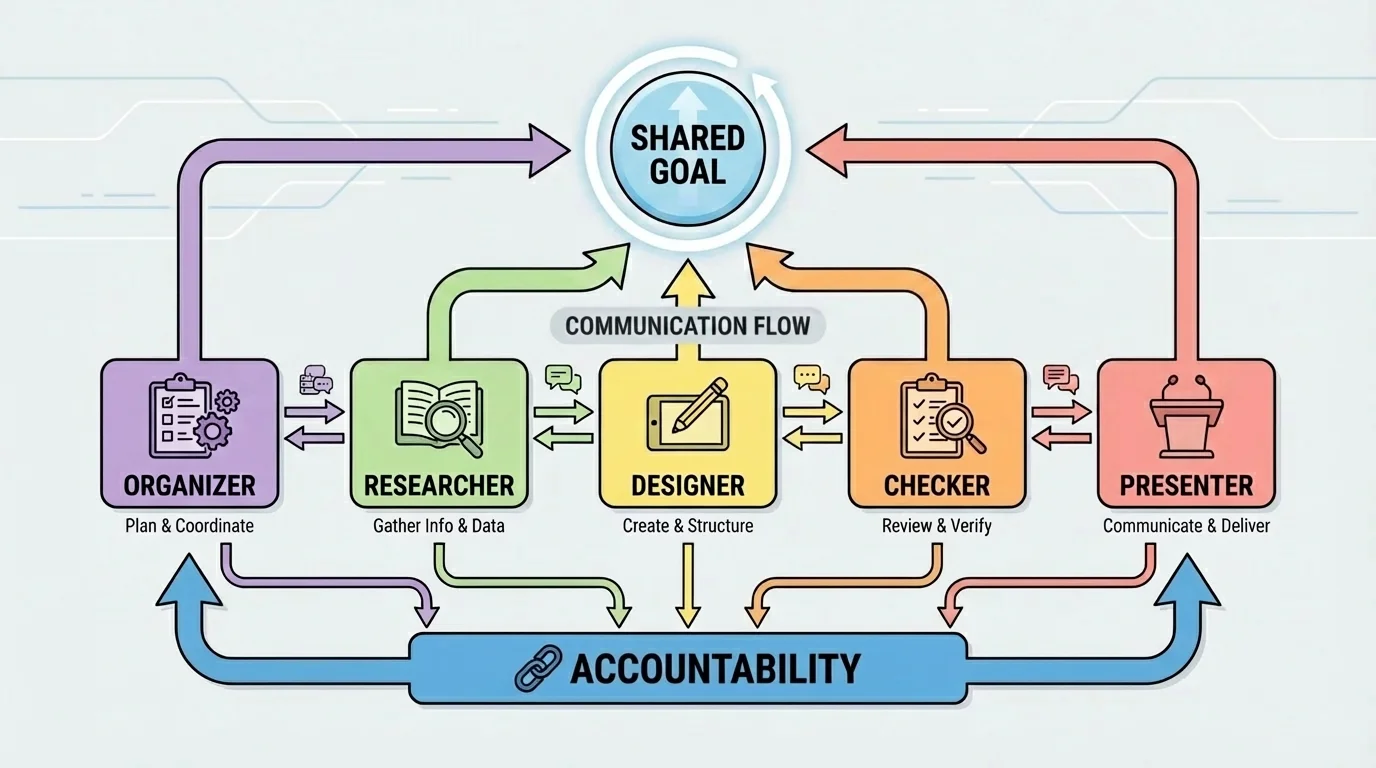
When roles are unclear, teams often run into three problems. First, some jobs get repeated because two people think they are supposed to do the same thing. Second, some jobs get ignored because everyone assumes someone else will do them. Third, people may feel upset because the workload becomes unfair.
Roles should match both the task and the person. If someone is great at keeping track of details, they may be a good reviewer or planner. If someone enjoys speaking, they may be a good presenter. But teams should also stay flexible. A role is not a permanent label. Sometimes people need to switch, share, or support each other.
That flexibility matters. A strong team does not say, "That is not my job," and stop helping. Instead, they say, "My main role is this, but I can also help the team move forward." That is teamwork with initiative.
Real-life role example
A group of three friends wants to create care packages for a local shelter.
Step 1: They divide roles.
Friend A makes a list of needed items. Friend B contacts people who may donate supplies. Friend C packs and labels the bags.
Step 2: They check whether the roles cover the whole job.
They notice no one is tracking dates, so Friend A also keeps a shared deadline list.
Step 3: They stay flexible.
When Friend B gets fewer replies than expected, Friend C helps by sharing the request online.
The team succeeds because each person knows their role, but they also help each other when needed.
You can assess roles by asking: Are the jobs clear? Are the roles balanced? Do the roles match the team's needs? If the answer is yes, the team has a much better chance of success.
Communication is more than talking. It includes listening, asking questions, giving updates, and making sure everyone understands the same plan. In online teamwork, this matters even more because people cannot always see facial expressions or hear tone clearly. As [Figure 2] illustrates, a clear message saves time, while a vague one creates confusion.
Good communication is usually simple. It says what needs to be done, who is doing it, and when it should be finished. For example, "I will make the title slide by Tuesday evening" is much clearer than "I'll work on it later."
Listening is also part of communication. If one teammate says they are confused and everyone ignores it, the team may keep moving in the wrong direction. Strong teams make space for questions. They do not treat questions as a problem. They treat them as a way to avoid bigger mistakes.
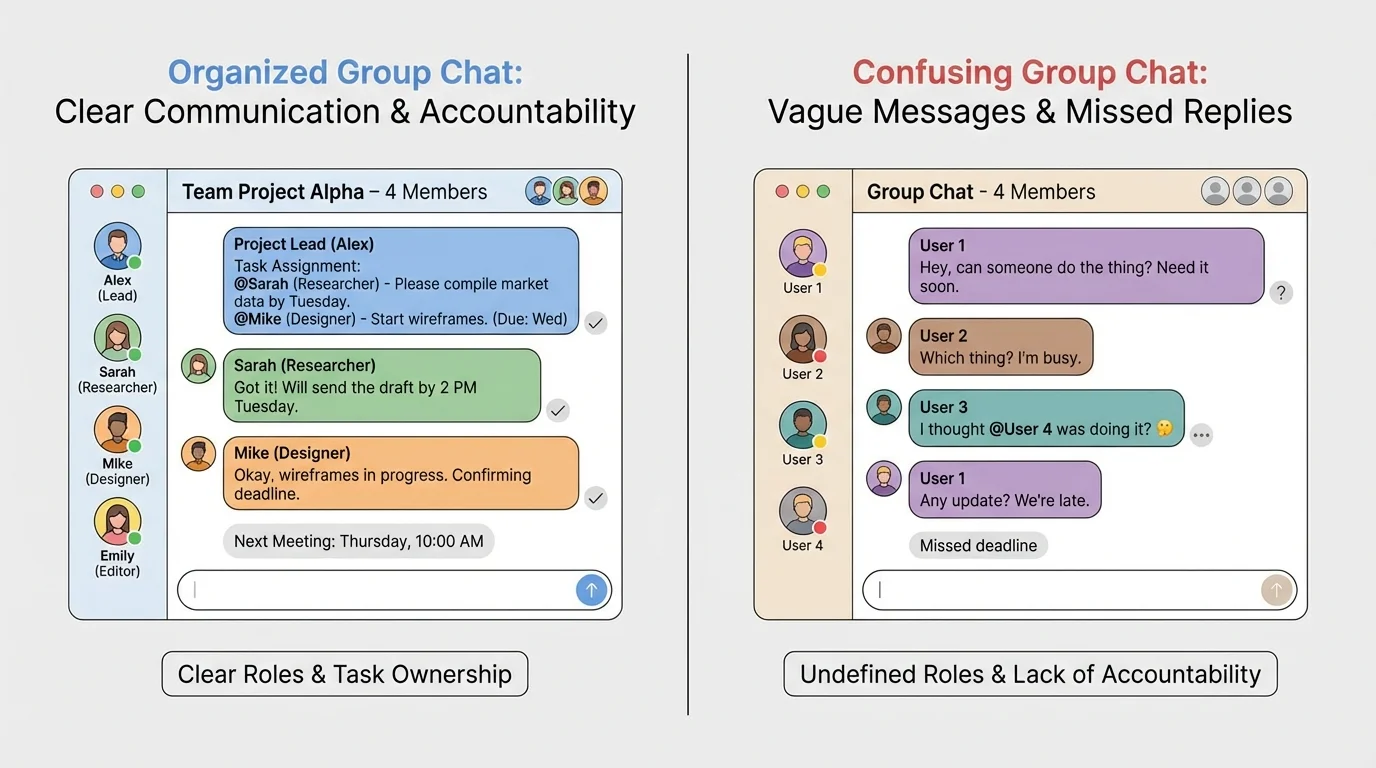
Tone matters too. A short message like "Do it again" can sound rude or angry, even if the writer did not mean it that way. A better message might be, "Can you revise this part? I think we need clearer examples." Respectful wording helps people stay open instead of becoming defensive.
Timing matters as well. If you wait until the last minute to tell the team you are stuck, the whole group may lose time. Early updates give the team choices. They can help you, adjust the deadline, or divide the work differently.
One useful habit is the "check-back." After the team makes a plan, one person quickly repeats it in clear words: "Just to confirm, Maya is making the poster, Eli is checking facts, and I am uploading the final version by Friday." This lowers confusion because everyone hears the same plan.
What clear communication does
Clear communication reduces guessing. It helps people know the goal, the next step, and the current problem. It also builds trust, because teammates can see that information is being shared honestly and on time.
You can often tell a team's future by how it communicates. A team with clear updates, respectful feedback, and active listening can recover from mistakes. A team with silence, mixed messages, or rude comments usually struggles even if the members are talented.
Later, when you compare successful and unsuccessful teams, [Figure 2] still matters because it shows how small message choices can change the whole flow of work.
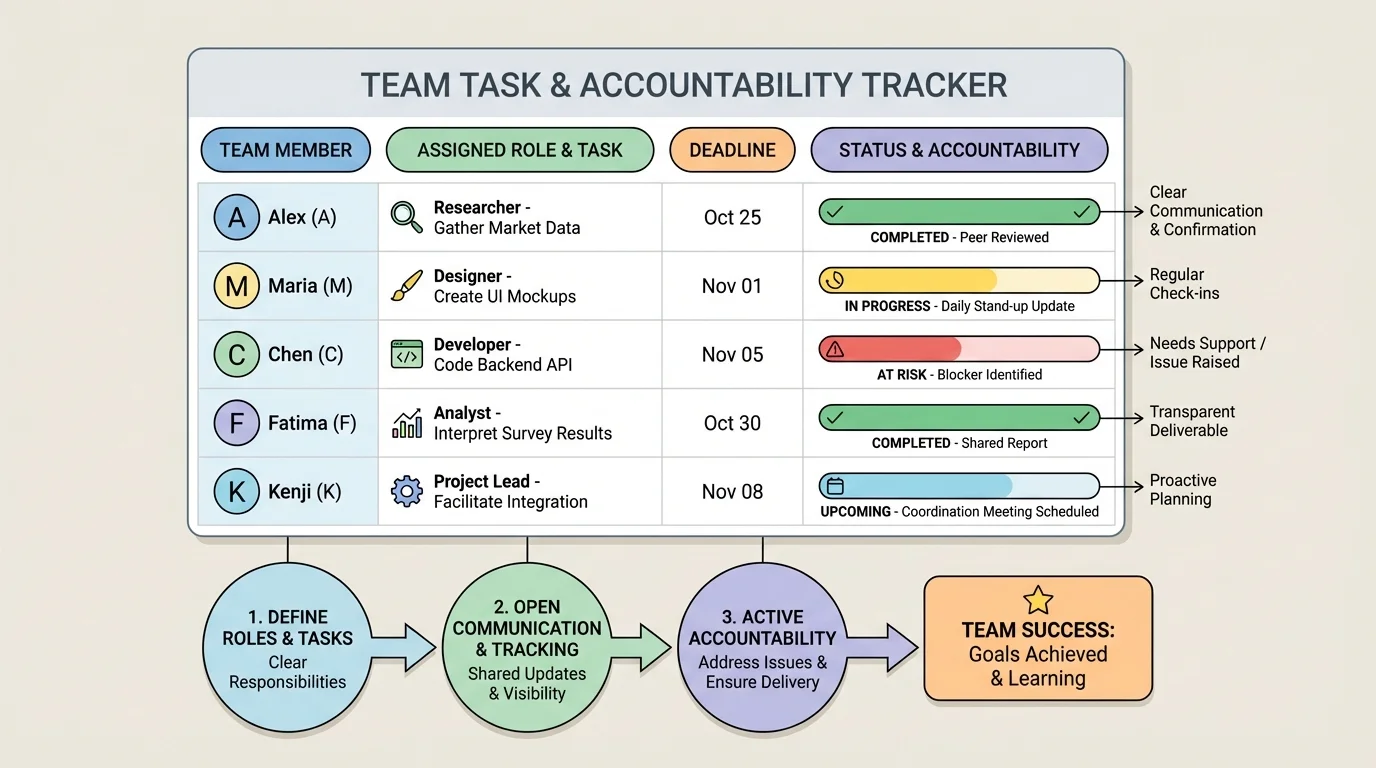
Accountability means each person owns their part of the work. A team works better when jobs, deadlines, and progress are visible. Accountability is not about blaming people. It is about making sure promises turn into action.
As [Figure 3] shows, when people are accountable, they do what they said they would do, or they speak up early if they cannot. This helps the team plan around real information instead of false hope.
Without accountability, trust weakens fast. If one person keeps missing deadlines without warning, other teammates may feel they have to carry extra work. That can lead to resentment. Soon, the team is not just working on the project anymore. It is dealing with frustration too.
Accountability also includes self-checking. Before a deadline, ask yourself: Did I finish my part? Did I do it carefully? Did I tell the team my progress? Did I ask for help soon enough if I was stuck?
Some teams use a simple tracker. It can list each task, the person responsible, the due date, and whether the task is started, in progress, or done. You do not need anything complicated. A shared note or simple chart can work well.
| Team habit | What it looks like | Effect on success |
|---|---|---|
| Clear role ownership | Each person knows their task | Less confusion |
| Regular updates | People report progress honestly | Fewer surprises |
| On-time follow-through | Tasks are completed by the agreed deadline | More trust |
| Early problem alerts | People speak up when stuck | Faster solutions |
Table 1. Habits that strengthen accountability and improve team success.
A team can be friendly and still fail if no one is accountable. Kindness matters, but teamwork also needs reliability.
Many successful groups in sports, business, and community work use short check-ins more often than long meetings. A quick update can prevent a much bigger problem later.
You can assess accountability by asking: Do people follow through? Do they warn the team when plans change? Can the team depend on each member?
These three parts of teamwork are strongest when they support each other. Roles answer, "Who is doing what?" Communication answers, "What is happening right now?" Accountability answers, "Did each person actually do their part?"
If a team has roles but poor communication, people may still misunderstand the plan. If a team communicates well but roles are unclear, members may talk a lot without making progress. If a team has roles and communication but no accountability, good plans still fall apart because people do not follow through.
You can think of it like a three-part system. Remove one part, and the system weakens. A team needs direction, shared information, and responsibility at the same time.
This is why strong teams often seem calm even when they are busy. People know their jobs, they keep each other informed, and they trust each other to get things done.
One common problem is conflict. Conflict is a disagreement, and it is not always bad. Sometimes it helps a team improve. The key question is whether the disagreement stays respectful and focused on the problem instead of turning personal.
If two teammates disagree about how to complete a project, they can compare ideas using the team goal. Which choice fits the deadline? Which choice is clearer for the audience? This keeps the discussion useful.
Another common problem is silence. Maybe one person is shy, unsure, or worried about saying the wrong thing. Teams should make it easier for people to join in. A leader might ask, "What do you think?" or "Do you see any problem we missed?" That small invitation can change the conversation.
Another issue is uneven work. If one person is doing much more than others, the team should not just hope it gets better. They should pause, list the tasks, and rebalance them. Sometimes the issue is laziness, but sometimes it is confusion. Assessment means looking for the real cause.
Problem-solving example
A four-person team is making a short online presentation about pet adoption.
Step 1: Notice the problem.
Two people have finished their parts, one person is half done, and one person has not replied for two days.
Step 2: Communicate clearly.
A teammate sends a respectful message: "We need to upload the final version tomorrow. Can you update us on your part by tonight?"
Step 3: Adjust roles if needed.
If that teammate cannot finish, the group divides the missing work into smaller parts.
Step 4: Increase accountability next time.
For the next project, they set a mid-project check-in instead of waiting until the end.
The team improves because they fix the process, not just the immediate problem.
Missed deadlines, repeated confusion, and unfair workloads are clues. They tell you where the team system needs repair.
You do not need to wait for a perfect team. You can help create one. Start with a few practical habits that work in real life.
Step 1: Make the goal clear. Everyone should be able to explain what the team is trying to do.
Step 2: Divide the work. Give each person a specific job.
Step 3: Set mini-deadlines. A large task feels easier when broken into smaller parts.
Step 4: Use clear updates. Say what you finished, what you are doing next, and whether you need help.
Step 5: Check progress before the final deadline. This catches problems early.
Step 6: Be honest. If you are behind, say so quickly so the team can adjust.
Step 7: Reflect after the task. Ask what worked well and what should change next time.
Try This: The next time you work with others, send one message that includes all three parts: your task, your timeline, and your question if you have one.
Try This: Before your team starts, ask, "Who is doing what, and when should we check in?" That one question can prevent a lot of confusion.
Initiative means taking helpful action without waiting to be told every step. In a team, initiative might look like organizing the first meeting, writing a shared task list, or noticing a missing job and offering to help.
Leadership is not the same as controlling everyone. A strong leader helps the group stay focused, listens to others, and supports fair teamwork. Good leaders do not grab all the power. They make it easier for everyone to contribute.
Sometimes leadership changes depending on the moment. One person may lead planning, while another leads the final editing. That can be healthy because it uses different strengths.
As you saw earlier in [Figure 1], strong teams use roles well, but leadership helps those roles stay organized and connected.
"Teamwork begins with trust, and trust grows when people do what they say they will do."
If you want to stand out as a helpful teammate, be the person who brings order, clarity, and follow-through. Those qualities matter in schoolwork, community projects, jobs, and everyday life.
Think about a gaming team trying to complete a challenge. If one player rushes ahead, one does not share useful information, and another ignores the plan, the team may lose even if each player is skilled. But when roles are shared, communication is quick and clear, and everyone follows the strategy, the team performs much better.
Or think about siblings planning a family dinner. If one shops, one cooks, and one sets up, the event can go smoothly. But if nobody confirms the plan, two people may buy the same item while something important is forgotten. Again, the issue is not effort alone. It is coordination.
Community groups show this too. A neighborhood cleanup works best when volunteers know where to go, how long to stay, what supplies are needed, and who is checking progress. Reliable teams get more done and create a better experience for everyone involved.
When you assess team success, do not just ask, "Did they finish?" Also ask, "How did they work together?" A team that finishes while one person does everything is not as healthy or sustainable as a team that shares work fairly and communicates well.
That is the real goal of teamwork: not just finishing a task, but building a way of working that people can trust and repeat.
