Your choices build your reputation even when nobody is grading them. A single message, a quick comment in a group chat, or a decision to hide the truth can change whether people trust you. Ethical choices are not only about big, dramatic moments. They happen in ordinary situations: finishing your own work, giving credit in a shared project, telling the truth after breaking something, or deciding whether to go along with a friend who wants you to cover for them.
When you make a strong ethical choice, you protect something valuable: trust. Trust helps families work better, friendships feel safer, teams cooperate, and communities solve problems. When honesty and fairness are missing, people become unsure of each other. That can lead to arguments, hurt feelings, lost opportunities, and damage that takes a long time to repair.
For students learning online, ethical choices matter in digital spaces too. You may work independently, join video calls, message others, play games online, or take part in clubs, sports teams, faith groups, or neighborhood activities. In all of these places, your character travels with you. People notice whether you tell the truth, treat others fairly, and stay steady when others pressure you.
Ethics means thinking about what is right, responsible, and respectful. An ethical choice is a decision that matches strong values, even when the easier option is tempting.
One important truth is that a choice can feel small in the moment but still have a big effect later. A lie might seem like a shortcut. Going along with a group might seem easier than speaking up. But repeated choices shape your habits, and habits shape your character.
Three ideas often work together when you assess a choice: honesty, fairness, and peer influence. These ideas connect in everyday decisions, as [Figure 1] illustrates. For example, if a friend asks you to say they completed their part of a project when they did not, honesty and fairness are both involved, and peer influence is pushing on your decision.
Honesty means being truthful in words and actions. It includes not cheating, not hiding important facts, and not pretending you did something you did not do. Fairness means treating people justly and giving people what they deserve, not always treating everyone exactly the same. Peer influence is the effect other people have on your thoughts and choices, whether that influence is helpful or harmful.
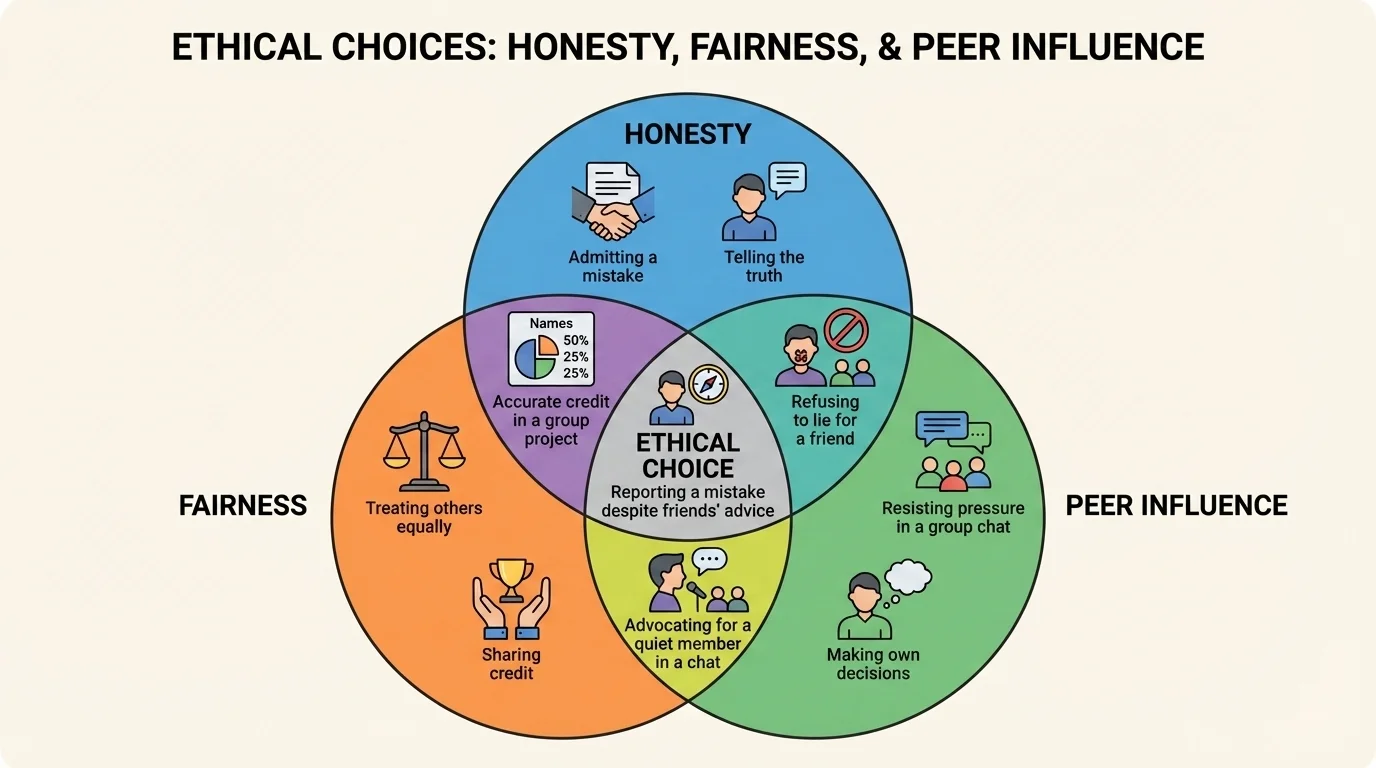
These three ideas overlap a lot. A fair choice is often honest. An honest choice often resists unhealthy pressure. And good friends can positively influence you to do the right thing. The goal is not to ignore other people. The goal is to think for yourself and choose what is right.
People often feel stronger pressure to make a poor choice when they think "everyone else is doing it," even if that is not actually true. Slowing down and checking the facts can break that pressure.
That is why ethical thinking is a skill. You can practice it, get better at it, and use it in real life.
Integrity means doing what is right even when it would be easier to hide the truth. Honesty is a major part of integrity. Honest people do not just avoid lying; they also avoid misleading others.
Here are common situations where honesty matters:
Sometimes honesty feels risky because you may worry about getting in trouble or disappointing someone. But dishonesty usually creates a bigger problem. First there is the original mistake. Then there is the lie, excuse, or cover-up. That can damage trust more than the first mistake did.
Suppose you forgot to finish your part of a shared online presentation. A dishonest response would be saying, "The file disappeared," when that is not true. An honest response would be, "I didn't manage my time well, and my part is not finished. I'm sorry. I can finish it by tonight." The honest response may feel uncomfortable, but it gives others real information and shows responsibility.
Case study: Honest mistake, honest repair
You accidentally delete a shared document that your club was using.
Step 1: Tell the truth quickly.
Say what happened without blaming someone else: "I deleted the shared file by mistake."
Step 2: Acknowledge the effect.
Show that you understand the impact: "I know this slowed everyone down."
Step 3: Offer a repair.
Take action: "I'm checking the recycle folder and message history, and I can help rebuild the missing parts."
Step 4: Change the habit.
Prevent the problem next time: "I'll make a backup copy before editing shared files."
This response builds trust because honesty is matched with action.
Honesty does not mean saying every thought in a rude way. You can be truthful and kind at the same time. Instead of saying, "Your idea is bad," you can say, "I don't think this plan will work well because we may run out of time." Honest words should still show respect.
Bias can make fairness harder. Bias means leaning toward one person or side in a way that is not fully just. Sometimes people are unfair without noticing it. They may give more chances to a friend, ignore another person's effort, or judge someone too quickly.
Fairness is not always identical treatment. If two people do different amounts of work, fairness may mean different amounts of credit. If one person needs extra help understanding instructions, fairness may mean giving support so everyone has a real chance to succeed.
Here are signs of a fair choice:
Think about a neighborhood sports team choosing who starts in a game. A fair process could include effort, attendance, attitude, and skill. An unfair process would be choosing only close friends no matter what. Fairness helps people feel respected, even if they do not get everything they want.
| Situation | Unfair Response | Fair Response |
|---|---|---|
| Shared project | One person gets all the credit | Credit matches each person's actual work |
| Disagreement online | Assume one side is right without listening | Hear both sides before deciding |
| Team activity | Pick only friends | Use clear reasons and consistent rules |
| Household chore mix-up | Blame the youngest automatically | Check facts before deciding responsibility |
Table 1. Examples comparing unfair and fair responses in everyday situations.
Later, when you think about the overlap among these values, [Figure 1] remains useful: many unfair actions are also dishonest, and many are encouraged by social pressure.
"Character is what you do when no one is watching."
— Common saying
Fairness also includes fairness toward yourself. Do not let others use guilt or pressure to make you carry their work, break your rules, or ignore your own values.
Peer pressure is one form of peer influence. It happens when people try to push you toward a choice, directly or indirectly. Sometimes they say it out loud: "Just tell them I was there." Sometimes it is silent pressure: everyone in the group chat is laughing at someone, and you feel pushed to join in.
Not all peer influence is bad. Friends can influence you in healthy ways by encouraging honesty, kindness, effort, or courage. A good friend might say, "You should tell the truth," or "Let's include them," or "We should give credit to the person who made the design." Positive influence helps you become stronger, not weaker.
Unhealthy peer influence often sounds like this:
These phrases are powerful because they try to make a wrong choice feel normal, harmless, or necessary for belonging. But belonging that depends on dishonesty or unfairness is not real respect.
Why pressure works
People naturally want acceptance. That is normal. The problem begins when the desire to fit in becomes stronger than your values. Recognizing that feeling gives you power. When you can name the pressure, you are less likely to obey it automatically.
A useful warning sign is this question: Would I make the same choice if I were alone? If the answer is no, peer influence may be steering you away from your best judgment.
When a choice feels confusing, use a quick ethical check. The decision path in [Figure 2] shows the order of questions that can help you slow down and think clearly before you act. This process is simple enough to use in a text thread, during a call, or when someone wants an answer right away.
Step 1: Ask, "Is it true?" If the action requires lying, hiding key facts, or pretending, that is a major warning sign.
Step 2: Ask, "Is it fair?" Think about who gains, who loses, and whether the same rule would make sense for everyone.
Step 3: Ask, "Who could be harmed?" Harm can include embarrassment, stress, loss of trust, exclusion, extra work, or damage to someone's reputation.
Step 4: Ask, "Am I being pressured?" Notice guilt, teasing, fear of being left out, or pressure to rush.
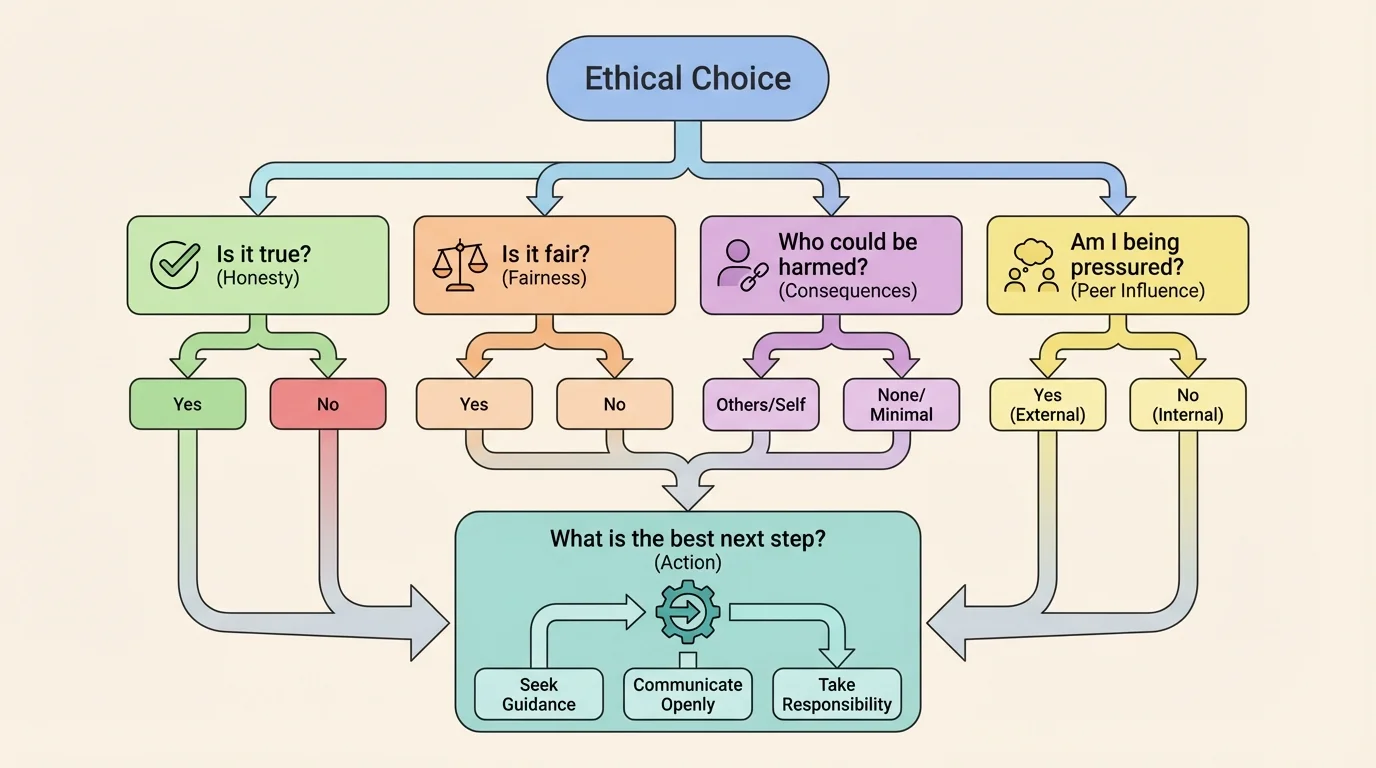
Step 5: Ask, "What choice could I explain proudly later?" This is a powerful test. If you would feel embarrassed explaining your decision to a trusted adult or future version of yourself, pause.
Step 6: Choose an action. You might say no, tell the truth, ask for time to think, get help from a trusted adult, or suggest a better option.
Short responses can help when pressure is high:
As you keep practicing, the steps in [Figure 2] become faster and more natural. Ethical decision-making is not about having perfect words every time. It is about building a reliable pattern of choosing what is right.
You already use decision-making skills in daily life when you compare options, think about consequences, and make plans. Ethical thinking adds values to that process: truth, fairness, respect, and responsibility.
If you are unsure, it is wise to pause instead of pretending to be certain. Time can lower pressure and help you see the situation more clearly.
Real choices can feel messy because more than one value is involved. The scenes in [Figure 3] show how peer influence can push in two different directions: toward dishonesty or toward a stronger choice. Looking at realistic situations helps you practice what to notice.
Scenario 1: A friend messages you and says, "Tell the group leader I was at the volunteer meeting. I had other stuff to do." This choice fails the honesty test because it asks you to lie. It also fails the fairness test because others gave their time honestly. A strong response is: "I can't say you were there if you weren't. You should message them yourself."
Scenario 2: In a gaming chat, several players start making fun of one person after a mistake. You feel pressure to join so you do not look different. Fairness means not piling on. Honesty also matters if you know the jokes are mean, not harmless. A strong response might be to stay out of it, change the subject, or message support to the person being targeted.
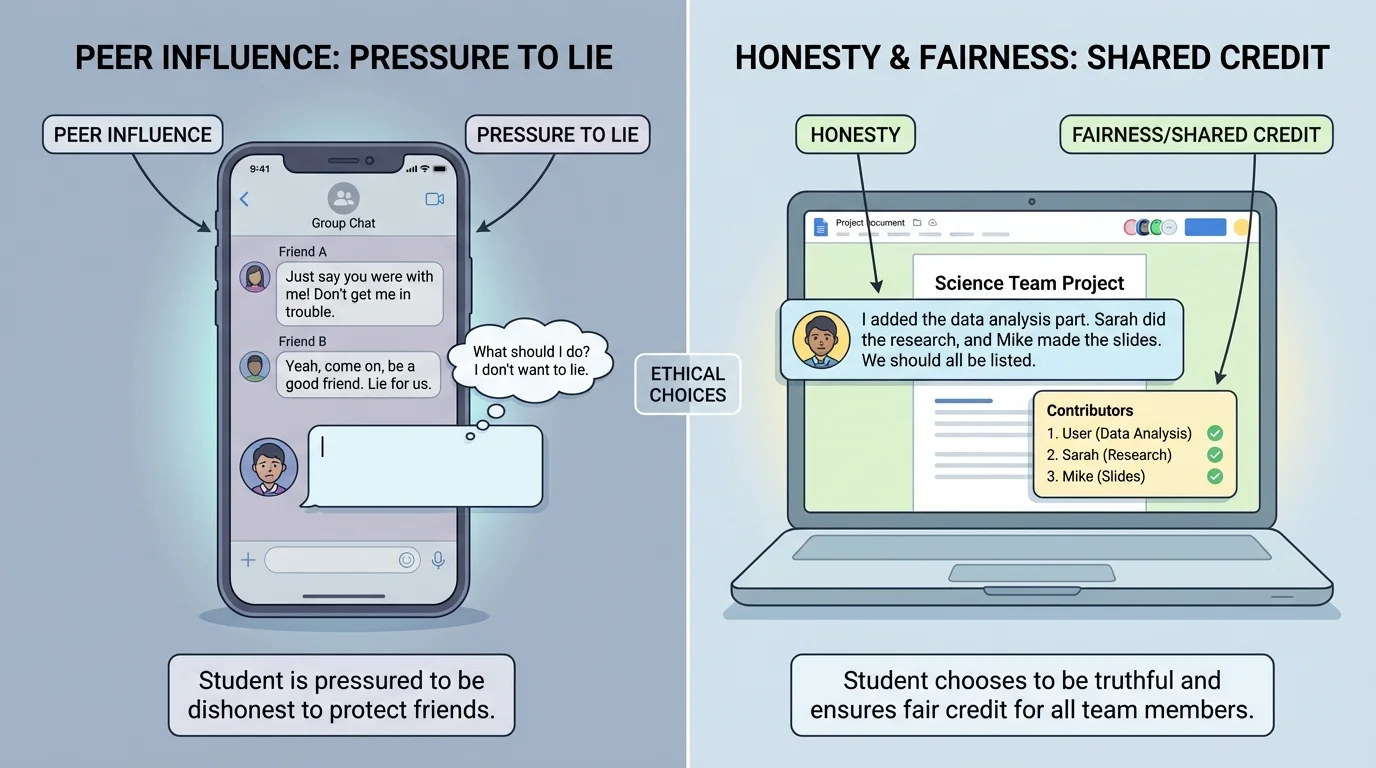
Scenario 3: During an online team project, one teammate did most of the design work, but another person wants everyone to say the work was "equal." Fairness means credit should match effort. You can say, "We all helped, but the design was mostly done by Maya, and we should say that."
Scenario 4: You accidentally break a household item and think you might avoid trouble by staying quiet. Honesty asks you to admit it. Fairness means not letting someone else get blamed. A strong response is to tell the truth and offer to help fix or replace it if possible.
Case study: Assessing a pressured choice
You are in a club chat. Someone says, "Let's tell the coach the schedule post was confusing, even though we just forgot."
Step 1: Check honesty.
The message is not true. The real problem is forgetting, not confusing instructions.
Step 2: Check fairness.
Blaming the coach shifts responsibility away from the people who forgot.
Step 3: Notice peer pressure.
The group wants everyone to agree so no one stands out.
Step 4: Choose a response.
"I'm not saying that. We forgot, and we should just be honest."
This answer protects your integrity and may also help others make a better choice.
When you revisit the split situations in [Figure 3], notice that the strongest responses are clear, calm, and respectful. You do not have to be loud to be firm.
Good character is built one choice at a time. You do not need to be perfect. You do need to be willing to notice mistakes, correct them, and keep practicing. That is how responsibility grows.
Here are habits that make ethical choices easier:
An apology is stronger when it has three parts: what happened, ownership, and repair. For example: "I shared that screenshot without asking. That was wrong. I deleted it, and I won't do it again." This kind of response shows maturity.
Your future matters here too. The habits you build now affect later friendships, teamwork, leadership, and trust. People remember whether you are reliable. Even now, you are already building the reputation that travels with you into bigger responsibilities.
Strong boundaries protect strong values
A boundary is a clear limit you set to protect what matters. Ethical boundaries sound like, "I don't lie for people," "I don't join in bullying," or "I give honest credit." Boundaries make decisions easier because you choose your values before the pressure arrives.
Try This: Pick one boundary sentence you want to use this week, such as "I tell the truth even when it is awkward," or "I don't laugh at people to fit in." Say it to yourself before a situation comes up. Practicing the words ahead of time makes them easier to use when you need them.
Try This: The next time you feel pushed by a group, pause and ask yourself two questions: "Would I do this alone?" and "Would I be proud to explain this later?" Those two questions can stop a poor choice before it starts.
Try This: After a disagreement, check for fairness by asking whether you listened to the other person's side completely. If not, go back and listen before deciding what is right.
