People trust you for a reason. They trust you to finish what you say you will finish, tell the truth when something goes wrong, and treat others fairly. That trust does not appear by magic. It grows from everyday choices. If you upload an assignment on time, reply respectfully in a message, or complete your part of a shared task, people learn that they can count on you. If you avoid your duties or make excuses, trust gets weaker.
Responsibility and accountability are not just "school rules." They are life skills. They help you succeed in online learning, build strong relationships, and become someone others want on their team. These skills also give you more freedom. When adults see that you can manage your time and own your choices, they are more likely to trust you with bigger jobs and more independence.
Think about two students. One says, "I forgot" every time an assignment is late. The other says, "I missed the deadline. I set a reminder now, and I will turn it in by tonight." Both made a mistake. But the second student shows something powerful: not just a problem, but a plan.
Responsibility means doing what you are supposed to do, even when no one is watching. Accountability means owning the results of your choices and actions, including mistakes, and taking steps to fix them.
These two ideas work together. Responsibility is about your job. Accountability is about your response. You are responsible for turning in your work, being honest, and treating people well. You are accountable for what happens when you do those things well, and also when you do not.
Here is a simple way to remember the difference. Responsibility says, "This is mine to do." Accountability says, "I own what happened, and I will deal with it honestly." A responsible person fulfills commitments. An accountable person does not hide when something goes wrong.
Being responsible does not mean being perfect. You will forget things sometimes. You might send a rude message when annoyed, misunderstand an instruction, or miss your part in a group task. Accountability matters because mistakes are normal. What matters most is what you do next.
Trust grows in small moments. Every time you keep a promise, meet a deadline, tell the truth, or correct a mistake, you strengthen your reputation. People begin to expect good choices from you. That is how character is built: one action at a time.
Your character is like a pattern made from repeated choices. One good choice helps. Many good choices build a strong pattern. One poor choice does not define you, but repeated poor choices create a pattern too. That is why daily habits matter so much.
In online school, self-management matters a lot because you are not sitting in a room where a teacher can remind you every few minutes. Responsible schoolwork uses systems, not luck, as [Figure 1] illustrates. If you rely only on memory, you will forget things. If you use a planner, digital calendar, checklist, or reminder, you are making responsibility easier.
Start with the basics. Know what is due, when it is due, and how long it will probably take. Break big assignments into smaller parts. A report is not just "do the report." It may be "pick topic," "find sources," "make outline," "write draft," and "submit final version." Smaller steps feel less stressful and are easier to complete.
Responsible schoolwork also means doing your own work. If you copy answers, use someone else's writing, or let another person do too much of the task for you, you may get short-term relief, but you lose trust and learning. Honest work helps you improve. Even if your first try is not perfect, it belongs to you, and that matters.
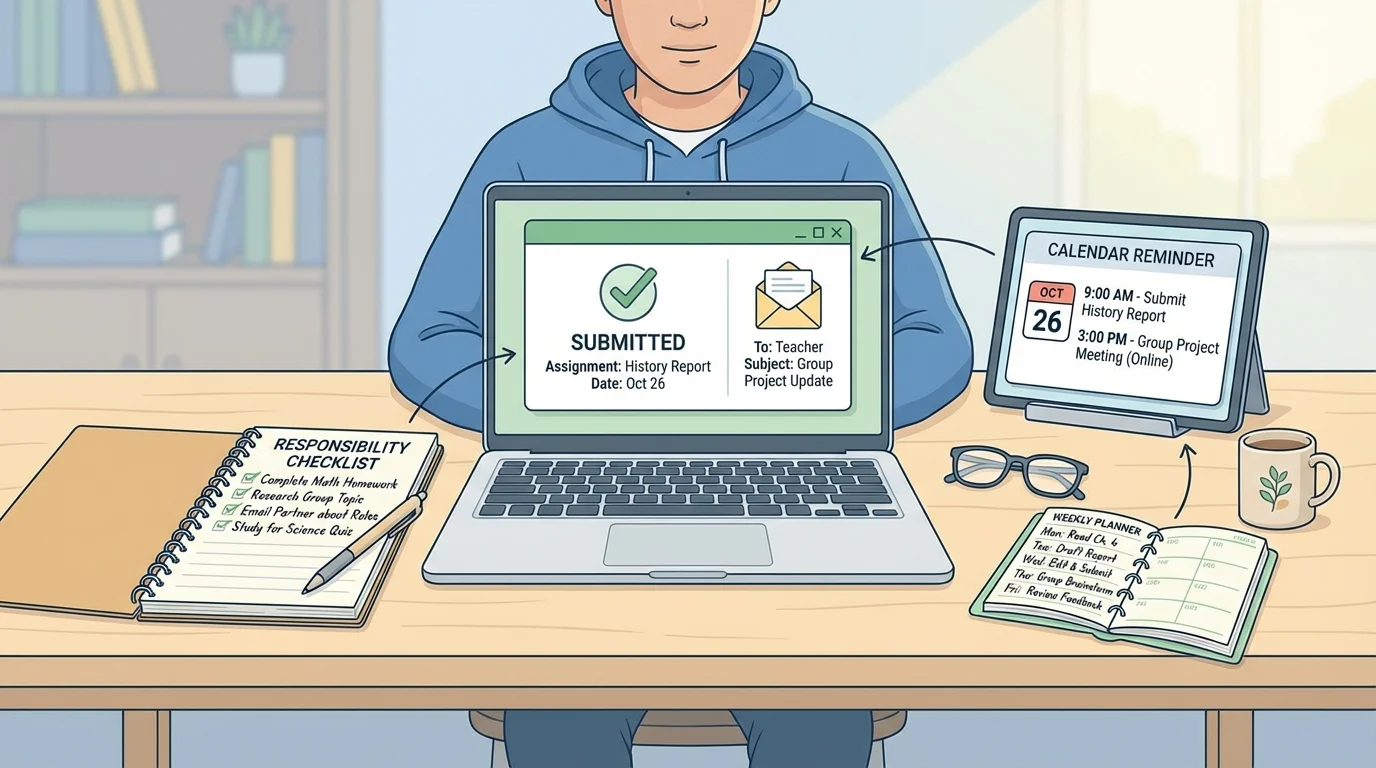
Another part of responsibility is asking for help early. Some students think asking for help means failure. It does not. Waiting until the last minute usually makes the problem worse. If directions are confusing, internet problems happen, or you are stuck, send a message as soon as possible. A responsible message might say, "I'm confused about part two of the assignment. I tried reading the directions twice and checking my notes. Can you explain what to include?"
You can also use a simple daily routine. Check assignments. Choose your top tasks. Start with the hardest one first or the one due soonest. Work for a set amount of time. Then check what is finished before you log off. The systems in [Figure 1] show that staying on track is usually about habits, not talent.
Practical schoolwork routine
Step 1: Check your course page and list all tasks due this week.
Step 2: Put each task in order: due first, most difficult, or quickest to complete.
Step 3: Break one large task into smaller parts.
Step 4: Set one reminder for the start and one reminder for the deadline.
Step 5: Before ending the day, make sure finished work is actually submitted.
This routine lowers stress and helps you avoid last-minute panic.
There are also responsibilities that happen before you even begin working. Charge your device if possible. Keep login information in a safe place. Have materials ready. If you know your family schedule may interrupt your learning time, plan around it. Responsibility often looks boring from the outside, but it saves you from many avoidable problems.
Even responsible people make mistakes. You may forget to submit a finished file, miss an online meeting, or rush through work and do poorly. Accountability follows a pattern, as [Figure 2] shows: notice the mistake, admit it, respond honestly, and make it right if possible. This is much stronger than blaming other people, hiding the problem, or pretending it did not happen.
Here is what accountability sounds like: "I missed the deadline. That was my mistake. I already completed half of it, and I will finish the rest by tomorrow at 6:00." Notice what is missing from that sentence: excuses. An explanation can be helpful, but excuses try to remove responsibility. Accountability keeps the focus on action.
If your mistake affected another person, include repair. For example, if you did not send your part of a group slideshow on time, the other group members may have been stressed or delayed. In that case, accountability means apologizing and helping fix the problem, not just saying, "Oops."
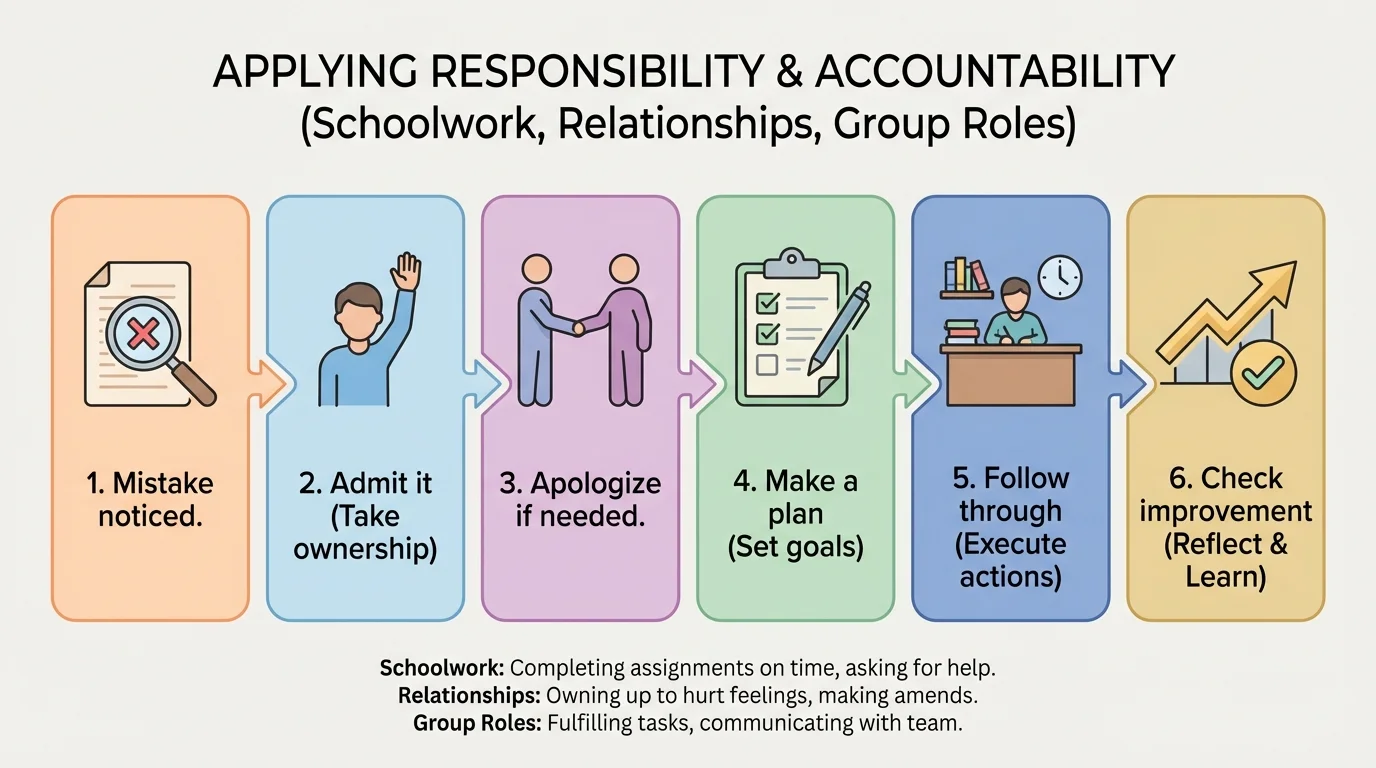
Accountability also means learning from the mistake. If late work happens once, that may be a tough day. If it happens again and again, it is a habit. Ask yourself, "What caused this?" Maybe your workspace was distracting. Maybe you started too late. Maybe you did not understand the directions and stayed silent. Once you know the cause, you can change the system.
A useful way to think is this: excuse, reason, solution. An excuse avoids blame. A reason explains what happened. A solution changes what you do next. Reasons can be true and still not be enough. If your internet failed once, that is a reason. Your accountability is in what you do after that: message your teacher, use another device if available, or submit as soon as access returns.
"The strongest people are not the ones who never make mistakes. They are the ones who face them honestly."
Owning your mistake may feel uncomfortable for a few minutes, but hiding it often creates a bigger problem for a much longer time. Honest accountability protects your reputation better than pretending nothing happened.
Responsibility is not only about tasks. It also matters in how you treat people. In friendships, family relationships, online chats, team spaces, and community activities, responsibility means being respectful, truthful, and dependable. If you say you will call, join a meeting, help with a chore, or keep a private message private, that becomes your responsibility.
One important relationship skill is integrity. Integrity means doing what is right even when it is difficult or when no one will know. For example, if a friend sends you a screenshot of a private conversation and asks you to spread it, integrity helps you say no. Responsible people do not build friendships by breaking trust.
Digital communication needs responsibility too. Online messages can feel fast and casual, but they still affect real people. Before you send something, ask: Is it true? Is it kind? Is it necessary? Is this the right place to say it? A joke that seems funny in your head may seem rude or hurtful in text because tone is hard to read online.
Many conflicts online grow because people answer too quickly. Taking even a short pause before responding can prevent a small problem from becoming a big one.
Responsibility in relationships also includes boundaries. You are responsible for respecting other people's time, privacy, feelings, and personal limits. You are also responsible for protecting your own. If someone pressures you to share private information, join in bullying, or ignore your schoolwork, responsible behavior may mean stepping back or getting help from a trusted adult.
Reliable people often do small things consistently. They respond when they can. They tell the truth. They do not promise everything just to sound nice. They are careful with other people's feelings. That kind of steady behavior creates safe, strong relationships.
At some point, you will probably hurt someone's feelings, break a promise, or react poorly when you are upset. Accountability in relationships means more than saying "sorry" quickly so the moment ends. It means understanding what you did, showing that you care about the impact, and changing your behavior.
A strong apology has several parts. First, name what you did. Second, show that you understand the effect. Third, say what you will do differently. For example: "I interrupted you during the call and then made fun of your idea in the chat. That was disrespectful. I'm sorry. Next time I will let you finish and respond more calmly." That is much stronger than "Sorry if you got mad."
How to repair trust after a mistake
Step 1: Stop defending yourself long enough to listen.
Step 2: State the exact action you took.
Step 3: Acknowledge how it affected the other person.
Step 4: Apologize without adding excuses.
Step 5: Show the change through your future actions.
Trust usually returns through repeated better choices, not one speech.
This is where consequence becomes important. A consequence is the result of an action. Some consequences are set by adults or rules. Others happen naturally. If you ignore a friend's messages for weeks, the natural consequence may be that the friendship feels less close. Accountability means understanding that actions have effects.
Sometimes accountability also means accepting that repair takes time. You cannot force someone to trust you again immediately. What you can do is be honest, patient, and consistent.
In group tasks, shared jobs only work when each person understands their role and follows through. In an online project or community activity, one person may research, another may design slides, another may speak, and another may check the deadline, as shown in [Figure 3]. Responsibility in a group means doing your part on time and at a level that actually helps the team.
A common problem in teams is uneven effort. One person does nearly everything while another disappears until the last moment. That is unfair and frustrating. If you accept a role, own it. If you cannot complete it, communicate early. Silence makes things harder for everyone else.
Good teamwork starts with clarity. Ask questions such as: Who is doing what? When is each part due? How will we update each other? What happens if someone gets stuck? These simple questions prevent confusion later.
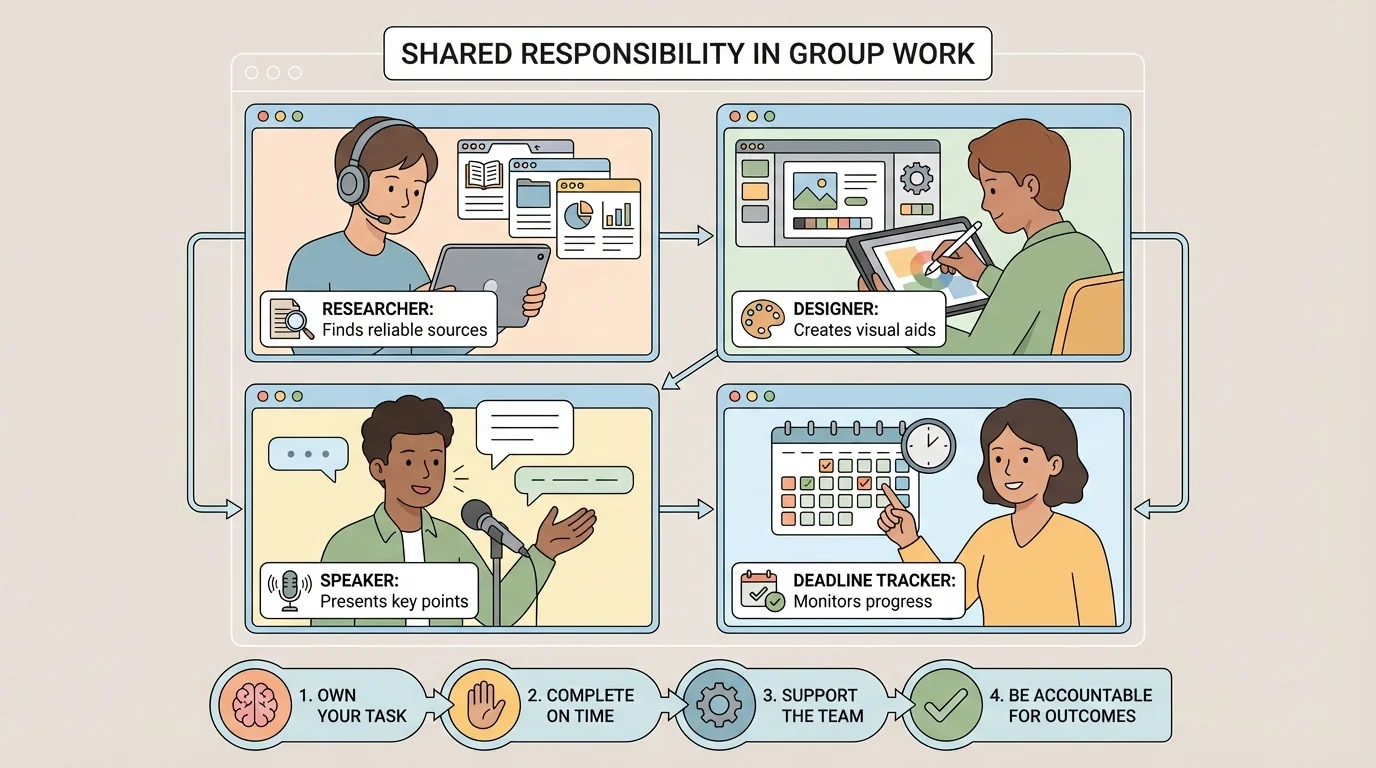
Responsibility in groups also means not controlling everything. If you are the strongest writer or fastest worker, you may feel tempted to take over. But a responsible team member helps others contribute instead of making all decisions alone. Accountability includes being fair, not just being efficient.
Groups need communication habits. A short check-in message can help: "My part is done." "I need help with slide three." "I may be late unless I finish by 5:00." Clear updates are much better than disappearing. Later, when your team reflects on what worked, [Figure 3] remains useful because it shows that strong groups depend on clear roles, not guessing.
| Situation | Irresponsible Response | Responsible and Accountable Response |
|---|---|---|
| Assignment due tonight | Ignore it and hope no one notices | Start early, use reminders, and submit on time |
| Missed deadline | Blame someone else | Admit it, explain briefly, and make a plan |
| Friend is upset | Mock them or ghost them | Listen, apologize if needed, and repair trust |
| Group project part unfinished | Stay silent | Tell the group early and ask for a solution |
| Private information shared | Spread it further | Protect privacy and stop the sharing |
Table 1. Comparison of irresponsible choices and responsible, accountable responses in common situations.
When you are unsure what to do, use a quick decision tool. It does not need to be complicated. Pause for a moment and ask yourself a few strong questions.
Step 1: What is my job here?
Step 2: Who might be affected by what I do?
Step 3: What is the honest thing to do?
Step 4: If this goes wrong, am I willing to own it?
Step 5: What action shows respect, fairness, and follow-through?
This tool helps with schoolwork, messages, teamwork, and family duties. It turns a confusing moment into a clearer choice. Responsible people do not always feel sure. They often just stop and think before acting.
You already know that habits shape outcomes. Skills like time management, respectful communication, and self-control support responsibility and accountability. These are connected life skills, not separate ones.
Another helpful question is, "What would future me be glad I did?" Future you will usually be glad you told the truth, started early, sent the message, asked for help, or apologized sincerely.
These skills matter now, but they also matter later. Responsibility and accountability are the kind of qualities people look for in teammates, volunteers, leaders, and workers. A person who can be counted on becomes valuable in almost every setting.
You do not build that reputation in one day. You build it by repeating simple actions: finish tasks, communicate clearly, tell the truth, correct mistakes, and respect others. Those actions may seem small, but together they shape your future.
Try This: For one week, choose one area to improve: schoolwork, relationships, or group roles. Each day, do one visible action in that area. Examples include checking due dates before lunch, sending a respectful follow-up message, or updating a group about your progress. Small repeated choices create strong habits.
Try This: If you make a mistake this week, practice using one accountable sentence: "I did this. It affected this person or task. Here is what I will do next." It may feel awkward at first, but it builds courage and trust.
Try This: Create a two-column note titled My Responsibilities and How I Show Accountability. Fill it with real examples from your day. This helps you notice that these skills are active choices, not just ideas.
