You probably notice community rules most when something goes wrong: a stop sign is ignored, trash is not collected, a park is damaged, or a website for local services is confusing. But these systems affect you every single day, even when they seem invisible. The water you use, the roads you travel on, the library card you sign up for, the emergency number you can call, and the rules that protect people online and offline all shape your daily life.
A community is more than a place on a map. It includes the people, shared spaces, services, and systems that help everyone live together. Whether you live in a city, suburb, small town, or rural area, your community has rules, institutions, and services. Learning how they work helps you become more independent, safer, and better prepared to solve problems.
Community systems matter because they help people live together without constant confusion. Think about what would happen if there were no traffic rules, no garbage pickup, no public library, no fire department, and no process for reporting a problem. Everyday life would become less safe, less fair, and much harder to manage.
These systems also affect your choices. If your neighborhood has sidewalks, streetlights, and crossing signals, walking is safer. If your area has a library with free internet, it becomes easier to study, apply for programs, or explore hobbies. If local rules protect clean parks and quiet hours, shared spaces become more enjoyable. Good systems do not solve every problem, but they make daily life more organized and more predictable.
Community rules are guidelines or laws that help people live safely and fairly together. Institutions are organized groups that carry out important jobs in a community, such as government offices, courts, libraries, and emergency services. Services are the helpful actions or systems communities provide, such as trash pickup, water, public parks, road repair, and emergency response.
When you understand these three parts, you can better answer everyday questions: Who can help with this problem? What rule applies here? What service should I use? Those are practical life skills, not just facts to memorize.
Community rules include both written laws and shared expectations. Some rules are formal, meaning they are official laws or policies. Others are informal, meaning people follow them because they help everyone get along.
Formal rules include things like stopping at red lights, wearing seat belts, following noise limits, obeying pet leash laws, and respecting property boundaries. Informal rules include taking turns, cleaning up after yourself in a shared space, being polite in online community groups, and keeping music at a reasonable volume. You may not agree with every rule, but rules usually exist because someone needed to solve a problem.
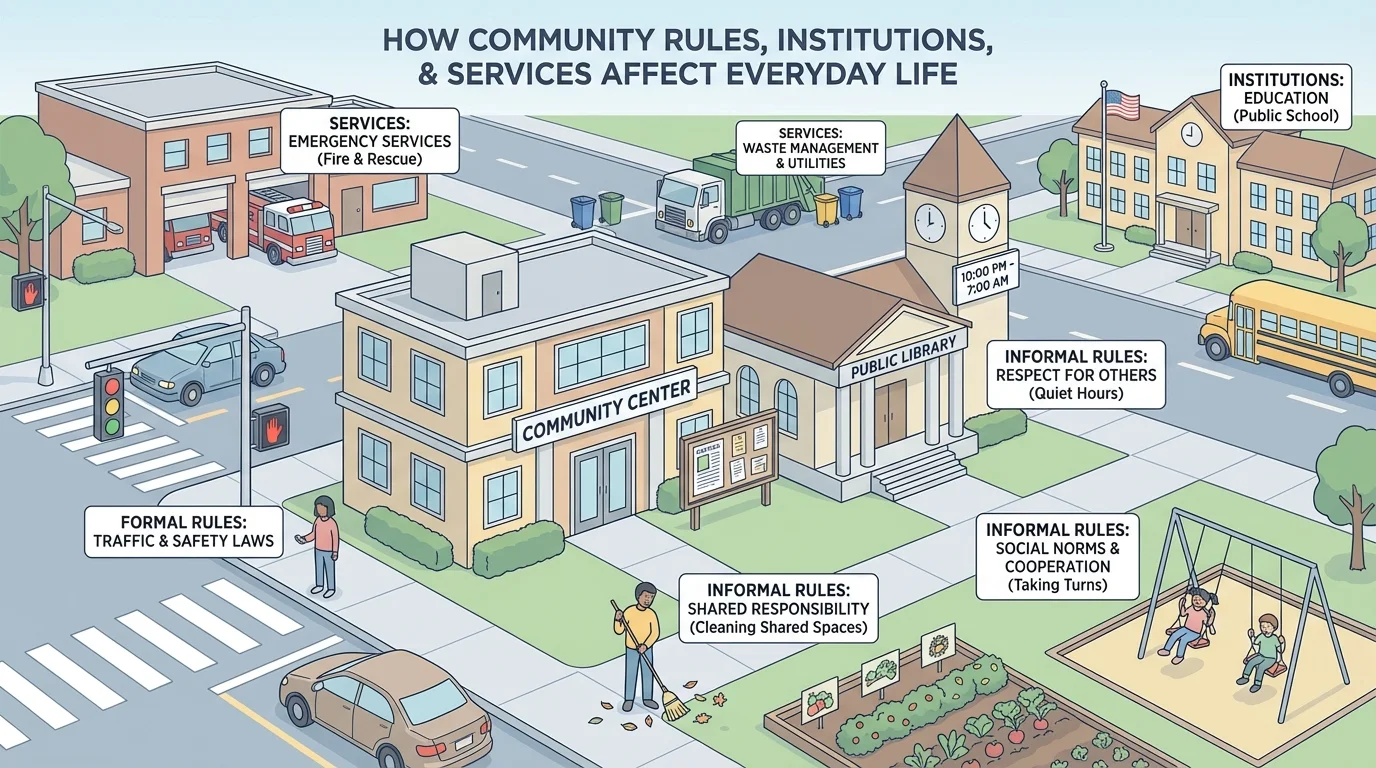
Good rules usually aim to protect safety, fairness, and order. Safety rules lower the chance of harm. Fairness rules help prevent one person from taking advantage of others. Order rules make it easier for many people to share the same spaces and resources.
For example, a rule about putting trash in the correct bin may seem small, but it can reduce pests, keep streets cleaner, and help recycling systems work. A rule about crossing at a crosswalk may save lives. A rule about online threats or harassment protects people from harm in digital spaces. Rules often affect everyday life in ways you do not fully notice until they are ignored.
Sometimes rules can feel annoying. Maybe a park closes at sunset, or a community center asks you to sign up in advance. Still, it helps to ask: What problem is this rule trying to prevent? That question helps you analyze a rule instead of reacting to it emotionally.
A institution is an organized part of community life that handles important responsibilities. Some institutions create rules, some enforce them, and some provide services directly. Many do all three in different ways.
Local government is one major institution. It may include a mayor, council, or other leaders who make decisions about roads, zoning, parks, public safety, and budgets. Courts are another institution. They help settle disputes and decide what happens when laws are broken. Police and fire departments respond to emergencies and protect public safety. Public health departments share safety information and respond to health concerns.
Libraries are also important institutions, even though people sometimes think only of government offices. A library gives access to books, technology, programs, learning tools, and often free internet access. Parks departments take care of sports fields, trails, playgrounds, and public spaces. Utility providers manage water, electricity, and sometimes gas service. Each institution has a role that affects ordinary routines.
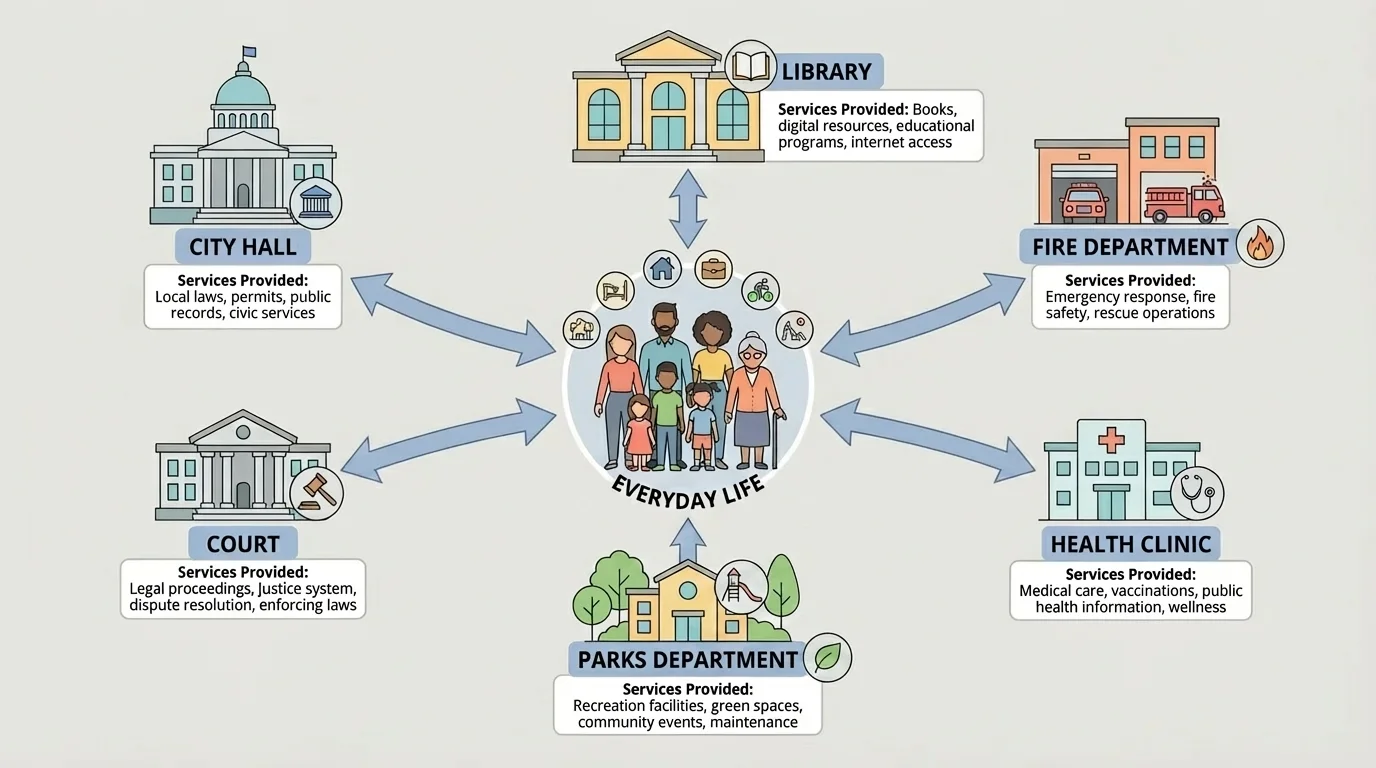
Here is a simple comparison of some common institutions and what they do.
| Institution | Main Job | How It Affects You |
|---|---|---|
| Local government | Makes decisions for the community | Influences parks, roads, rules, and public spending |
| Library | Provides learning resources and access | Gives books, internet, programs, and study support |
| Fire department | Responds to fires and emergencies | Protects lives and property |
| Court system | Helps settle legal issues | Supports fairness and consequences |
| Health department | Protects public health | Shares alerts and safety guidance |
| Parks department | Cares for shared outdoor spaces | Keeps parks usable, clean, and safe |
Table 1. Examples of community institutions, their main jobs, and their effect on daily life.
When these institutions work well, many tasks become easier and safer. When they fail, people notice quickly. A damaged road, a delayed emergency response, or a poorly maintained park can change daily life for many families.
Many public libraries now offer much more than books. Depending on the area, they may provide homework help, job-search tools, maker spaces, digital classes, and free device lending.
As we saw earlier in [Figure 1], communities depend on both formal systems and shared habits. Institutions help turn those ideas into real action by organizing people, money, and resources.
A public service is something a community provides to meet shared needs. Some services are easy to see, like buses, parks, or road repair. Others are easy to forget because they happen in the background, like water treatment, sewer systems, streetlight maintenance, or emergency communication.
Think through one ordinary day. You turn on a faucet. Clean water arrives. Trash is collected on schedule. Roads are marked. Street signs guide travel. A park or recreation area may be available nearby. If there is danger, emergency services can respond. None of that happens by accident. It takes planning, funding, workers, rules, and institutions.
Services also shape opportunities. If a community has reliable internet access points, safe public spaces, and strong recreation programs, young people may have more chances to learn, connect, and stay active. If those services are missing, daily life can feel harder and less fair.
Access changes opportunity
Two people can work equally hard and still have different experiences because their communities offer different services. One student may have a nearby library, safe sidewalks, and a recreation center. Another may have fewer safe public spaces or limited transportation. Understanding services helps you see why community conditions matter, not just individual effort.
That does not mean you are powerless if services are limited. It means being aware of what exists, what is missing, and where to ask for help. Practical awareness is a powerful skill.
Rules, institutions, and services are connected in a chain. A rule sets expectations. An institution is responsible for handling the issue. A service is the action people receive.
Suppose a streetlight stops working. A rule or policy may say the local government is responsible for safe public infrastructure. A city department or utility office receives reports about outages. Workers are sent to inspect and repair the light. The result is a safer street. One everyday problem involves all three parts: rules, institutions, and services.
The same pattern appears in many situations. Noise complaints, recycling pickup, park damage, unsafe intersections, and emergency alerts all depend on this kind of system. If one part breaks down, the whole process becomes weaker. A rule without enforcement may be ignored. An institution without enough workers may respond slowly. A service without clear rules may become unfair or confusing.
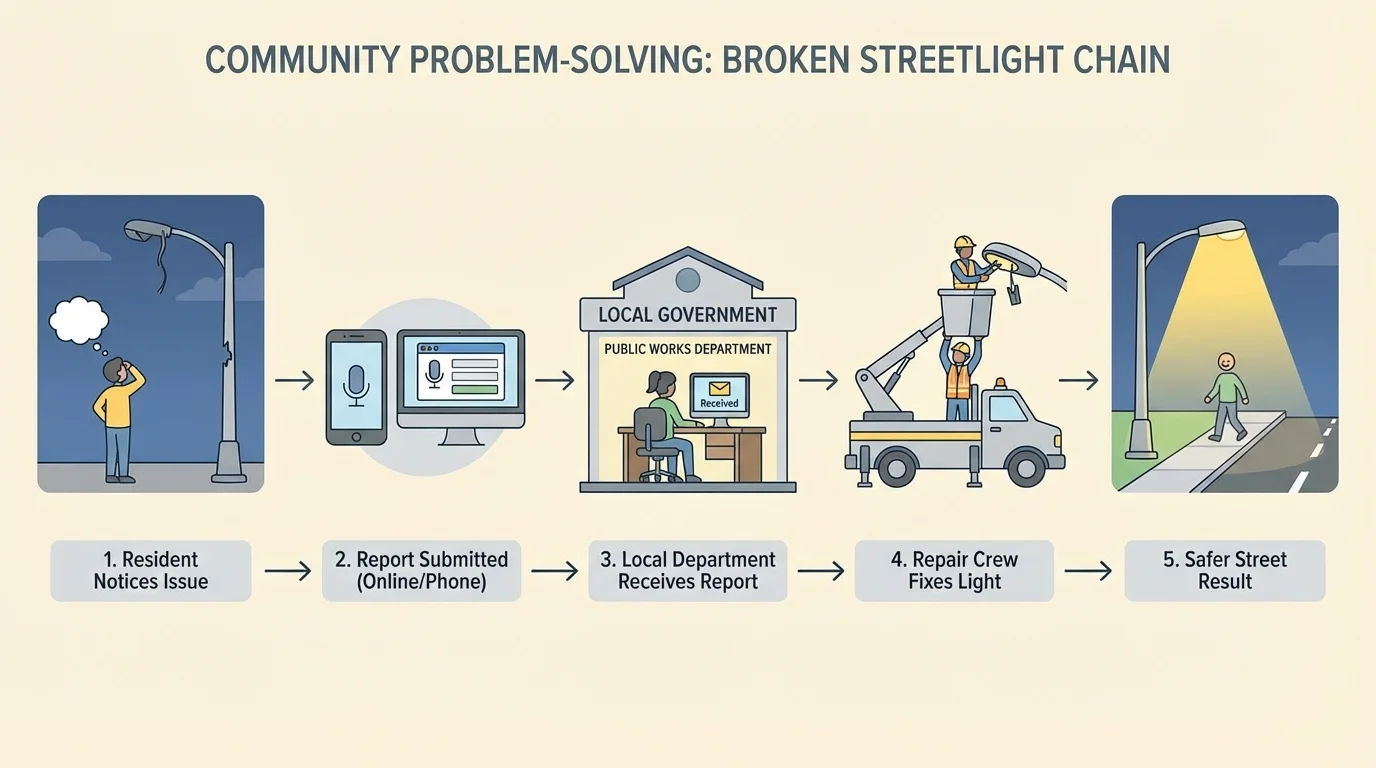
Understanding this chain helps you solve problems more effectively. Instead of just saying, "This is unfair," you can ask, "Which rule applies? Which institution is in charge? What service should happen next?" That makes you more capable and more confident.
Case study: A broken swing in a public park
You notice a swing chain is damaged and could hurt someone.
Step 1: Identify the safety issue.
The problem is not just inconvenience. It is a possible injury risk in a shared public space.
Step 2: Think about responsibility.
A parks department or local government office is usually responsible for maintaining park equipment.
Step 3: Use the correct channel.
Check the community website, hotline, or reporting form. Give the location and a clear description.
Step 4: Act safely while waiting.
Stay off the equipment and warn others nearby if possible.
This is civic engagement in real life: noticing a problem, understanding the system, and taking responsible action.
Later in the lesson, this same problem-solving pattern matters again. Whether the issue is a sidewalk crack, unsafe online behavior in a local youth forum, or a missed trash pickup, the chain in [Figure 3] helps you think clearly about what to do next.
Community systems affect where you go, what feels safe, how easy it is to get help, and what opportunities are available. At home, rules may affect noise levels, pet care, recycling, parking, or home safety. In the neighborhood, rules shape traffic flow, building use, and how shared spaces are protected.
They also affect your digital life. Many communities have online reporting systems, public information websites, library apps, local discussion pages, and recreation sign-ups. Rules about privacy, respectful communication, and digital safety matter here too. If you join a local online group, being respectful, not spreading false information, and protecting private details are all part of responsible participation.
Think about a simple example: a local recreation program opens registration online. If the website is clear and accessible, more families can sign up easily. If the system is confusing or only works well for some users, access becomes less fair. Community services are not only physical. They can also be digital, and digital design affects real people.
Another example is emergency information. During severe weather, people may rely on local alerts, websites, or social media updates from trusted agencies. Clear communication can protect lives. Confusing or false information can create danger. That is why institutions need public trust, and community members need good judgment.
When you evaluate information online, pause and ask three questions: Who posted this? Is it current? Can it be confirmed by an official local source? That habit is part of civic responsibility.
As shown earlier in [Figure 2], institutions are connected to different kinds of needs. Some of those needs now happen online just as often as they happen in physical community spaces.
When community systems work well, life feels smoother. Streets are safer. Public spaces are cleaner. Help is easier to find. Rules feel clearer and more predictable. People are more likely to trust the system when they see that it works fairly.
When systems do not work well, the effects can spread. If trash is not collected regularly, neighborhoods may become dirtier and less healthy. If bus routes are limited, getting to appointments or activities can be harder. If people think rules are enforced unfairly, trust can drop. If a local website is hard to use, some residents may miss important information or services.
Not all communities have equal access to the same services. Some areas have more parks, safer roads, or more reliable internet than others. That is why fairness is an important part of community analysis. Asking whether a service exists is only the first step. Also ask whether people can actually use it.
This is where the idea of civic engagement matters. Civic engagement means taking part in helping your community work better. For a sixth grader, that might mean following community rules, speaking respectfully, joining a cleanup effort, reporting a hazard, attending an online town hall meeting with family, or sharing helpful information from trusted sources.
"A community works best when people do not just use shared spaces and services—they also help care for them."
You do not need to be an adult to notice what is fair, what is useful, and what needs improvement. Careful observation is the first step toward responsible action.
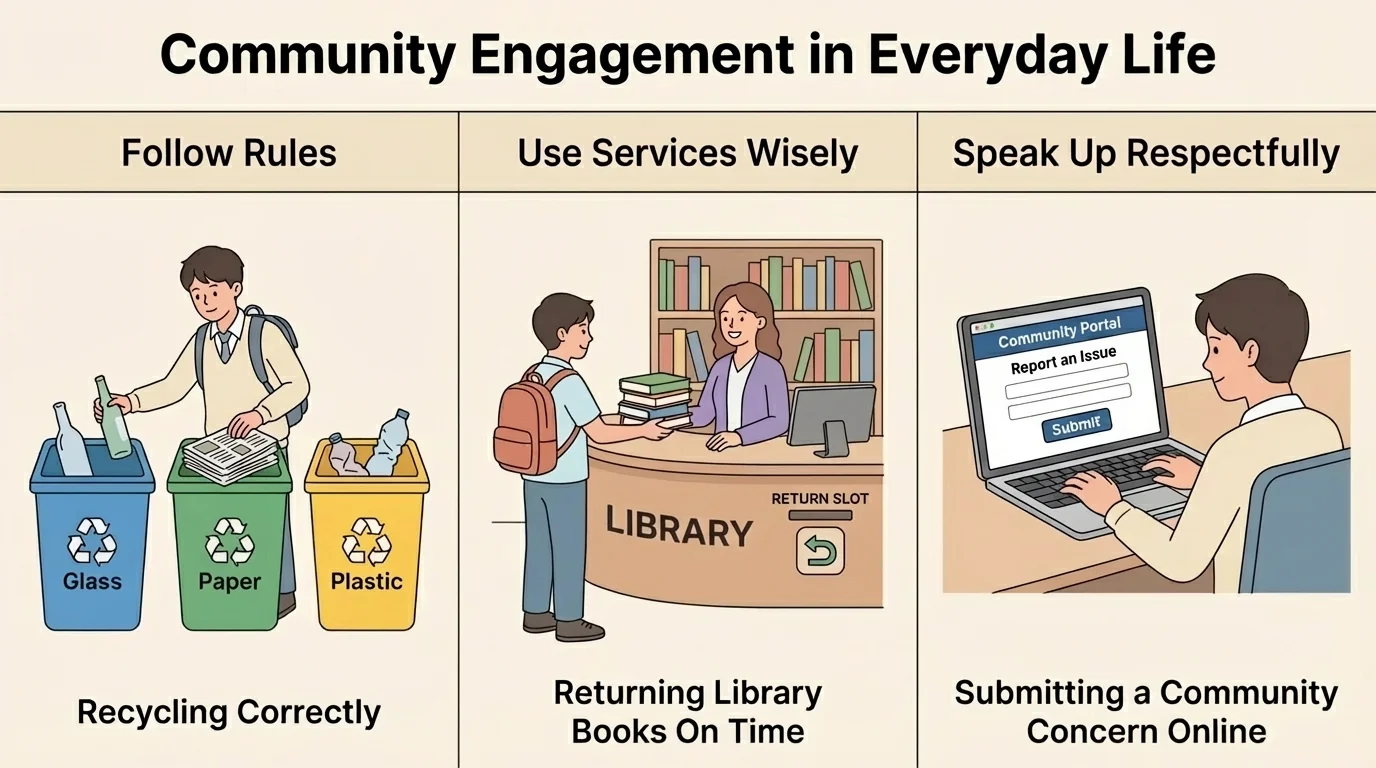
Being active in your community does not always mean doing something big. It often means doing small things consistently. Active community membership includes following rules, using services wisely, and speaking up respectfully when there is a problem.
First, know the basic rules that affect your daily life. Learn local expectations for safety, public behavior, pet care, recycling, and online conduct in community spaces. Second, use services responsibly. Return library items on time, take care of parks and equipment, follow posted instructions, and treat shared resources with respect. Third, communicate clearly. If something is broken or unsafe, report it through the right channel instead of only complaining about it.
Here is a practical checklist you can use:
Step 1: Notice the issue carefully. What exactly is happening?
Step 2: Decide if it is about a rule, a service, or both.
Step 3: Identify who is responsible. Is it the library, parks department, utility provider, or local government?
Step 4: Use the correct reporting method, such as a website form, email, phone line, or trusted adult who can help.
Step 5: Explain the issue clearly and respectfully. Include where, when, and what you noticed.
Step 6: Stay safe while waiting for a response.
This approach works for many situations: a dangerous sidewalk, a damaged public bench, confusing posted information, or a problem in a community online forum. The habits in [Figure 4] are small, but they build trust and responsibility over time.
Real-world example: Writing a helpful report
A strong report is short, respectful, and specific.
Step 1: State the problem clearly.
"The trash bin at Oak Park is overflowing."
Step 2: Add useful details.
"It is next to the basketball court and was overflowing on Tuesday afternoon."
Step 3: Explain why it matters.
"Trash is blowing onto the court and could attract pests."
Step 4: Keep the tone respectful.
"Could someone please check this location?"
Helpful reporting makes it easier for services to respond.
One important skill is knowing the difference between an emergency and a regular community problem. A broken park bench is important, but it is not the same as a fire, severe injury, or immediate danger. For urgent threats, use emergency services. For non-urgent problems, use the normal reporting system.
Understanding community systems now prepares you for more independence later. As you grow older, you will use more services, follow more rules, and make bigger decisions. You may sign up for programs, travel alone more often, work part-time, use public transportation, or vote when you are old enough. Civic awareness helps you do all of that responsibly.
It also helps you think more deeply about fairness. If one area has excellent parks and another has very few safe places to gather, that matters. If some people cannot easily access important services, that matters too. Paying attention to those differences helps you become not only a rule-follower, but also a thoughtful problem-solver.
Community life is not just something that happens around you. You are part of it. Your choices affect shared spaces, shared information, and shared trust. When you follow fair rules, use services responsibly, and speak up in helpful ways, you make everyday life better for yourself and for other people.
