One small habit can change how people see you. If you join an online club meeting on time, with your device charged, your notes ready, and a question prepared, adults notice. They may think, "This student is responsible." Readiness habits work like that. They are small actions you do before, during, and after a new situation so you can handle it well.
As you get older, people expect more from you. You may need to manage your time more independently, remember instructions without being reminded over and over, and act appropriately in different places. These places might include your online classes, your home, a sports team, a community center, a music lesson, a volunteer activity, or a family event.
When you are ready, things usually go more smoothly. You miss fewer deadlines. You forget fewer materials. You ask better questions. You make a stronger first impression. When you are not ready, you may feel rushed, confused, embarrassed, or stressed. Readiness does not mean being perfect. It means being prepared enough to begin, respond, and adjust.
Readiness means being prepared to meet what a situation requires. Expectations are the rules, directions, or behaviors people are counting on. Responsibilities are tasks or duties that belong to you. A transition is a change from one situation, role, or routine to another.
Changes can feel exciting or uncomfortable. Both are normal. You might feel ready for one change, like starting a new hobby, but unsure about another, like taking more responsibility for your own schedule. The goal is not to avoid change. The goal is to build habits that help you handle change well.
In everyday life, readiness is not just a thought like "I think I'm ready." It is visible in your actions. You set an alarm. You check the time of an online meeting. You put needed items in one place. You read directions carefully. You ask if something is unclear. You begin your task without waiting for five reminders.
A person with readiness habits often seems calm, even when something is new. That is not because everything is easy for them. It is because they have systems. A system is just a repeatable way of doing something. For example, before every virtual class, your system might be: charge device, open the correct tab, get water, get notebook, silence distractions, and log in two minutes early.
Readiness is a skill, not a personality trait. Some people think, "I'm just not organized," or "I'm bad at change." But readiness grows through practice. The more often you prepare, check, and adjust, the easier it becomes. You are not stuck with your current habits.
You can start small. A student who forgets things often does not need a complete life makeover. That student needs one or two reliable habits used consistently. Small habits repeated many times are stronger than big plans used once.
A helpful way to think about readiness is as a cycle, as shown in [Figure 1]. First, you identify the expectation: you notice what will be expected. Next, you prepare what you need. Then you act by showing up and doing the task. After that, you check how it went. Finally, you adjust for next time.
This cycle works for many situations. If you are joining a new online coding club, you notice the meeting time and rules, prepare your login and materials, attend and participate, check whether you followed directions, and adjust if you were late or forgot something.
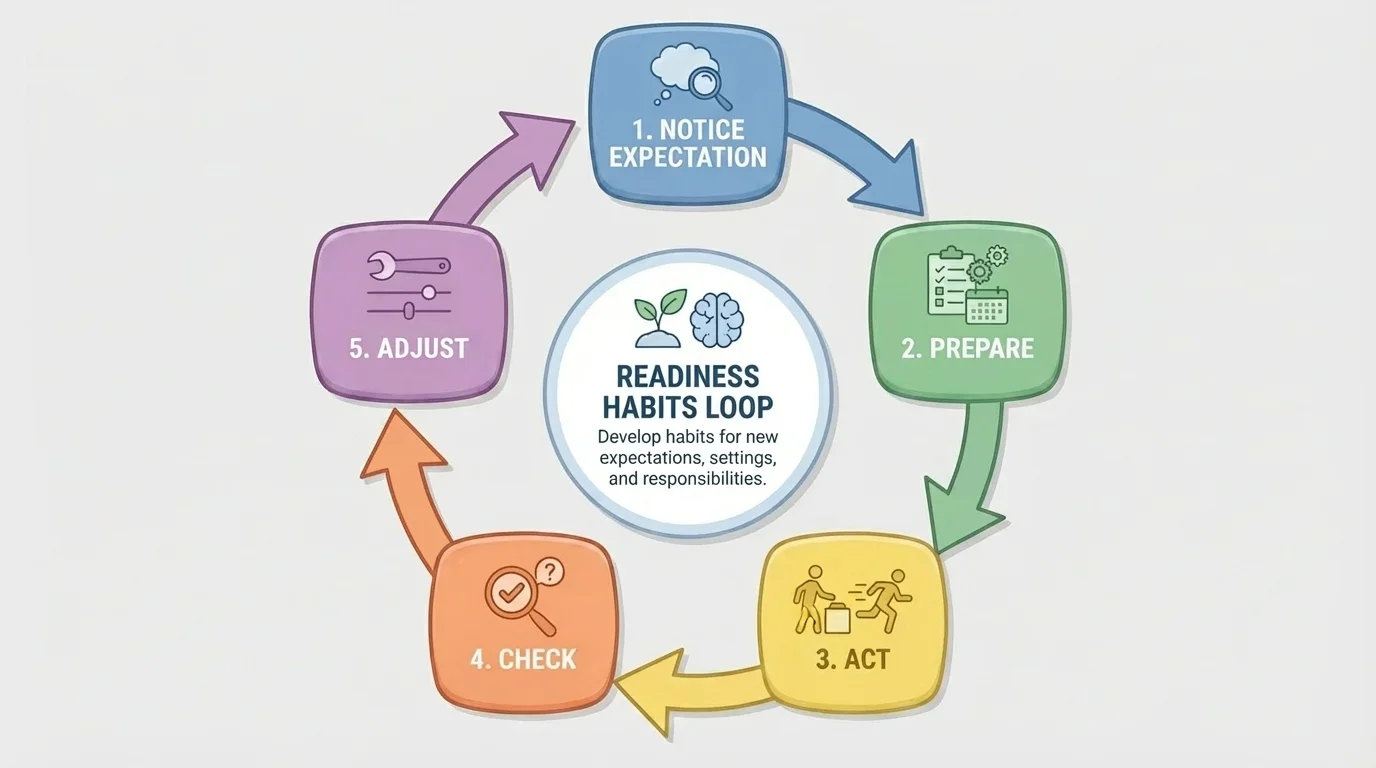
Here is the cycle in simple steps:
Step 1: Notice. Ask, "What is expected here?" Think about time, behavior, materials, and task quality.
Step 2: Prepare. Gather supplies, make a plan, and get yourself mentally ready.
Step 3: Act. Do the task. Show the expected behavior.
Step 4: Check. Ask, "Did I do what was needed? What went well? What was hard?"
Step 5: Adjust. Make one change so next time goes better. Readiness is something you repeat, not something you finish once.
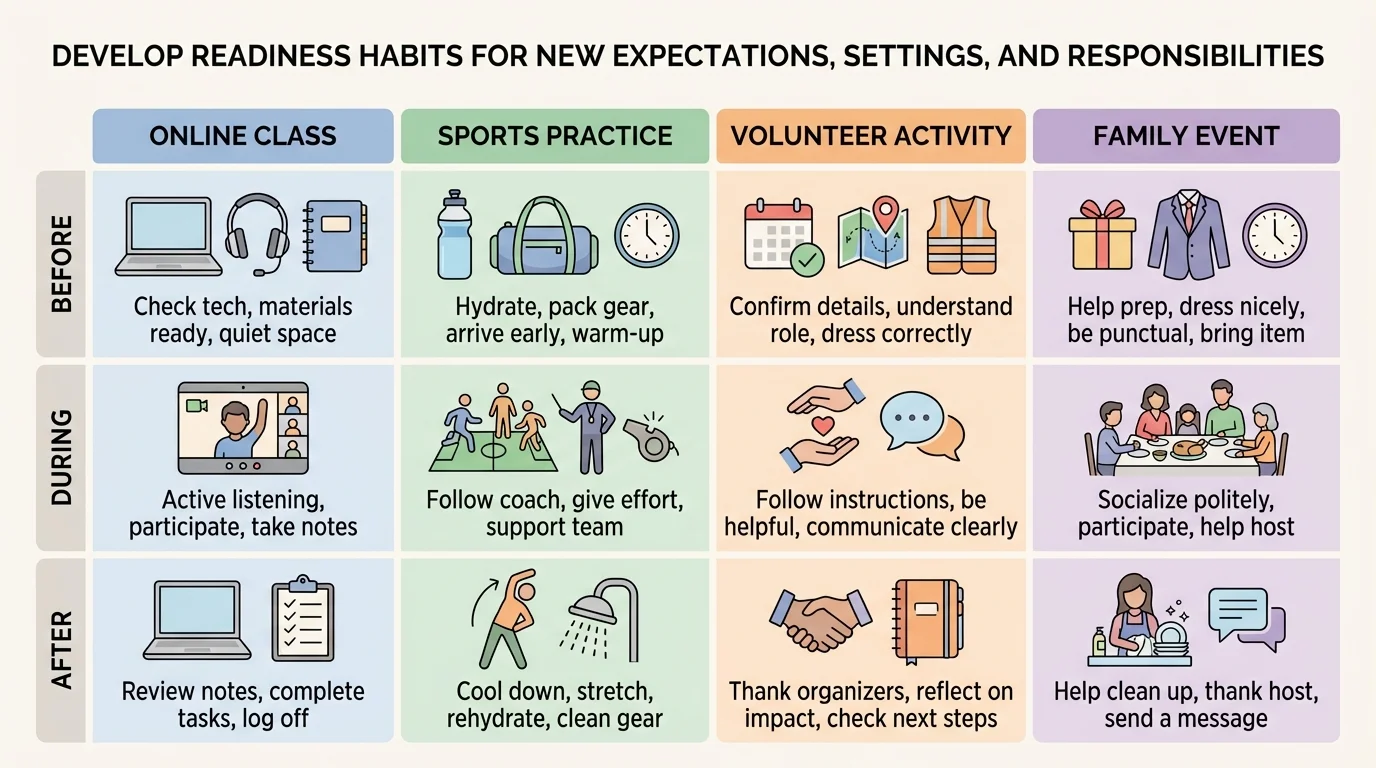
Different settings have different rules, and strong readiness habits help you notice those differences early. [Figure 2] compares several common settings to show that being "ready" does not look exactly the same everywhere. The key is to ask: What matters most in this place?
For an online class, readiness may mean logging in on time, keeping your camera and microphone settings appropriate for class rules, having materials open, and staying focused instead of switching tabs. For a sports practice, readiness may mean wearing the right gear, bringing water, arriving early, and listening carefully to instructions.
For a volunteer job, readiness may include being polite, following safety directions, completing a task without complaining, and asking what to do next when finished. For a family event, readiness might mean dressing appropriately, helping set up, greeting people respectfully, and managing your behavior even if you feel bored.
A smart habit is making a quick "setting scan" before something new. Ask yourself these questions:
What is the goal? Am I there to learn, help, compete, celebrate, or listen?
What should I bring? Device, notebook, water, permission form, materials, or correct clothing?
How should I behave? Quiet and attentive, energetic but respectful, formal, friendly, or especially careful?
Who can I ask? Parent, coach, activity leader, instructor, or organizer?
This habit keeps you from assuming that every setting works like the last one. If you use the comparison in [Figure 2], you can see that the same student may need different behaviors in each place while still showing responsibility in all of them.
Real-life example: starting a new community art class
Step 1: Notice the expectations.
You check the class time, location, materials list, and whether you should keep your microphone muted during online instruction or arrive with supplies if the class meets in the community.
Step 2: Prepare the day before.
You place your sketchbook and pencil set in one spot, set a reminder, and wear clothing that is okay to get messy.
Step 3: Act responsibly.
You join or arrive on time, listen to instructions, and begin when the teacher says to begin.
Step 4: Check and adjust.
You realize you forgot an eraser, so you add "check supply pouch" to your routine for next time.
The student does not become perfect in one day. The student becomes more ready each time.
Try This: Before your next new activity, write a three-part note: "before, during, after." Under each part, list one action you will take.
Responsibilities often grow little by little. You may be expected to manage more of your own schedule, keep track of assignments, help with chores, care for younger siblings for short times, or remember repeated tasks without being asked each time. These are signs that adults are trusting you more.
Routine helps responsibility feel easier. A routine is a pattern you repeat so you do not have to decide from scratch every time. For example, instead of waiting until bedtime to remember everything, you can create an afternoon routine: snack, check messages and assignments, finish one task, pack what you need, then relax.
One useful idea is to break responsibilities into three parts: start, continue, finish. Some students are good at starting but not finishing. Others avoid starting because the task feels big. If you know which part is hardest for you, you can build a support habit there.
| Responsibility | Readiness habit before | Readiness habit during | Readiness habit after |
|---|---|---|---|
| Online assignment | Check directions and due time | Work in focused chunks | Submit and confirm |
| Household chore | Gather supplies | Do the full task, not half | Put materials away |
| Pet care | Know feeding time | Feed and refill water | Check area is clean |
| Team practice | Pack gear early | Listen and participate | Clean up and review next time |
Table 1. Examples of readiness habits before, during, and after common responsibilities.
Readiness also means following through when no one is watching. That is called follow-through. If you say, "I'll do it later," but later never happens, trust can shrink. When you complete a task as promised, trust grows.
Your brain gets better at routines when you repeat the same action in the same order. That is why checklists and regular times can make responsibility feel easier instead of harder.
Try This: Pick one repeated responsibility and make a tiny checklist for it. Keep the checklist short enough that you will actually use it.
Sometimes students seem unprepared not because they do not care, but because they do not communicate clearly. Readiness includes knowing how to ask, answer, and confirm. Good communication can save you from confusion.
Here are helpful phrases you can use in real life and online:
To ask for clarification: "Can you explain what I should do first?"
To confirm details: "So the meeting starts at 4:30, and I should bring my notebook. Is that right?"
To show responsibility: "I finished my part. What should I do next?"
To solve a problem early: "I may be a few minutes late because of a conflict. What is the best way to catch up?"
This kind of clear message shows initiative. Initiative means taking action without waiting for someone else to push you. It is a powerful habit for your future because teachers, coaches, leaders, and employers all value people who speak up respectfully and solve problems early.
"Being responsible means doing the right thing even when no one reminds you."
When writing messages online, reread before sending. Make sure your message is polite, clear, and complete. Include the important facts, but keep it short. A message like "help" is too vague. A better message is: "I cannot find the assignment link. I checked the course page and messages. Can you tell me where to look?"
Even when you know what to do, change can still feel hard. You might feel nervous before meeting new people, annoyed by new rules, or frustrated when you make mistakes. Emotional readiness means noticing those feelings without letting them control all your choices.
One useful skill is a transition pause. This is a short moment between one activity and the next when you reset yourself. You might take three slow breaths, read the directions again, sip water, or tell yourself, "New does not mean impossible."
Another useful skill is replacing a thought that shuts you down with one that helps you act. Instead of "I can't do this," try "I can do the first step." Instead of "I messed up, so I'm bad at this," try "I learned what to fix next time."
Comfort and readiness are not the same. You do not have to feel fully comfortable in order to be ready. Many people feel nervous before a new activity but still prepare carefully and do well. Courage often looks like preparation plus action, even with butterflies in your stomach.
Try This: Before a new situation, choose one reset action you can do in less than one minute. Practice it ahead of time so it feels familiar when you need it.
Readiness habits matter now, but they also prepare you for bigger opportunities later. College and other post-secondary paths expect students to manage time, notice deadlines, communicate clearly, and ask for help before a problem becomes serious. Jobs expect workers to arrive prepared, follow instructions, and adapt to different settings.
You do not need to be in college or have a job yet to practice these skills. Every time you prepare for an online class without reminders, complete a task fully, or speak up respectfully when you need information, you are building independence. Independence does not mean doing everything alone. It means knowing how to manage yourself and how to get help wisely.
If two students have the same talent, the one with stronger readiness habits often does better over time. Talent helps, but dependability opens doors. People trust dependable students with more chances.
Scenario: same skill, different habits
Two students both enjoy digital design. One student often forgets meeting times, loses files, and does not answer messages. The other student labels files clearly, checks deadlines, and confirms instructions. The second student is more likely to be invited to bigger projects because others can count on that student.
That is why readiness habits are really future habits. They help you become someone others trust.
A weekly plan turns good intentions into actions. As [Figure 3] shows, a strong plan includes not only events and tasks, but also short preparation times before them. Planning the preparation is what many people forget.
Here is a simple weekly system you can use:
Pick one planning time. Choose the same day each week to look ahead.
List your main events. Include online classes, activities, chores, appointments, and family responsibilities.
Add prep steps. If something starts at 6:00, ask what needs to happen before 6:00.
Check for conflicts. If two things are close together, plan a transition.
Set reminders. Use alarms, sticky notes, or a calendar.
Review each day. A quick daily check keeps the week from surprising you.
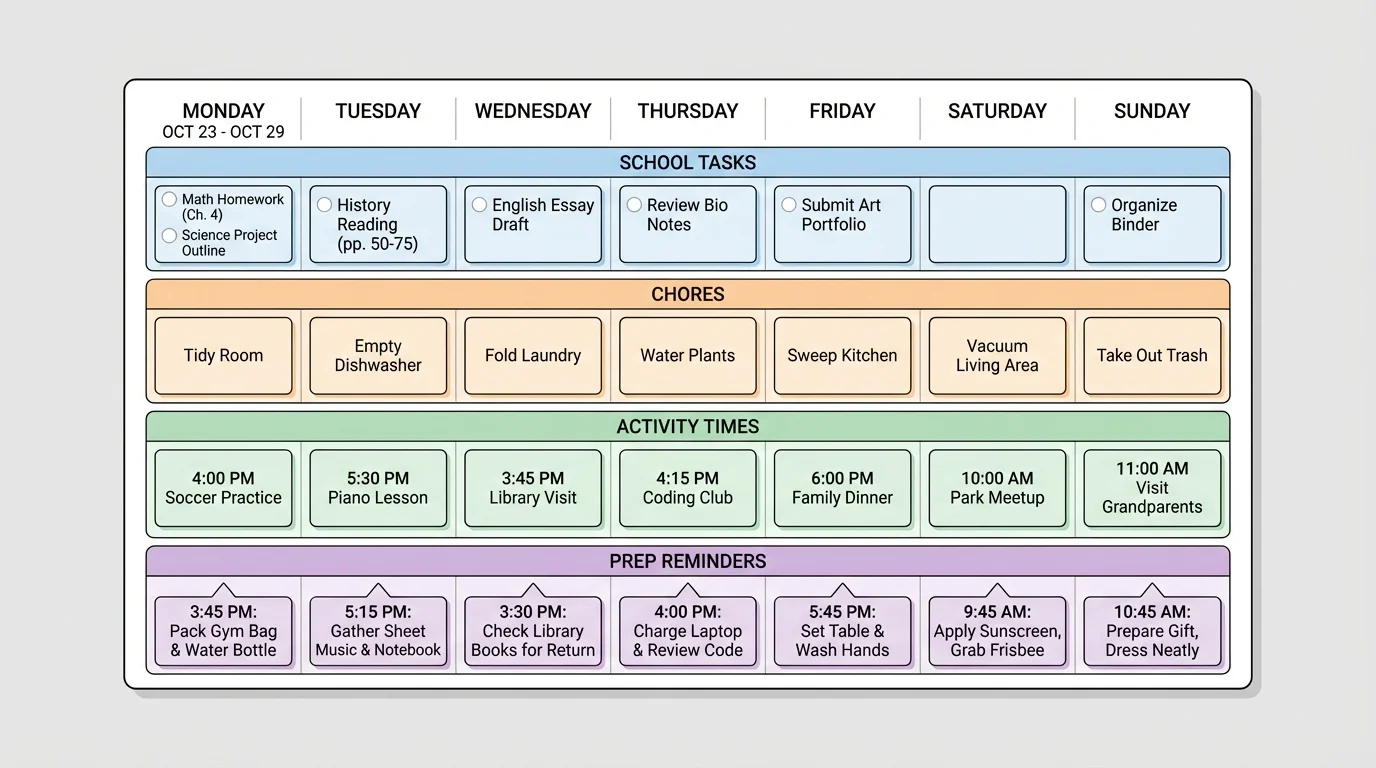
Suppose you have an online class at 9:00, a chore at 4:00, and soccer practice at 6:00. A weak plan says, "I'll remember." A strong plan says: at 8:50 open class materials, at 3:55 start the chore, at 5:30 pack gear and fill water bottle. That kind of planning makes preparation visible.
If your day feels crowded, use the rule of one important next step. Do not try to solve the entire week at once. Ask, "What is the next thing I need to do to be ready?" Then do that one thing.
Checklists, reminders, and calendars are tools, not signs of weakness. Strong, responsible people use tools on purpose so they can remember what matters.
Try This: During your next planning time, add one short prep step before each event instead of only writing the event itself.
You will forget something sometimes. You will be late once in a while. You may misunderstand directions. Readiness is not destroyed by one mistake. What matters is how you respond next.
When something goes wrong, use this recovery pattern: own it, fix it, learn from it. Owning it means telling the truth without making excuses. Fixing it means doing what you can now. Learning from it means changing your system so the same mistake is less likely next time.
For example, if you miss an online meeting because you mixed up the time, own it by sending a respectful message. Fix it by asking what you missed. Learn from it by setting two reminders next time and double-checking the time zone if needed.
This response builds trust faster than hiding the mistake. Adults usually understand errors better than repeated carelessness. They want to see that you can recover responsibly.
The strongest habits are the ones you connect to your identity. Instead of saying, "I'm trying to be less forgetful," you can say, "I am a person who gets ready." That simple shift changes your choices. People often act in ways that match the kind of person they believe they are becoming.
Start with one setting, one responsibility, and one communication habit. Keep them simple. Repeat them until they feel normal. Then add another. Over time, your habits will make new expectations feel less overwhelming because you will already know how to prepare, act, check, and adjust.
Readiness is not about impressing everyone. It is about being able to step into new situations with more confidence, more responsibility, and more independence. That is a skill you can build right now.
