Some goals fail for a surprising reason: not because people are lazy, but because they never check how things are going. You can want something very badly and still get off track if you do not have a plan to follow. Whether you are saving money for something important, practicing for a sports team, finishing an online project, or keeping up with chores at home, planning tools help you notice progress early and fix problems before they grow.
A planning tool is anything that helps you organize what you want to do, when you will do it, and how you will check your progress. It can be as simple as a paper checklist or as detailed as a digital calendar with reminders. The point is not to make your life seem perfect. The point is to make your next step clear.
When you track progress, you are less likely to forget tasks, waste time, or feel overwhelmed. When you do not track progress, it becomes easy to say, "I think I'm doing okay," even when important steps are being missed. That distinction matters. Someone who checks progress every week can fix a small problem in a few minutes. Someone who ignores it may end up stressed, rushed, or disappointed.
Goal means something you want to achieve. Progress means the movement you make toward that goal. Milestone means a smaller checkpoint that shows you are moving forward. Adjust means changing part of your plan so it works better.
Planning tools are useful in daily life because many goals take more than one day. If your goal takes time, you need a way to remember what has been done and what still needs attention. This is part of being responsible: you follow through, notice what is happening, and make thoughtful changes instead of waiting for someone else to rescue the plan.
You do not need a fancy app to be organized. A planning system can be made from tools you already know how to use. Here are some common ones:
Checklists are good for tasks that must be completed. Calendars are good for tasks that must happen on certain days. Habit trackers are good for actions you repeat often, like reading, exercising, or practicing an instrument. Progress charts are good for showing how far you have come. Reflection notes are short comments about what worked and what needs to change.
Each tool answers a different question. A checklist answers, "Did I do it?" A calendar answers, "When will I do it?" A habit tracker answers, "How consistently am I doing it?" A progress chart answers, "How far have I come?" Reflection notes answer, "What should I do next?"
Many athletes, musicians, and business owners use simple tracking systems every day. Even high achievers do not rely only on memory. They rely on routines and records.
That is important because memory is not a dependable plan. You may remember your goal but forget one key step. A written or digital tool gives your brain less to hold and makes it easier to focus on doing the work.
A useful plan begins with a clear goal. A vague goal like "get better at math" or "be more helpful at home" is hard to track because you cannot easily tell what success looks like. A clearer goal gives you something you can measure or observe.
For example, instead of saying, "I want to save money," you could say, "I want to save $40 in 8 weeks for a game." Instead of saying, "I want to read more," you could say, "I want to read for 15 minutes on 5 days each week for 1 month." These goals are easier to track because you know the target and the time period.
A strong goal is clear enough to guide action. A good goal tells you what you are trying to do, how much or how often, and by when. If a goal is too huge or too fuzzy, your plan becomes fuzzy too. Clear goals make better decisions possible because you can compare your progress to something real.
One easy way to test your goal is to ask three questions: What exactly am I trying to do? How will I know if I am making progress? When will I check my progress? If you cannot answer those questions, your goal needs to be clearer before you build a plan.
A big goal often feels hard because your brain sees the whole thing at once. Breaking it into smaller actions makes it manageable. Instead of one giant task, you create a series of smaller jobs that you can actually finish.
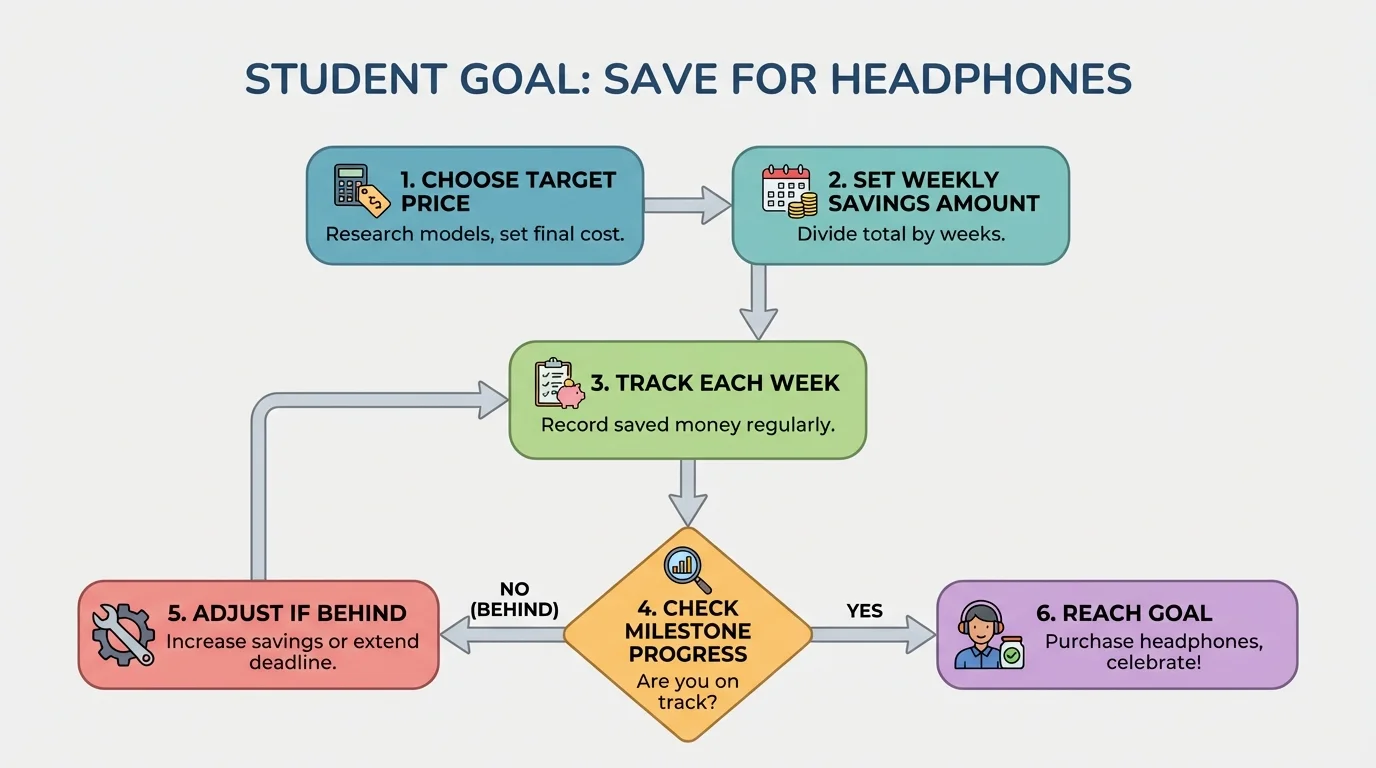
Suppose your goal is to save $40 in 8 weeks. As [Figure 1] illustrates, you can divide the amount by the number of weeks: \(40 \div 8 = 5\). That means a possible plan is saving $5 each week. Now the goal feels less like one giant problem and more like a weekly routine.
You can also add milestones. If your total goal is $40, milestones might be $10, $20, $30, and $40. Milestones help because they let you celebrate progress before the very end. They also help you notice trouble sooner. If week 4 arrives and you only have $8, you know right away that your plan needs attention.
Breaking goals into steps works for many parts of life. If you want to help more at home, your steps might be: choose two chores, assign days, set reminders, track completion, and review each weekend. If you want to improve at basketball, your steps might be: practice dribbling on four days each week, record time practiced, check progress every Sunday, and adjust if you miss days.
The smaller the step, the easier it is to start. That does not mean the goal is weak. It means your plan is smart. Small steps reduce excuses and make progress easier to see.
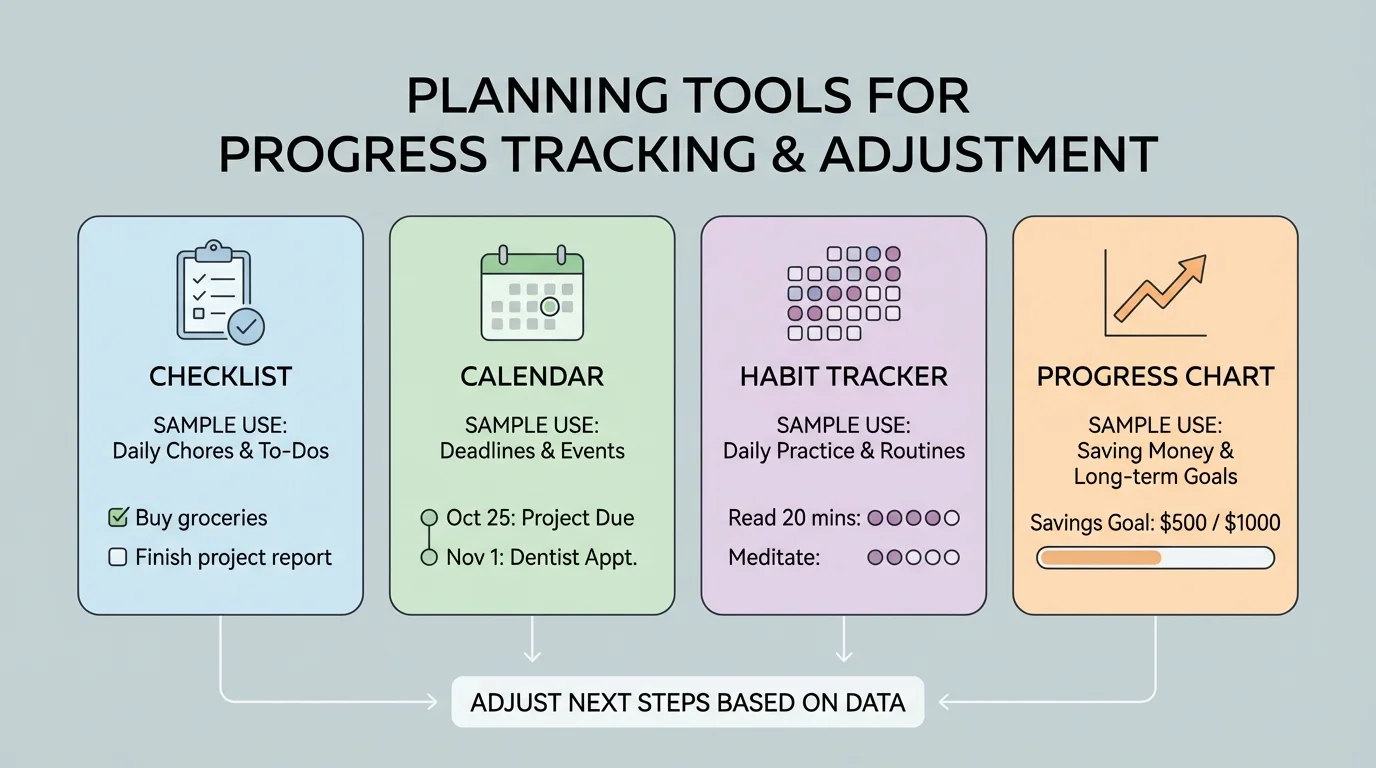
Different planning tools are useful for different situations. If your goal repeats on many days, a habit tracker may work better than a checklist. If your goal depends on deadlines, a calendar may be the better choice.
Here is a simple way to match the tool to the goal, as [Figure 2] helps show. Use a checklist when tasks need to be completed once or in a certain order. Use a calendar when time matters most. Use a habit tracker when consistency matters most. Use a progress chart when seeing movement motivates you. Use reflection notes when you need to think about what is helping or blocking you.
| Tool | Best for | Example | What to look for |
|---|---|---|---|
| Checklist | Tasks to finish | Complete project steps | Which items are done or not done |
| Calendar | Dates and deadlines | Plan video club meeting and homework time | What must happen on specific days |
| Habit tracker | Repeated actions | Read 15 minutes each day | How often you follow through |
| Progress chart | Longer goals with milestones | Save $40 over 8 weeks | How far you are from the target |
| Reflection notes | Problem-solving | Write why a plan worked or failed | Patterns, obstacles, and ideas |
Table 1. Common planning tools, their best uses, and what they help you notice.
Sometimes the best system uses more than one tool. For example, if you are preparing for a community performance, you might use a calendar for rehearsal dates, a checklist for costume and materials, and reflection notes after each practice.
Try to choose tools that you will actually use. A simple chart you check every evening is better than a complicated app you open once and forget. Good planning tools fit your real life.
Example: choosing a tool for a reading goal
Goal: Read for 15 minutes on 5 days each week for 4 weeks.
Step 1: Identify what matters most.
This goal is about repeating an action many times, so consistency matters more than a single deadline.
Step 2: Pick the best tool.
A habit tracker fits best because it lets you mark each reading day.
Step 3: Add a review point.
At the end of each week, count the number of completed days. If the target is 5 and you completed 3, the gap is \(5 - 3 = 2\) days.
Step 4: Adjust if needed.
If evenings are too busy, move reading time to the morning or right after lunch.
The tool matches the goal because it makes repeated effort visible.
Notice that the tool itself does not do the work for you. It only helps you see what is happening. That is why honest tracking matters. If you skip days but mark them as done, your tool becomes useless.
Tracking means checking your plan often enough to notice what is happening while there is still time to respond. Weekly tracking works well for many goals because it is frequent but not overwhelming.
A good weekly check can take just a few minutes. Ask yourself: What did I complete? What did I miss? What got in the way? What is my next step? These questions keep the focus on action, not blame.
It helps to compare your actual progress to your planned progress. If your goal was to save $5 each week and after 3 weeks you planned to have $15, but you only have $12, then you are behind by \(15 - 12 = 3\). That does not mean failure. It means you have information.
Checking progress is different from judging yourself. Tracking is about gathering useful information. It helps you make better choices next, just like checking a map helps you choose the right direction.
Some students like to color a progress bar. Others like a notebook with dates and notes. Others prefer a phone reminder and a quick checkmark system. The best tracking method is one that is easy to repeat and easy to understand when you look back at it later.
Adjustment is not quitting. It is part of good planning. Responsible people do not just notice a problem; they respond to it.
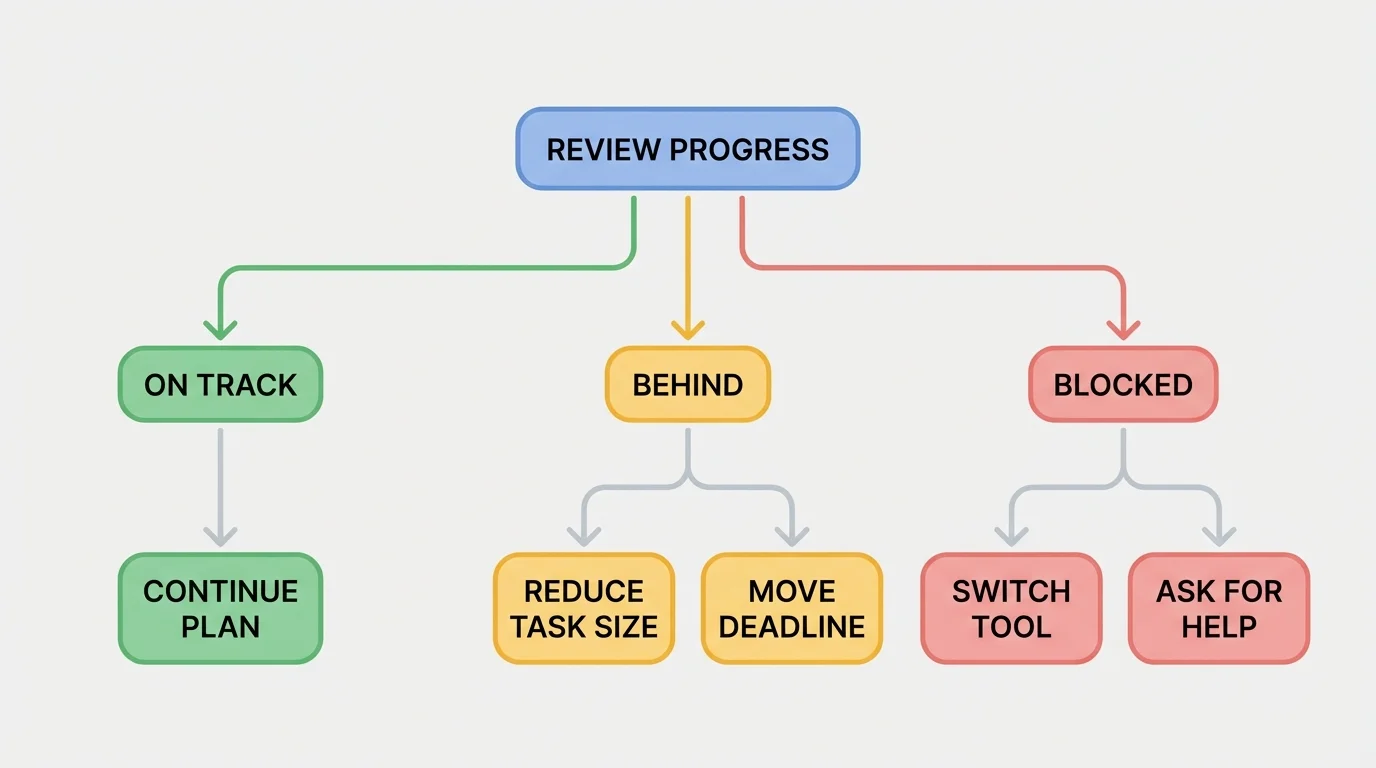
When you review progress, as [Figure 3] suggests, ask three questions: Should I keep going as planned? Should I change the size of my steps? Should I change the support or schedule around the goal? These questions help you decide what to do next instead of getting discouraged.
There are several smart ways to adjust a plan:
Change the timeline. If the goal is still important but your schedule became busier, you may need more time. Change the task size. If the steps are too hard, make them smaller. Change the method. If a checklist is not enough, switch to a calendar with reminders. Change the environment. If distractions keep getting in the way, move to a quieter space or ask a family member to help you stay on track. Ask for support. Sometimes a parent, coach, club leader, or trusted adult can help you solve a problem faster.
Here is the key idea: you should adjust the plan before you decide the goal is impossible. Many goals do not fail because the goal was bad. They fail because the first plan was not realistic. Looking back at [Figure 1], you can see why smaller steps make adjustment easier. It is simpler to change one small step than to rebuild everything.
Use evidence, not feelings alone. Sometimes you feel like you are failing when you are actually making steady progress. Other times you feel busy but are not moving toward the goal. Planning tools give evidence. They show what has happened so you can make fair, smart decisions.
If you are behind, avoid two extremes: pretending it is fine or giving up completely. A better response is to ask what specific change would make the next week more successful.
One common mistake is setting a goal that is too broad. "Be healthier" is hard to track. "Walk for 20 minutes on 4 days each week" is clearer. Another mistake is making steps so large that missing one day ruins the whole plan. Smaller steps create more chances to succeed.
A different mistake is tracking only when things are going well. That defeats the purpose. You most need your planning tools when life gets messy. Honest tracking helps you notice patterns, such as always missing practice on a certain day or always forgetting a task when you do not set a reminder.
Some students also spend too much time decorating a planner and not enough time using it. A planning tool is useful only if it helps action. Simple and consistent usually works better than complicated and impressive.
Research on habits shows that people are more likely to keep going when they can see small wins. A tiny checkmark on a tracker can be more motivating than waiting a long time for one big result.
Another mistake is thinking a missed step means the whole goal is over. Missing one day, one chore, or one week of savings does not erase all progress. Resetting quickly is usually more effective than feeling guilty for too long.
Planning tools matter outside schoolwork too. They help with money, health, responsibilities at home, clubs, hobbies, and future goals. This is part of preparing for your future: learning how to notice what is working, fix what is not, and keep moving.
Example: saving for something you want
Goal: Save $24 in 6 weeks for art supplies.
Step 1: Break the goal into weekly parts.
Divide the total by the number of weeks: \(24 \div 6 = 4\). The weekly target is $4.
Step 2: Choose tools.
Use a progress chart for total savings and a checklist for each week's saving action.
Step 3: Track honestly.
After 3 weeks, the planned amount is \(3 \times 4 = 12\). If you saved $9, you are behind by \(12 - 9 = 3\).
Step 4: Adjust next steps.
You might save $5 for the next 3 weeks instead. That gives \(3 \times 5 = 15\), and \(9 + 15 = 24\), which reaches the goal.
This example connects to [Figure 3] because being behind leads to a decision, not a panic.
That same process works for family responsibilities. Suppose you want to be more dependable with chores. You might make a weekly checklist with tasks for Monday, Wednesday, and Saturday, then review it each Sunday. If Wednesday keeps being missed, the adjustment may be changing the day, setting a phone reminder, or pairing the chore with another routine you already do.
Example: improving a skill
Goal: Practice guitar for 20 minutes on 4 days each week for 5 weeks.
Step 1: Pick the main tool.
A habit tracker works well because this goal depends on repeating practice regularly.
Step 2: Set a review rule.
At the end of each week, count completed practice days. If the target is 4 and the result is 2, then the shortfall is \(4 - 2 = 2\).
Step 3: Look for the real obstacle.
If you miss practice because you forget, use reminders. If you miss because 20 minutes feels too long, change the step to 10 minutes for now.
Step 4: Keep the goal alive.
After a successful week or two, build the time back up again.
This kind of adjustment keeps progress moving instead of stopping the goal completely.
Planning tools can even help with community activities. If you are helping with a neighborhood cleanup, online club event, or family project, a checklist and calendar make it easier to share responsibilities, meet deadlines, and be someone others can rely on.
A good plan is not something you make once and forget. It is something you return to. Building a planning habit means choosing a regular time to check your tools. For many students, that could be Sunday evening, Monday morning, or the last 10 minutes before ending the day.
Keep your review routine short. Look at your goal, mark what is done, notice what is late, and choose one next step. You do not need a giant meeting with yourself. You need a consistent moment of attention.
Over time, this habit builds confidence. You start to trust yourself because you know you can notice problems early and respond. That is a powerful life skill. It helps now, and it will help later with bigger responsibilities like managing your time, money, commitments, and future plans.
"Plans are useful when they help you take the next step."
If you remember only one thing, remember this: planning tools are not about being perfect. They are about being aware, responsible, and ready to adjust. As the comparison in [Figure 2] makes clear, the best tool is the one that helps you see what to do next and keeps you moving toward a goal that matters.
