Have you ever noticed that the same photo can make one person feel proud and another feel like they are not good enough? A lot of that has to do with peer influence. The people around you, including friends, teammates, online communities, and people you follow, can shape what you think is normal, cool, embarrassing, risky, or worth doing. That matters because your choices do not just appear out of nowhere. They are often shaped by what you see, hear, and want from others.
At your age, friendships and group belonging can feel very important. That is normal. You are learning who you are, what matters to you, and how you want other people to see you. But there is a difference between learning from others and letting other people control your self-worth or decisions. A strong life skill is being able to notice influence, think clearly, and choose what fits your values.
Your friends and social connections can affect what you wear, what apps you use, what jokes you laugh at, what challenges you try, and even how you talk about yourself. If a group constantly praises kindness, effort, and honesty, those habits can grow stronger in you. If a group makes fun of people, pressures others to overspend, or acts reckless online, that can shape you too.
Peer influence is powerful because humans want connection. Most people want to belong, be accepted, and avoid feeling left out. That is not weakness. It is part of being human. The goal is not to stop caring what anyone thinks. The goal is to care wisely about whose opinions deserve space in your mind.
Self-image is the picture you have of yourself, including how you see your personality, appearance, strengths, and worth. Peer influence is the effect people your age or social group have on your thoughts, feelings, and actions. Decision-making is the process of choosing what to do after thinking about options and consequences.
Your self-image can become stronger or weaker depending on the messages you take in. If people around you respect your ideas, your self-image often grows healthier. If they tease you, compare you, or only value you when you copy the group, your self-image can become shaky.
A healthy self-image does not mean thinking you are perfect. It means you can notice your strengths, accept that you are still growing, and know that your value is not based only on looks, likes, followers, or approval. Someone with a healthier self-image is more likely to say, "That trend is not for me," without feeling ashamed.
Sometimes peer influence is obvious. Someone may say, "Come on, just do it," or "If you were really my friend, you would." Other times it is subtle. You may notice everyone in a group posting edited photos, buying expensive items, or laughing at mean comments, and you start to feel pressure without anyone saying a word. This indirect pressure can be just as strong as direct pressure.
One helpful term is social comparison. That means comparing yourself to other people to decide how well you are doing or how you look. Social comparison happens easily online because you often see the best, funniest, or most edited version of someone's life. If you forget that, you may start judging yourself against something unrealistic.
People often share highlights, not the full story. A person who seems confident online may still feel insecure, lonely, or worried about fitting in.
Another important idea is self-esteem. Self-esteem is how much value and respect you give yourself. Peer influence can raise self-esteem when you are encouraged and appreciated for who you really are. It can lower self-esteem when acceptance depends on acting like someone else.
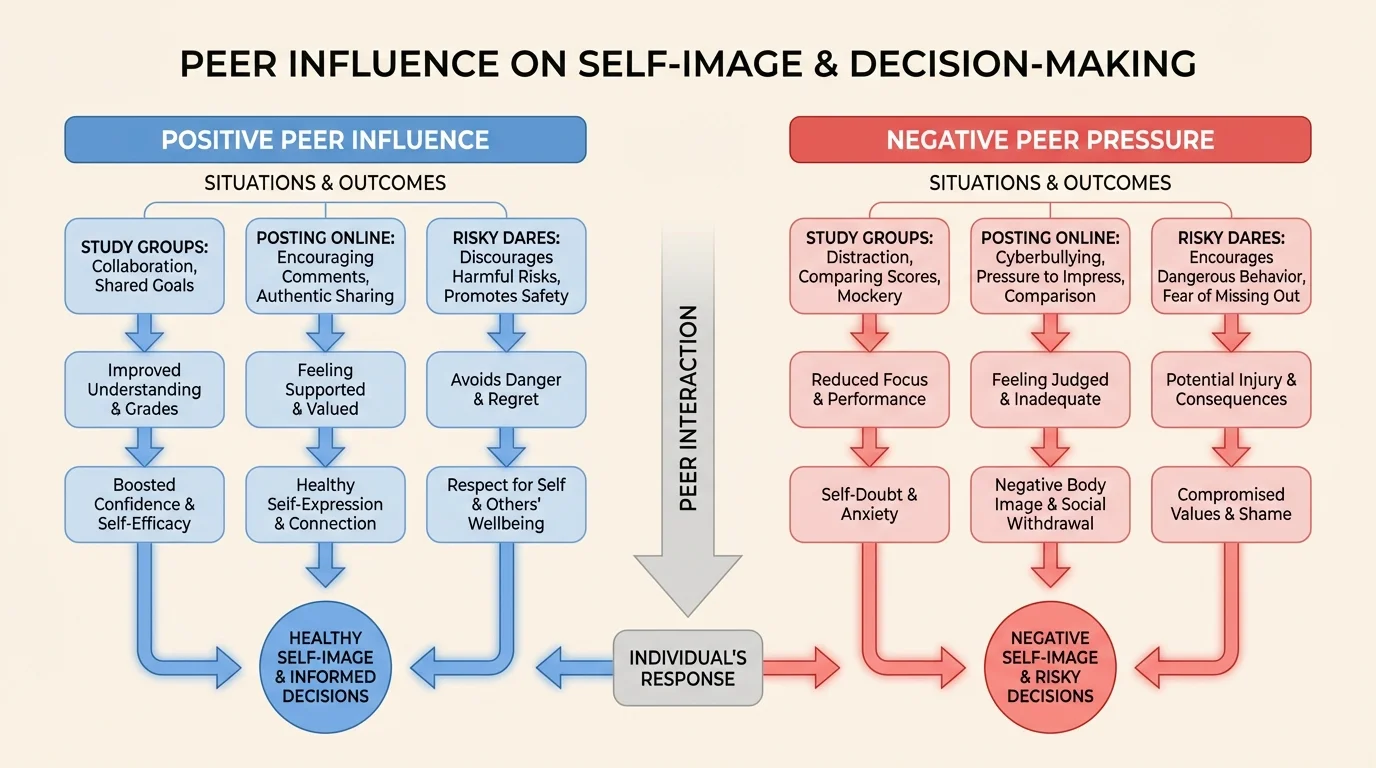
Peer influence can move your choices in healthy or unhealthy directions, as [Figure 1] illustrates through different paths from the same social need to belong. A friend might encourage you to join a coding club, try out for a community team, apologize after hurting someone, or log off when a group chat gets mean. Those are examples of positive influence.
Negative influence happens when people push you toward choices that go against your safety, values, goals, or respect for others. That might include posting something embarrassing about someone, joining a risky challenge, lying to parents, spending money just to fit in, or keeping harmful secrets.
There are several kinds of influence you should be able to spot:
Online spaces can make pressure stronger because things spread fast. A comment, screenshot, or post can be shared in seconds. If a group expects instant replies, constant posting, or total agreement, you may start making rushed decisions just to avoid conflict. Fast pressure often leads to poor choices.
Peer influence can also shape your identity in positive ways. Maybe a friend introduces you to digital art, volunteering, basketball, music production, or healthier routines. Sometimes you discover talents and interests because someone invited you into something good. So the question is not "Are peers always bad?" The real question is, "Is this influence helping me become more honest, safe, kind, and confident?"
That is why the pattern in [Figure 1] matters: the same need to belong can lead to growth or harm depending on who is influencing you and what they are encouraging.
You may not always notice influence right away. Sometimes your feelings give you the first clue. Watch for these signs:
A related term is FOMO, which stands for "fear of missing out." FOMO can make you act fast because you worry that saying no means losing fun, popularity, or connection. But many bad decisions happen when people choose to avoid missing out instead of choosing what is right.
You might also experience boundaries being crossed. A boundary is a limit that protects your comfort, values, time, privacy, and safety. If people ignore your "no," mock your limits, or demand access to your passwords, photos, or private information, that is not healthy friendship.
Why pressure changes decisions
When people feel strong emotions like excitement, embarrassment, fear, or urgency, they often think less carefully. Peer pressure can create all four at once. That is why pausing matters. A short pause gives your brain time to move from "react fast" to "think clearly."
Not every change is fake or bad. People naturally grow and try new things. The key question is this: Am I changing because I truly like this, or because I am scared of not fitting in? That one question can reveal a lot.
When pressure hits, it helps to use a repeatable process. The decision check in [Figure 2] gives you a simple way to slow down and choose instead of react. You can use it for group chats, invitations, dares, spending, posting, and conflicts.
Here is the process in everyday language: pause, notice your feelings, ask what could happen next, compare the choice to your values, decide, and then review how it went. This may sound simple, but simple tools are often the most useful when emotions are high.
Decision check you can use right away
Step 1: Pause. Do not answer instantly. If you need time, say, "I need a minute to think."
Step 2: Name the pressure. Ask yourself, "Am I doing this because I want to, or because I want approval?"
Step 3: Check the consequences. Think about what could happen today, tomorrow, and next week. Could someone get hurt, embarrassed, grounded, scammed, or excluded?
Step 4: Compare with your values. Does this match who you want to be: honest, safe, respectful, responsible?
Step 5: Choose and speak clearly. Say yes only if it is safe and right. If not, use a calm no.
Step 6: Review. Afterward, ask, "Do I feel proud of that choice?" Your answer teaches you for next time.
If a choice needs to be hidden from a parent, guardian, coach, or trusted adult, that is a warning sign. If the choice could hurt someone, damage trust, or put private information at risk, it is probably not worth the approval you might get for a few minutes.
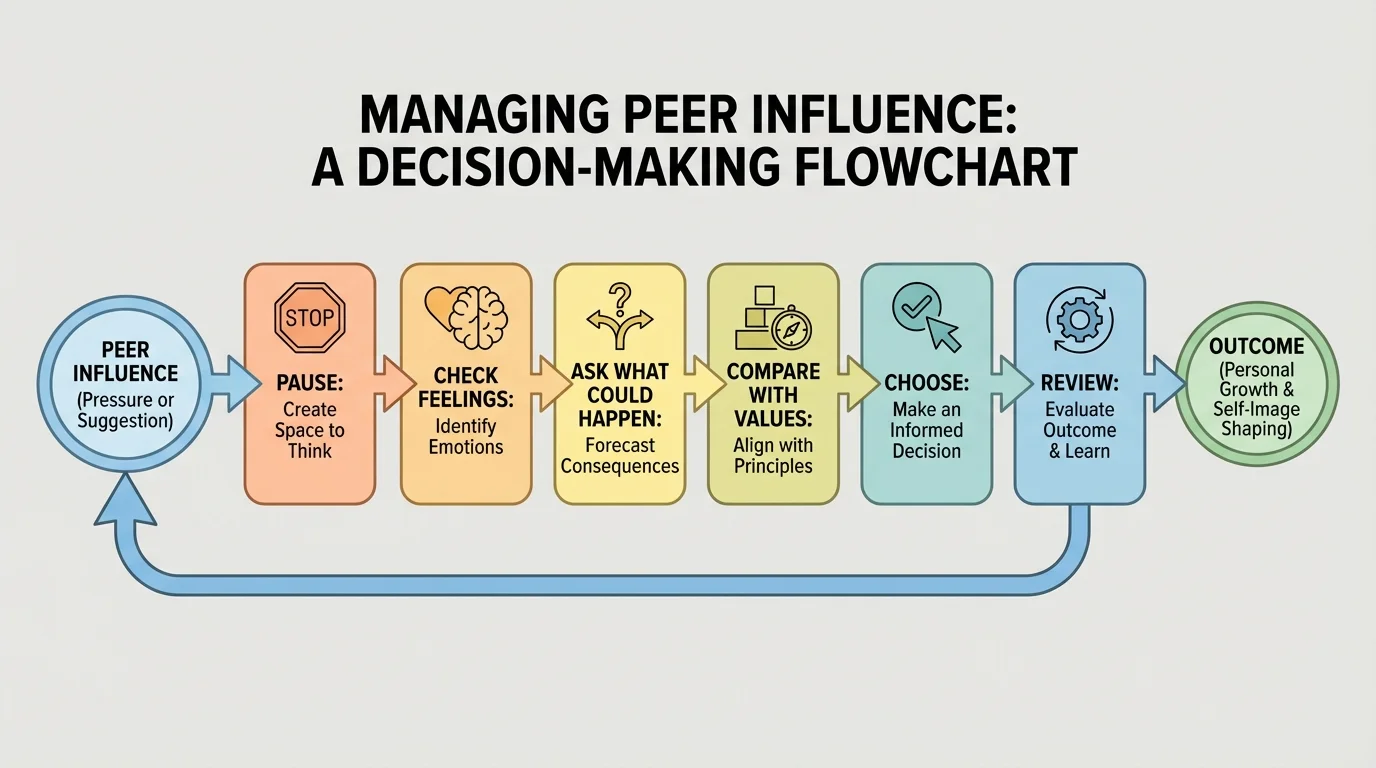
Using a process like the one in [Figure 2] does not make you weak or slow. It makes you more in control. Strong decision-making is not about always being confident; it is about acting with thought instead of being pushed around by the moment.
Peer influence becomes easier to understand when you connect it to real situations. Here are some common examples.
Situation 1: Posting a photo. Your friends are sharing heavily edited selfies and making jokes about "bad angles." You start thinking your normal face is not good enough. This affects your self-image because it teaches you that looking perfect matters more than being real. A healthier response might be to post less for approval, unfollow accounts that make you feel worse, or remind yourself that edited images are not the full truth.
Situation 2: Joining in on exclusion. A group chat starts leaving one person out on purpose. Everyone is laughing, and you do not want to be the only one who speaks up. The pressure is social, but the decision is still yours. Going along with it may protect your place in the group for a moment, but it can damage your character and someone else's well-being.
Situation 3: Buying something to fit in. A friend group is excited about a brand or game add-on that costs more than you want to spend. If you buy it only to avoid feeling embarrassed, the choice came from pressure, not from your own priorities. This is not just about money. It is about whether your worth feels connected to what you own.
Situation 4: Trying a risky dare. Someone wants you to do a dangerous stunt, prank call, or humiliating challenge and upload it. A true friend does not need proof of your loyalty through unsafe behavior. If there is risk, shame, or secrecy involved, saying no is smart, not boring.
Case study: The group chat dare
Mila is in a chat where several kids push her to send a voice message making fun of another player from an online game. They tell her it is "just a joke" and say she is too sensitive.
Step 1: Mila notices the pressure. She feels worried that the group will turn on her.
Step 2: She uses the decision check and asks what could happen. The other player could be hurt, and the recording could spread.
Step 3: She compares the dare with her values. She wants to be funny, but not cruel.
Step 4: She replies, "I'm not doing that. Let's drop it." Then she mutes the chat and messages one friend privately.
Mila protects both her self-respect and someone else's dignity. She may lose approval from part of the group, but she gains trust in herself.
Notice something important: the best choice does not always feel easy in the moment. Sometimes the healthy choice feels awkward first and rewarding later.
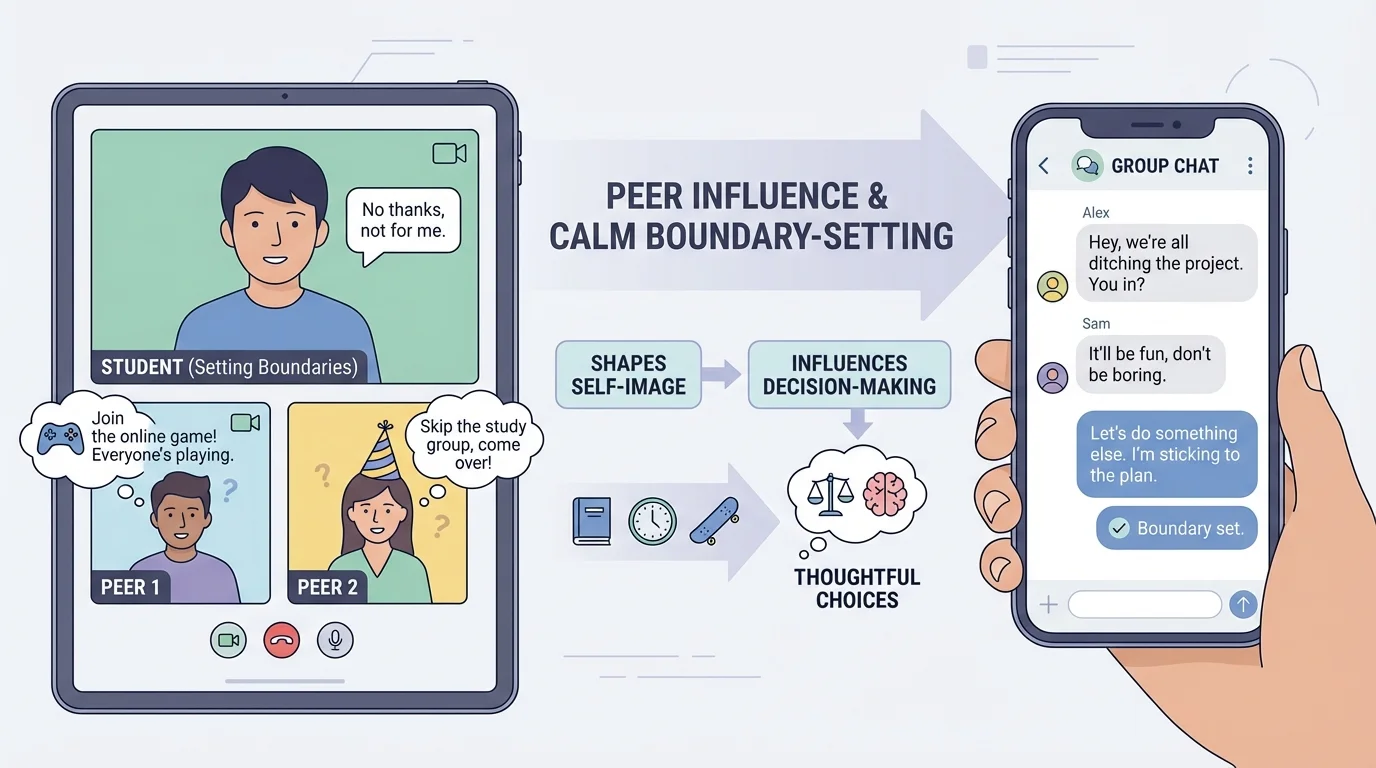
You do not need to fight everyone or isolate yourself to stay true to who you are. Protecting your individuality can be calm, respectful, and clear, as [Figure 3] shows through simple boundary-setting responses in everyday messages and calls. In fact, many people respect you more when you are honest about your limits.
Start by knowing what matters to you. Maybe your values include kindness, honesty, safety, faith, loyalty, privacy, or responsibility. When you know your values, you make decisions faster because you already have a guide.
It also helps to prepare a few phrases ahead of time. You are more likely to use a boundary if you already know the words. Try responses like:
Another powerful strategy is to spend more time with people who bring out your better qualities. Ask yourself: After I talk with this person, do I usually feel more confident, more calm, and more like myself? Or do I feel smaller, anxious, fake, or pressured? Your answer tells you a lot about the influence in that relationship.
The communication style in [Figure 3] matters because boundaries work best when they are short, clear, and not over-explained. You do not need a long speech to protect your choices. A respectful no is enough.
| Type of friend influence | How it feels | Likely effect on you |
|---|---|---|
| Supportive | You feel safe, respected, and able to be honest | Stronger confidence and healthier choices |
| Controlling | You feel guilty, rushed, or afraid to disagree | Weaker boundaries and more poor decisions |
| Encouraging | You feel challenged in a good way | Growth, effort, and skill-building |
| Mocking | You feel embarrassed or "not enough" | Lower self-image and more approval-seeking |
Table 1. Comparison of common types of peer influence and their effects on self-image and choices.
You can also build resistance to unhealthy pressure by growing confidence in other parts of your life. Practice skills, keep promises to yourself, take care of your body, and spend time on interests that matter to you. Confidence grows when your actions match your values.
"Not every group you fit into is a group you should follow."
Being yourself does not mean never changing. It means your changes come from growth, not fear. You can learn from others without losing your own direction.
Some situations are too serious to handle alone. If peer influence involves bullying, threats, sexual messages, sharing private images, pressure to self-harm, stealing, dangerous stunts, or anything illegal, talk to a trusted adult right away. That could be a parent, guardian, counselor, coach, youth leader, or another adult who takes your safety seriously.
If someone says, "Don't tell anyone," ask yourself why secrecy is so important to them. Healthy friendships do not depend on silence when someone is being harmed. Getting help is not betrayal. It is protection.
This is especially true in situations involving manipulation. Manipulation happens when someone tries to control you using guilt, fear, flattery, or pressure instead of honesty and respect. A manipulative person may say things like, "If you cared about me, you would do this," or "Everyone already agreed, so don't be difficult."
Strong friendships allow disagreement. If saying no causes someone to insult you, threaten you, or embarrass you, the problem is not your boundary. The problem is their behavior.
You are allowed to protect your mind, your body, your privacy, and your reputation. You are allowed to leave a chat, block an account, refuse a dare, or ask for support. Those choices are signs of maturity.
Over time, every decision teaches you something about yourself. If you keep choosing based only on approval, your self-image may depend on what others think. If you keep choosing based on values, your self-image becomes more steady. That does not mean you will never care about others. It means you will not hand them the job of deciding your worth.
