Some people look confident in every role they take on, but the truth is that nobody is strong at everything all the time. A student might be great at speaking up in a video call but struggle to stay organized. Another person might be dependable and kind but feel overwhelmed when too many tasks pile up. Knowing this is powerful, because your success in online school and in your community is not just about trying harder. It is also about understanding yourself clearly.
When you reflect on what you do well and where you have limits, you make smarter choices. You can take on roles that fit your current skills, ask for help before a problem grows, and work on areas that need improvement without feeling ashamed. This kind of self-awareness helps you participate more fully, more fairly, and with less stress.
Your roles affect other people. If you are part of an online class discussion, a gaming club, a volunteer group, a youth sports team, or your family's daily routines, your actions matter. When you know your strengths, you can contribute in useful ways. When you know your limits, you can avoid overcommitting, communicate honestly, and protect your well-being.
Think about two students in an online class project. One says yes to doing everything, then misses deadlines because the workload is too big. The other says, "I'm good at making slides and organizing ideas, but I need help with presenting live." The second student is more likely to do their part well because they understand both their abilities and their limits.
Strengths are abilities, traits, or habits that help you do something well. Limits are areas where you have less skill, less energy, less experience, or a real barrier that makes participation harder. A limit is not the same as failure. It is information you can use.
Reflecting on strengths and limits does not mean labeling yourself as "good" or "bad." It means noticing patterns. You are learning what helps you participate and what makes participation harder.
Self-awareness means noticing what is happening inside you and around you. You might notice, "I stay calm when plans change," or "I get distracted when my phone is nearby," or "I enjoy helping new people feel included." These observations give you useful clues.
Strengths can be skills, personal qualities, or supports you already use well. Limits can come from skill gaps, stress, health needs, lack of confidence, or outside conditions. For example, having a slow internet connection during a live meeting is a real limit. So is feeling nervous about talking to unfamiliar people. So is having too many responsibilities in one week.
You do not have the same strengths and limits in every setting. You might be patient with younger siblings but impatient during group chats. You might be creative in art but unsure how to lead a team. Reflection works best when it is specific.
You probably have more roles than you think. In daily life, one person can be a student, a friend, a sibling, a helper at home, and a member of a community group all at once, as [Figure 1] illustrates. Each role asks for different skills, and your strengths and limits may show up differently in each one.
In online school, your roles might include participating in video lessons, messaging teachers respectfully, managing assignments, and working with classmates online. In your community, your roles might include helping a neighbor, joining a club, attending a faith group, caring for a pet, babysitting, or volunteering at an event.
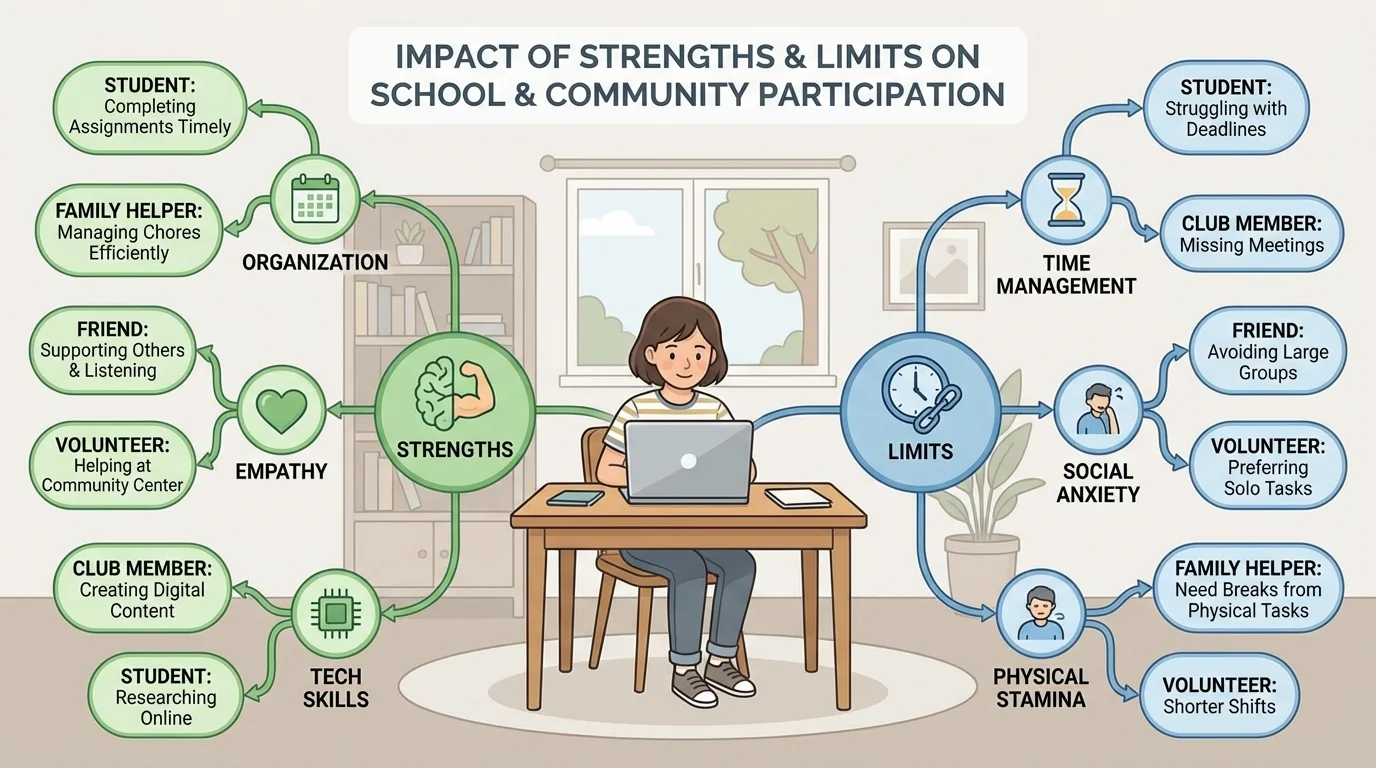
Being aware of your roles helps you ask better questions: Which role feels easiest right now? Which one drains my energy? Which one matches my strengths? Which one needs more support?
People often notice their mistakes faster than their strengths. That means reflection can feel negative unless you intentionally look for what is already working well.
If you only focus on limits, you may underestimate yourself. If you only focus on strengths, you may overpromise. Balanced reflection helps you stay honest and confident at the same time.
Some strengths are connected to executive functioning, which includes the mental skills you use to manage tasks and behavior. These strengths can include planning ahead, remembering deadlines, starting tasks without too much delay, paying attention, and switching between activities when needed.
Other strengths are social. You may be a good listener, a kind encourager, a calm problem-solver, or someone who notices when another person feels left out. These interpersonal strengths matter just as much as academic skills when you are part of a team or community.
| Strength | How it helps | Example |
|---|---|---|
| Organization | Keeps tasks and materials under control | You use a digital checklist for assignments and submit on time. |
| Reliability | Builds trust | You do the job you agreed to do in a volunteer group. |
| Empathy | Improves relationships | You notice when a friend sounds upset in messages and check in kindly. |
| Creativity | Helps solve problems in fresh ways | You design a clear slideshow for a project. |
| Persistence | Helps you keep going through frustration | You revise an assignment instead of giving up. |
Table 1. Examples of strengths that support participation in school and community roles.
Your strengths are not only the things you are "best at." They also include habits that make life easier for you and others. A student who always replies politely and clearly may be strengthening trust even if they are not the loudest speaker in a group.
A barrier is something that gets in the way of full participation. Some barriers are inside you, such as weak planning skills or fear of making mistakes. Some are outside you, such as family schedule conflicts, technology problems, transportation issues for community activities, or not knowing what is expected.
Limits can show up in many ways: forgetting deadlines, becoming overwhelmed, having trouble speaking during a live call, interrupting others, avoiding responsibility, or saying yes to too many tasks. These limits do not mean you are incapable. They show where support or practice is needed.
As you saw with the role picture in [Figure 1], one role can compete with another. If you spend two hours helping at home, you may have less energy for a club meeting. That does not make you lazy. It means your time and energy are limited resources.
Limits are not excuses, and they are not flaws. A useful reflection asks, "What is making this hard, and what can I do about it?" Sometimes the answer is to build a skill. Sometimes it is to ask for support. Sometimes it is to reduce a commitment. Mature self-awareness means choosing a helpful response instead of pretending the limit is not there.
There is an important difference between a temporary limit and a lasting pattern. Being tired one day is different from always struggling to manage time. Both matter, but they may need different solutions.
Reflection works best when you describe facts instead of attacking yourself. "I missed two deadlines this week" is useful. "I'm terrible at everything" is not useful. One statement gives you something to work with; the other only creates shame.
You are not the same as your current skill level. If public speaking is hard for you now, that means it is a growth area, not your identity. If you are organized right now, that is a strength, but it does not mean you never need help.
"Know yourself, and you can choose your path more wisely."
— A practical rule for everyday growth
Good reflection often uses these sentence starters: "I notice that...," "I do well when...," "I struggle when...," "I need support with...," and "Next time I will...." These keep your thinking calm, specific, and focused on action.
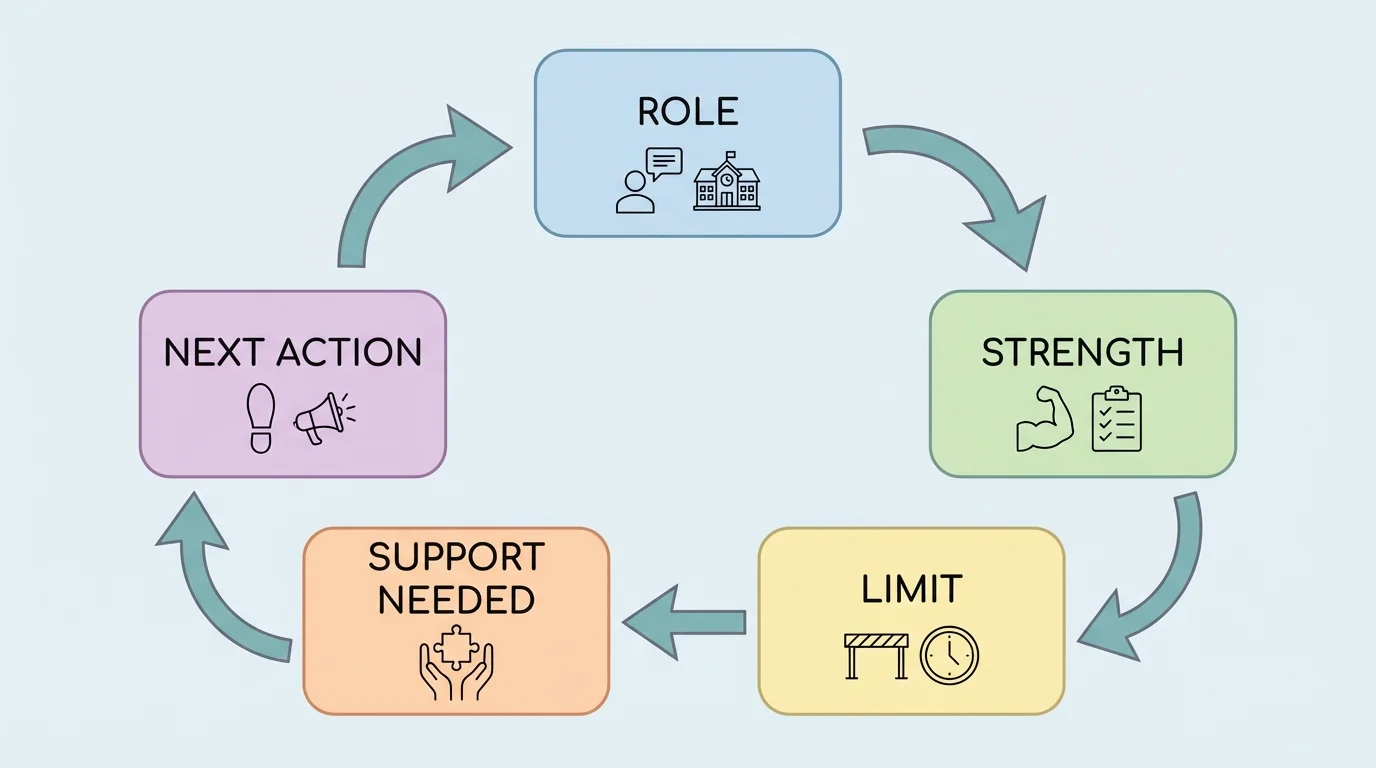
You do not need a complicated system. As [Figure 2] shows, a practical reflection process can be as simple as five steps. Start with the role, name a strength, name a limit, identify a support, and choose one next action.
For example, if your role is "online science project partner," your strength might be creativity, your limit might be trouble speaking live, your support might be notes or practice, and your next action might be to record your part ahead of time or ask to handle visuals while another teammate speaks.
Using the five-step reflection process
Step 1: Name the role.
"I am helping with a weekend community clean-up event."
Step 2: Identify one strength.
"I am dependable and I follow instructions well."
Step 3: Identify one limit.
"I get nervous talking to new people."
Step 4: Name one support.
"I can work with a partner and ask for a clear task."
Step 5: Choose one next action.
"I will sign up for set-up work first and practice one introduction sentence before I go."
This reflection helps you participate without pretending you have no limits.
If you want, you can even use a quick rating system for yourself. For example, after an activity, you might rate your energy, focus, and confidence from low to high. The exact number matters less than the pattern you notice over time.
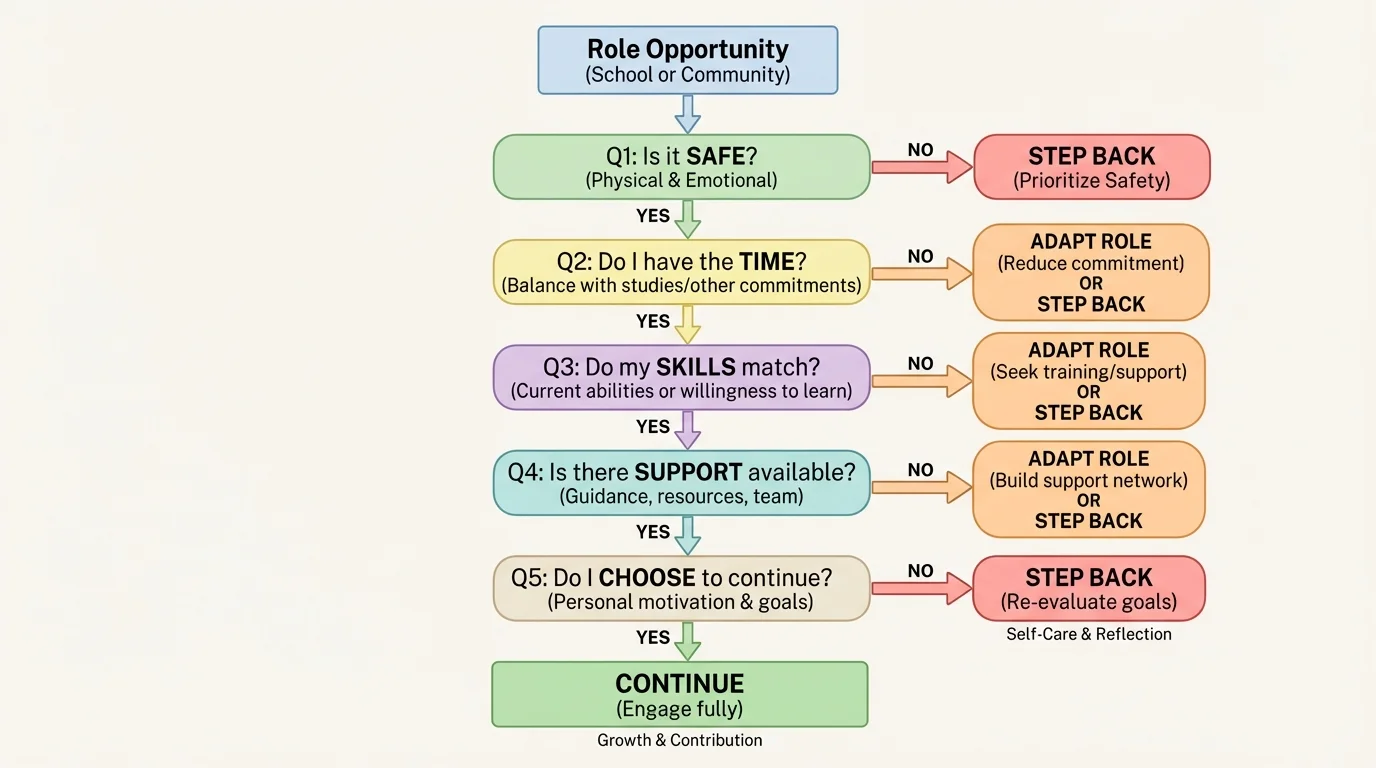
Sometimes students think there are only two choices: do everything or stop completely. In real life, there is usually a middle option. As [Figure 3] shows, you can adjust how you participate. Adapting a role is often more responsible than pushing yourself until you crash.
Adaptations can include asking for extra instructions, breaking a task into smaller parts, changing when you work, choosing a behind-the-scenes job, using reminders, limiting screen distractions, or telling a leader what support you need. These changes help you stay involved while respecting your limits.
For example, if you want to help run a youth club social media page but you miss deadlines, you do not have to quit right away. You might ask to create one post per week instead of daily updates. You might use a calendar reminder. You might work with another student who checks your draft before it is posted.
Sometimes the healthiest choice is to step back from a role. If a commitment is harming your sleep, school progress, health, or relationships, reducing or pausing it may be wise. Boundaries are not selfish when they protect your ability to function well.
Being responsible does not mean saying yes to every opportunity. It means making choices you can actually carry out with honesty and care.
Later, when you review your choices, the decision flow from [Figure 3] can help you ask whether the problem is about effort, skill, support, or overload. Different causes need different responses.
Here are a few realistic examples of how strengths and limits affect participation.
Online school discussion: You understand the material well but feel anxious speaking on live video. Your strength is content knowledge. Your limit is live speaking confidence. A smart adaptation is to type ideas in chat first, practice one short comment before class, or ask if you can share your answer in a discussion board post.
Family responsibilities: You are caring and helpful, but your homework gets pushed later and later because you do not plan your evening. Your strength is generosity. Your limit is time management. A useful step is to make a schedule with a parent or guardian so home tasks and school tasks both have a place.
Volunteer role: You are enthusiastic but inexperienced. Your strength is motivation. Your limit is lack of practice. Instead of acting like you already know everything, you can ask for a demonstration, observe first, and then try the task with guidance.
Friendship and group chats: You are funny and energetic, but sometimes you send messages too quickly and hurt someone's feelings. Your strength is enthusiasm. Your limit is impulse control. A practical strategy is to pause before sending, reread your message, and ask, "Will this sound respectful?"
Club or team role: You are organized and steady, but you do not like leading. That is okay. Participation does not always mean being in charge. You may be most effective as the person who tracks deadlines, shares reminders, or keeps materials in order, just as the process in [Figure 2] reminds you to match actions with your actual strengths and limits.
Case study: Choosing a fair role in a group project
Jordan is in an online history project with three classmates.
Step 1: Jordan notices a strength.
Jordan is strong at researching and making outlines.
Step 2: Jordan notices a limit.
Jordan freezes during live presentations.
Step 3: Jordan communicates honestly.
Jordan tells the group, "I can organize our sources and build the slide order, but I need support with presenting."
Step 4: The group adjusts roles.
Another student does more of the presenting, while Jordan handles research and creates speaker notes.
Jordan still participates fully, but in a way that is realistic and fair.
These examples show that reflection is not about doing less. It is about participating in a smarter way.
Sometimes your strength means you should step up. If you are calm during conflict, you may be the right person to help solve a disagreement. If you are organized, you may be able to coordinate a project timeline. Ignoring your strengths can mean missing chances to contribute.
Other times, knowing your limits means saying no, not now, or not by yourself. If you are already overwhelmed, adding another role can make all your responsibilities weaker. Saying yes when you cannot follow through may disappoint others more than an honest no.
A useful question is: "Can I do this role well enough without harming something important?" If the answer is no, you may need to adapt, delay, or decline.
Your current limits are not always permanent. Many can improve with practice, support, and time. If planning is hard, you can learn to use a checklist. If speaking up is hard, you can practice one sentence at a time. If you interrupt people, you can work on pausing and listening.
Growth is easier when you build from your strengths. For example, if you are creative but disorganized, use your creativity to design a color-coded planner. If you are social but forgetful, ask a friend to be an accountability partner for deadlines. Strong habits often grow faster when they connect to abilities you already have.
Use strengths as tools for improving limits. A strength is not only something to show off. It can also support your weaker areas. A kind student can use empathy to improve teamwork. A curious student can use curiosity to ask better questions when confused. A reliable student can use routines to build better focus.
One small change repeated often can matter a lot. A nightly five-minute check of your tasks, messages, and next-day plan may prevent missed work and last-minute stress. Real growth usually looks small at first, then becomes more noticeable over time.
Here are simple ways to reflect and act in daily life:
The goal is not to become perfect in every role. The goal is to understand yourself well enough to participate with honesty, effort, and wisdom.
When you know your strengths, you can contribute with confidence. When you know your limits, you can protect your energy, seek support, and keep growing. That is what strong self-awareness looks like in real life.
