Some people seem calm under pressure, but usually they are not just "naturally good" at hard moments. They often have systems. When a text message feels rude, when you forget an assignment, when a family member is upset, or when you want to quit something difficult, routines give you something solid to do next. In stressful moments, your feelings can get loud. A routine helps your actions stay thoughtful.
Persistence does not mean pushing forward in a wild, messy way. It means continuing in a steady, thoughtful way even when something feels uncomfortable, frustrating, or unfair. A routine is a repeated set of actions you can count on. When emotions rise, routines protect you from making the situation worse.
Think about two students learning from home. One gets a disappointing grade, feels embarrassed, and avoids checking messages for three days. The problem grows. The other feels disappointed too, but follows a routine: pause, breathe, read feedback, write one question, and make a small plan. The second student still had a bad moment, but the routine kept one setback from turning into a bigger one.
Persistence is continuing to work through difficulty instead of giving up right away.
Conflict is a disagreement or clash between people, ideas, or goals.
Setback is a problem, mistake, or disappointment that slows your progress.
Responsibility is something you are expected to do or take care of.
Resilience is the ability to recover and keep going after stress or difficulty.
Without routines, tough moments can control your choices. You may send a harsh reply, ignore a problem, blame someone else, or quit too quickly. With routines, you create a small space between what happens and what you do next. That space is powerful. It is where better decisions begin.
Persistence is not the same as pretending everything is fine. It is also not the same as arguing forever, refusing help, or forcing yourself to keep going when you are exhausted. Real persistence is flexible. It includes calming down, trying again, making repairs, adjusting your plan, and sometimes asking for support.
A lot of students think, "If I were stronger, I would not feel upset." That is not true. Strong self-management means you notice your feelings and still choose helpful actions. You can be nervous and responsible. You can be angry and respectful. You can be disappointed and still take the next step.
Routines turn big problems into small actions. When a challenge feels huge, your brain may jump to extremes such as "I ruined everything" or "I can't do this." A good routine breaks that moment into a sequence: slow down, figure out what happened, choose one useful action, then continue. This lowers stress and makes persistence easier to practice.
That is why routines should be simple. As [Figure 1] shows, if your plan has too many steps, you probably will not use it when you are upset. The best routine is the one you can remember and actually do.
During stress, a reset routine helps you move from reaction to response. This routine works during conflict, after a mistake, or when a responsibility starts to feel overwhelming.
Start with a short rule you can remember: Pause. Breathe. Name it. Choose. That can take fewer than one minute, but it changes the direction of the moment.
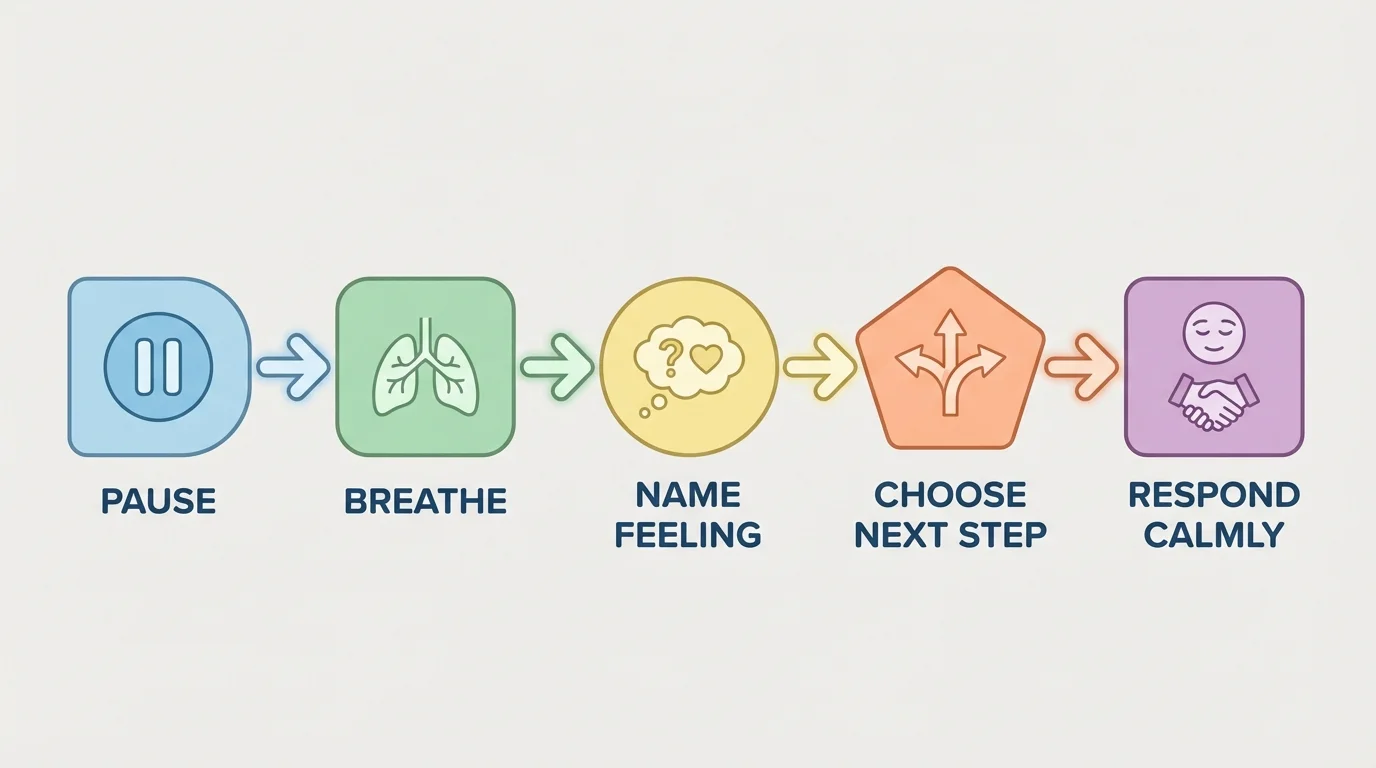
Pause means do not answer right away, do not slam your device shut, and do not make a dramatic decision. Count slowly to 10, take a sip of water, or put your hands flat on a desk. You are not avoiding the problem. You are stopping the emotional rush.
Breathe helps your body settle. Try breathing in for a count of 4, holding for a count of 4, and breathing out for a count of 6. The counts are simple: inhale for \(4\), hold for \(4\), exhale for \(6\). Longer exhales often help your body relax.
Name it means saying what is happening as clearly as possible: "I feel embarrassed." "I'm getting angry." "I'm worried I let someone down." Naming a feeling does not make it bigger. It makes it clearer.
Choose means deciding on the next helpful action. Examples include asking one question, apologizing, rereading instructions, setting a timer for 10 minutes, or stepping away before replying. Later, when you use this process again, [Figure 1] still reminds you that calm action usually starts with a pause, not a perfect mood.
Example: Using a reset routine after an upsetting message
You read a message that sounds insulting during a group project chat.
Step 1: Pause
Do not reply immediately. Put the device down for one minute.
Step 2: Breathe
Take three slow breaths using the \(4, 4, 6\) pattern.
Step 3: Name it
Tell yourself, "I feel disrespected and defensive."
Step 4: Choose
Reply with: "I may be reading this the wrong way. What did you mean?"
The routine lowers the chance of turning one tense message into a bigger conflict.
Your reset routine should fit your life. Some students write a note on paper. Some put a phrase on their device wallpaper. Some keep a glass of water nearby as a signal to pause. The exact tool matters less than using the same pattern again and again.
Conflict is normal. The goal is not to avoid every disagreement. The goal is to handle it without making things worse. A communication routine helps with texts, game chats, social media comments, sibling arguments, and tense conversations with adults, as [Figure 2] illustrates.
One useful routine is Read carefully, check your story, respond clearly, and know when to pause. "Check your story" means asking yourself what explanation your brain is creating. Are you assuming the other person meant to embarrass you? Are you guessing without enough information?
Written messages are especially risky because you cannot always hear tone. A short message like "okay" might mean anger, distraction, or simply "I saw this." Before reacting, ask one clarifying question. For example: "Are you upset with me, or are you just busy?" That question can prevent a lot of unnecessary stress.
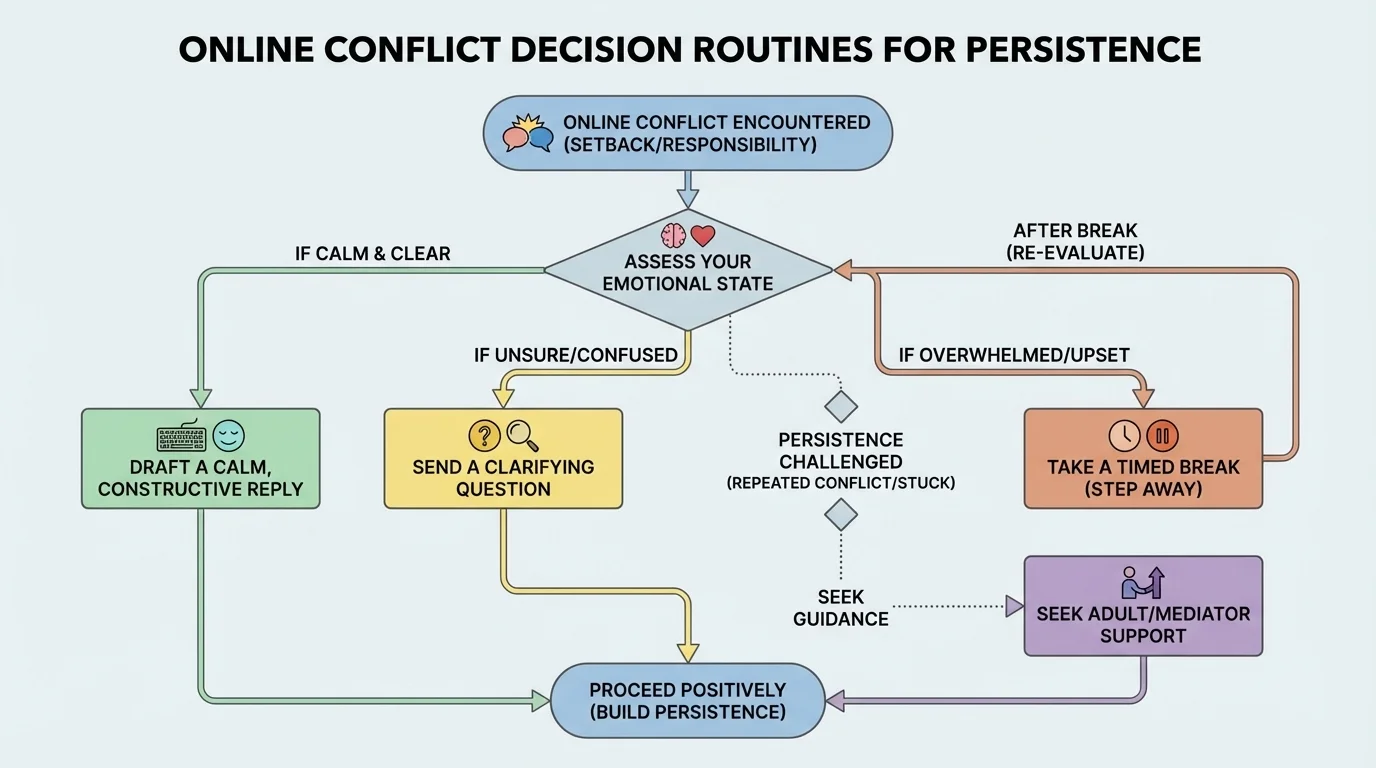
If the conversation is heating up, switch routines. Do not keep typing fast. You can say, "I want to handle this well, so I'm taking a short break and will reply later." That is not weakness. That is self-control.
When you do respond, aim for these habits:
If someone is being cruel, threatening, or repeatedly disrespectful, persistence does not mean staying in the fight forever. It may mean saving messages, blocking contact, telling a trusted adult, or leaving the conversation. As in [Figure 2], a smart routine includes decision points. Not every conflict should be solved by replying more.
Your brain is more likely to misread tone in short digital messages when you are already upset. That is one reason pausing before responding can completely change the outcome of a conflict.
At home, conflict routines matter too. Maybe you forgot a chore, someone blames you for something, or a rule feels unfair. Try this pattern: listen fully, repeat what you heard, say your part calmly, and offer a next step. For example: "I hear that you're upset because I said I would clean up and didn't. I understand that. I'll do it now, and next time I'll set a reminder."
A setback can feel personal, but recovery is a process. You might miss a deadline, lose motivation in a class, forget a commitment, perform badly in a sport or activity, or get corrected by someone you respect. What matters most is what you do next.
The unhelpful pattern looks like this: mistake, shame, avoidance, bigger problem. As [Figure 3] shows, the helpful pattern looks different: mistake, reflection, small action, recovery. You do not need to feel fully confident before starting recovery. You just need the next step.
Try a bounce-back routine with four parts: admit, study, adjust, restart. Admit what happened honestly. Study the cause without insulting yourself. Adjust your plan. Restart quickly. Waiting too long often makes the task feel heavier.
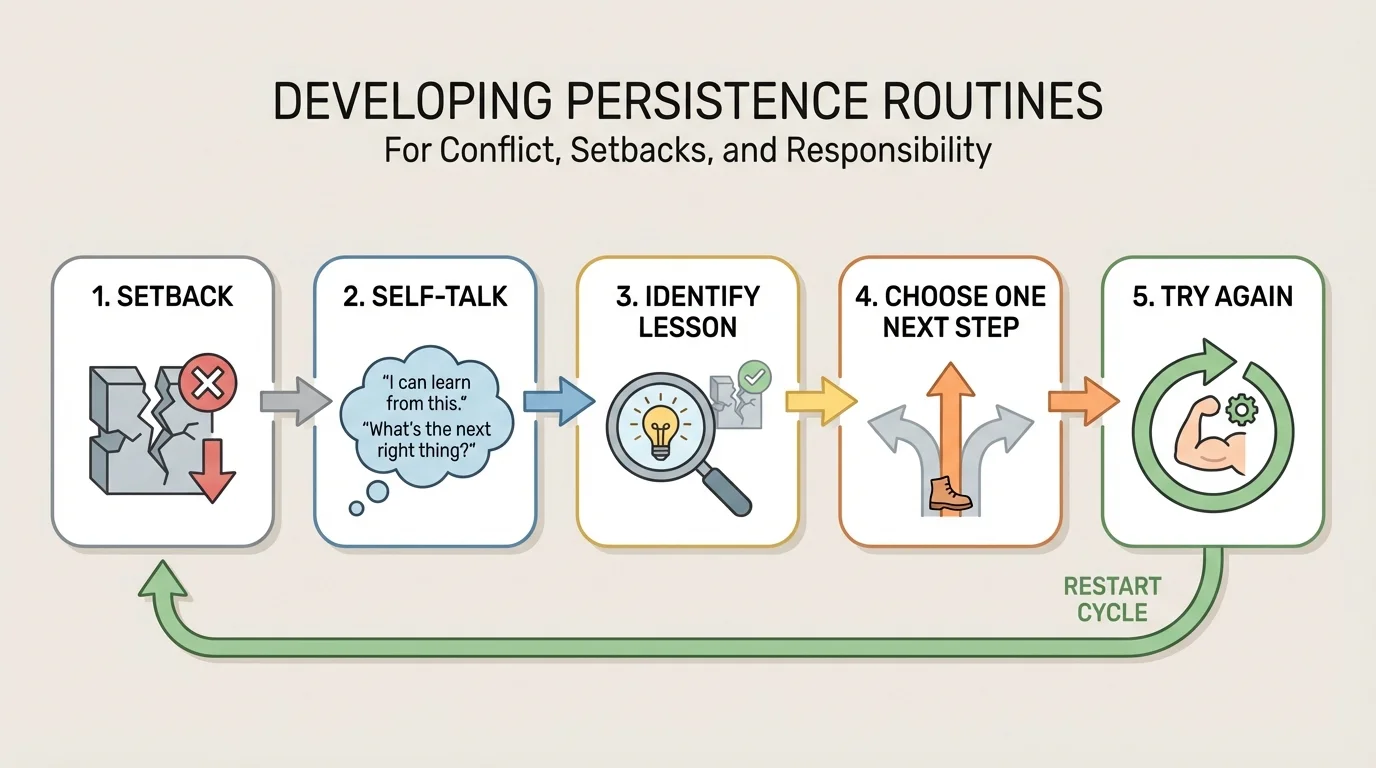
For example, maybe you planned to finish an online assignment but spent too much time watching videos. Instead of saying, "I'm lazy," try: "My plan was weak because I worked near distractions." Then adjust: move your device, use full-screen mode, or set a timer for 15 minutes. The lesson is about the system, not your worth.
Example: Recovering after a missed deadline
You forgot to submit a task on time and feel like hiding from it.
Step 1: Admit
Say the truth clearly: "I missed the deadline."
Step 2: Study
Ask: "Why did this happen?" Maybe you did not write it down, started too late, or got stuck and stopped asking questions.
Step 3: Adjust
Choose one fix: a reminder alarm, a checklist, or asking for help earlier.
Step 4: Restart
Send a respectful message, submit what you can, and begin the next task with the new plan.
This routine helps you learn from the setback instead of becoming stuck in it.
Notice that bounce-back routines use self-talk. Self-talk is the way you speak to yourself in your mind. Harsh self-talk often sounds dramatic: "I always fail." "Everyone thinks I'm irresponsible." Helpful self-talk is honest but steady: "I messed this up, but I can repair it." "This feels bad, and I still know my next step." Later, when you face another disappointment, [Figure 3] still applies: identify the lesson, choose one action, and keep moving.
Responsibility is not only about doing what you want to do. It is also about doing what you said you would do. That may include online coursework, household chores, caring for a pet, showing up on time for an activity, or keeping a promise to help someone.
Responsibilities are easier to manage when you stop depending on memory alone. Memory is useful, but it is not strong enough to carry everything. Build a routine around visible reminders, short planning, and clear finishing steps.
A simple follow-through routine is List it, schedule it, start small, prove it finished. "Prove it finished" means checking the result. Did you actually submit the file? Did you really wash the dishes, or only rinse a few? Did you send the message you promised to send?
| Situation | Unhelpful habit | Helpful routine |
|---|---|---|
| Online assignment | Assume you will remember later | Write it in a planner and set an alert |
| Chore at home | Wait until someone reminds you | Attach it to an existing habit, like doing it right after lunch |
| Group commitment | Stay silent when behind | Send an update early and ask for help if needed |
| Personal goal | Try to do everything at once | Work for 10 to 15 minutes and build momentum |
Table 1. Common responsibility problems and practical routines that help you follow through.
If you break trust, persistence includes repair. Repair means you do not just say "sorry" and disappear. You say what happened, what you will do now, and how you will prevent it next time. That is how responsibility grows.
"You do not rise to the level of your goals. You fall to the level of your systems."
— A common principle of success
One reason this matters is that people begin to trust patterns more than promises. If you are usually late, forgetful, or defensive, others may stop relying on your words. If you develop strong routines, people notice that too. They see consistency.
A routine only helps if you use it often enough for it to become familiar. The beginning is usually the hardest part. You may remember the routine after the problem instead of during it. That is normal. Improvement often looks like this: first you notice too late, then a little sooner, and eventually in the moment.
To make your routine stick, keep it visible and small. Use a note on your desk, a checklist in your planner, a reminder on your device, or a short phrase you can repeat. "Pause first." "One next step." "Repair quickly." Short cues are easier to remember under stress.
Habits grow faster when they connect to things you already do. If you already check your planner each morning, add your responsibility list there. If you already drink water before starting schoolwork, use that moment as your reset cue.
It also helps to prepare for predictable trouble spots. Ask yourself: When do I usually react badly? When do I usually avoid work? When do I forget responsibilities? Build routines around those moments, not around your best days.
Here are practical ways to strengthen your routine:
You do not need a perfect streak. If you used your routine 3 times this week and 5 times next week, that is growth. In simple numbers, that change is \(5 - 3 = 2\) more successful uses. Small improvements count because routines are built through repetition.
Being persistent does not mean handling everything alone. If conflict becomes threatening, if stress feels too big to manage, if you keep shutting down, or if a responsibility problem keeps repeating even after trying new routines, reach out to a trusted adult. That might be a parent, guardian, counselor, coach, mentor, or teacher online.
Asking for help is not quitting. It is a responsible action. You can say, "I keep getting stuck when I'm upset, and I want help building a better routine," or "I'm trying to fix this pattern, but I need support." Those are strong sentences.
Example: What asking for help can sound like
You are having repeated conflict in a gaming group and your reset routine is not enough.
Step 1: State the pattern
"This has happened several times, and I'm getting overwhelmed."
Step 2: Explain what you already tried
"I paused before replying and asked clarifying questions, but the conflict keeps growing."
Step 3: Ask for support clearly
"Can you help me decide what to do next?"
This keeps you active in the solution instead of waiting for someone else to fix everything.
Your routines will not make hard moments disappear. Conflict will still happen. Setbacks will still happen. Responsibilities will still pile up sometimes. But routines give you a reliable way to respond. Over time, that is how persistence becomes part of your character: not through one heroic moment, but through many steady choices.
