Have you ever seen a group chat change someone's behavior in just a few minutes? One message can make people laugh together, but it can also push someone to pile on, stay silent when something is wrong, or leave a person out. That is why learning to evaluate social pressure matters. It helps you notice what is happening around you instead of getting swept along by it.
Social pressure affects more than one moment. It shapes who feels welcome, who gets heard, and what a group becomes known for. In online communities, neighborhood activities, sports teams, clubs, volunteer groups, and friend circles, pressure can lead to fairness or unfairness, belonging or exclusion, kindness or harm. When you understand it, you can make choices you are proud of.
People often think pressure is only about someone saying, "Come on, do it." But pressure can be much quieter. It can be the fear of being ignored, the wish to fit in, the idea that "everyone else is doing it," or the worry that speaking up will make you the next target. These forces are strong because most people want connection and acceptance.
That does not make social pressure always bad. Pressure can also encourage good behavior. A group can make kindness normal, remind each other to include new people, or stop gossip before it spreads. The important skill is not avoiding all influence. It is learning how to tell whether the influence is helping the community or hurting it.
Social pressure is the influence a group has on a person's thoughts, words, or actions. Fairness means using consistent and respectful standards for everyone. Inclusion means making sure people feel welcomed, valued, and able to participate. Community behavior is the way people act together in a shared group, space, or network.
When you assess social pressure well, you ask questions like: Who benefits? Who gets hurt? Are the same rules being applied to everyone? Is someone being pushed out? Are people acting from values or just reacting to the crowd?
Social pressure can be direct or indirect, as [Figure 1] shows through the path from a group message to a personal choice. Direct pressure happens when someone openly pushes you: "Post this," "Don't invite them," or "If you're really with us, prove it." Indirect pressure happens when no one orders you, but the group mood sends a message anyway. Maybe everyone is liking a rude post, ignoring one person on a video call, or laughing at a cruel joke.
Pressure can also be positive or negative. Positive pressure encourages behavior that protects people and improves the group. Negative pressure encourages behavior that is unfair, unsafe, dishonest, or excluding. The same group can create both kinds at different times.
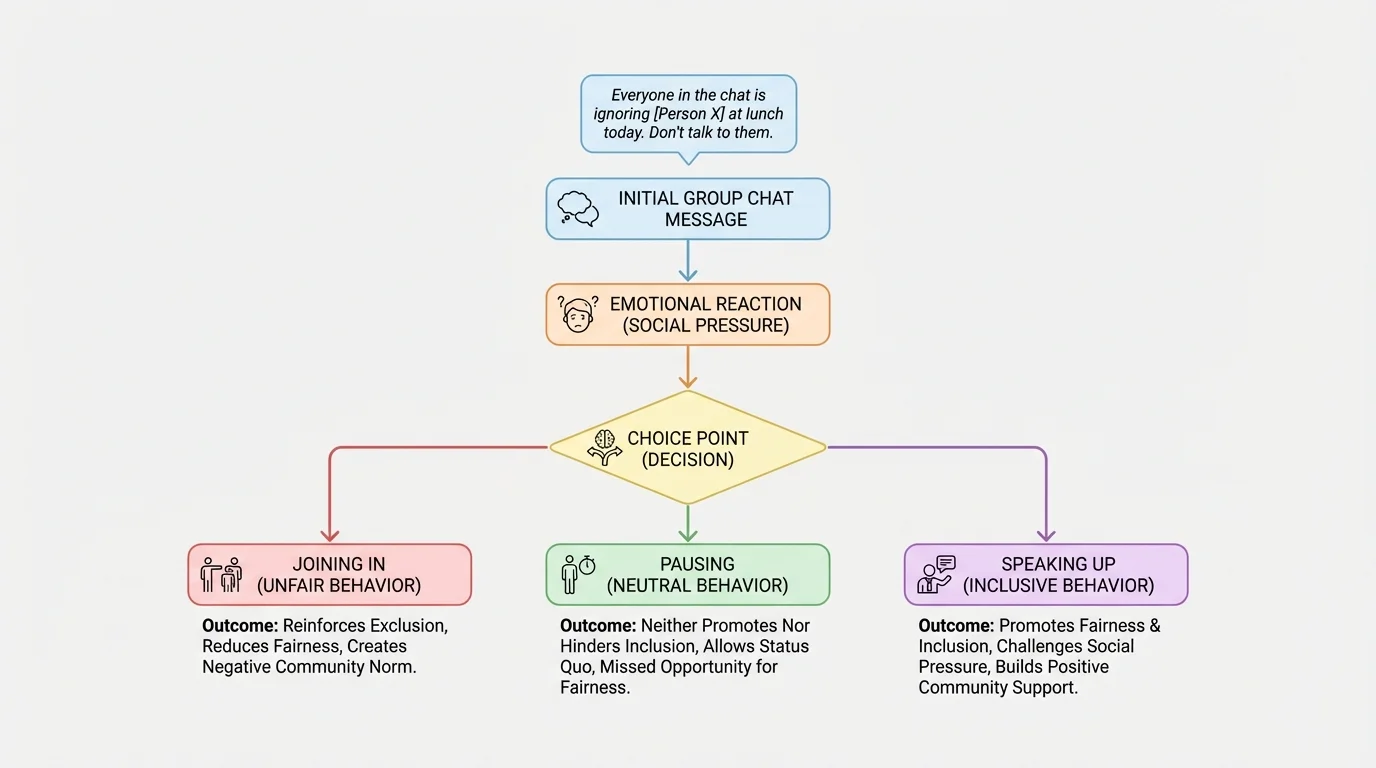
Online spaces can increase pressure because reactions happen fast. Likes, comments, reposts, and silence all send signals. If a person sees ten laughing responses to a mean comment, they may feel pushed to join even if they know it is wrong. If they see one person calmly saying, "Let's not do this," that can change the direction too.
This matters because group behavior often becomes a pattern. As we saw in [Figure 1], the moment between feeling pressure and making a choice is small but powerful. A quick pause can stop you from doing something unfair just to keep your place in the group.
Researchers who study group behavior have found that people often go along with a group even when they privately disagree. That does not mean people are weak. It means belonging feels powerful, which is why self-awareness and empathy are such important skills.
One useful rule is this: if you feel rushed, watched, or afraid of being left out, you may be under pressure. That is your signal to slow down and think before acting.
Fairness means people are treated by clear, respectful standards rather than by popularity, fear, or favoritism. Social pressure can damage fairness when a group excuses bad behavior from one person but punishes the same behavior in someone less popular. This can make the same decision look very different when rules are consistent versus when status controls the outcome.
[Figure 2] For example, suppose an online club is choosing who gets to present a project. A fair process might use clear guidelines such as preparedness, effort, or rotating turns. An unfair process might ignore those standards and choose only the people the group already likes. That may seem small, but repeated unfair choices tell some people, "You do not count as much here."
Pressure also affects fairness when people stay silent. If a group knows a decision is biased but no one wants to challenge the crowd, unfairness becomes normal. Silence does not always mean agreement. Sometimes it means fear. But if no one interrupts the pattern, the pattern grows.
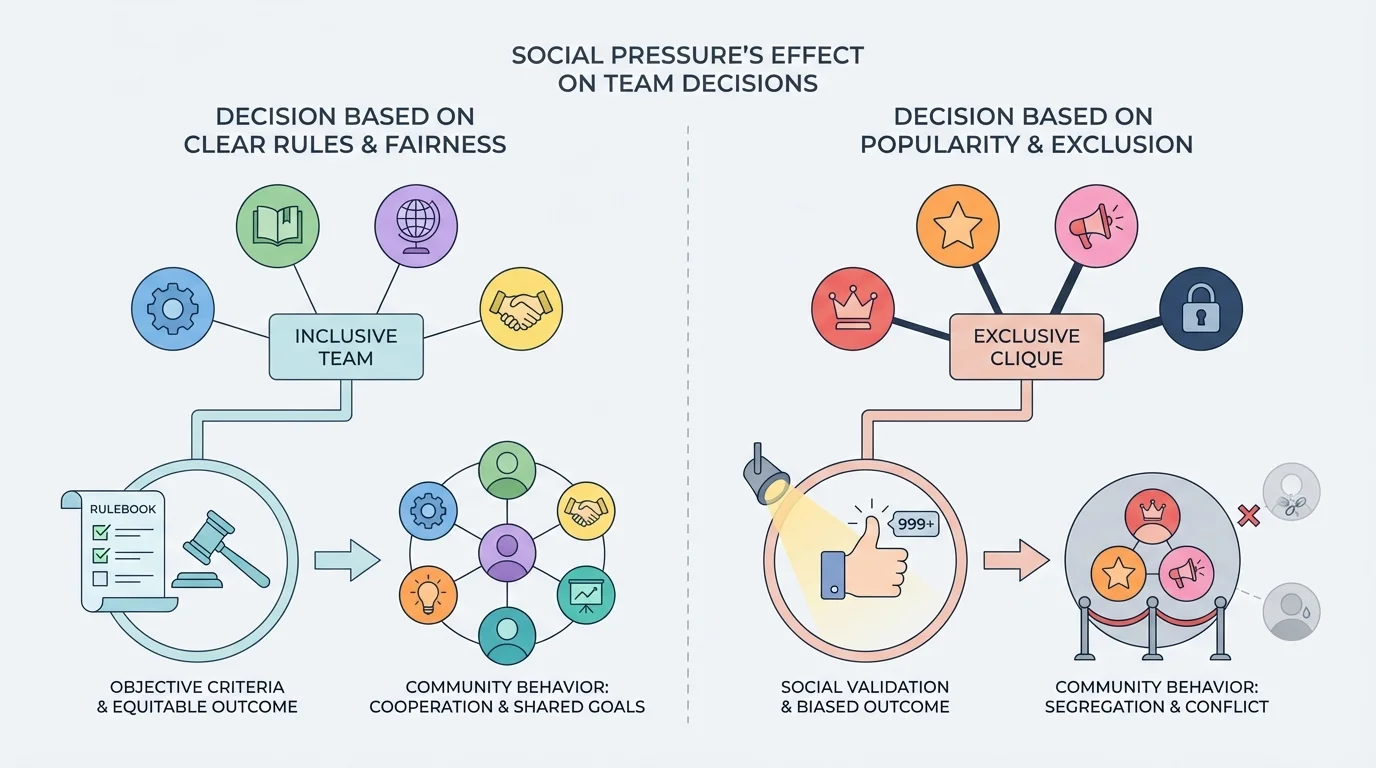
Another fairness problem is favoritism. Favoritism happens when someone gets special treatment because of closeness, popularity, or group status instead of fair reasons. In a gaming group, that might mean certain players get endless second chances while others get mocked or removed quickly for the same mistake.
Pressure can also lead to double standards. A joke is called "harmless" when one person says it but "rude" when another person says the same thing. A mistake is forgiven for a leader but not for a new member. Later, when you assess a conflict, remember what [Figure 2] makes visible: fairness depends on consistent standards, not on who has the loudest supporters.
| Situation | Fair Response | Unfair Response Under Pressure |
|---|---|---|
| A group chooses a leader | Use clear criteria and let everyone be considered | Pick the most popular person automatically |
| Someone makes a mistake online | Respond calmly and privately if possible | Publicly shame them because others are doing it |
| A rule is broken | Apply the same consequence to everyone | Excuse one person and punish another |
| A new person joins | Explain expectations and include them | Ignore them because the group already has its favorites |
Table 1. Comparison of fair responses and unfair responses that can result from social pressure.
When fairness weakens, trust weakens too. People stop believing the group will treat them honestly. That can make them less likely to join, contribute, or ask for help.
Inclusion is more than inviting someone once. It means people are not pushed to the edge because they are different, quiet, new, unpopular, or misunderstood. Social pressure harms inclusion when the group treats exclusion as normal.
This can happen in subtle ways. Maybe a group keeps making inside jokes on a call and never explains them. Maybe people create a private chat that leaves out one person on purpose. Maybe everyone follows the same creators, interests, or style, and anyone who does not match gets dismissed. No one may say, "You do not belong," but the message still lands.
How exclusion spreads
Exclusion often starts with small signals: ignoring a message, not answering a question, posting without including someone, or acting as if one person's ideas never count. When these actions repeat, they become a group norm. A norm is an unwritten rule about what behavior feels acceptable in the group.
Pressure can also make people go along with stereotypes, which are oversimplified ideas about a group of people. Stereotypes are unfair because they treat people like labels instead of individuals. If a group assumes someone is "too quiet to lead," "too new to understand," or "not really one of us," that pressure can close doors before a person even gets a chance.
Empathy helps interrupt that. Empathy means trying to understand how another person might feel or what their experience might be like. It does not require you to agree with everything someone says. It requires you to remember that your actions affect a real person.
Ask yourself: If I were new here, would this feel welcoming? If I were the one being joked about, would I call this "just kidding"? If my message was ignored over and over, would I still feel like I mattered? Those questions can reveal whether social pressure is pushing the group away from inclusion.
"The test of a group is not how it treats the most popular person, but how it treats the person with the least power in the moment."
Inclusive groups are not perfect. People still make mistakes. The difference is that they notice harm sooner, correct it more honestly, and make room for people to belong.
Community behavior is the overall pattern of how people act together. A single choice may seem tiny, but repeated choices become a reputation. If a group rewards mockery, mockery spreads. If a group rewards honesty and respect, those spread too.
This is the ripple effect of social pressure. One person starts a behavior, others copy it, and soon it feels normal. In a volunteer project, one person cutting corners may push others to do the same. In a neighborhood event, a few people welcoming newcomers can make friendliness contagious. In an online fandom, a few loud voices can create a hostile mood unless others set a different tone.
Norms matter because people often look around to decide what is acceptable. If the group acts as if cruelty is entertainment, more people may join in. If the group acts as if kindness is standard, more people usually follow that lead. That is why your behavior matters even when you are not the leader.
You already know that actions have consequences. In group situations, those consequences are shared. Your choice does not affect only you; it can shape what others think is normal.
Healthy community behavior includes listening, accountability, respectful disagreement, and making space for different people. Unhealthy community behavior includes dogpiling, gossip, humiliation, exclusion, and acting like harm is funny or "not a big deal."
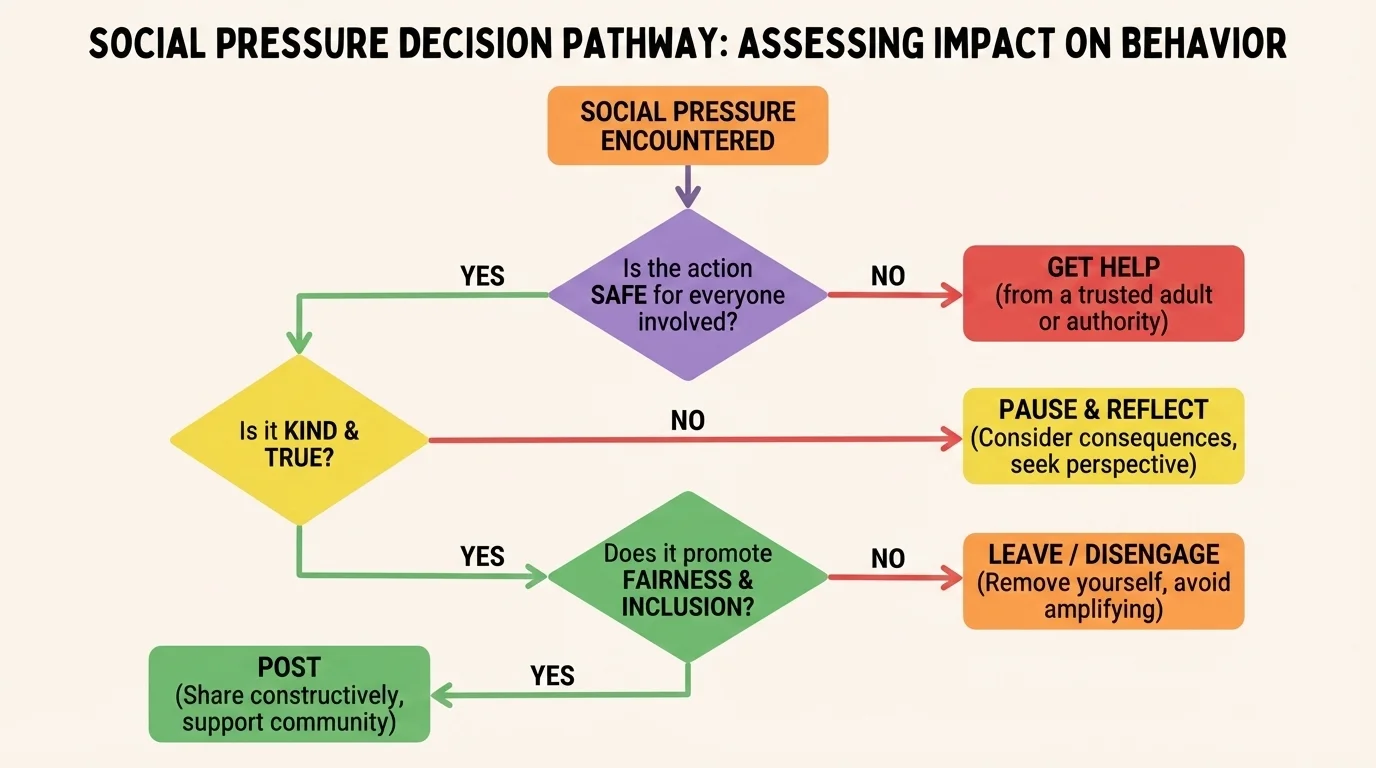
When pressure hits fast, you need a simple process. A quick assessment tool can help you slow down and evaluate what is really happening instead of reacting automatically.
[Figure 3] Use this checklist in your head before you comment, repost, joke, agree, or stay silent. Even a pause of a few seconds can protect your judgment.
Step 1: Notice the pressure. Are you feeling rushed, nervous, eager to impress, or worried about being left out?
Step 2: Name the behavior. What exactly is happening? Is someone being mocked, ignored, blamed unfairly, or excluded?
Step 3: Check fairness. Are the same standards being used for everyone, or is popularity changing the rules?
Step 4: Check inclusion. Is this helping people belong, or is it pushing someone to the outside?
Step 5: Check truth and harm. Is the information even accurate? Could reposting or joining in embarrass, isolate, or hurt someone?
Step 6: Choose your response. You can pause, say something respectful, message someone privately, leave the conversation, or get adult help if the situation is serious.
Later, when you feel uncertain, return to the path in [Figure 3]. It reminds you that you usually have more than two choices. You do not have to either join in or make the situation more confrontational. There are calm, smart middle options.
Case study: a group chat starts targeting one person
A few people begin making fun of someone's photo in a chat. Others react with laughing messages. You feel pressure to respond.
Step 1: Notice the signal
You realize you are worried that staying silent might make you look different from the group.
Step 2: Assess fairness and inclusion
The person being mocked is not present to respond, and the comments are targeting them instead of discussing a real issue. This is unfair and excluding.
Step 3: Pick a response
You could avoid reacting, send a calming message such as "Let's stop," or privately check in with the targeted person. If it continues, save evidence and tell a trusted adult.
This response protects your values and reduces harm instead of feeding the crowd.
Assessing social pressure is not about overthinking every interaction. It is about noticing when a moment could affect someone's dignity, access, or sense of belonging.
Once you realize pressure is leading toward unfairness or exclusion, you need practical actions. You do not always have to make a big speech. Small moves can be powerful.
Pause before posting. Fast reactions often support the group mood without reflecting your actual values.
Use calm language. Saying "Let's not do that," "That seems unfair," or "We should include them" is often more effective than attacking the group.
Support privately when needed. If someone is being left out or embarrassed, a direct message can remind them they are not alone.
Refocus on standards. Bring the conversation back to clear expectations: "Can we use the same rule for everyone?" or "Let's decide based on effort, not popularity."
Leave harmful spaces. If a chat, call, or online group keeps rewarding cruelty, stepping away is a strong choice, not a weak one.
Get help when necessary. Repeated targeting, threats, humiliation, or harassment should not be handled alone.
Helpful response starters
These phrases are simple, respectful, and useful in real situations.
Step 1: To challenge unfairness
"Can we slow down and use the same standard for everyone?"
Step 2: To support inclusion
"We should ask them too." or "They deserve a chance to join."
Step 3: To resist harmful pressure
"I'm not comfortable with this." or "I'm not reposting that."
Step 4: To interrupt pile-ons
"This is getting mean. Let's stop."
Short statements can shift the tone without creating extra drama.
Sometimes people worry that speaking up will make them unpopular. That can happen. But going along with harmful pressure can damage your trustworthiness and another person's well-being. Short-term approval is not worth long-term harm.
Groups always influence people, so one of the smartest things you can do is help create positive peer influence. That means using your example and your words to make fairness and inclusion feel normal.
You can do that by welcoming new members, crediting people for ideas, refusing to laugh at mean jokes, and backing up someone who speaks respectfully. You can also make group expectations visible: no humiliating posts, no exclusion games, no spreading private screenshots, and no changing rules based on popularity.
Positive pressure works because people notice what gets supported. If kindness is respected, more people feel safe being kind. If accountability is normal, fewer people get away with "I was just joking" after causing harm.
One calm person can influence a whole group more than you might expect. When even one person refuses harmful pressure, others often feel less alone and more willing to do the same.
This is leadership, even if you are not officially in charge. Leadership is often just the courage to help a group move toward better behavior.
Here are a few ways this can look in everyday life.
Scenario 1: Social media pile-on. A creator makes a mistake, and comments become cruel fast. Fairness means responding to the actual issue, not turning the person into entertainment. Inclusion means not joining harassment. A healthy community can criticize behavior without dehumanizing someone.
Scenario 2: Community sports team. A team captain keeps passing only to friends during practice outside of school. Pressure makes others act like it is fine. Fairness means using equal chances and team goals, not friendship status. Inclusion means making sure every player can participate and improve.
Scenario 3: Volunteer event. New volunteers are ignored because experienced members already know each other. No one is openly rude, but the result is exclusion. Positive pressure could look like assigning welcome buddies or making sure each new person gets a role and information.
Scenario 4: Gaming server. Members tease one player constantly and call it "tradition." If the target laughs along, others may assume it is okay. But fairness and empathy require checking whether the person actually feels safe and respected. Repeated humiliation is still harmful even if it is disguised as humor.
Scenario 5: Video-call project group. One person's ideas are interrupted repeatedly while another person's similar ideas get praised. Social pressure can hide this pattern because it feels normal in the moment. Assessing fairness means noticing whose voice gets space and whose does not.
Some situations are too serious to manage alone. If social pressure involves threats, blackmail, repeated harassment, hate speech, sharing private images or messages, dangerous dares, or nonstop targeting, involve a trusted adult right away. Save screenshots or records if it is safe to do so.
Getting help is not tattling when someone is being harmed. It is a responsible action that protects people and interrupts damaging patterns. Communities become safer when serious behavior is not hidden or minimized.
Trusted adults might include a parent, guardian, coach, club leader, counselor, or another adult who can take concerns seriously. Be specific when you explain what happened: who was involved, what was said or posted, how often it happened, and why it felt unsafe or unfair.
