A group chat can feel welcoming in one minute and hostile in the next. Sometimes the difference is not a huge event. It is one joke that crosses a line, one person being ignored, or one assumption made about someone's background, identity, beliefs, needs, or experiences. The good news is that community can also be built through small choices. When you learn how to make those choices on purpose, you help create spaces where people feel respected instead of pushed aside.
Respect across differences matters because you will be part of many communities: your family, neighborhood, sports team, volunteer group, online class discussions, gaming spaces, clubs, faith communities, and future workplaces. In every one of those places, people bring different personalities, cultures, languages, traditions, opinions, abilities, and life experiences. Knowing how to work with those differences is a life skill, not just a "be nice" rule.
When people feel respected, they are more likely to speak honestly, share ideas, ask questions, and solve problems together. When people feel judged or excluded, they often shut down, get defensive, leave, or strike back. That affects friendships, teamwork, safety, and trust. Community-minded action means thinking beyond yourself and asking, What helps this group become safer, fairer, and more welcoming?
Community-minded action is a choice that helps a group work better and helps people feel respected, included, and safe.
Respect across differences means treating people with dignity even when they are different from you in identity, background, beliefs, ability, communication style, or opinion.
Empathy means trying to understand what someone else may be feeling or experiencing.
Inclusion means making sure people have a real chance to participate and belong.
Being respectful does not mean you have to agree with everyone. It does mean you avoid treating people as less important because they are different. You can disagree with someone's opinion while still speaking and acting with care.
Differences can be visible, like age, language, or clothing, and they can be invisible, like religion, learning needs, mental health challenges, family situation, or personal history. You usually do not know everything about another person. That is why assumptions are risky.
A stereotype is a fixed idea about a group that gets applied to individuals. Stereotypes can sound casual, but they often cause real harm. For example, saying "people like you always…" treats someone like a label instead of a person. Community-minded people notice patterns carefully, but they do not reduce people to categories.
Another important word is bias. Bias is a tendency to think in a certain direction, often without realizing it. Everyone has biases because the brain often uses mental shortcuts. The goal is not to pretend you have none. The goal is to slow down, check your thinking, and choose fair behavior anyway.
Your brain often makes quick judgments before you have all the facts. That can help in emergencies, but in social situations it can lead to unfair assumptions unless you pause and think.
One of the strongest respect skills is curiosity. Curiosity sounds like: "Can you tell me more about that?" or "I haven't experienced that before." Judgment sounds like: "That's weird," "That makes no sense," or "People should just do things normally." Respect grows when curiosity is stronger than judgment.
Start by observing without rushing to explain. Maybe someone keeps their camera off during a video call. You might assume they are lazy or uninterested. But there could be many reasons: internet issues, a crowded home, anxiety, a cultural preference, or needing privacy. Respectful behavior means you do not shame them based on a guess.
This does not mean ignoring harmful behavior. It means separating facts from stories you tell yourself. A fact is "Jordan has not replied for two days." A story is "Jordan does not care." Facts help you respond wisely. Assumptions often increase conflict.
A useful habit is to ask yourself three questions before reacting: What do I know for sure? What might I be assuming? What is the most respectful next step? These questions can stop a lot of unnecessary drama.
Respect is active, not passive
Respect is more than avoiding obvious insults. It includes who gets invited, who gets listened to, whose ideas are credited, whose needs are considered, and whether people feel safe joining in. Sometimes harm happens through silence and exclusion, not just through mean words.
That is why community-minded action often looks small from the outside. Inviting someone into a conversation, pronouncing their name correctly, waiting your turn, or asking what support they need may seem minor. But repeated over time, those actions change the whole mood of a group.
Respectful communities are built from repeatable choices, as [Figure 1] shows in common online and community situations. You do not need a perfect speech or a big leadership role. You need steady habits that tell others, "You matter here."
One habit is listening to understand. On a video call, that might mean not interrupting, not rolling your eyes, and not typing rude side comments while someone speaks. In a group message, it might mean reading carefully before reacting. In a community activity, it might mean making room for quieter people instead of letting the loudest person control everything.
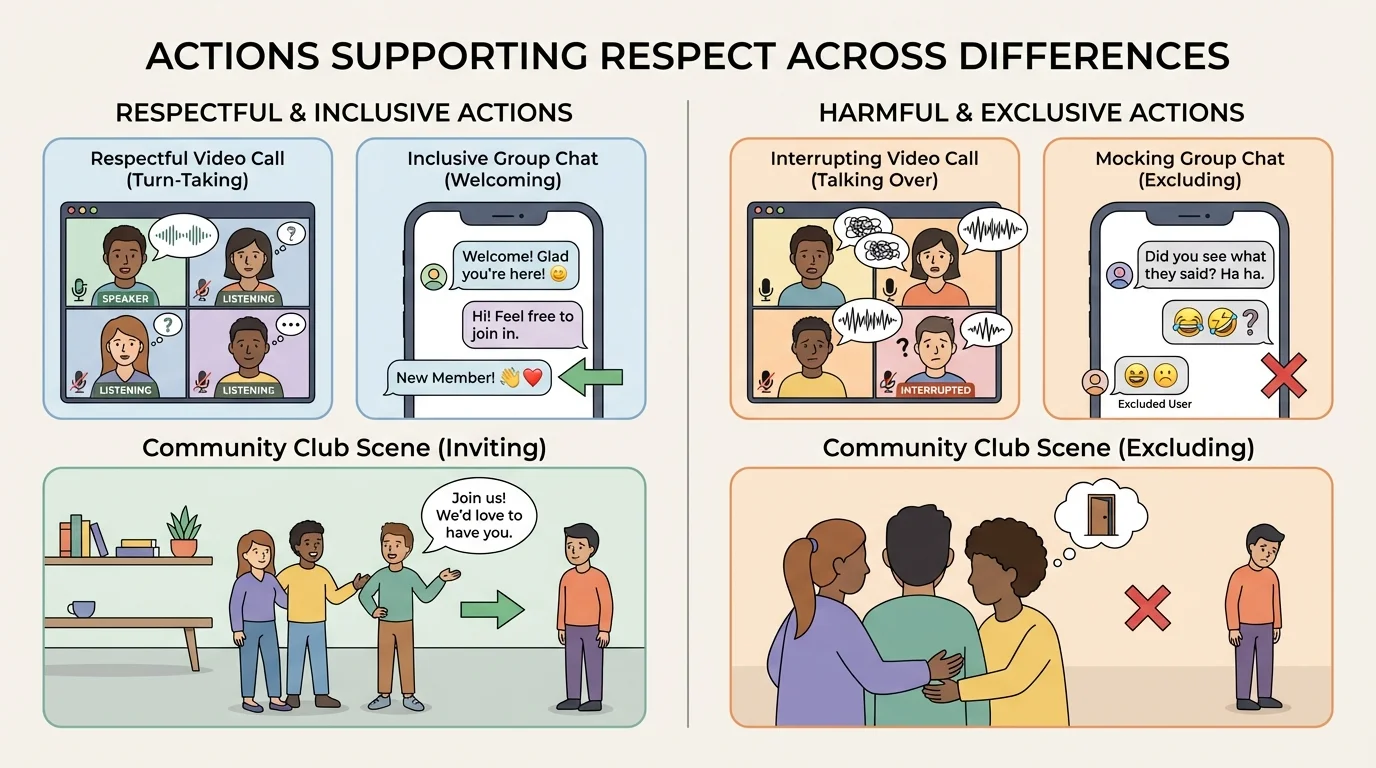
Another habit is using inclusive language. That means choosing words that do not mock accents, identities, traditions, or differences in ability. It also means avoiding "jokes" that depend on putting a group down. A joke is not harmless if the target is expected to laugh just to avoid being isolated.
A third habit is sharing space. If you often speak first, try pausing. If you lead often, try asking, "What do the rest of you think?" If you notice one person getting ignored in a group chat, you can say, "I think Maya had an idea too." Respect is not only about your own voice. It is also about whether others get a fair chance to use theirs.
A fourth habit is learning before commenting. If someone shares a tradition, identity, or experience you do not know much about, do not rush to debate their reality. It is okay to ask respectful questions, but it is not respectful to demand that someone prove their worth or explain their pain for your convenience.
A fifth habit is keeping private things private. If someone tells you something personal, sharing it without permission can break trust fast. Respect across differences includes respecting different comfort levels about what people want made public.
These habits matter in digital life too. Digital inclusion means making online spaces easier for others to join. That can include using clear messages, not flooding chats with inside jokes that shut others out, and checking whether everyone understands the plan.
| Situation | Unhelpful choice | Community-minded choice |
|---|---|---|
| New person joins an online club | Ignore them and continue inside jokes | Welcome them and explain what the group is doing |
| Someone speaks differently from you | Mock their accent or wording | Listen carefully and ask politely if you missed something |
| You disagree in a chat | Use sarcasm or attack the person | Respond to the idea and stay calm |
| Someone is quiet | Assume they have nothing to add | Invite them to share without pressuring them |
| A friend makes an offensive joke | Laugh along to fit in | Say it is not okay or redirect the conversation |
Table 1. Examples of everyday choices that weaken or strengthen respect across differences.
Later, when you think about how a community becomes welcoming, remember the patterns in [Figure 1]. Respect usually looks ordinary: taking turns, welcoming people in, and stopping mocking behavior before it becomes normal.
Differences do not become a problem only when people disagree badly. A simple process, shown in [Figure 2], helps you handle tense moments without losing respect for yourself or others. This matters online because typed words can sound harsher than you intended, and fast replies can turn a small disagreement into a bigger conflict.
Step 1: Pause before replying. If your body feels tense, your heart is racing, or you want to "win" immediately, that is a sign to slow down. A pause can be as short as taking three breaths, rereading the message once, and deciding not to answer while angry.
Step 2: Clarify what was meant. You can say, "I want to make sure I understood your point," or "Are you saying…?" Sometimes conflict gets worse because people react to what they think was said, not what was actually meant.
Step 3: State your view without insulting the person. A useful sentence frame is: "I see it differently because…" Another is: "I disagree with that idea, but I want to keep this respectful." These phrases protect dignity while making your position clear.
Step 4: Set a boundary if needed. If someone becomes rude, threatening, or targeted, you do not have to stay in the conversation. You can say, "I'm willing to talk if we keep it respectful," or "I'm leaving this chat if the insults continue." Boundaries are not punishments. They are limits that protect safety.
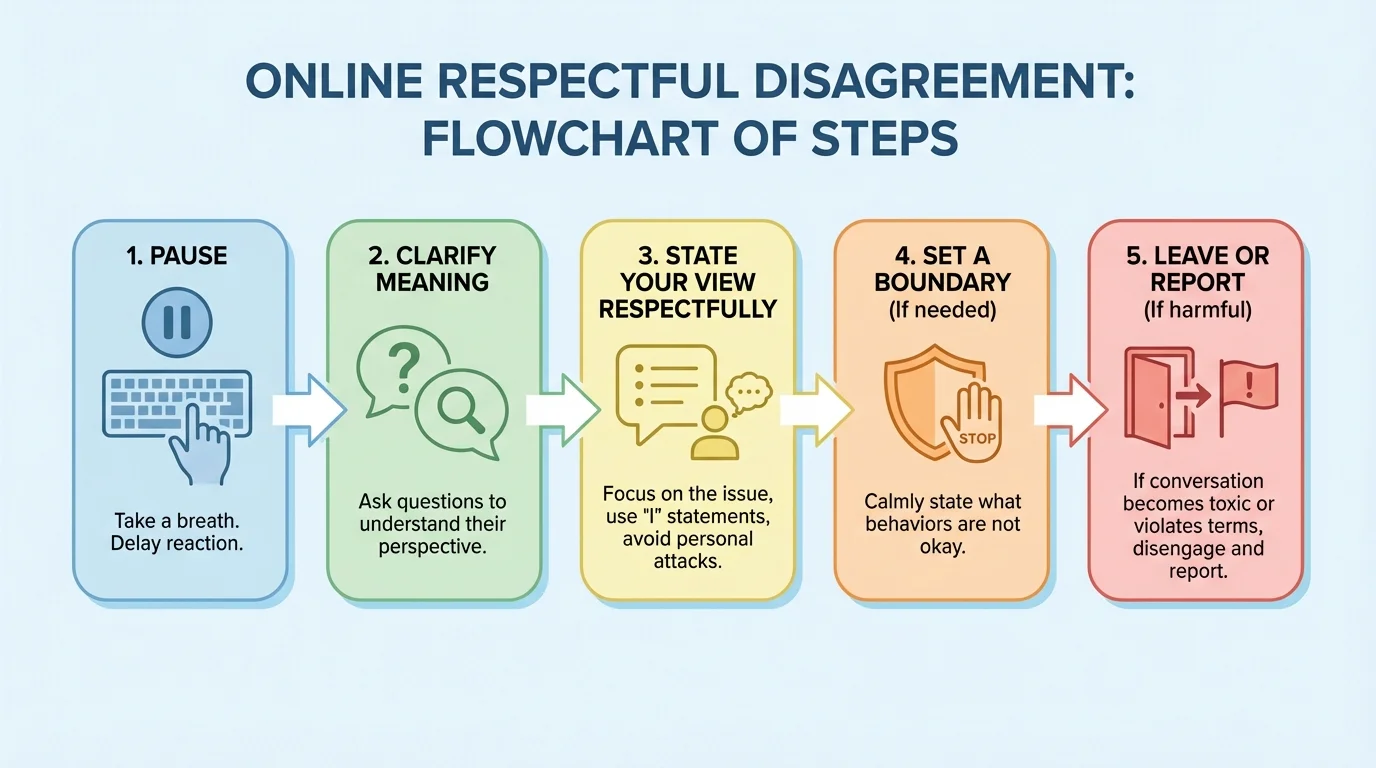
Step 5: Report or get help if harm continues. If a conversation includes harassment, hate, threats, or repeated targeting, do not try to handle everything alone. Save evidence if needed and tell a trusted adult, program leader, moderator, or another responsible person.
Scenario: disagreement in a group chat
Your community volunteer team is discussing an event online. One person writes, "That idea is stupid." You feel angry because they are talking about your plan.
Step 1: Pause instead of attacking back.
You do not type, "You're the stupid one." You wait, breathe, and reread the message.
Step 2: Clarify and redirect.
You reply, "Can you say what part of the plan you're concerned about? I want to understand your issue."
Step 3: Set the tone.
If the person keeps insulting, you say, "I'm okay discussing the idea, but not name-calling."
Step 4: Get support if needed.
If the person continues, you save the messages and contact the adult organizer.
This protects your dignity and makes the group safer for others too.
Respectful disagreement is not weak. It takes more self-control than sarcasm, public shaming, or revenge posting. It also makes you more trustworthy, because people learn that you can handle conflict without becoming cruel.
When you look back at the process in [Figure 2], the key idea is that disagreement should move toward understanding, boundaries, or safety, not toward humiliation.
If someone is mocked, excluded, or attacked, there are several safe ways to help, as [Figure 3] explains. You do not have to be the loudest person in the room to make a difference. In fact, some of the most effective support is quiet, steady, and specific.
You might be a bystander, which means you are present when something harmful happens but are not the person being targeted. Bystanders have power because group behavior often changes when even one person refuses to go along with the harm.
One option is interrupting. That can be as simple as, "Not okay," "Let's stop," or "We're not doing that here." Another option is redirecting. You can change the topic, move attention away from the harmful behavior, or invite the targeted person into another conversation.
Another option is checking in privately. A message like "I saw what happened. Are you okay?" can matter a lot. It tells the person they were not invisible. If they want help reporting the situation, you can offer support.
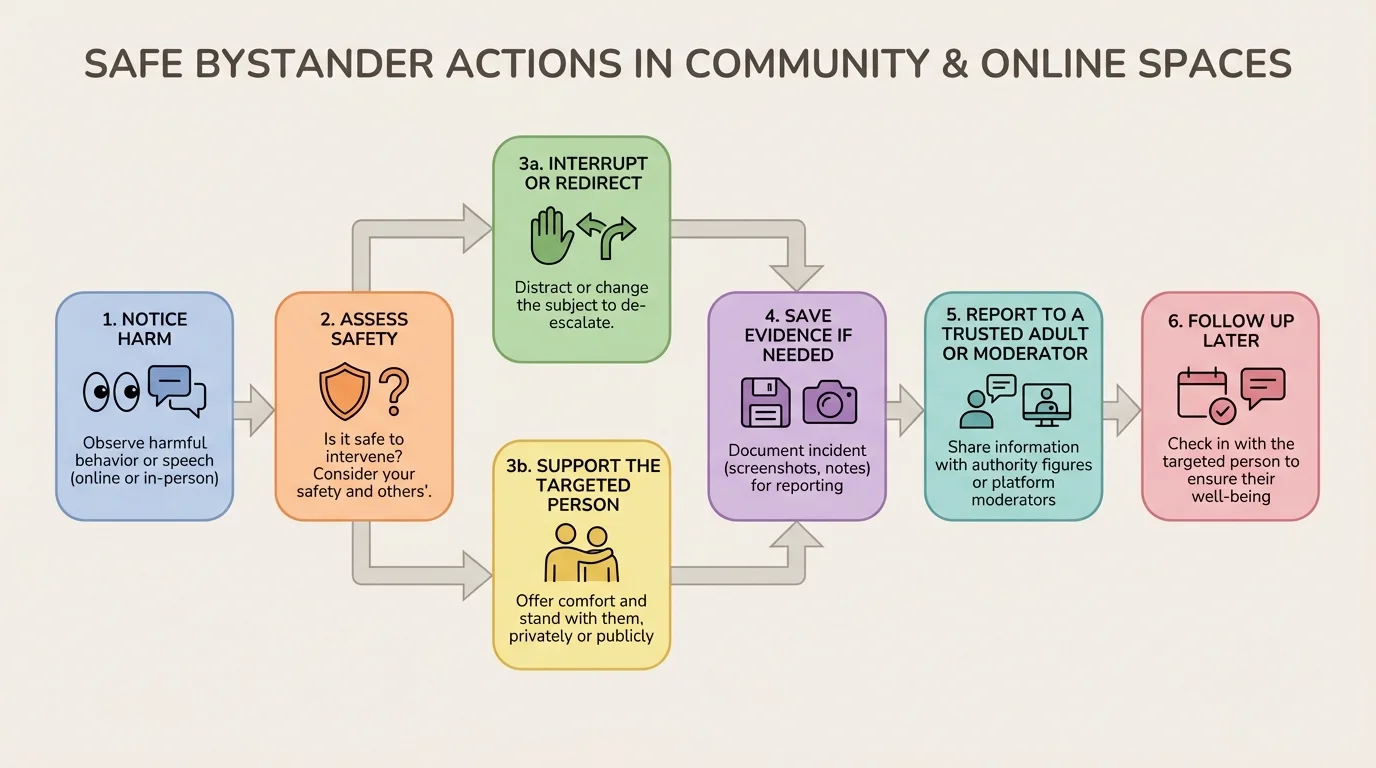
Sometimes helping means documenting and reporting. If there are harmful messages, screenshots may be useful. If there is a pattern of exclusion or harassment in a club, game server, or community activity, an adult leader or moderator should know. Reporting is not overreacting when someone's safety or dignity is being damaged.
"You do not have to be loud to be brave."
— Community leadership principle
What matters most is safety. If speaking up publicly would put you in danger, choose another action: leave the space, save evidence, tell a trusted adult, or support the targeted person privately. Helping should be smart, not reckless.
Respect across differences is not a one-time performance. It is a set of habits. Habits matter because communities notice patterns. If you are respectful only when adults are watching, people will sense that. If you are steady, fair, and willing to repair mistakes, trust grows.
One helpful habit is regular self-reflection. After a conversation, ask yourself: Did I listen? Did I make assumptions? Did I help someone feel included? Did I stay respectful during disagreement? This is not about guilt. It is about growth.
Another habit is learning how to repair harm. You will make mistakes. Everyone does. The key question is what you do next. A real apology is not "Sorry if you were offended." A stronger apology sounds like: "I said something disrespectful. It was wrong. I'm sorry. I'll do better." Then your behavior has to change.
Belonging grows through repeated signals
People feel like they belong when they receive repeated signals that they are seen, heard, and valued. One invitation will not fix a hostile group, and one apology will not erase repeated harm. Community changes when respectful signals happen again and again.
You can also build respect by contributing positively. Share helpful information, welcome newcomers, credit other people's ideas, and notice who is missing from a conversation. In community groups, offer practical help instead of waiting to be asked every time. Community-minded action is not just avoiding harm. It is adding good.
Digital citizenship matters here too. Before posting, ask: Is it true? Is it necessary? Is it respectful? A post can spread fast, and deleting it later does not always undo the damage. Strong communities are careful with speed, tone, and impact.
You already know that words can affect emotions and relationships. This topic adds another layer: your choices also affect whether a whole group becomes more inclusive or more divided.
Think about your roles right now. Maybe you are in an online class forum, a neighborhood team, a youth group, a game community, or a volunteer project. In each place, you help set the norm. If you normalize mockery, exclusion spreads. If you normalize respect, that spreads too.
The options in [Figure 3] remind you that support can be public or private, direct or indirect. The goal is the same: reduce harm and increase belonging.
Here are a few situations where community-minded action makes a real difference.
Scenario: someone is left out of a planning chat
A youth event group is making plans in a chat thread. One person's ideas keep getting skipped.
Step 1: Notice the pattern.
You see that two of their messages were ignored while others got quick replies.
Step 2: Bring them back into the conversation.
You write, "I want to go back to Ana's idea about making the event cheaper. That seems worth discussing."
Step 3: Support fair participation.
If the pattern continues, you suggest everyone share one idea each before deciding.
This is a simple way to support fairness without attacking anyone.
Sometimes the best action is not dramatic. It is noticing who is being overlooked and adjusting the space so they can participate.
Scenario: a friend posts a disrespectful meme
Your friend shares a meme that mocks a cultural group. Other people are reacting with laughing comments.
Step 1: Decide not to join the harm.
You do not like, repost, or add jokes.
Step 2: Respond clearly.
You message, "That meme is disrespectful. I don't think it's okay to joke about people like that."
Step 3: Take further action if needed.
If the post stays up and continues causing harm, you report it through the platform and tell a trusted adult if the situation grows.
This protects both your values and the people being targeted.
Respect becomes visible through action. Other people may not remember every opinion you share, but they will remember whether they felt safe, heard, and treated like they mattered when they were with you.
