One short message can start a friendship problem faster than most people expect. A text like "Okay." can sound calm, annoyed, cold, or hurt depending on when it arrives, what came before it, and how the reader feels that day. Online communication is powerful because it is fast and constant, but that also means small choices can have big effects on trust.
When people trust you, they usually believe that you mean what you say, that you will treat them fairly, and that you will not try to embarrass or ignore them on purpose. Trust grows through many small moments, not just huge promises. A kind reply, an honest answer, or a clear explanation can strengthen a relationship. A rude comment, a delayed response without explanation, or a confusing post can weaken it.
This matters in everyday life. You might be messaging a friend, replying to a coach from an activity outside school, chatting in a gaming group, talking with a family member, or sending a message to an adult leading a club. In all of those situations, people notice not just what you say but how and when you say it.
Tone is the feeling or attitude a message seems to have. Timing is when a message is sent or answered. Digital communication is communication through screens or devices, such as texts, emails, direct messages, group chats, comments, voice notes, and video calls. Misunderstanding happens when someone interprets a message differently from what the sender meant.
Because digital communication removes many face-to-face clues, misunderstandings happen easily. You cannot always hear a person's voice, see a quick smile, or notice that they are tired or distracted. That is why learning to assess tone, timing, and digital choices is a real-life skill, not just a "be nice online" rule.
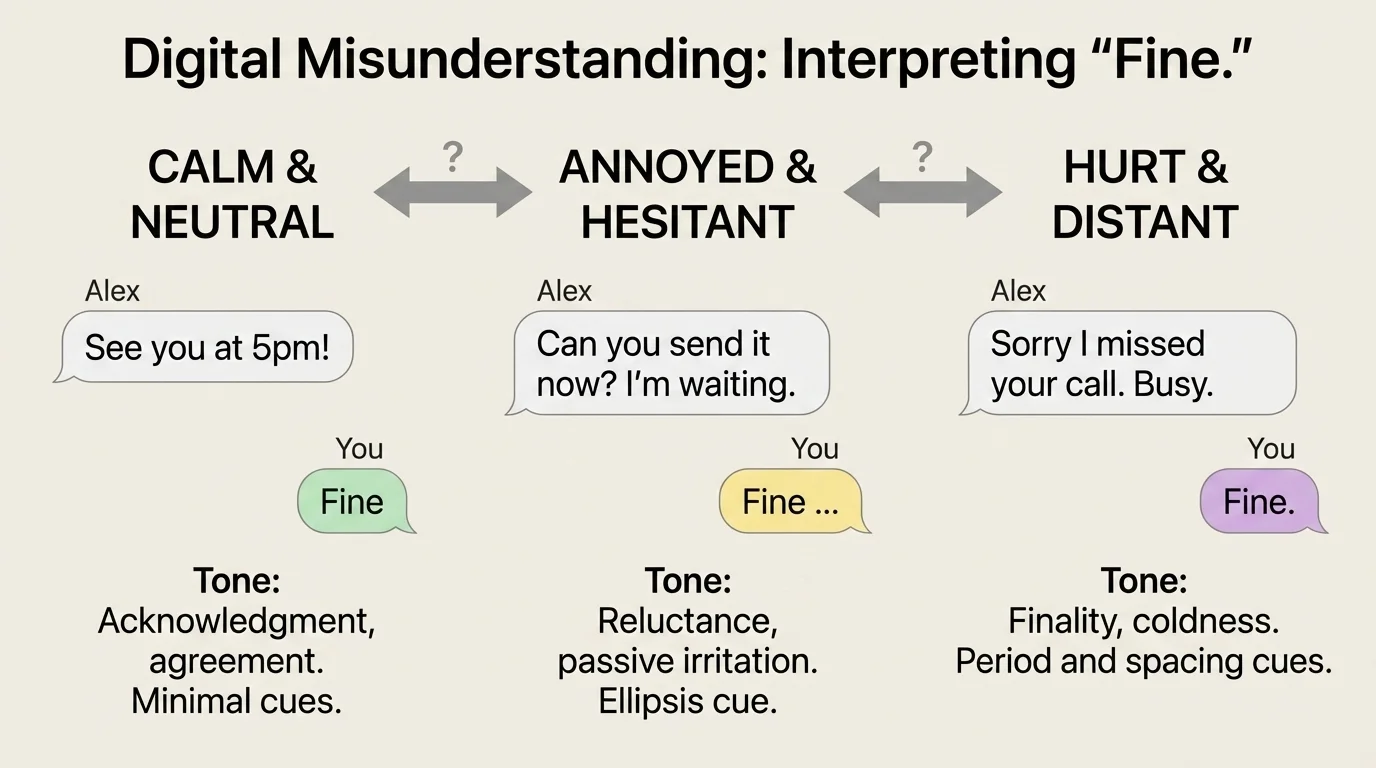
In digital messages, tone is often guessed from short clues, as [Figure 1] illustrates. People look at punctuation, word choice, capital letters, emojis or no emojis, message length, and what happened earlier in the conversation. Since readers are guessing, they can guess wrong.
Look at these examples. "Sure" can sound friendly if it follows a positive conversation. "Sure." might sound annoyed to some readers. "SURE" may seem like shouting. "I guess that's fine" may sound uncertain or upset even if the sender only meant "that works." The words are small, but the feeling changes.
Tone also depends on your relationship with the other person. A joke that makes your best friend laugh might confuse someone who does not know your style. Sarcasm is especially risky online because the reader cannot hear your voice. What sounds funny in your head may sound mean on a screen.
If your tone is unclear, the other person may fill in the blanks with their own feelings. If they are already worried, they may read your message as cold. If they are upset, they may assume you are criticizing them. This is one reason digital conflicts can grow quickly.
Case study: Same idea, different tone
A friend sends you a picture of a project they worked hard on. Here are three possible replies.
Step 1: Cold reply
"It's okay." This may sound dismissive, even if you did not mean it that way.
Step 2: Clear and kind reply
"It looks really creative. I like the colors." This gives specific support and sounds sincere.
Step 3: Risky sarcastic reply
"Wow, I guess you tried." Even if meant as a joke, it can sound insulting in text.
The safest choice is the one that makes your meaning easy to understand.
A helpful habit is to reread your message as if you were the other person. Ask yourself: Could this sound rude, bored, or blaming? If the answer is yes, change it before sending.
Timing sends a message even when you say nothing. A fast reply can show attention or excitement. A very late reply can feel like disinterest, avoidance, or disrespect. But timing is tricky because delays do not always mean something negative. People may be busy, resting, helping family, or away from their devices.
The problem starts when people assume they know the reason for a delay. If you send a message and get no response, you might think, "They are ignoring me." But maybe the person has not seen it yet. On the other hand, if you leave someone waiting for a long time again and again, they may begin to feel unimportant.
Timing matters most when the message is emotional, urgent, or important. If someone asks, "Are you still upset with me?" and you wait a long time to answer, the silence may increase their worry. If you need time to think, it often helps to say so: "I saw your message. I want to answer carefully, so I'll reply later tonight." That short message protects trust.
Good timing does not mean you must be available every second. Healthy communication includes boundaries. You are allowed to sleep, study, spend time with family, or take a break from screens. Trust grows when you communicate those limits clearly instead of disappearing without explanation.
Why silence can feel loud
Online, people often treat a lack of response like a response. Silence can feel like rejection, anger, or carelessness, even when none of those are true. A simple message such as "I'm busy right now, but I'll answer later" can reduce confusion and help the other person feel respected.
Timing also includes when you choose to start a conversation. Sending a serious complaint in the middle of the night, posting frustration publicly before talking privately, or bringing up a conflict right before someone's event can damage trust. A better choice is to pause and ask: Is this the right time and place for this conversation?
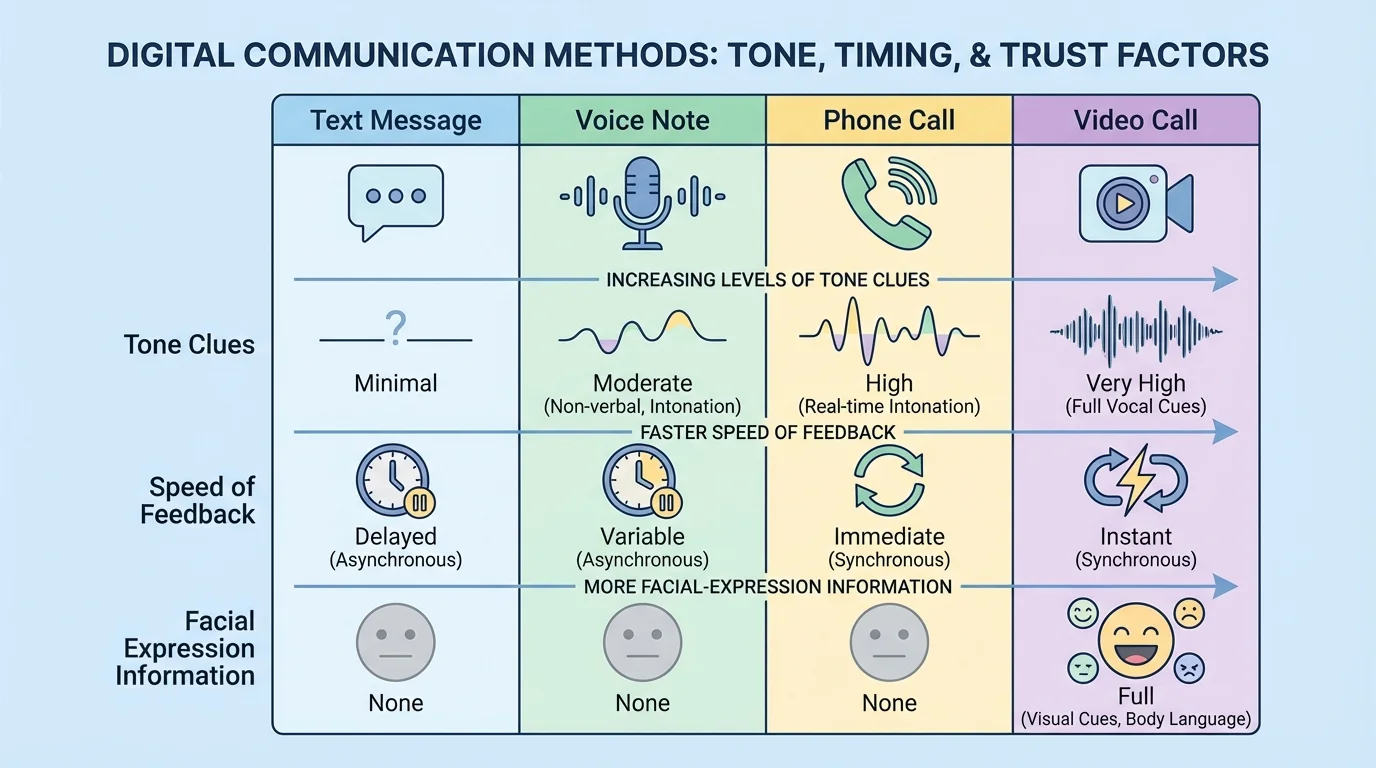
Different types of digital communication give different amounts of information, as [Figure 2] shows. A text message gives only words and punctuation. A voice note adds sound. A phone call adds real-time back-and-forth. A video call adds facial expression and body language. The fewer clues you get, the easier it is to misunderstand.
Texting is useful for quick updates, but it is one of the riskiest places for confusion. Group chats can make this worse because many people reply at once, jokes stack on top of each other, and someone may feel left out if others react but ignore their message. Social media adds even more pressure because comments and posts can be seen, shared, or screenshotted.
Email or formal messages to adults need special care. Short messages can sound blunt if they are too casual. If you are writing to a club leader, tutor, or volunteer coordinator, use a greeting, explain your message clearly, and end respectfully. This helps the reader trust that you are responsible.
Permanent records are another digital challenge. In spoken conversation, words disappear. Online, a message may stay visible for a long time. People can reread it when they are upset, and others can share it. That means one careless message can keep causing harm after you meant to move on.
Many online arguments begin because someone reacts to a message quickly without checking tone or asking a clarifying question first. Fast communication feels efficient, but slowing down by even a minute can prevent a much bigger problem.
When the topic is sensitive, switching formats often helps. If a text conversation is getting tense, a voice note or call may be better. If a call feels too emotional and you need time to organize your thoughts, a carefully written message may work better. The smart choice depends on how much clarity the moment needs.
Trust builds when your communication is consistent. If you usually answer when you can, tell the truth, apologize when needed, and avoid embarrassing others online, people learn that you are dependable. They do not have to wonder what version of you they will get.
Trust breaks when your words and actions do not match. For example, if you say "I'm here for you" but ignore someone whenever they need support, your message loses power. If you promise to keep something private and then share screenshots, the damage can be serious. People may forgive once, but repeated choices can make them feel unsafe with you.
Respect is a big part of trust. Respect online means not pressuring people to reply instantly, not mocking them in comments, not using private chats to say things you would be ashamed to say kindly, and not spreading half-true stories. Even if a message seems small to you, the effect on the other person may be large.
| Communication choice | Likely effect on trust | Likely risk of misunderstanding |
|---|---|---|
| Clear, kind message | Builds trust | Low |
| Very short reply with unclear tone | May weaken trust | Medium to high |
| Long delay with no explanation | May hurt trust | High |
| Honest message about needing time | Protects trust | Low |
| Public complaint instead of private conversation | Often damages trust | High |
| Private apology and clear repair | Can rebuild trust | Low |
Table 1. Common communication choices and their likely effects on trust and misunderstanding.
Notice that trust is not about being perfect. It is about being honest, respectful, and repair-minded. People usually feel safer with someone who says, "I handled that badly, and I want to fix it," than with someone who keeps insisting they did nothing wrong.
A misunderstanding often begins with guessing. One person guesses the tone. Another guesses the meaning of the delay. Someone else guesses why a message was posted publicly. Once guessing starts, emotions can fill in the gaps.
Some warning signs are easy to spot: shorter replies than usual, sudden defensiveness, repeated "Whatever," being left on read after a tense exchange, someone asking "What do you mean by that?", or a joke that gets no positive response. These signals do not always mean a conflict is happening, but they tell you to slow down.
To prevent misunderstanding, use clear language. Instead of "Fine," try "I'm okay with that plan." Instead of "Wow," try "I'm surprised, but I'm not upset." Instead of "K," try "Got it, thanks." Clarity may feel less dramatic, but it is much kinder.
Repairing a misunderstanding
You sent a short message, and your friend thinks you are angry.
Step 1: Notice the reaction
Your friend replies, "Why are you being so rude?"
Step 2: Clarify without attacking
Say, "I'm sorry. I didn't mean it to sound rude. I was in a rush, and my message came out too short."
Step 3: Restate your meaning clearly
Try, "What I meant was that I can join later, and I'm still interested."
Step 4: Choose a better format if needed
If texting keeps making it worse, ask, "Can we talk by voice or video for a minute?"
Repair works best when you focus on understanding, not winning.
Clarifying questions are powerful. You can ask, "Are you upset, or am I reading this wrong?" "When you said that, what did you mean?" or "I want to make sure I understand." These questions reduce guessing and show maturity.
Earlier, we saw in [Figure 1] how tiny wording changes can affect tone. That same idea matters during conflict repair: a few clearer words can completely change how safe and respectful your message feels.
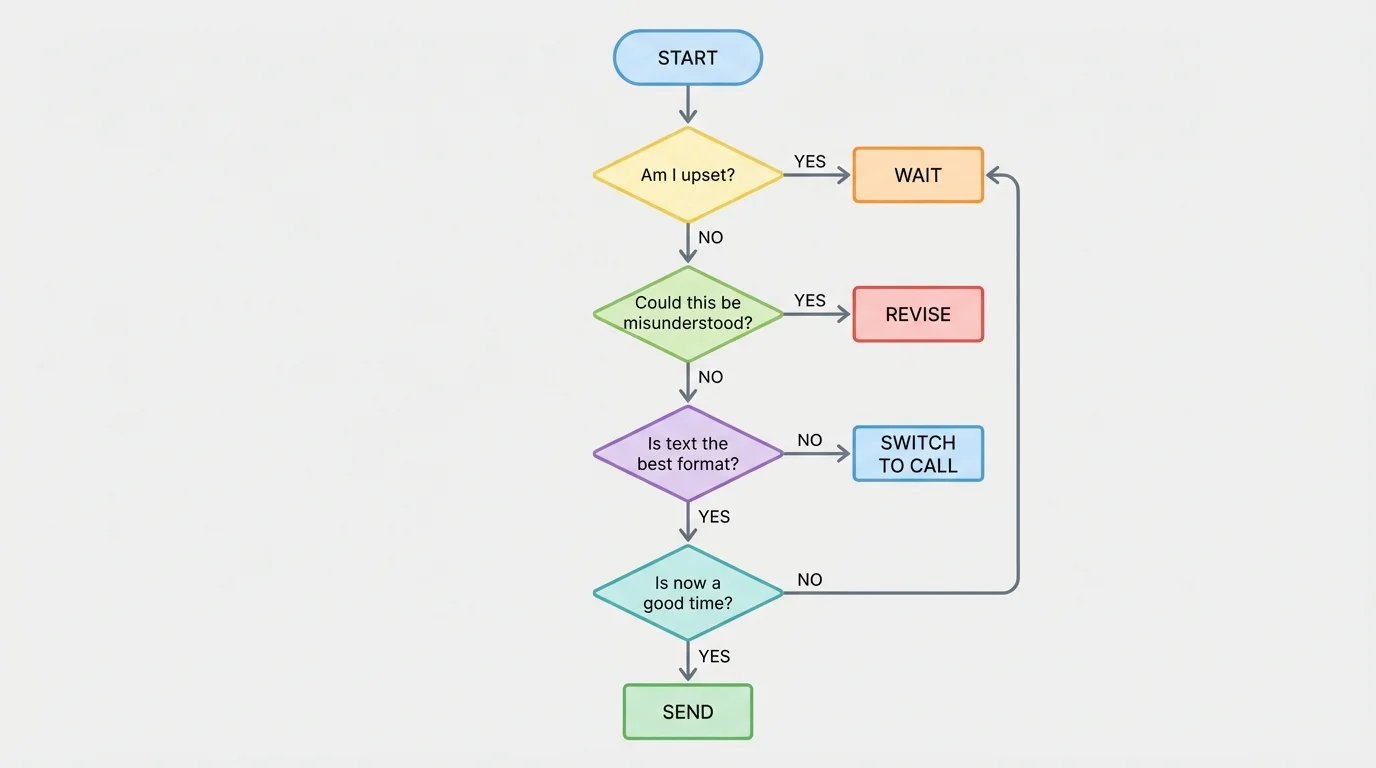
When emotions are high, use a quick decision process, as [Figure 3] illustrates. This routine helps you decide whether to send now, edit the message, wait, or switch to another communication method.
Step 1: Check your feeling. Are you angry, embarrassed, jealous, or hurt? If yes, pause before sending. Strong feelings often create sharp tone.
Step 2: Read the message out loud quietly. If it sounds rude or confusing when spoken, it may read that way too.
Step 3: Ask whether the message is clear. Could the other person misunderstand your meaning, joke, or level of seriousness?
Step 4: Ask whether text is the right tool. If the topic is emotional, private, or complicated, a call or voice note may work better. This matches the comparison we saw in [Figure 2], where some formats provide more communication clues than others.
Step 5: Decide whether timing is good. Is the person likely asleep, busy, or in the middle of something important? Is this a private issue that should not be posted publicly?
Step 6: Send the clearest version, or wait until you can communicate respectfully.
This routine is not about making every message formal. It is about helping you avoid preventable problems. A ten-second pause can save you from a ten-day argument.
Scenario 1: You are in a gaming group, and someone says, "Nice move," after your mistake. If the tone is unclear, do not assume they are insulting you. You can respond lightly but clearly: "Was that a joke, or are you frustrated?" That question gives them a chance to explain.
Scenario 2: A friend stops replying for a day after an emotional conversation. You feel ignored. Instead of sending five angry messages, try one respectful check-in: "I hope you're okay. I'm here when you're ready to talk." This protects trust better than accusations.
Scenario 3: You need to tell a community activity leader that you will miss a meeting. A message like "can't make it" may seem careless. A clearer message is: "Hi, I wanted to let you know I can't attend today's meeting because of a family commitment. I'm sorry for the late notice."
Scenario 4: Someone shares a private screenshot from a chat. Even if you were not the one who shared it, notice what happens to trust: people become more careful, less open, and more suspicious. Privacy and respect are connected.
"Clear is kind."
— A useful communication principle
That short idea matters because kindness is not only about good intentions. It is also about making your meaning easy for others to understand.
Strong communication habits grow over time. One habit is consistency: if you usually need a while to reply, tell people that. Another is privacy: do not share private messages without permission. Another is repair: if you realize a message sounded harsh, correct it quickly instead of hoping the problem disappears.
It also helps to separate urgent issues from ordinary ones. Not every delayed reply means a broken friendship. Not every short answer means anger. Giving others a fair chance before assuming the worst is part of respectful communication.
When you need a boundary, be direct and calm. You might say, "I can't text late at night," or "I need a break right now, but I'll reply tomorrow." Boundaries are not rude when they are communicated respectfully. They often make trust stronger because people know what to expect.
As shown in [Figure 3], pausing and choosing the right response is a skill you can practice. The goal is not to sound perfect. The goal is to reduce confusion, protect trust, and communicate in a way that matches your real meaning.
Try This: Before your next important message, pause for a few seconds and ask yourself three questions: "How could this sound?" "Is this the right time?" and "Is this the best format?" That tiny routine can make your communication much stronger.
