Have you ever been completely sure about a choice, and then later realized you were missing a big piece of the story? That happens to everyone. A decision can feel right in the moment and still turn out badly if you do not have enough facts or if your feelings are pushing you too hard in one direction. Learning how this works gives you a real advantage in daily life.
Every day, you make choices: whether to trust a message, how to spend money, how to respond to a friend, whether to join an activity, or how to use your time. Some choices are small, but small choices can still have real effects. A rushed reply can hurt a friendship. A quick online purchase can waste money. A panicked click on a fake link can create a safety problem. Strong decisions are not about being perfect. They are about thinking clearly enough to reduce mistakes.
Decision quality means how strong, thoughtful, and useful a decision is. High-quality decisions are based on enough reliable information, careful thinking, and awareness of consequences. Low-quality decisions are often rushed, based on weak information, or driven mostly by emotion.
One reason decisions go wrong is that people often confuse incomplete information with complete understanding. If you know only one side of a problem, you may think you know enough when you really do not. Another reason is emotion. Feelings matter and can give helpful signals, but they can also blur judgment when they become too intense.
A poor decision does not always come from carelessness. Sometimes a person is doing their best but still chooses badly because they are under pressure, upset, excited, tired, or missing important facts. That means improving your decisions is not just about "trying harder." It is about using smart habits that protect you when your brain is under stress.
Think about a simple example. You see a sale online for headphones you want. The price looks amazing, and the countdown says only a few minutes remain. If you act fast, you might feel clever for getting a bargain. But what if you did not notice the shipping cost, the return policy, or whether the website is trustworthy? The choice may feel smart, yet the quality of the decision is weak because the information is incomplete.
Now think about emotions. If you are angry after reading a rude comment, your first impulse may be to reply immediately. In that moment, the goal can shift from solving the problem to "winning" or hurting back. The result may be a message you regret later. Your emotion is real, but if it controls the choice, the decision quality usually drops.
Assumptions are ideas you accept without checking. They fill in the blanks when facts are missing. In daily life, missing information can happen in many ways, as [Figure 1] shows: you may hear only one person's version of an argument, read only the headline of a post, forget to compare prices, or ignore a possible consequence because nobody mentioned it.
Incomplete information does not always mean you know nothing. Usually, it means you know some things, but not enough to decide well. That is what makes it tricky. A little information can feel like plenty, especially if it matches what you already want to believe.
Common signs that your information is incomplete include hearing only one side, relying on rumors, skipping details, trusting a source without checking it, or deciding before asking questions. Sometimes the missing information is about facts. Sometimes it is about timing. Sometimes it is about consequences. For example, maybe you know a club fee is $20, but you do not know you will also need supplies later. The first number is real, but the full cost is still unclear.
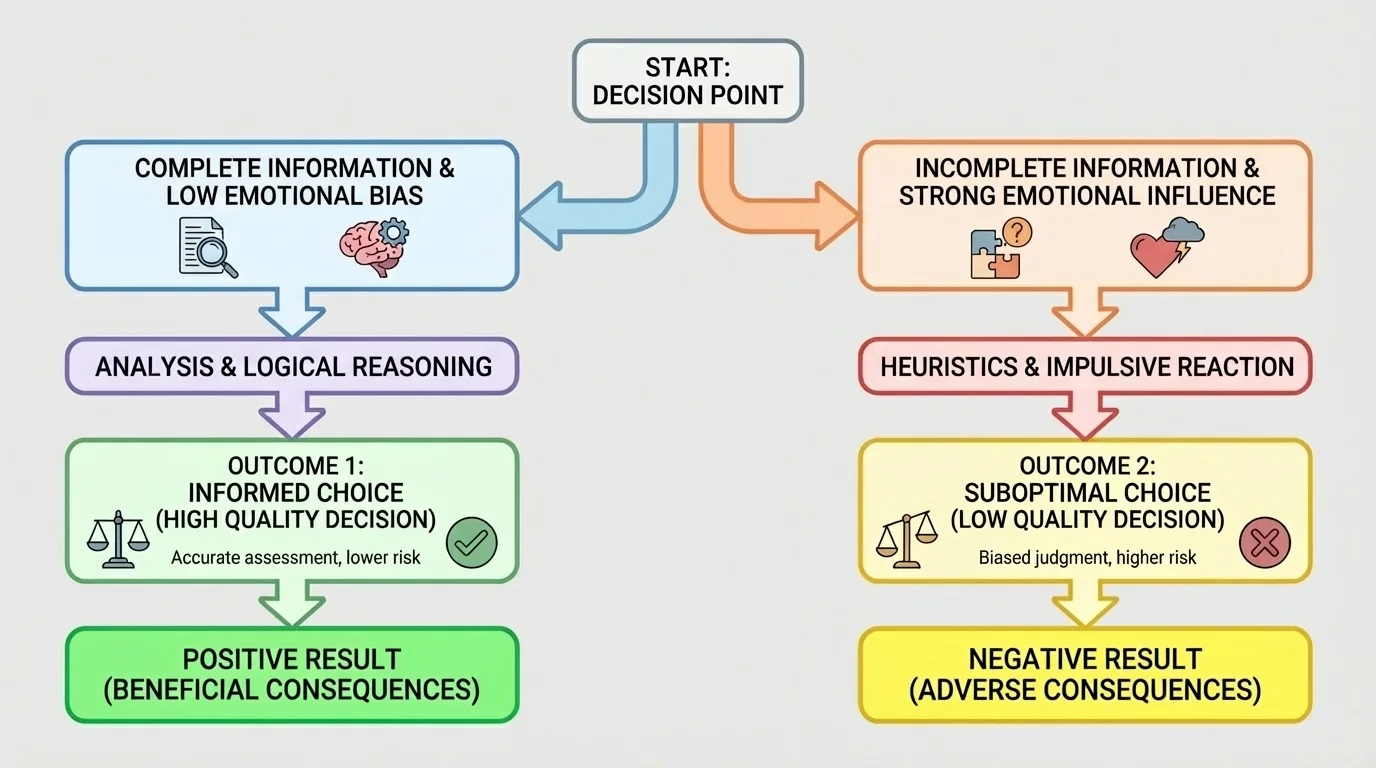
Missing facts can lead to different kinds of mistakes. You might choose something unsafe, spend more than planned, hurt someone's feelings, or waste time fixing a problem later. You may also miss a better option because you stopped searching too soon.
Suppose a friend sends a message saying, "Everyone is joining this online group chat. Come now." If you do not ask who is in it, what the rules are, or whether an adult is supervising, you are deciding with missing information. Later in the lesson, the same pattern will appear in other situations, just as [Figure 1] connects missing facts to weaker outcomes.
Not knowing everything is normal
You will almost never have perfect information. Good decision-making does not mean waiting forever or demanding every possible fact. It means gathering enough trustworthy information to make a reasonable choice for the situation. A small choice may need only a few facts. A bigger choice needs more checking.
One helpful question is: What do I still need to know before I decide? That single question can stop many avoidable mistakes. It moves your brain from guessing to investigating.
Your emotions are not the enemy. They give important signals, and [Figure 2] shows some of the common ways they can shape choices. Fear can warn you that something feels unsafe. Excitement can show that an opportunity matters to you. Sadness can tell you that something important was lost. But strong feelings can also narrow your thinking, making you focus on the moment instead of the bigger picture.
Anger often pushes people to act fast. Fear often pushes people to avoid, hide, or agree too quickly just to make the fear stop. Excitement can make risky choices seem smaller than they really are. Stress can make your brain grab the first option, even if it is not the best one. Overconfidence can make you stop checking facts because you feel sure already.
Emotions can affect what you notice, what you ignore, and how you interpret what happens. If you are already upset, a short message might seem rude even if it was not meant that way. If you are very excited about a new game or gadget, warning signs like poor reviews or extra costs may suddenly seem unimportant.
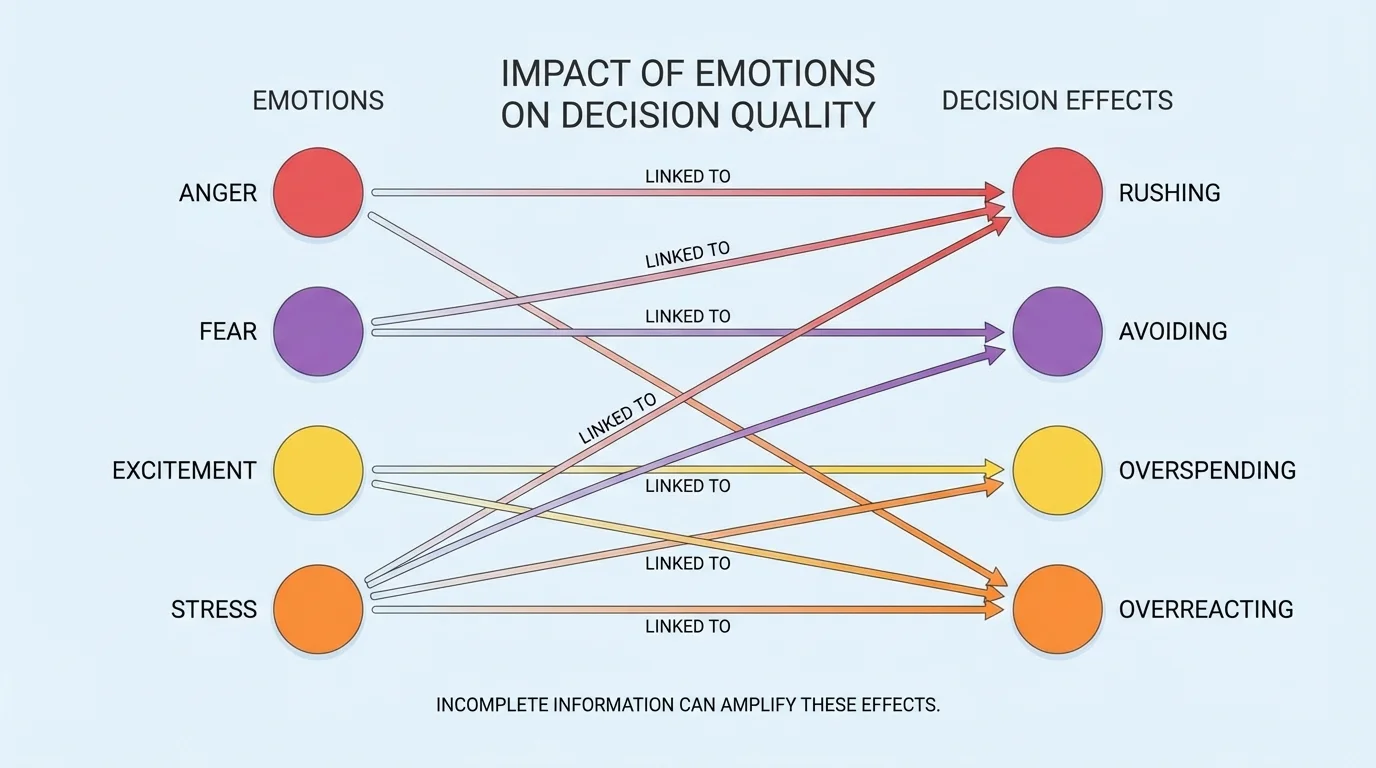
This does not mean you should ignore your feelings. It means you should notice them before deciding. Naming the feeling can reduce its power. Saying, "I am angry," or "I am nervous," helps you step back. Once you notice the feeling, you can ask whether it is helping the decision or hijacking it.
For example, if you are stressed because you have too much to do, you might say yes to a new commitment just to end the awkwardness of saying no. Later, you feel overwhelmed. The problem was not only the schedule. The problem was that stress made the decision for you.
Brains are designed to react quickly in emotional situations. That can be helpful in emergencies, but in everyday life it can also make people choose speed over accuracy.
A useful habit is to separate feelings from facts. Your feelings tell you how the situation affects you. Facts tell you what is actually known. You need both, but they do different jobs.
When a choice matters, use a short routine instead of relying only on impulse. A clear decision-making process helps you slow down just enough to think better without getting stuck.
[Figure 3] outlines a practical process you can use for many everyday situations: pause, name the feeling, gather facts, consider options, check consequences, decide, and review. You will not always need a long version. Even a short pause of a few seconds can improve the quality of your choice.
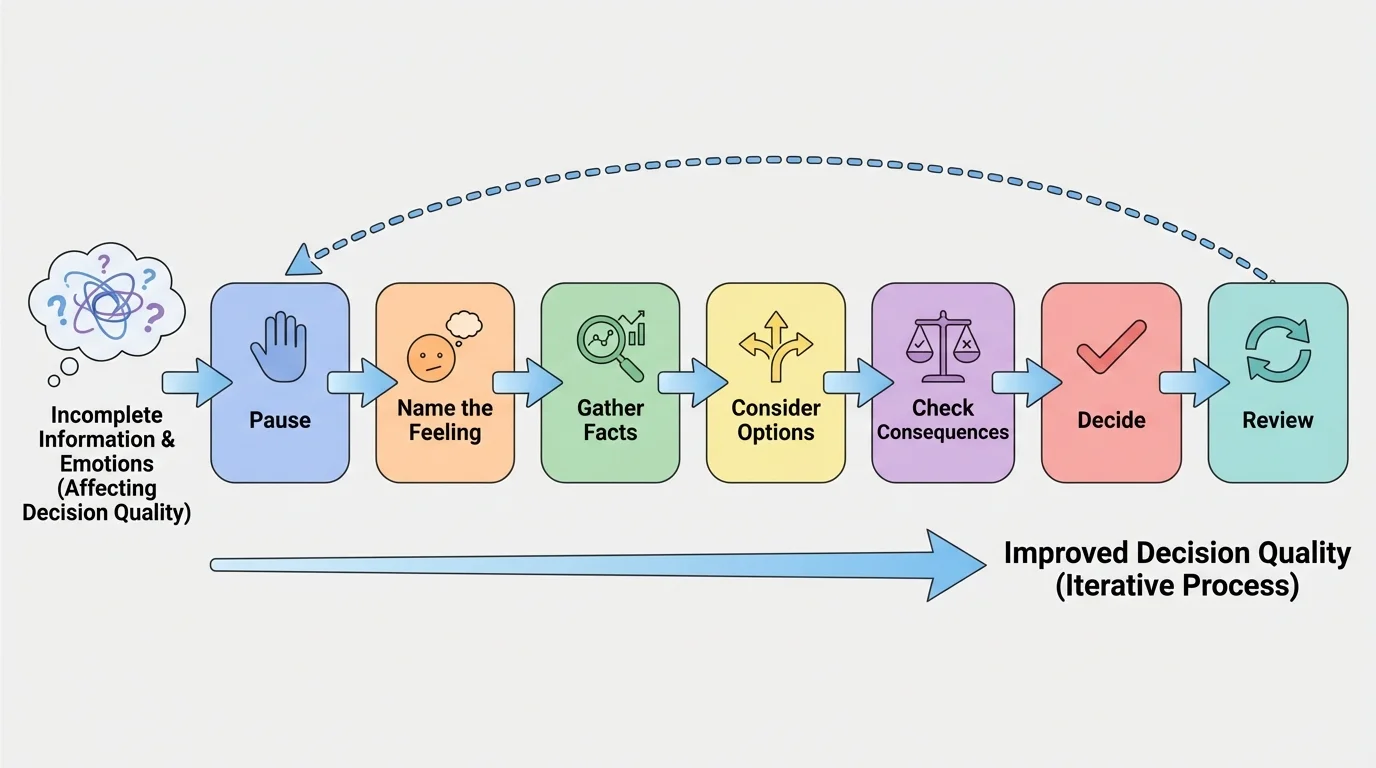
Step 1: Pause. If possible, do not decide at the exact moment you feel pressured. Pause for a few breaths, a few minutes, or even a day, depending on the situation. Pressure often lowers decision quality.
Step 2: Name the feeling. Ask yourself: Am I angry, embarrassed, excited, scared, stressed, or tired? If a strong emotion is present, be careful. It may not mean the decision is wrong, but it does mean you should double-check yourself.
Step 3: Gather facts. What do you know for sure? What are you only guessing? Who is the source? What information is missing? This is where you look for reliable details instead of trusting the first thing you hear.
Step 4: Consider options. Many poor decisions happen because people think there are only two choices: yes or no, now or never, agree or lose everything. Often there are more options. You might wait, ask for time, get advice, choose a smaller version, or say no politely.
Step 5: Check consequences. Think short-term and long-term. What might happen today? What might happen next week? Who could be affected besides you? This is where consequences matter most.
Step 6: Decide. Make the best choice you can with the information available. Not every decision will feel perfect. The goal is thoughtful action, not total certainty.
Step 7: Review. Afterward, ask: What worked? What would I change next time? Reviewing helps you improve future decisions. That is why the process in [Figure 3] ends with looking back, not just choosing.
Case study: Buying something online
You want to buy a used game controller from an online seller for $18.
Step 1: Pause instead of buying immediately.
You notice you feel excited because the price seems low.
Step 2: Gather facts.
You check whether shipping adds extra cost, whether the seller has reviews, and whether the controller works with your device. The total might be $18 plus $7 shipping, so the real cost is $25.
Step 3: Consider options and consequences.
You could buy now, compare with other listings, or wait. Buying too fast might mean paying more for a lower-quality item.
Step 4: Decide and review.
You compare two more listings and choose a better-rated controller for $22 with free shipping. The slower choice gives a better result.
Notice what changed the outcome: not advanced knowledge, just a pause, fact-checking, and awareness of emotion.
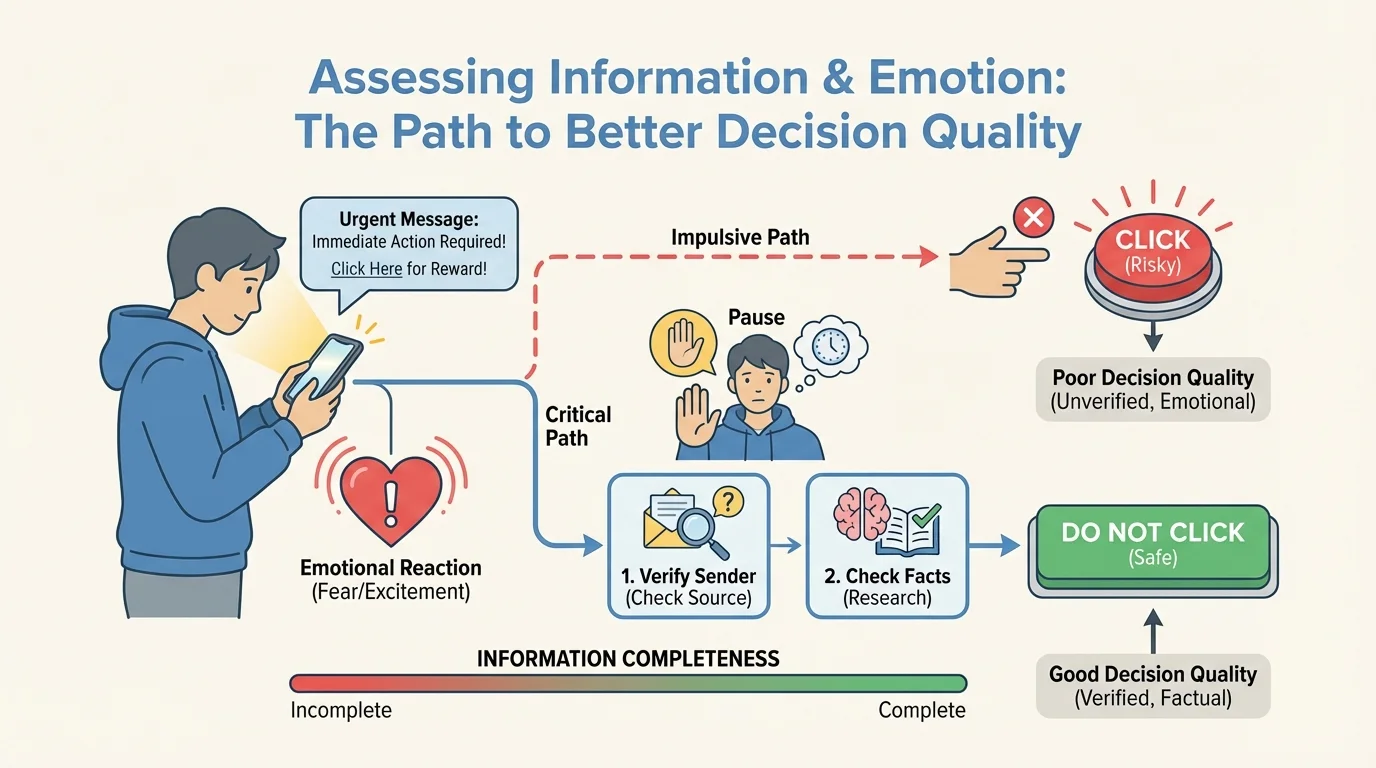
These skills matter most when you can use them in situations that feel real. Online messages are a strong example. Suppose you get a text that says, "Urgent: your account has a problem. Click here now." The word "urgent" creates pressure, and fear can push you to act before thinking. In situations like this, the safer response is to slow down, just as the online safety scene in [Figure 4] shows.
Instead of clicking, check whether the message came from an official source, whether the link looks suspicious, and whether you can verify the issue by going directly to the website or asking a trusted adult. Incomplete information plus emotional pressure is exactly how scams often work.
Friendship decisions can also be tricky. A friend may post something vague online, and you assume it is about you. If you respond while hurt or angry, you may create a bigger conflict. Better decision quality means asking for clarification before reacting. You might send a calm message like, "I'm not sure what you meant. Can we talk?" That small pause can protect the friendship.
Time management is another area where emotion and missing information combine. You may feel confident and assume an assignment, chores, sports practice, and family plans will all fit into one evening. But if you have not actually checked how long each task takes, your plan is based on incomplete information. Then stress rises, and rushed decisions follow. A more accurate plan comes from estimating time honestly and leaving a little extra space.
Group decisions also need care. If everyone in a club or team chat seems excited about one idea, you may go along without asking questions. This is a kind of bias, a thinking pattern that can pull you away from balanced judgment. One useful move is to ask, "What could go wrong?" or "Are we missing any facts?" A strong group is not the loudest group. It is the group that examines its reasoning.
| Situation | Missing Information | Emotion Involved | Better Move |
|---|---|---|---|
| Online sale | Total cost, reviews, return policy | Excitement | Compare options and check details |
| Suspicious message | Real sender, safe link, actual problem | Fear | Verify before clicking |
| Argument with a friend | Other person's intent, full context | Anger or hurt | Ask calmly before replying |
| Busy schedule | True time needed for tasks | Overconfidence or stress | Estimate realistically and plan ahead |
| Joining an activity | Rules, costs, commitment | Pressure to fit in | Ask questions before saying yes |
Table 1. Examples of how missing information and emotions affect choices in everyday life.
As with the earlier missing-information pattern in [Figure 1], real-life problems often begin before the bad outcome. They begin at the moment you skip a question, ignore a warning sign, or let a strong feeling rush the choice.
"Slow is smooth, and smooth is fast."
— Common decision-making principle
This saying means that a calm, careful approach often saves time in the end because you make fewer mistakes to fix later.
You do not become a strong decision-maker in one day. It is a skill you build through habits. Start by noticing the situations where you are most likely to rush: when you are excited, embarrassed, tired, worried about fitting in, or under time pressure. Those are the moments to use your process on purpose.
Another helpful habit is asking better questions. Try questions like: What facts do I have? What am I assuming? What feeling is strongest right now? What are two other options? What might happen later if I choose this? Questions create space between impulse and action.
You can also improve by checking sources. If information comes from a random post, one message, or a person who may not know the full story, be cautious. Reliable information usually comes from trustworthy people, direct evidence, or official sources. Better information leads to better decisions.
Mini-routine for emotional moments
Step 1: Stop and breathe slowly for a short moment.
Step 2: Say the feeling to yourself: "I feel angry," "I feel nervous," or "I feel pressured."
Step 3: Ask one fact question and one consequence question.
For example: "What do I know for sure?" and "What might happen if I act right now?"
Step 4: If needed, delay the decision until you are calmer.
One last skill matters a lot: learning from past choices without being too hard on yourself. Everyone makes decisions they regret. The useful response is not shame. It is reflection. Ask what information you missed, what feeling was strongest, and what sign you will watch for next time.
As you continue making choices online, at home, and in your community, remember that decision quality improves when you respect both facts and feelings. Facts help you see clearly. Feelings help you understand what matters. But neither works well alone. The strongest choices come when you notice your emotions, check for missing information, and give yourself enough time to think.
