One text, one comment, one click, one answer—sometimes that is all it takes to change your whole day. A lot of mistakes do not happen because someone is careless or "bad" at making decisions. They happen because a person reacts fast before they fully understand what is going on. Learning how to tell the difference between a quick reaction and a well-informed choice is one of the most useful life skills you can build.
Complex situations are tricky because they usually involve more than one problem at the same time. You might be dealing with strong feelings, pressure from other people, missing information, and a time limit all at once. That mix can make an impulsive move feel smart in the moment, even when it causes bigger problems later. The goal is not to become slow or afraid to decide. The goal is to know when to pause, think, and choose with intention.
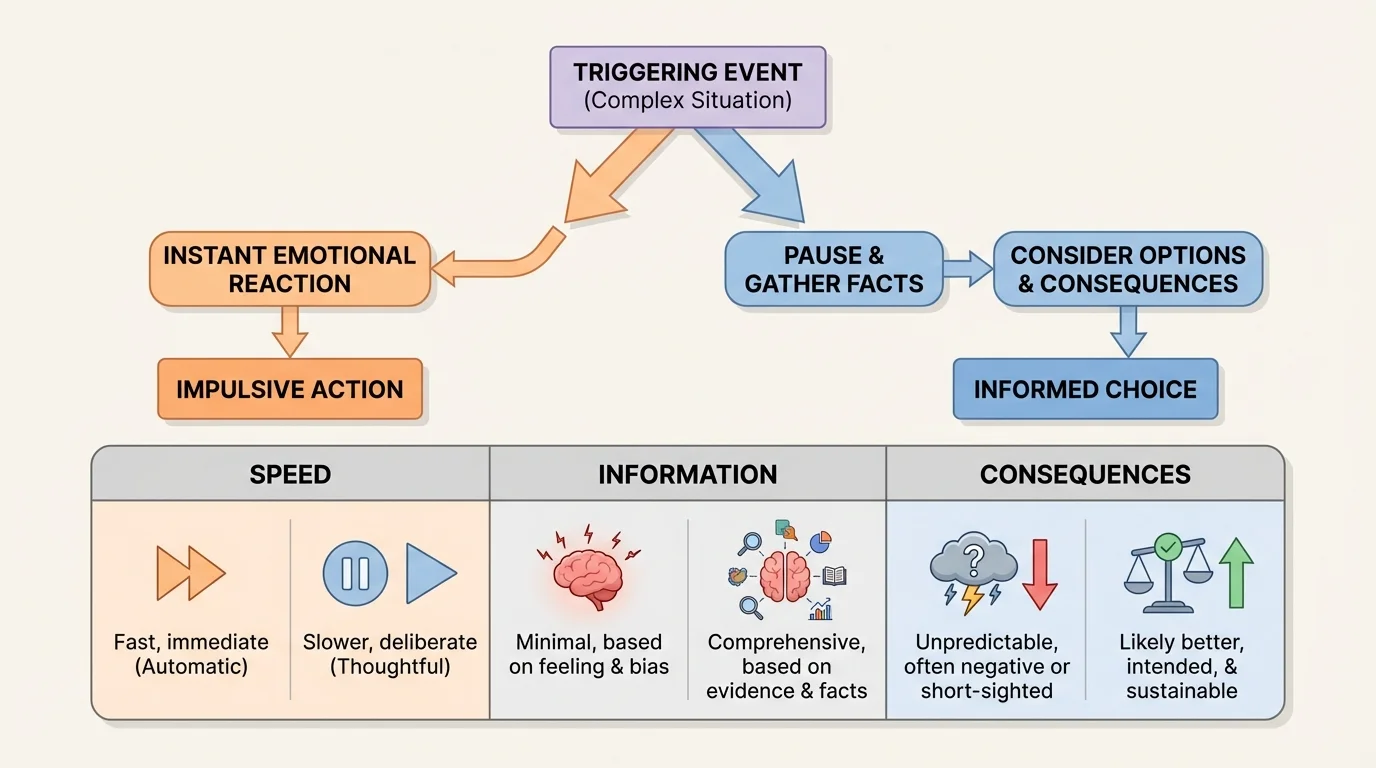
An impulsive reaction is a fast response made mainly from emotion, pressure, habit, or panic. An informed choice is a decision made after you pause, gather enough information, and think about consequences. In a complex situation, these two paths can look very different, as [Figure 1] shows through a side-by-side comparison of instant action and thoughtful decision-making.
That does not mean every fast choice is wrong. Sometimes you really do need to act quickly. But many everyday situations are not true emergencies. They only feel urgent. If a friend posts something rude, if someone dares you to do something risky, if an app offers a "limited-time" purchase, or if you are upset during a family disagreement, a fast reaction can make things worse.
Impulsive reaction means responding quickly without enough thought, often based on emotion or pressure. Informed choice means deciding after you understand the situation, think through options, and consider likely results. A complex situation is a situation with several factors at once, such as emotions, people, risks, and missing information.
Here is a simple way to compare them: impulsive reactions focus on the moment, while informed choices focus on both the moment and the future. An impulsive reaction asks, "What do I feel like doing right now?" An informed choice asks, "What is really happening, what are my options, and what happens next if I choose this?"
Suppose you get an online message that says, "Everyone is annoyed with you." An impulsive reaction might be sending back an angry message immediately, blocking people, or posting something embarrassing out of revenge. An informed choice might be pausing, asking who said that, checking whether the message is even true, and deciding to respond calmly or talk privately with a trusted adult if needed.
Your brain is designed to react quickly to strong feelings. That can help in danger, but it can also create trouble in social, emotional, and online situations. When you feel embarrassed, angry, left out, scared, excited, or rushed, your brain may focus on immediate relief instead of long-term results.
This is where triggers matter. A trigger is something that sets off a strong emotional response. A trigger could be a rude comment, a scary rumor, feeling ignored, seeing other people take a risk, or thinking you are about to miss out on something. Triggers do not force you to make a bad decision, but they do make impulsive reactions more likely.
Strong emotions can narrow your attention. That means when you are upset, you may notice the part of the situation that hurts or angers you most and miss other important facts.
Stress also makes complex situations harder. When you are tired, hungry, already frustrated, or overloaded with tasks, your patience gets smaller. Small problems can feel huge. That is why a choice that seems "obvious" late at night or during an argument may seem like a bad idea the next day.
Social pressure adds another layer. Even online, pressure is real. You may feel pushed to reply quickly, join in on teasing, share private information, accept a challenge, or buy something because others are doing it. An impulsive reaction often tries to protect your image in the moment. An informed choice protects your safety, values, and future.
One of the best decision-making skills is learning to notice the warning signs before you act. Your body and thoughts usually give clues. If you can catch those clues early, you have a much better chance of making a smarter choice.
Common body signs include a racing heart, tight shoulders, a hot face, shaky hands, or a sudden urge to move, type, shout, buy, or leave. Common thought signs include "I need to do something right now," "I'll show them," "It's probably fine," "I don't care what happens," or "If I don't act now, I'll miss my chance."
Digital behavior can also reveal impulsiveness. You may start typing without thinking, click before reading, send multiple messages quickly, repost something unverified, or agree to something in a group chat just to avoid feeling left out. These patterns matter because they usually happen before you have checked facts or considered consequences.
Fast feelings are real, but they are not always reliable guides. Your emotions give important information, such as "something feels unfair" or "this situation feels unsafe." But emotions alone do not tell you the whole story. Good decisions usually come from combining feelings with facts, timing, and consequences.
A useful question is: Am I solving the problem, or am I just releasing emotion? Releasing emotion can feel satisfying for a few seconds. Solving the problem usually takes a little more time, but it leads to better results.
When a situation feels messy, a clear method helps. Instead of guessing, you can follow a process. The consequences of your action become easier to see when you break the decision into steps, as [Figure 2] shows in a simple flowchart.
Step 1: Pause. Stop yourself from acting for a moment. Put the phone down, take a breath, count slowly to 10, get a glass of water, or step away from the screen. A short pause creates space between feeling and action.
Step 2: Name what you feel. Try specific words: angry, embarrassed, jealous, nervous, pressured, excited, confused. Naming the feeling helps you control it instead of letting it control you.
Step 3: Identify the real problem. Ask, "What decision am I actually making?" Sometimes the real problem is different from the first feeling. For example, the problem may not be "Someone annoyed me." It may be "I need to decide whether to respond now, later, or not at all."
Step 4: Gather facts. What do you know for sure? What are you assuming? What information is missing? Who is involved? Is this safe? Is it legal? Is it respectful? Is there a deadline, or does it just feel urgent?
Step 5: List your options. Most complex situations have more than two choices. You might respond, wait, ask a question, ask for help, say no, leave, report, or choose a compromise.
Step 6: Check likely results. Ask, "What happens next if I choose this?" Think about today, tomorrow, and next week. Also think about how the choice affects your trust, safety, time, money, and relationships.
Step 7: Choose what fits your values. A smart choice is not just the one that feels good right now. It is the one that matches who you want to be: honest, safe, respectful, responsible, and calm under pressure.
Step 8: Review afterward. Later, ask yourself whether the choice worked. This builds stronger judgment over time.
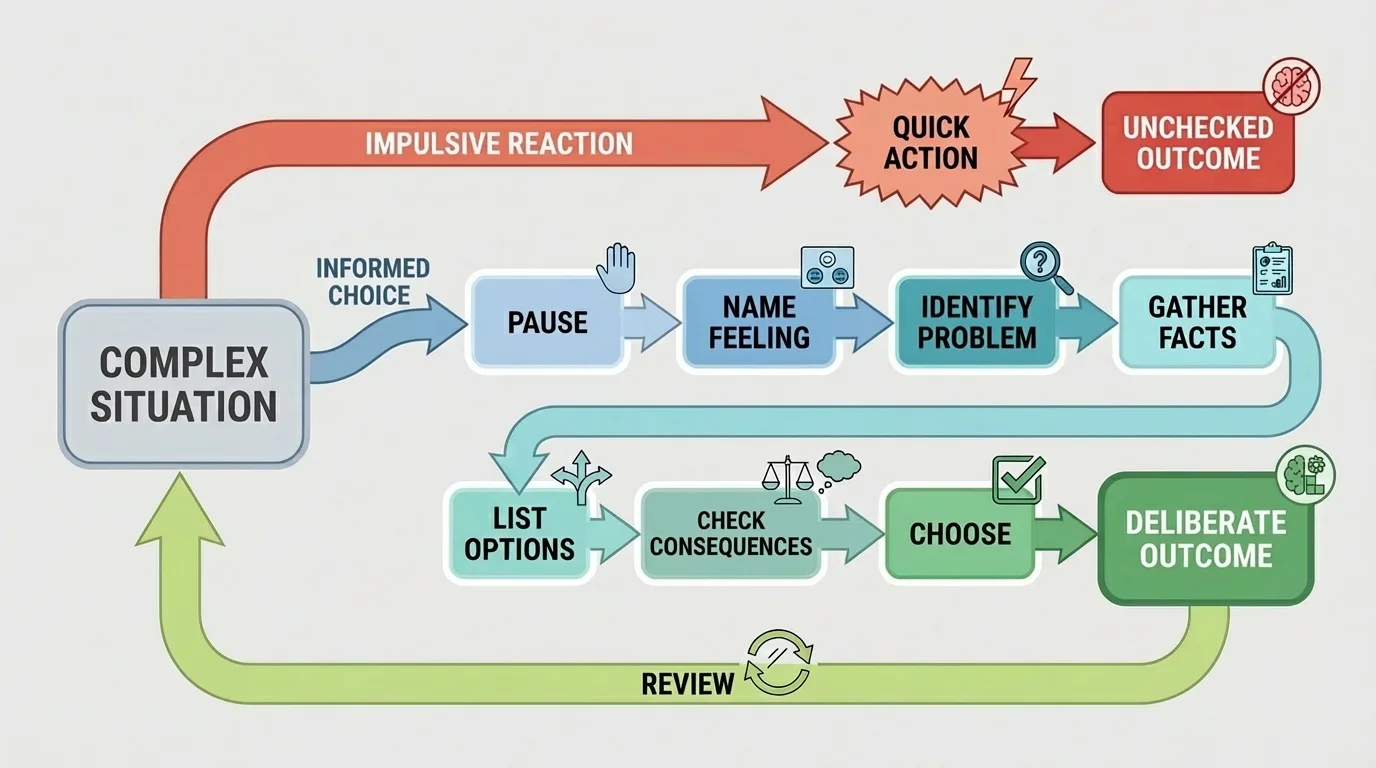
You do not have to use all eight steps perfectly every time. Even using the first four can stop a lot of trouble. The power of the method comes from moving in order instead of jumping from feeling straight to action.
Quick use of the pause-and-choose method
You see a message saying, "Send me your password so I can fix your account."
Step 1: Pause instead of replying immediately.
Step 2: Name the feeling: worried and rushed.
Step 3: Identify the problem: someone is asking for private account access.
Step 4: Gather facts: real companies do not ask for passwords in direct messages.
Step 5: Choose: do not share the password, report the message, and ask a trusted adult for help if needed.
The informed choice protects your safety and prevents a bigger problem.
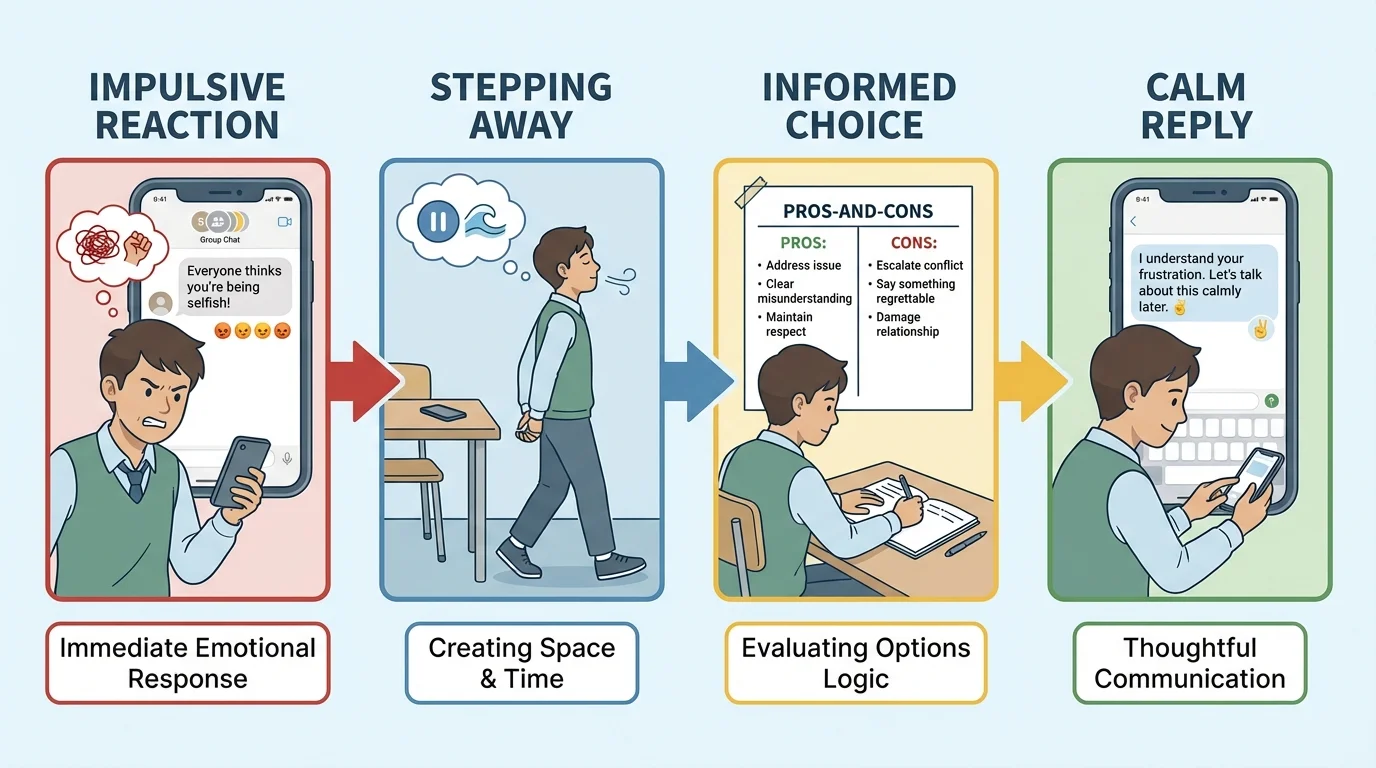
Real life is not always neat. Many situations involve mixed feelings and mixed facts. One upsetting message can lead either to damage or to a thoughtful response, as [Figure 3] illustrates in an online conflict scenario where a pause changes the outcome.
Situation 1: Online conflict. You see that someone left you out of a group chat joke. Your first reaction may be anger or embarrassment. An impulsive reaction would be posting a mean reply, sharing someone's private messages, or starting a bigger argument. An informed choice would be to pause, save evidence if needed, ask one clarifying question, and decide whether to respond calmly, leave the conversation, mute the chat, or tell a trusted adult if it becomes harassment.
Situation 2: Risky dare. Someone online challenges you to film yourself doing something unsafe for attention. The impulsive reaction is to focus on likes, approval, or proving you are brave. The informed choice is to ask whether the action could cause injury, property damage, or long-term embarrassment. If the answer is yes, the best choice is no.
Situation 3: Spending money. You want a game accessory that is on sale "for today only." An impulsive reaction is buying it because the timer makes it feel urgent. An informed choice is checking whether you actually want it, whether you can afford it, and what else that money is needed for. A sale is only a good deal if the purchase fits your plan.
Situation 4: Overloaded schedule. You agree to help with a community event, join an activity, and take on extra responsibilities at home in the same week. Saying yes to everything can be impulsive too, especially if you do it from guilt or pressure. An informed choice means checking your time honestly and deciding what you can do well without burning out.
Situation 5: Safety concern. Someone asks to meet in person without clearly identifying themselves, or asks you to keep something secret that feels wrong. In this case, informed choices may include refusing, leaving the conversation, blocking the person, saving evidence, and telling a trusted adult right away. Safety matters more than politeness.
Notice that informed choices are not always the most comfortable choices. They may require patience, honesty, or saying no when saying yes would feel easier in the moment. But as we saw in [Figure 3], a short pause can completely change what happens next.
You should not pause forever. Some situations need quick action. If there is immediate danger—such as a fire, a medical emergency, a serious threat, or someone trying to get your location or access to your account right now—fast protective action makes sense. That might mean leaving, calling for help, logging out, blocking, or telling a trusted adult immediately.
The key question is this: Is this a true emergency, or just an emotional emergency? A true emergency involves immediate risk to safety, health, or security. An emotional emergency feels intense, but usually allows time to think. Learning that difference helps you respond wisely.
| Situation type | Better response | Reason |
|---|---|---|
| Account security threat | Act quickly to protect the account | Immediate risk of harm |
| Angry comment online | Pause before replying | Time to think reduces damage |
| Pressure to buy something | Wait and review | Urgency may be a sales tactic |
| Unsafe challenge | Refuse immediately | Safety comes first |
| Misunderstanding with a friend | Ask questions and gather facts | You may not know the full story |
Table 1. Examples of when fast action helps and when pausing leads to better decisions.
"You do not have to believe every urgent feeling."
— Decision-making reminder
That reminder matters because urgency is not the same as importance. Many bad decisions happen when people confuse the two.
Good decisions are easier when you build habits before the next stressful moment happens. You do not rise to the level of your best intention; you usually fall back on your habits.
One helpful habit is creating delay rules for yourself. For example, you might decide: "I do not reply to upsetting messages immediately," "I wait before making online purchases," or "I never share passwords, codes, or private details in a direct message." Clear rules reduce pressure because you have already decided in advance.
Another useful habit is checking with a trusted person when a decision feels confusing, risky, or secretive. Asking for help is not weakness. It is smart information-gathering. Sometimes the most informed choice is realizing you should not handle the situation alone.
Critical thinking means asking questions, checking evidence, and not assuming your first thought is always correct. Decision-making uses that same skill in real life.
Reflection helps too. After a tough situation, think about what happened. What triggered you? What helped you pause? What option worked best? Over time, this builds judgment, which means the ability to make sensible decisions based on experience, facts, and values.
Try this: pick one area where you tend to react quickly—messages, spending, arguments, or overcommitting. Create one pause habit for that area today. Keep it simple and realistic. Small habits repeated many times are powerful.
You are not trying to become perfect. You are learning how to make fewer choices you regret and more choices you respect. That is what maturity in decision-making looks like.
