One quick phone check can turn into twenty minutes. One delayed assignment can turn into a stressful evening. One late-night scroll can turn into a tired morning. These moments may feel small, but they can quietly change your grades, mood, sleep, and confidence. When you learn online, your screen is both your classroom and one of your biggest sources of temptation, so your daily habits matter a lot.
Performance is not just about test scores. It also includes how well you focus, how carefully you complete work, how much you remember, how often you meet deadlines, and how stressed or calm you feel while doing school tasks. Good performance usually comes from steady habits, not from last-minute rushing.
A distraction is anything that pulls your attention away from what you are trying to do. It might be a notification, a video, background noise, another tab, a thought about something else, or even your own urge to get up and do anything except the task in front of you.
Procrastination means delaying something you need to do, even when you know waiting will probably make things harder. It is not the same as taking a planned break. A break is a choice that helps you recover. Procrastination is a delay that often increases stress later.
Your digital habits are the regular ways you use phones, tablets, computers, games, apps, videos, and social media. Some digital habits help you, like using a calendar or turning on focus mode. Others can hurt your progress, like checking messages every few minutes or staying up too late watching videos.
Distraction pulls your attention away from a task.
Procrastination is delaying an important task instead of starting it.
Performance is how well you complete tasks, manage time, stay accurate, and reach your goals.
These three ideas are connected. A distraction can lead to procrastination. Procrastination can lead to poor digital choices, like avoiding work by scrolling. Unhealthy digital habits can create more distractions. Once this loop starts, schoolwork often feels heavier than it really is.
Your brain works best when it can stay on one job long enough to get into a rhythm. But attention often jumps around, as [Figure 1] shows, when a student switches from an assignment to a message alert, then to a video, and then back again. Each switch may seem short, but your brain needs time to settle back into the original task.
This is why distractions do more than waste the exact number of minutes you spend on them. If you stop for a two-minute notification, you may lose extra time remembering where you were, finding your place, and getting focused again. That means a task that should take thirty minutes can stretch much longer.
Distraction also increases mistakes. You are more likely to skip directions, misread a question, forget part of an answer, or turn in work without checking it. In online learning, where much of your work depends on self-management, this can lower the quality of your assignments even when you understand the material.
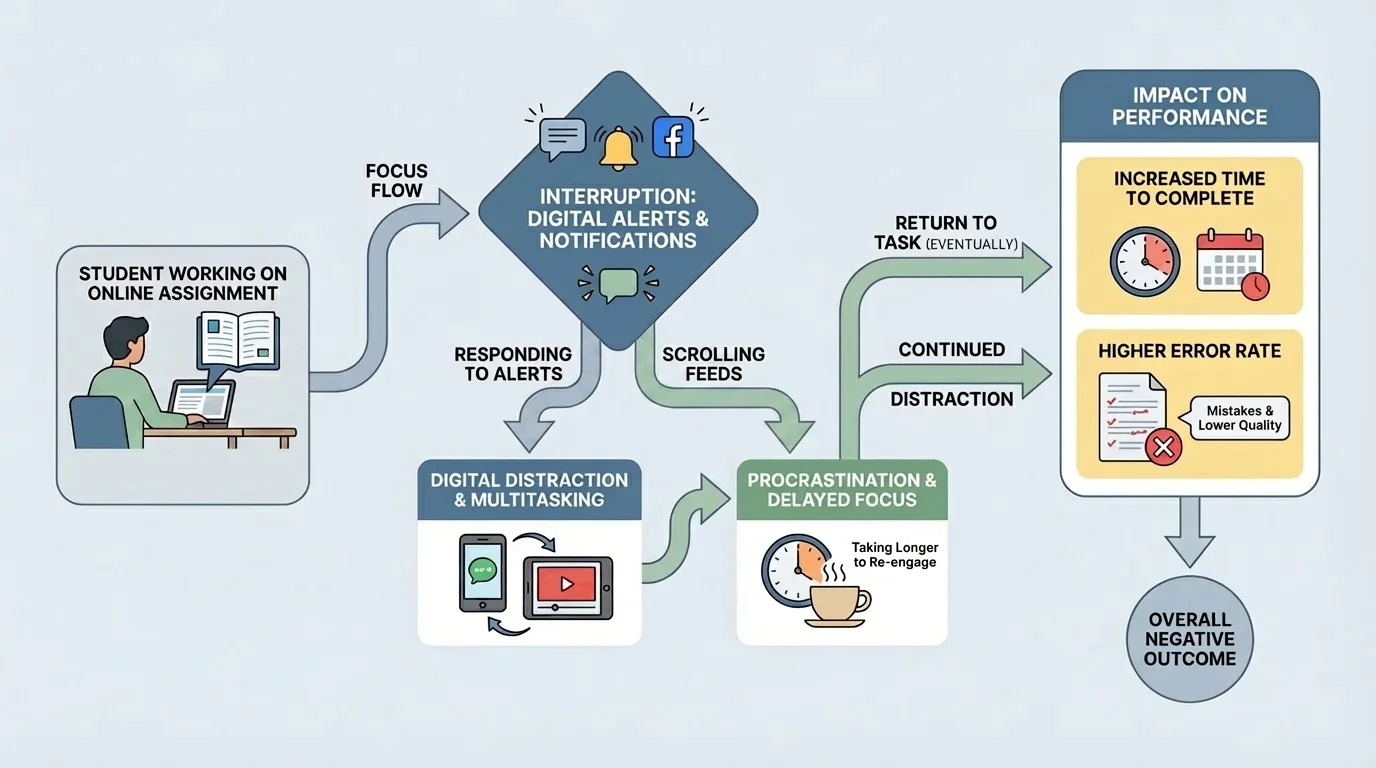
Another problem is weaker memory. When you only half-focus on a lesson or assignment, your brain stores less of it. Later, the work feels unfamiliar, so studying takes longer. This is one reason distractions can make school feel harder over time, not just in the moment.
Think of focus like trying to fill a bucket with water. If the water keeps spilling out through holes, the bucket fills slowly. Distractions are those holes. The more often your attention leaks away, the more energy you need to finish the same task.
Many people believe multitasking makes them faster, but for school tasks, it usually means your brain is rapidly switching between jobs instead of doing both well at once.
That is why even "small" distractions matter. A student who checks messages ten times during a work session may not notice how much energy is being lost. But the final result often shows it: slower work, more frustration, and less confidence.
Procrastination often follows a repeat pattern, and [Figure 2] illustrates that cycle clearly: you put off the task, feel temporary relief, run out of time, feel stressed, rush, and then dislike the whole experience even more next time. This cycle is common because procrastination can feel good for a moment, even though it creates problems later.
Sometimes students procrastinate because a task feels boring, confusing, long, or scary. You might think, "I'll do it later when I feel more ready." But later often comes with less time and more pressure. The task has not changed, but now your stress level is higher.
When you wait too long, your choices shrink. You may have no time to ask for help, reread directions, or fix mistakes. That can lead to lower scores, missing parts, or work that does not show your real ability. It is frustrating to know you could have done better if you had started earlier.
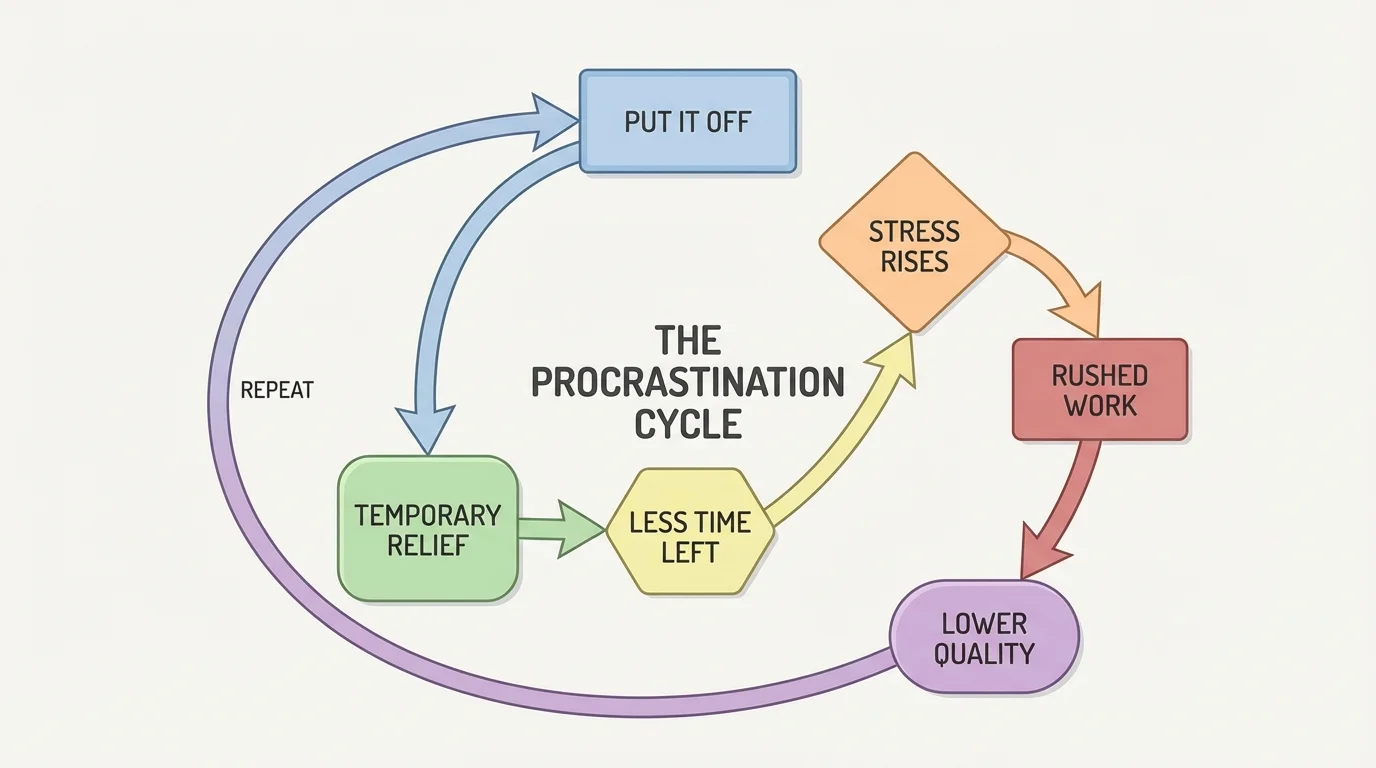
Procrastination also affects emotions. It can create guilt, which drains motivation. Then schoolwork starts to feel tied to dread instead of progress. Over time, that can hurt your confidence. You may start thinking you are "bad at school," when the real issue is often the habit of delay, not your ability.
Here is a simple way to tell the difference between a useful pause and procrastination. A useful pause has a purpose: rest, food, movement, or time to think. Procrastination avoids the task without solving the problem. If the delay leaves you less ready, less calm, or closer to a deadline, it is probably procrastination.
The procrastination trap happens when avoiding a task gives short-term comfort but causes long-term stress. Your brain learns to chase quick relief, so starting becomes harder next time. Breaking the trap means making the first step small enough to begin.
A good question to ask yourself is: What am I avoiding? Is it the whole task, the first step, confusion, fear of getting it wrong, or the feeling that it will take too long? Once you know the reason, you can choose a better response.
Your technology is not automatically good or bad. What matters is how you use it and when. Helpful digital habits support learning. Harmful ones interrupt learning, steal sleep, or make it harder to stay calm and organized.
Notifications are a major example. If your device lights up, buzzes, or pops up messages during work time, your attention gets trained to expect interruption. Even if you do not open every notification, part of your brain is still wondering what you missed. That lowers deep focus.
Another habit is keeping too many tabs, apps, or videos open while studying. It can feel productive because you are "doing a lot," but often it makes your brain skim instead of think carefully. If you are watching a lesson, checking a chat, and browsing something unrelated, your learning becomes shallow.
Late-night device use can also damage performance. Bright screens, exciting videos, and endless scrolling can delay sleep. Less sleep means slower thinking, weaker memory, more irritability, and less patience with difficult work the next day. A tired brain gives up faster.
Gaming, videos, and social media are not automatically bad. The key is whether they fit into your day in a healthy way. If they happen after responsibilities are handled and sleep is protected, they can be part of balanced free time. If they replace school tasks, exercise, meals, or rest, they are starting to control your schedule instead of serving you.
| Habit | Likely Effect | Long-Term Result |
|---|---|---|
| Checking notifications during work | Broken focus | Slower completion and more mistakes |
| Starting tasks late | Less time to think | Rushed, lower-quality work |
| Using screens late at night | Poor sleep | Tiredness and weaker concentration |
| Using calendar or reminders | Better planning | More tasks finished on time |
| One-tab, one-task work sessions | Stronger focus | Better understanding and less stress |
Table 1. Common habits and how they can affect school performance over time.
Notice that the same device can either help or hurt you. A phone can distract you with short videos, or it can remind you about your study plan. A laptop can open ten unrelated tabs, or it can be a clean workspace for one assignment. The tool is the same. The habit changes the result.
If you want to improve, first you need to notice what is really happening. A simple self-check, like the one shown in [Figure 3], helps you spot patterns between a habit, what triggers it, and how it affects your performance. You do not need to judge yourself harshly. You just need honest information.
Step 1: Pick one school week to observe. During that time, pay attention to when you get distracted, when you delay starting, and how you use your devices before work, during work, and at night.
Step 2: Write down specific habits, not vague ones. Instead of "I use my phone too much," write "I check messages every five minutes while doing science." Specific details are easier to fix.
Step 3: Notice triggers. A trigger is what happens right before the habit. Maybe you open social media when a task feels hard. Maybe you start watching videos when you feel tired. Maybe you switch tabs when you get bored.
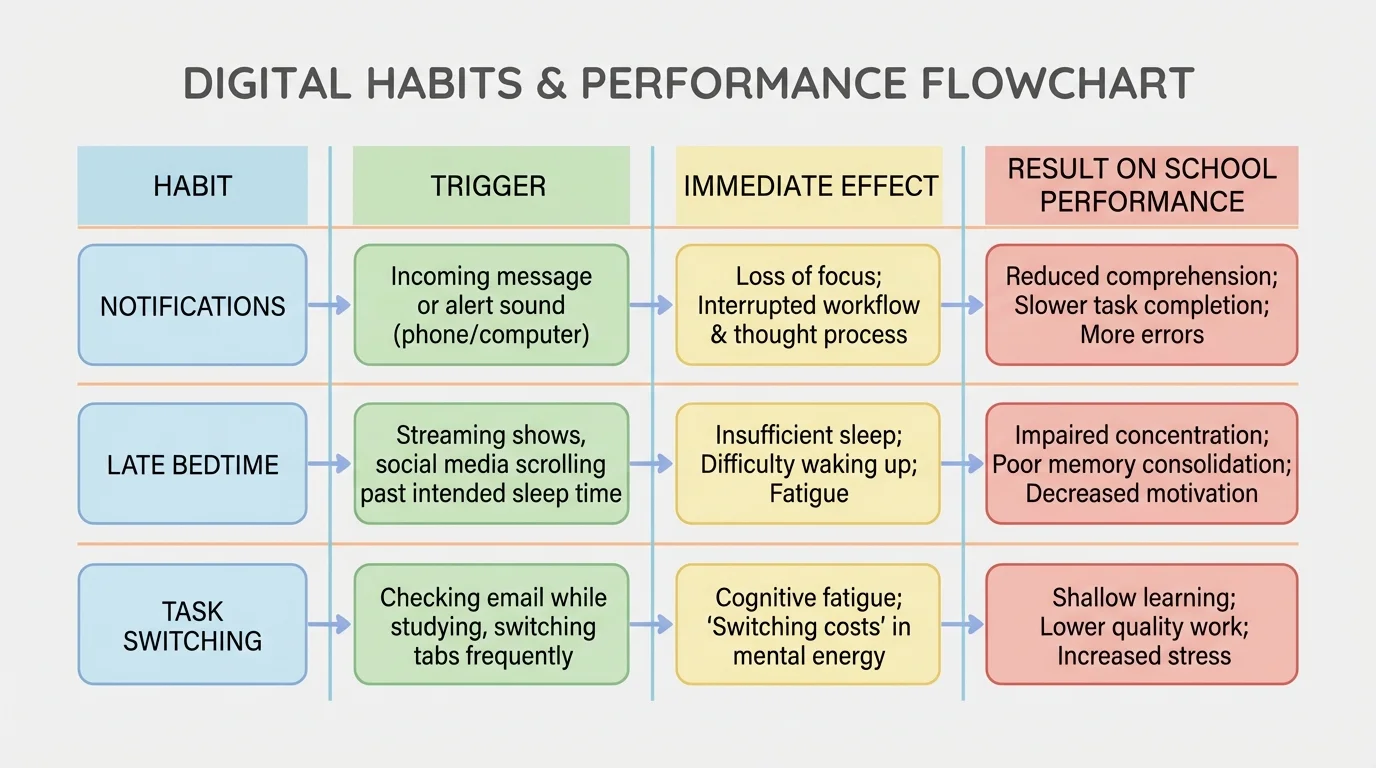
Step 4: Notice the effect. Ask yourself: Did this habit make my work faster or slower? Better or worse? Did it help me feel calm or stressed? Did it protect my sleep or steal from it?
Step 5: Look for patterns. If the same problem happens again and again, that is good news in a way, because patterns can be changed. Random problems are harder to fix than repeated ones.
Personal habit check example
A student notices that math assignments keep taking much longer than expected.
Step 1: Identify the habit
The student realizes they keep opening a video app "for one minute" whenever a question feels difficult.
Step 2: Identify the trigger
The trigger is the uncomfortable feeling of not knowing the answer right away.
Step 3: Identify the effect
The "one minute" turns into ten minutes, focus breaks, and the assignment feels even harder to restart.
Step 4: Choose a better response
The student decides that when stuck, they will first reread the example, then write one question for later help, instead of leaving the task immediately.
As you keep noticing your habits, remember that one bad day does not define you. Assessing your habits is about finding causes, not blaming yourself. You are trying to understand your system so you can improve it.
Once you know the problem patterns, build routines that make better choices easier. A simple focus sequence, shown in [Figure 4], can reduce decision-making and help you begin work faster: choose one task, silence notifications, set a timer, work, take a short break, and repeat.
Start with one clear target. Do not tell yourself to "do school." That is too broad. Say, "Finish questions one through five," or "Write the first paragraph," or "Watch the lesson and take notes." Specific goals make starting less intimidating.
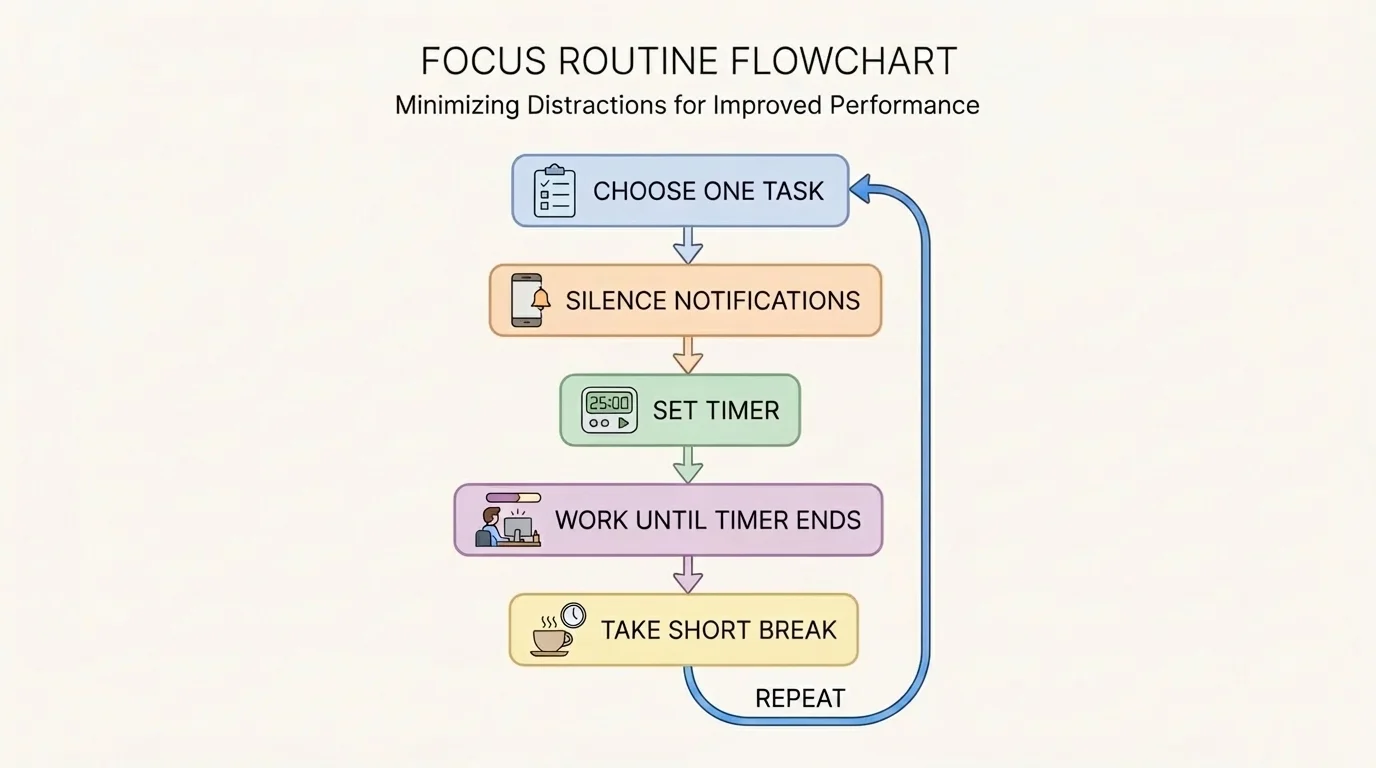
Silence what you can. Turn off non-urgent notifications, put your phone out of reach, close unrelated tabs, and keep only the materials you need. This reduces the leaks in your attention that we saw earlier in [Figure 1].
Use short work sessions. If a task feels huge, start with a short timer such as ten or fifteen minutes. Beginning is often the hardest part. Once you get moving, continuing becomes easier.
Break big tasks into small pieces. "Do the project" feels heavy. "Choose a topic," "find two sources," and "write the introduction" feel possible. Small steps reduce the fear that often feeds procrastination.
Create a rescue plan for distractions. You will not stay perfect all day. When you notice you got off track, do not waste energy feeling bad. Use a reset sentence like, "I got distracted, and now I am returning to question three." Fast recovery is a real skill.
"You do not need to feel ready to begin. Beginning often creates the readiness."
Protect sleep. Set a device cutoff time before bed. Even thirty minutes without scrolling can help your brain settle. Better sleep helps focus, memory, mood, and self-control the next day.
Match tools to your goal. If you need to write, open only the writing document. If you need to read, use full-screen mode. If you need reminders, use alarms or a checklist. Let technology support the task instead of competing with it.
Reward completion, not avoidance. For example, finish one work session and then watch a video or message a friend. This teaches your brain that effort comes first and fun follows, rather than the other way around.
Healthy habits do not have to be huge. Repeating a small useful action every day usually helps more than making a giant plan you cannot keep.
One helpful rule is to change the environment before changing your willpower. It is easier to focus when the tempting app is closed, the phone is across the room, and your materials are ready. Good systems reduce the number of hard choices you must make.
Scenario 1: Maya keeps missing small assignment details. She realizes she watches short clips while doing work. Her fix is to use one-tab study sessions and save entertainment for after school tasks. Within a week, she notices fewer mistakes and less re-reading.
Scenario 2: Jordan delays writing assignments because starting feels overwhelming. He decides to work in small chunks: title, opening sentence, first example, then a break. This weakens the procrastination cycle we saw in [Figure 2], because the task no longer feels impossible.
Scenario 3: Elena feels tired and unfocused during morning lessons. After tracking her habits, she notices she is scrolling late at night. She sets a charging spot outside her bed area and reads for a few minutes instead. Better sleep helps her pay attention more consistently.
These examples are not about becoming perfect. They show that small changes in habits can create noticeable changes in performance. When students improve the systems around their work, they often improve the work itself.
Strong performance usually comes from routines you can repeat, not from rare bursts of motivation. Motivation changes from day to day. Habits are what carry you when motivation is low.
Choose one or two changes at a time. If you try to fix everything at once, it becomes too much. You might start with only one goal: no notifications during work sessions. Once that feels normal, add another goal, such as starting assignments within ten minutes of your planned time.
Check your progress honestly. Ask: Am I finishing faster? Am I making fewer mistakes? Am I less stressed? Am I sleeping better? These questions help you assess whether a new habit is actually improving performance.
Also, expect setbacks. A bad day does not erase progress. What matters most is returning to your plan quickly. Students who improve are not students who never slip. They are students who reset faster and keep going.
Better habits create better performance because they reduce friction. When your environment supports focus, your tasks are broken into clear steps, and your device use has limits, you spend less energy fighting yourself and more energy learning.
You are not stuck with your current habits. Distraction, procrastination, and unhealthy digital routines can affect performance in real ways, but they can also be changed in real ways. The more clearly you notice your patterns, the more power you have to improve them.
