Some adults switch careers more than once, and many say they wish they had understood themselves better earlier. That does not mean you need to pick your future job right now. It means this is a smart time to start noticing patterns: what pulls your attention, what matters to you, and what you are already getting good at. Those patterns can help you make better choices about hobbies, projects, volunteering, classes, and future work.
A career pathway is not just one job title. It is the route you take through learning, practice, experiences, and jobs over time. You might start by helping a family member fix things, making digital art, caring for younger kids, editing videos, or organizing a community event online. Those small experiences can point toward later opportunities.
When people choose a path that fits them well, they are often more motivated, more confident, and more likely to stick with challenges. When the fit is poor, they may feel bored, stressed, or stuck. That is why learning about yourself matters. Good career planning is not guessing. It is paying attention.
Career pathway is a series of connected learning and work experiences that can lead you toward a type of career. It is wider than a single job because it includes the steps that help you get there.
You do not need to know your whole future to make smart choices now. You only need to get better at asking, What seems like a good fit for me at this stage?
[Figure 1] Your best career matches often happen where interests, values, and skills overlap. If you only look at one of these, your choice may be incomplete. For example, you might enjoy something but not want the lifestyle that comes with the job, or you might be skilled at something but not enjoy doing it every day.
Interests are the topics and activities that catch your attention and make you curious. Values are the things that matter deeply to you, such as helping others, earning a strong income, having a steady schedule, being creative, or working outdoors. Skills are abilities you can use to get something done, such as writing clearly, listening well, coding, cooking, drawing, problem-solving, or staying organized.
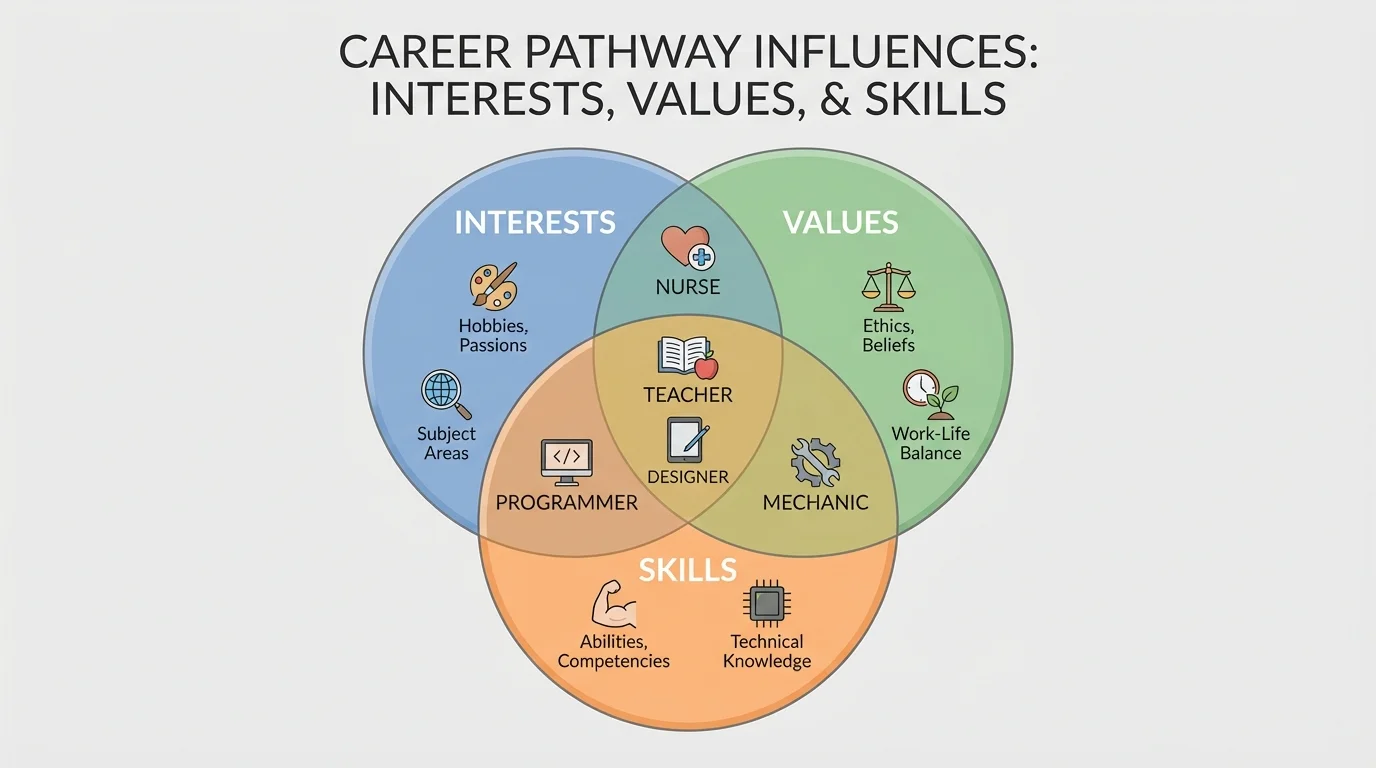
Think of these three factors as different lenses. One lens shows what you like. One lens shows what matters to you. One lens shows what you can do now and what you can improve with practice. Looking through all three helps you see more clearly.
If a student says, "I like animals," that is a useful starting point, but it is not enough by itself. Does the student value high income, flexible hours, scientific research, hands-on care, or being outdoors? Does the student already have strong observation skills, patience, or comfort handling animals? The answer changes which pathways make sense.
Your interests often show up in your free time. What videos do you choose to watch? What kinds of problems do you like solving? What topics make you lose track of time in a good way? Those clues matter.
Interests can include areas like technology, sports medicine, music production, fashion, construction, health, business, nature, public safety, food, transportation, media, or design. An interest does not guarantee a career, but it can point you toward one. If you enjoy building and fixing things, careers in engineering, repair, construction, robotics, or technical trades may feel more engaging than jobs with mostly desk-based tasks.
It is also normal to have more than one interest. A student who likes art and technology might explore animation, web design, video editing, game design, or digital marketing. A student who likes science and helping others might explore nursing, physical therapy, veterinary work, medical lab work, or public health.
Many jobs combine interests in ways people do not notice at first. For example, sports can connect to careers in physical therapy, nutrition, video analysis, event management, journalism, and athletic equipment design.
One important warning: an interest is not the same as a fantasy. Loving music does not mean the only option is becoming a famous performer. It might also connect to sound engineering, music teaching, audio editing, event production, instrument repair, or marketing for artists.
Interests can change as you grow. That is not failure. It is information. If you used to love one topic and now you do not, that tells you something useful about your direction.
[Figure 2] Your values are a hidden filter behind career choices. Two people can both enjoy science, but one may want a calm routine and another may want fast-paced emergency work. The interest is the same, but the values are different, so the pathway may be different too.
Values answer questions like these: Do you want to help people directly? Do you care about job stability? Do you want lots of teamwork or more independence? Is creativity important to you? Do you want work that feels meaningful? Do you hope for flexible hours? Would you rather be indoors or outdoors? Is a high income one of your top goals?
None of these values are automatically right or wrong. What matters is being honest. If you strongly value time with family, a job with unpredictable hours may frustrate you. If you value action and variety, a very repetitive job may feel draining. If you value service, you may prefer work where you can see your impact on others.
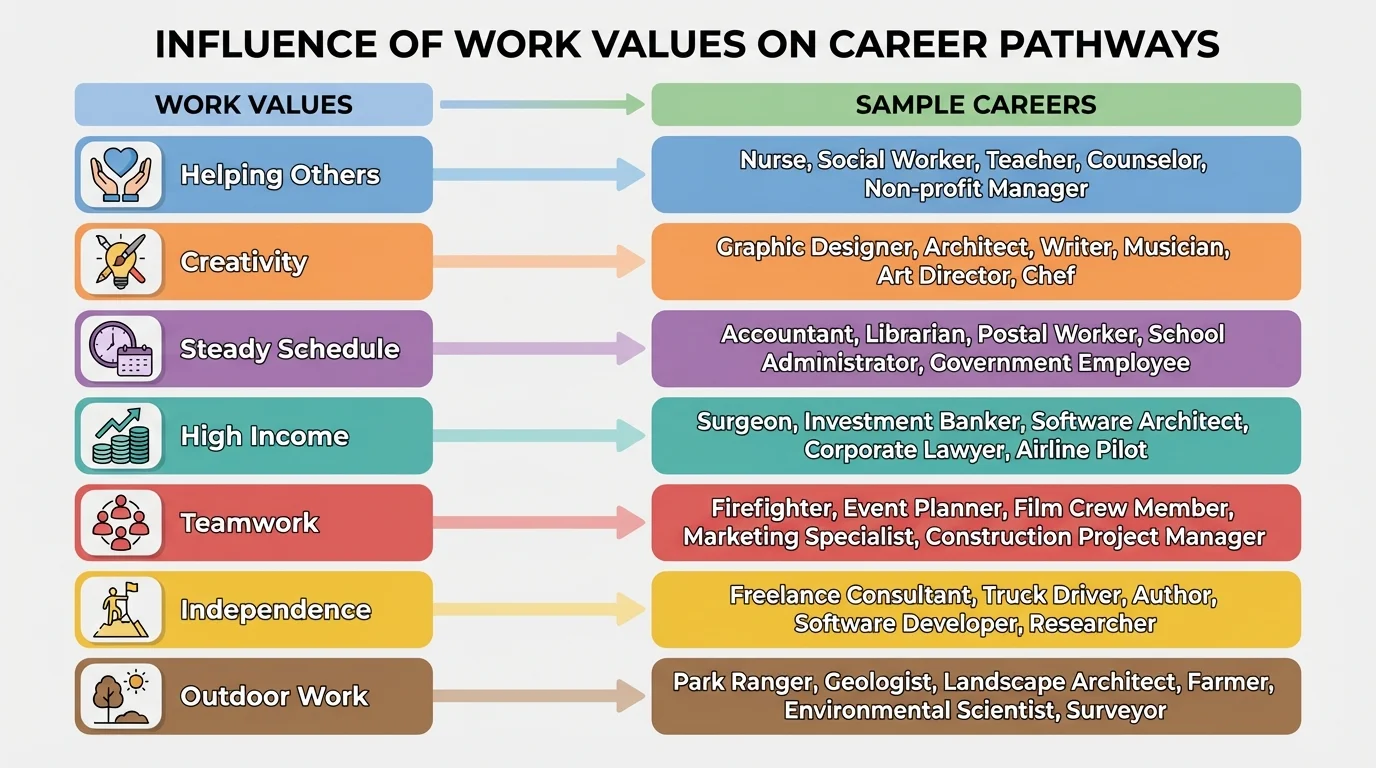
Values also explain why a job that looks impressive to one person may feel wrong to another. For example, a student might be interested in law because of debate and problem-solving, but later realize that their strongest values are creativity and flexible work time. That student may shift toward media, design, or entrepreneurship instead.
Money matters too. It is okay to care about income. Adults need to pay for housing, food, transportation, and other essentials. But choosing only for money can lead to problems if the work clashes with your interests or values. A stronger plan is to ask, Can I find a pathway that supports my needs and fits who I am?
Values shape daily life, not just big goals. A career is not only about the job title. It affects your schedule, stress level, relationships, energy, and sense of purpose. When your values match your work, daily life often feels more manageable and meaningful.
Later, when you compare several pathways, think beyond "Would this job sound cool?" Ask, "Would I actually like the kind of life this work creates?" That is often the better question.
Skills are not fixed. Some are already strengths. Others are just beginning. A lot of students make the mistake of thinking, "If I'm not great at it now, it is not for me." That is not true. Many careers start with basic interest and beginner skill, then grow through practice.
There are different kinds of skills. Technical skills are specific abilities like editing videos, using spreadsheets, coding, baking, measuring materials, repairing a bike, or speaking another language. Transferable skills are useful in many jobs, such as communication, teamwork, time management, adaptability, and problem-solving.
A strength is a skill or quality you use especially well. A strength could be staying calm, noticing details, explaining ideas clearly, thinking creatively, fixing things, or encouraging others. Strengths matter because they often make tasks feel easier and more natural.
Still, do not confuse "easy for me" with "the only thing I should do." Maybe you are good at organizing files and schedules, but you also deeply care about health care. That could lead toward medical office work, project coordination in a clinic, or later training in a health-related field. Skills can support a pathway even when they are not the whole reason you choose it.
Example: Looking at skills honestly
A student wants to work in game design.
Step 1: Name current skills.
The student is creative, tells strong stories, and can learn software quickly.
Step 2: Notice skill gaps.
The student has very little experience with coding and team project deadlines.
Step 3: Make a growth plan.
The student starts a simple design project, watches beginner tutorials, and practices finishing small tasks on time.
This student is not "unqualified." The student is at the beginning of a pathway.
As you saw earlier, skills work best when they connect with what you enjoy and what matters to you. Being skilled at something is helpful, but long-term motivation is often stronger when the skill is part of a larger fit.
One factor alone rarely gives a complete answer. You may enjoy an activity but dislike the work environment linked to it. You may value helping others but not yet have the skills needed for certain roles. You may be good at something but not want to do it every day. Strong career planning looks for patterns across all three areas.
Here is a simple way to compare them:
| Factor | Main Question | Example Clues | Risk If Ignored |
|---|---|---|---|
| Interests | What do I enjoy learning or doing? | You watch tutorials, read about the topic, or choose it for projects | You may feel bored or unmotivated |
| Values | What matters to me in work and life? | You care about purpose, schedule, income, creativity, or stability | You may feel stressed or dissatisfied even if the job looks good |
| Skills | What can I do now, and what can I improve? | You communicate well, solve problems, create, repair, organize, or lead | You may choose a path without preparing for it |
Table 1. A comparison of interests, values, and skills and how each affects career decisions.
If all three line up well, a pathway often feels more realistic and rewarding. If one area is weak, that does not mean "no." It may mean "not yet" or "needs more exploration."
You do not need a perfect match before taking action. Career exploration works best when you test ideas, reflect, and adjust. The goal is progress, not instant certainty.
For example, suppose you are interested in health care, value helping others, and already have patience and strong listening skills. That combination may point toward pathways such as nursing, therapy, counseling, or medical assisting. If you are interested in technology, value independence, and enjoy solving logic problems, pathways such as programming, cybersecurity, or IT support may fit better.
A pathway usually has stages. First you notice an interest. Then you explore it. Then you build beginner skills. Later you may take a course, earn a certification, volunteer, create a portfolio, shadow someone, or get an entry-level job. Over time, you move forward or sometimes change direction.
This matters because students sometimes believe they must choose one future and never change. Real life is more flexible. A person may start in customer service and later move into sales, business management, or marketing. A person may begin by editing videos for fun and later study communications, media, or design. Early experiences often open doors, even if they are not your final destination.
The word pathway is important because it reminds you that the route has steps. You are not supposed to be at the end when you are just beginning.
"Choose a direction, not a destiny."
— Career planning principle
That idea can lower pressure. Your job right now is not to predict your entire adult life. Your job is to learn enough about yourself to choose smart next steps.
[Figure 3] The process moves from self-knowledge to action in a sequence. You do not need expensive programs or a perfect plan. You need curiosity, honesty, and follow-through.
Start by noticing patterns in what you enjoy, what frustrates you, and what people often ask you for help with. Then connect those patterns to possible careers. After that, test your ideas in small ways instead of making huge assumptions too early.
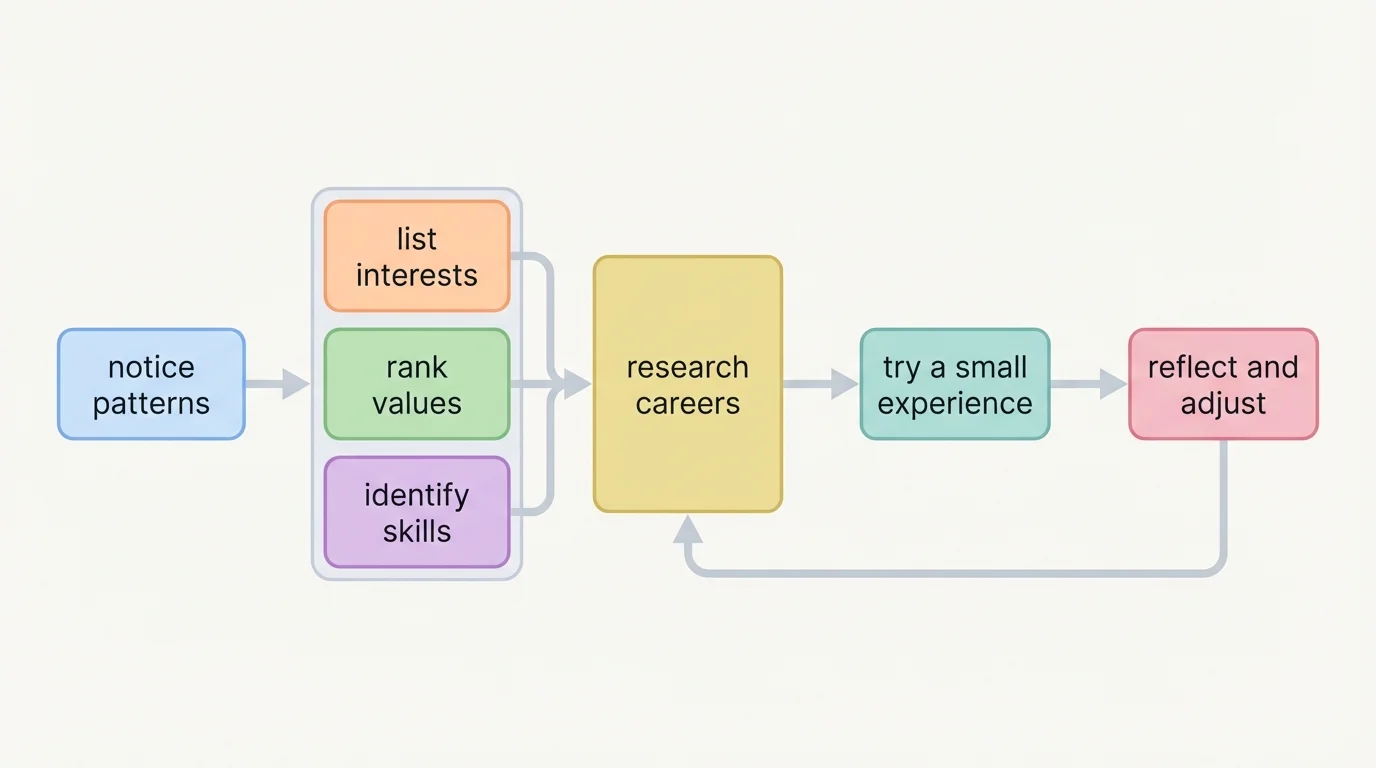
Step 1: List your interests. Write down topics, tasks, and activities you genuinely like. Include things you do at home, online, in hobbies, sports, family responsibilities, or community activities.
Step 2: Rank your values. Pick the top few things that matter most to you in future work, such as helping others, stability, creativity, income, teamwork, independence, or flexibility.
Step 3: Identify your current skills. Be specific. Instead of saying "I'm good at school," say "I explain ideas clearly," "I stay organized," or "I learn software quickly."
Step 4: Research careers that match your patterns. Read job descriptions, watch day-in-the-life videos, or visit reliable career websites. Pay attention to real tasks, not just the title.
Step 5: Try a small experience. This could mean creating a sample project, interviewing an adult over video call, taking a beginner tutorial, helping in a family business, volunteering, or joining a community activity.
Step 6: Reflect and adjust. Ask: What did I enjoy? What felt tiring? What skill do I need next? What surprised me?
Later, when you feel unsure, return to the process. It is not a straight line forever. You may repeat steps as you learn more.
Example: Exploring a pathway in a practical way
A student thinks photography might be part of a future career.
Step 1: Interest check
The student enjoys taking pictures, editing images, and noticing visual details.
Step 2: Values check
The student cares about creativity and flexible work more than having a strict office routine.
Step 3: Skills check
The student already understands basic editing apps but needs to improve communication and planning.
Step 4: Small test
The student creates a photo portfolio and offers to photograph a local event for practice.
From there, the student can explore pathways such as photography, media production, marketing content, journalism, or graphic design.
Small tests are powerful because they replace guessing with evidence. You learn faster from doing than from only thinking.
One common mistake is choosing based only on what looks impressive online. A job may seem exciting in short clips, but real work includes routines, responsibilities, deadlines, and sometimes stress.
Another mistake is choosing only based on money. Income matters, but if your interests and values clash with the work, staying motivated can be hard. On the other hand, choosing only based on fun can also cause problems if you ignore training needs, job demand, or lifestyle fit.
A third mistake is saying, "I'm bad at this, so I can never do it." If the pathway matters to you, ask whether the problem is lack of practice rather than lack of ability. Many strong workers were once beginners.
Smart career choices balance fit and growth. A good pathway is not always the easiest one, and it is not always the highest-paying one. It is a path where your interests, values, and skills can work together while leaving room for you to improve.
Another mistake is letting other people choose for you completely. Advice can help, but no one else lives your daily life. If a relative pushes a job because it sounds stable, but you know it strongly conflicts with your values or interests, take that seriously. Listen respectfully, then think for yourself.
Consider three students with different patterns.
Maya likes solving tech problems, values independence, and already has patience and strong focus. She may explore IT support, coding, robotics, or cybersecurity.
Jordan enjoys cooking, values creativity and making people happy, and has growing time-management skills. Jordan may explore culinary arts, baking, food content creation, catering, or restaurant management.
Elena likes biology, values helping others, and is calm in stressful moments. She may explore nursing, emergency medical work, physical therapy, or veterinary care.
Notice that none of these students picked a path from only one factor. Their choices make more sense because they combine interests, values, and skills. That is the pattern to remember.
The comparison chart from earlier helps with exactly this kind of decision. Two students may like the same subject, but different values can lead them toward different work lives.
You do not have to wait years to start exploring. You can take useful steps now from home and in your community.
Try This: Keep a simple note on your device for two weeks. Write down moments when you feel interested, proud, useful, bored, or frustrated. Patterns will start to appear.
Try This: Ask one adult about their work through a conversation, phone call, or video chat. Ask what they actually do each day, what skills matter most, and what they wish they had known earlier.
Try This: Pick one pathway and do a tiny test. If you are curious about design, make a poster. If you are curious about coding, complete one beginner lesson. If you are curious about child care, help plan activities for younger children in your family or community.
Try This: Build one skill that fits many careers, such as communication, organization, or reliability. These transferable skills make almost every pathway stronger.
Your future career path does not appear all at once. It becomes clearer as you notice your interests, understand your values, and build your skills. The more honestly you do that, the better your next choices will be.
