Lots of projects fail for a simple reason: the idea was not the problem, but the planning was. A person might have a great idea for a dog-walking service, a custom bookmark shop, or a neighborhood tutoring service, but if they do not know who it is for, what it costs, or how to check whether it worked, the idea can fall apart fast. Good planning does not make a project boring. It makes it possible.
When you plan a small project or service, you are really answering a few smart questions before you begin. Who needs this? What problem does it solve? What will I need? How will I test it? How will I know if it worked? These questions matter whether you are starting a mini lawn-care service, offering help with pet feeding while neighbors travel, or organizing a small online craft sale.
A project is a planned piece of work with a goal and an end point. A service is work you do to help someone else, like editing a video, watering plants, or walking dogs. Both need planning because real life includes limits. You only have so much time, money, energy, and space.
Planning helps you avoid common problems. Without planning, you might buy supplies no one wants, offer a service at the wrong time, or promise more than you can actually do. With planning, you can start smaller, make better choices, and build confidence. This is a career skill too. Adults use these same steps when starting businesses, organizing events, or creating community programs.
Target audience means the specific group of people your project or service is meant for. Pilot test means trying an idea on a small scale first. Resources are the things you need to complete your plan, such as time, money, tools, supplies, and help. Results are the outcomes you measure to see whether your plan worked.
If you learn to think this way now, you will be better prepared for future jobs, side projects, volunteer work, and personal goals. Even something simple, like selling homemade greeting cards online, becomes easier when you break it into steps.
Before you do anything else, decide exactly what you want to do. A weak goal sounds like, "I want to make something people like." A stronger goal sounds like, "I want to sell 10 handmade bookmarks to students who enjoy reading, using less than $20 in supplies." The second goal is better because it is specific.
A good goal usually answers these questions: What are you offering? Who is it for? What result do you want? What limits do you have? If you cannot answer these clearly, your plan is still too fuzzy.
Here are some examples of clear goals:
You do not need a giant idea. In fact, small is often smarter. Starting with a simple goal gives you a better chance of finishing strong.
Your target audience is the group most likely to want what you offer. This step matters because trying to help "everyone" usually helps no one very well. A better plan is to narrow your focus, as [Figure 1] shows, from a broad group to a more specific one with a clear need.
Think about people's problems, habits, age group, budget, and schedule. If you are offering pet sitting, your target audience is not all pet owners everywhere. It might be busy families in your neighborhood who sometimes need short-term help on weekends. If you want to sell custom study guides, your audience might be middle school students who want simple review sheets for one subject.
Audience planning becomes easier when you ask:
You can also think about what your audience cares about. Some people want the cheapest option. Others care more about speed, quality, convenience, or style. If you know what matters to them, you can design your project or service in a way that fits.
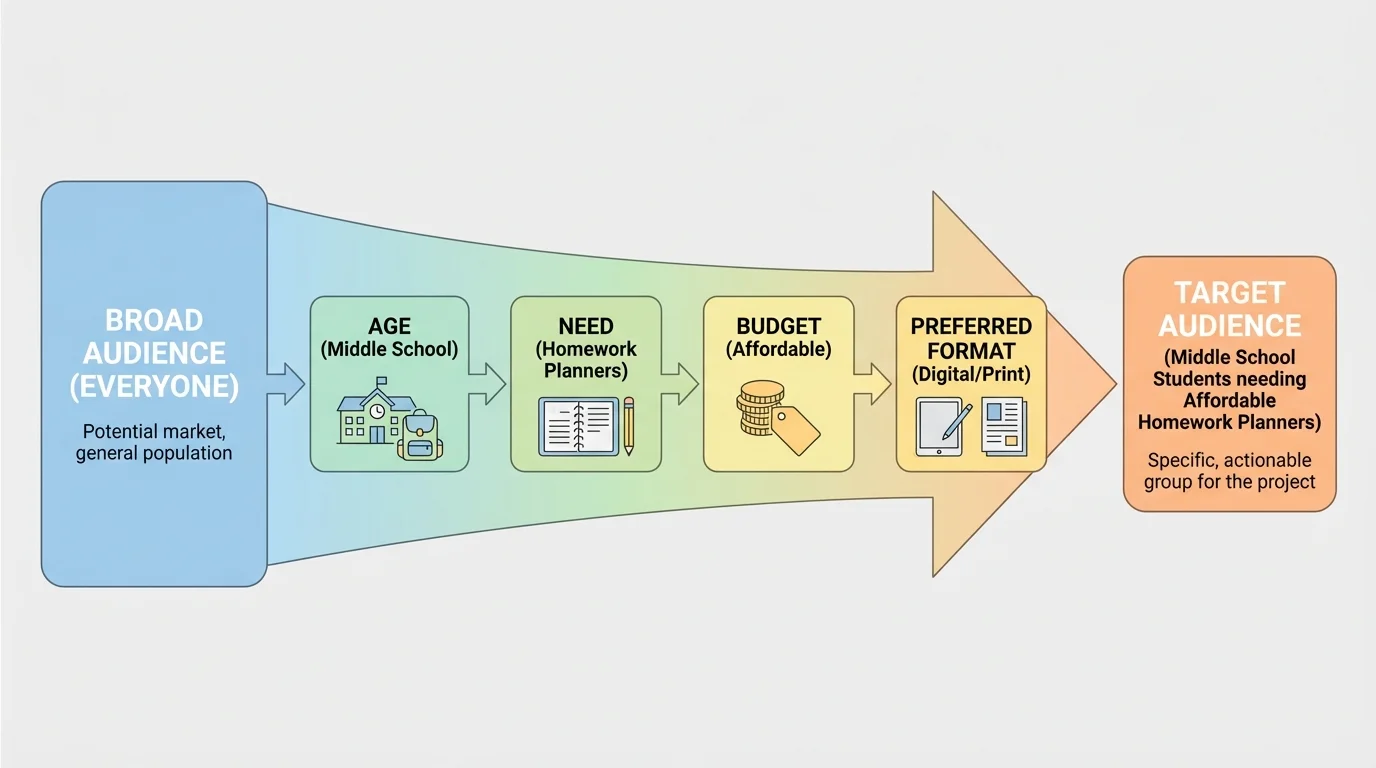
Suppose you want to create a simple homework planner. A weak audience choice is "students." A better audience choice is "students ages 12 to 14 who want a low-cost printable planner to keep schoolwork organized." That tells you much more. It affects the design, price, format, and how you share it online.
Later, when you make decisions about cost and advertising, the audience choice in [Figure 1] still matters. If your audience wants something quick and affordable, a fancy version with too many extras may actually be the wrong choice.
Example: Choosing an audience
A student wants to start a pet-care service.
Step 1: Start broad
The first thought is "people with pets."
Step 2: Narrow the group
The student notices that nearby families with dogs often need short evening walks.
Step 3: Define the audience clearly
The target audience becomes "busy local dog owners who need short weekday evening walks."
Step 4: Match the offer to the audience
The service becomes a 15-minute evening walk instead of an all-day pet-sitting service.
This clearer audience makes the project easier to manage and more likely to succeed.
A smart target audience does not have to be large. It just has to be real. Helping a small group well is often better than trying to impress a huge group with something unclear.
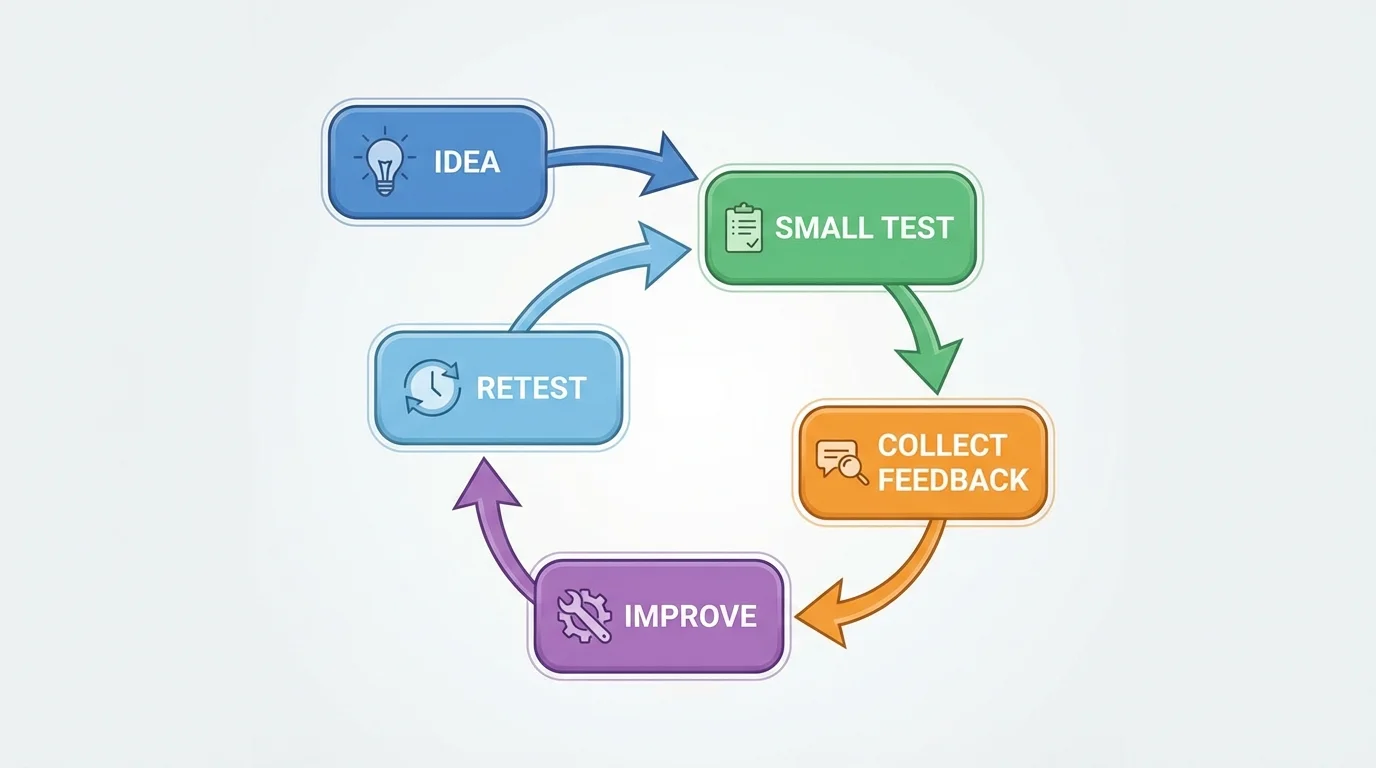
One of the smartest things you can do is run a pilot test. That means trying your idea with a small number of people before you fully launch it. This keeps you from wasting resources, and it helps you learn quickly. The improvement cycle in [Figure 2] shows that a small test is not the finish line. It is the beginning of making the idea better.
A small-scale test can look different depending on your idea. If you are offering tutoring, you might test one short session with one or two students. If you are selling handmade keychains, you might make only five first and ask buyers for opinions. If you are planning a yard cleanup service, you might try it for one neighbor before offering it more widely.
During a small test, pay attention to what works and what does not. Did people understand what you were offering? Was the price fair? Did the service take longer than expected? Were there problems with quality, timing, or communication?
Feedback is one of the most useful tools in a test. Feedback means comments or reactions from people who tried your idea. Good feedback is specific. "It was fine" is not very useful. "The design looked nice, but the print was too small to read easily" is useful because you know what to fix.
You can gather feedback by asking simple questions such as:
Testing small also protects your reputation. If there is a problem, it is easier to fix when only a few people are involved. That is much better than making a big promise and then disappointing many people.
Why a small test saves you trouble
A small test helps you find problems early, when they are easier and cheaper to fix. You might discover that a task takes twice as long as you expected, that customers want a different version, or that your message is unclear. Fixing those issues after a small test is much easier than fixing them after a full launch.
Suppose you planned to sell 20 snack packs for a weekend sports event. A small test could mean making just 4 packs first. If each pack costs $2.50 to make, then testing 4 packs costs only $10, because \(4 \times 2.50 = 10\). If you skipped the test and made 20 packs, your cost would be $50, because \(20 \times 2.50 = 50\). Testing first can protect your money as well as your time.
The pilot cycle in [Figure 2] keeps repeating in real life. Adults do this all the time when they release a sample product, run a trial version of an app, or test a service with a small group before expanding.
Every plan needs resources. These include more than money. They also include time, materials, tools, space, transportation, skills, and sometimes help from other people. The resource categories in [Figure 3] show why a good planner does not focus on only one type of need.
Start by making a simple list of what you need. For many small projects, five resource categories are enough: time, money, materials, tools, and people. Time includes how long preparation and delivery take. Money includes startup costs. Materials are the physical items you use. Tools are items like a device, printer, leash, or design app. People include anyone helping you or anyone whose permission you need.
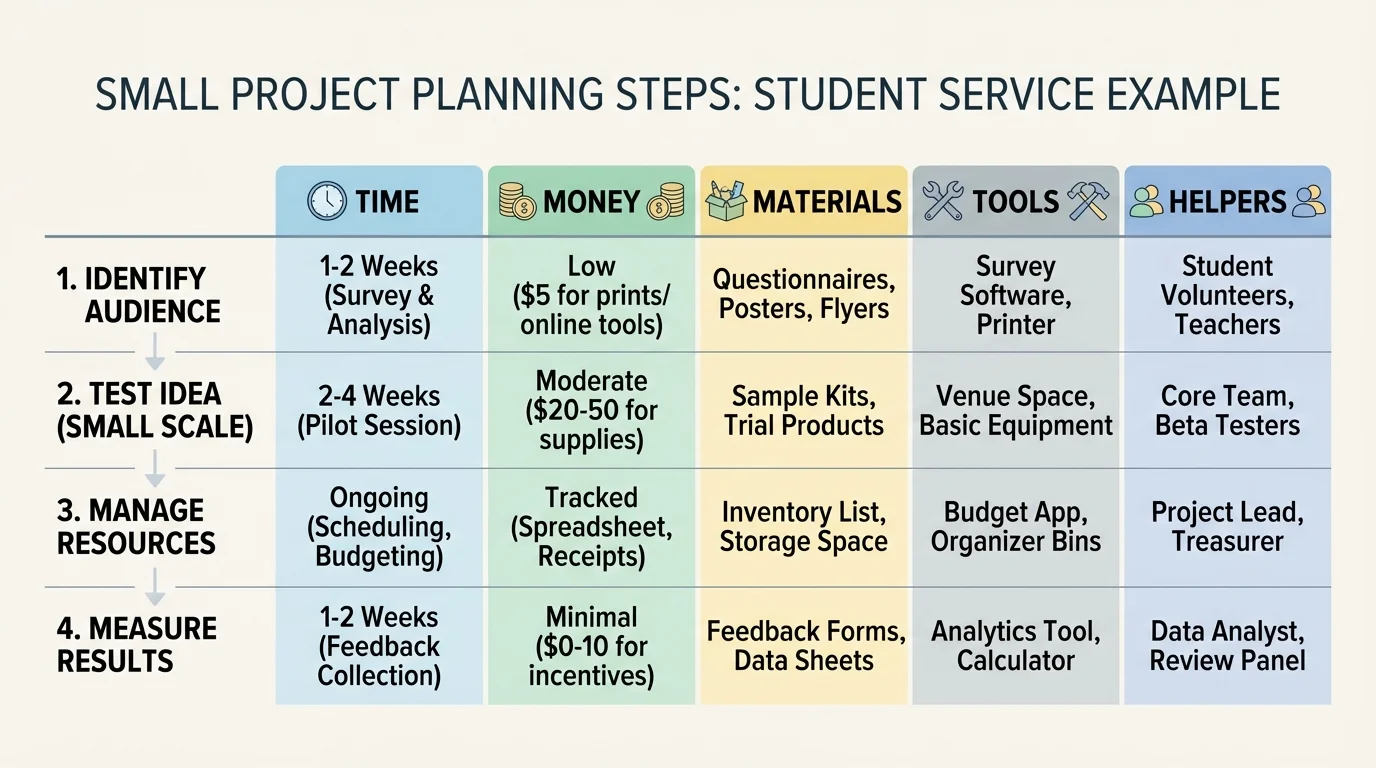
A resource plan can be basic and still be powerful. For example, imagine you want to offer custom digital birthday invitations. You might need:
Sometimes resource management includes a simple budget. A budget is a plan for how money will be used. You do not need advanced math to make one. If your supplies cost $18 and your expected earnings are $30, then your estimated profit is $12, because \(30 - 18 = 12\). If you discover you forgot $5 in packaging costs, your new profit becomes $7, because \(12 - 5 = 7\). That small check can prevent a bad surprise.
Time management matters just as much as money. If you promise to edit three videos in one evening but each one takes 1.5 hours, then the total time is \(3 \times 1.5 = 4.5\) hours. That may be more time than you actually have. A plan should fit your real schedule, not your imaginary best-case schedule.
Example: Simple resource check for a bookmark project
A student wants to sell handmade bookmarks online.
Step 1: List supply costs
Cardstock costs $6, markers cost $4, ribbon costs $3, and protective sleeves cost $5.
The total cost is \(6 + 4 + 3 + 5 = 18\).
Step 2: Estimate sales
The student plans to sell 12 bookmarks at $2 each.
Total sales would be \(12 \times 2 = 24\), so expected earnings are $24.
Step 3: Compare money in and money out
Estimated profit is \(24 - 18 = 6\), so the student would make $6.
Step 4: Check time
If each bookmark takes 15 minutes, then 12 bookmarks take \(12 \times 15 = 180\) minutes, which is 3 hours.
This student can now decide whether the project is worth the cost and time.
Good resource management also means having a backup plan. What if a supply runs out? What if the weather changes your schedule? What if someone cancels? Thinking ahead makes you more reliable.
A plan is not complete until you decide how to measure success. This is where results matter. Your results can include numbers, opinions, or both. The tracker in [Figure 4] shows how you can compare your goal with what actually happened and decide what to do next.
Start by choosing a few simple measures. These are often called success measures or goals. You might track how many people bought something, how many signed up, how many came back, how much money you earned, or how satisfied people were.
Here are some measurable results:
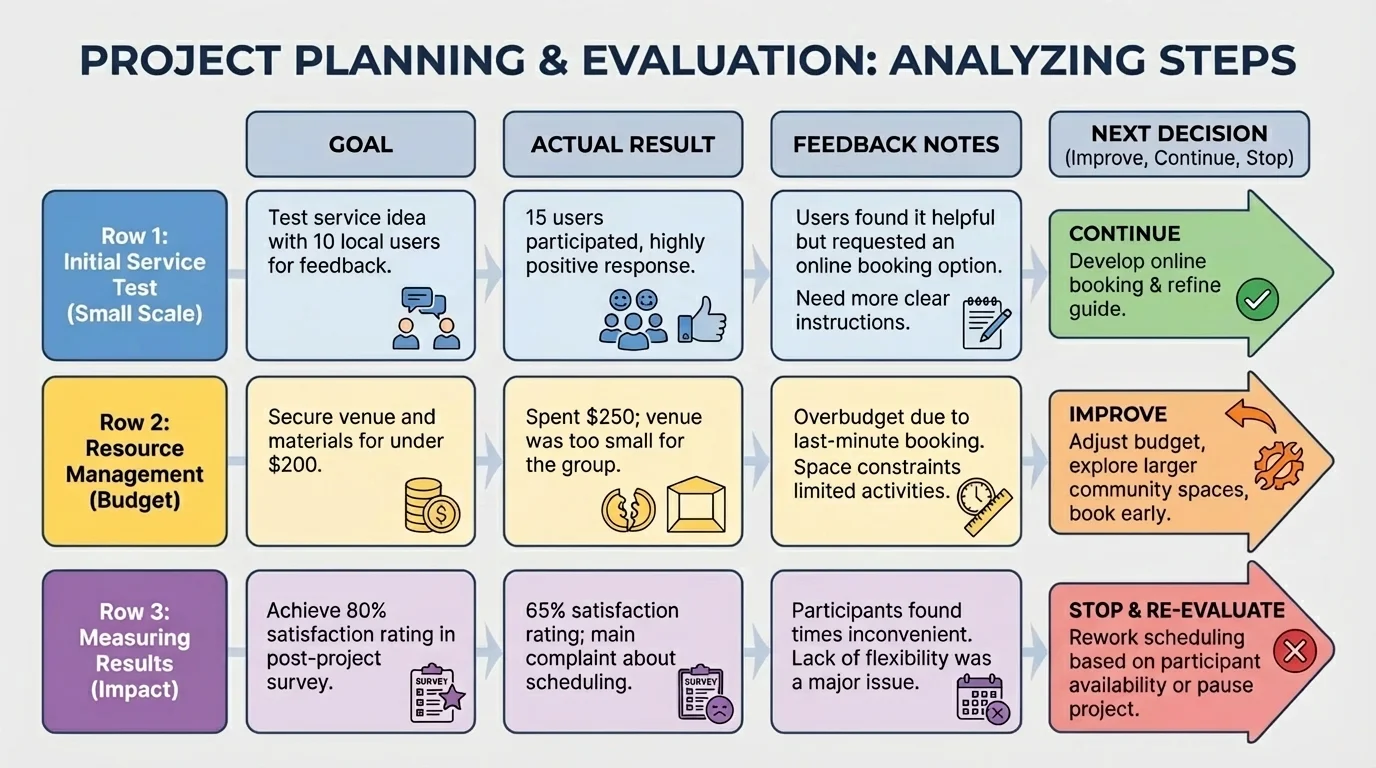
Suppose your goal was to get 8 customers for a weekend plant-watering service, but only 5 signed up. That does not automatically mean failure. It means you need to ask why. Maybe your audience was too broad. Maybe your message was unclear. Maybe the timing was wrong. If 5 customers signed up and all gave strong reviews, that could still be a promising result.
Results are strongest when they mix numbers and comments. For example, if you sold 9 of 10 snack packs, that number matters. But if three buyers said the packs were too salty, that comment matters too. A number tells you what happened. Feedback often tells you why.
You can compare your goal to your actual result with a simple success rate. If your goal was 10 sales and you made 8 sales, then your success rate compared to the goal is \(\dfrac{8}{10} = 0.8\), or \(80\%\). That does not mean "good" or "bad" by itself. It just gives you clear information to guide your next decision.
The comparison system in [Figure 4] is useful because it helps you avoid guessing. Instead of saying, "I think it went okay," you can say, "I reached \(80\%\) of my sales goal, people liked the design, and I need to lower the price or improve advertising." That is much more useful.
Many successful businesses start by testing and measuring tiny versions of their ideas first. Small beginnings are normal, not a sign that the idea is weak.
When you measure results, be honest. If something did not work, that is not the end. It is information. Good planners use information to improve, not to quit too early.
Let's look at a full example. A student wants to offer a weekend pet-feeding service for neighbors who travel short distances.
First, the goal is made clear: offer pet feeding for cats and fish in one apartment complex on weekends. Next, the target audience is narrowed to nearby pet owners who need short-term help. Then the student runs a small test by helping one family for one weekend and asking for feedback afterward.
After the test, the student checks resources. Time needed is 20 minutes per visit. Transportation is not a problem because the homes are in one building. Supplies are minimal, but the student needs a checklist and a way to communicate clearly with pet owners. A small budget may include printed checklists or sanitizer if needed.
Then the student measures results. Did the visit happen on time? Were the pets cared for properly? Did the customer feel comfortable and satisfied? Would they recommend the service to someone else? These results help the student decide whether to continue, improve the plan, or stop.
"Start small, learn fast, improve wisely."
That short idea is useful in almost every career path. People who plan well are often trusted more because they think ahead, keep promises, and solve problems before they grow.
One common mistake is choosing an audience that is too broad. A fix is to narrow it by age, location, problem, or budget. Another mistake is skipping the test phase because you feel excited or in a hurry. A fix is to remind yourself that one small test now can save a lot of stress later.
Another mistake is forgetting hidden resource costs, especially time. People often count supply costs but forget travel time, setup time, cleanup time, or message replies. A fix is to track every step once and see how long it really takes.
A final mistake is measuring only feelings. It is okay to feel proud, disappointed, or surprised, but decisions should also use facts. Count customers, compare costs, notice repeated feedback, and check whether your goal was realistic.
Pick one small idea you could realistically do: a digital design service, a simple neighborhood help service, or a small handmade product. Write one sentence for your goal. Then write one sentence that clearly names your audience. After that, list your top five resources and one small way to test the idea.
You do not need permission from the whole world to practice planning. You just need a real idea, a small first step, and the willingness to learn from what happens.
