One text message can tell you a lot about a relationship. If you say, "I can't talk right now," and the other person replies, "Okay, talk later," that feels very different from "If you cared about me, you would answer." Relationships are not judged only by whether people know each other well or say they care. They are judged by how people treat each other, especially when someone says no, asks for space, or makes a mistake.
Relationships can include family members, friends, teammates, people from clubs or faith groups, online friends, and possibly dating relationships. Learning to tell the difference between healthy, unhealthy, and unsafe behaviors helps you protect your peace, your privacy, and your safety. It also helps you become the kind of person others can trust.
Good relationships can make life feel steadier. You feel respected, heard, and supported. Unhealthy or unsafe relationships can do the opposite. They can make you anxious, distracted, confused, or scared. Sometimes a person does not look "mean" from the outside, but their behavior still crosses lines.
This is especially important online. A person can pressure you through direct messages, group chats, gaming voice chat, or social media without ever standing next to you. The screen does not make harmful behavior less serious. In some cases, it can make it easier for someone to bother you over and over, save private information, or share things without permission.
Knowing the signs early helps you act sooner. That might mean having a calm conversation, setting a stronger boundary, stepping back from the relationship, or getting help from a trusted adult before things get worse.
A relationship is a connection between people. Some are close and long-term, like family. Some are casual, like people you talk with in an activity group. Some happen mostly online. No matter what kind of relationship it is, the same basic question matters: Do both people feel respected and safe?
Healthy relationships are not perfect. People disagree, get annoyed, or make mistakes. What matters is how they handle those moments. Respectful people listen, take responsibility, and try to fix problems without hurting or controlling the other person.
Healthy relationship means a connection in which people treat each other with respect, honesty, care, and fairness.
Unhealthy relationship means a connection in which patterns such as disrespect, pressure, jealousy, manipulation, or control keep showing up.
Unsafe relationship means a connection in which someone's behavior causes fear, harm, threats, coercion, stalking, abuse, or danger.
These categories are useful because not every problem is the same. Healthy, unhealthy, and unsafe behaviors are different levels of concern. Some situations need better communication. Others need distance and adult support right away.
[Figure 1] Think of it like a traffic signal. Healthy behaviors are like green lights: they help the relationship move safely. Unhealthy behaviors are like yellow lights: they warn you to slow down, pay attention, and make changes. Unsafe behaviors are red lights: stop, protect yourself, and get help.
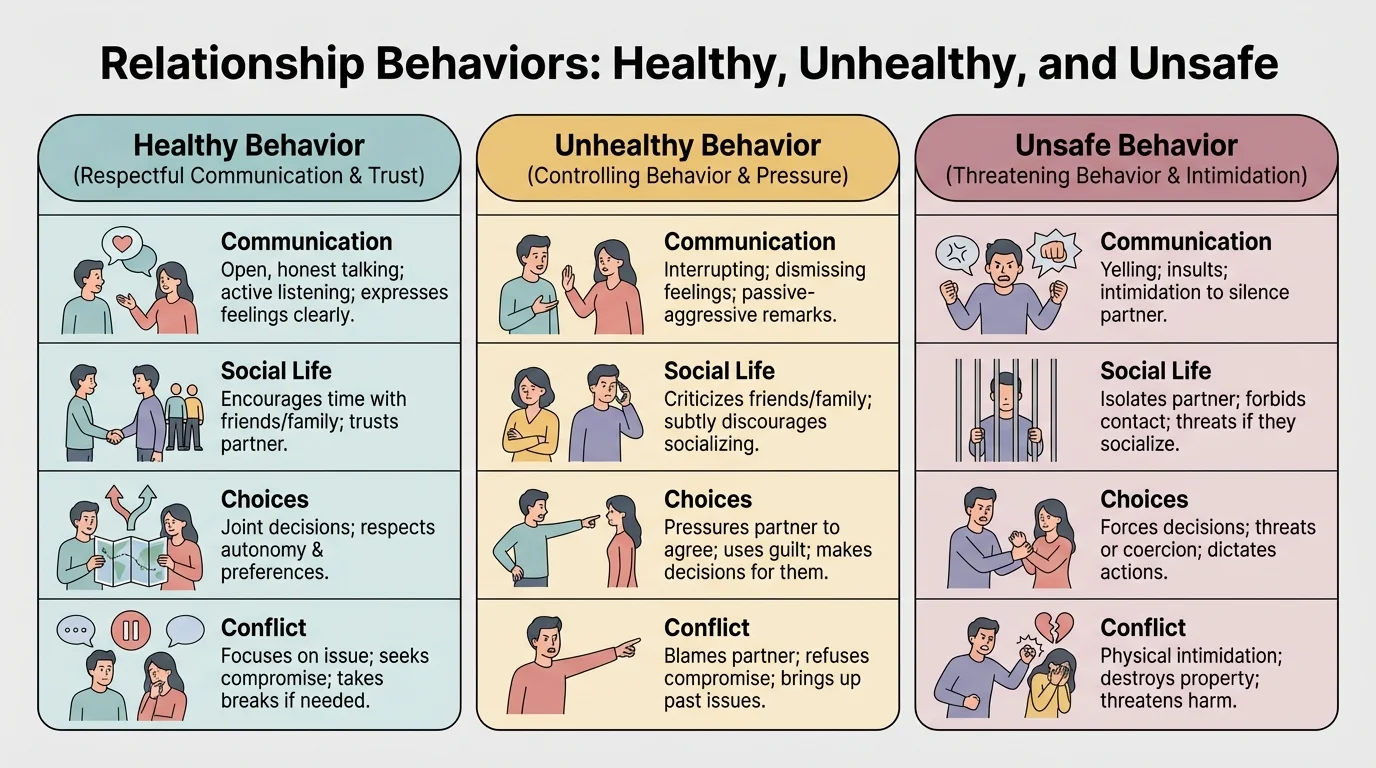
You do not need to wait until something becomes extreme before taking it seriously. If a pattern feels draining, disrespectful, or confusing, that matters. Your discomfort is information.
A healthy relationship includes boundaries. A boundary is a limit you set to protect your comfort, time, space, feelings, or privacy. In a healthy relationship, the other person may not love your boundary, but they respect it.
Healthy relationships also include consent. Consent means freely agreeing to something. It should be clear, not forced, and it can be changed at any time. This matters in physical situations, but also in digital ones. For example, asking before posting a photo of someone is a form of respect and consent.
Here are common signs of a healthy relationship:
Here is what that can sound like: "I'm upset, but I want to talk about it calmly." "No problem, take your time." "Thanks for telling me." "I should not have said that. I'm sorry." Those responses build trust.
Example: healthy texting
You tell a friend you are turning off notifications to finish homework and rest.
Step 1: You state a clear boundary.
"I'm logging off for the night. I'll respond tomorrow."
Step 2: The friend respects it.
"Okay, good luck. Talk tomorrow."
Step 3: Trust stays strong.
No guilt trip, no spam messages, and no pressure to prove you care.
This is healthy because your time and needs are respected.
Notice that healthy does not mean "always agreeing." Two people can disagree and still be respectful. In fact, one sign of a strong relationship is being able to handle conflict without threats, insults, or pressure.
An unhealthy relationship usually involves patterns that wear you down. Maybe the person constantly makes you feel guilty, gets upset when you spend time with others, or acts like your boundaries are a personal attack. These behaviors might be brushed off as "just caring a lot," but caring and control are not the same thing.
One common warning sign is manipulation. Manipulation is when someone tries to control your choices or emotions in sneaky or unfair ways. They might guilt-trip you, twist your words, or make you feel responsible for their behavior.
Another warning sign is pressure. This can sound like "Come on, if you trusted me, you would do it," or "Everyone else does this." Pressure can happen around sharing photos, staying online late, giving personal information, hugging, hanging out alone, or keeping secrets from trusted adults.
Other unhealthy signs include:
Unhealthy behavior can sometimes improve if the person takes responsibility and changes consistently over time. But if the pattern keeps repeating, it is not enough for them to say "I didn't mean it." Their actions need to change.
As we saw in [Figure 1], unhealthy behavior sits in the warning zone. It may not always involve immediate danger, but it still harms trust and emotional well-being. It deserves attention, not excuses.
Intent versus impact
A person may say they were joking or did not mean to hurt you. Intent is what they meant to do. Impact is what actually happened. In relationships, impact matters. If someone keeps hurting you after you explain the problem, the pattern is the issue.
You do not have to prove that someone is "a bad person" before deciding their behavior is unhealthy for you. A healthier question is: How do I feel after interacting with them most of the time? If the answer is tense, guilty, small, or confused, pay attention.
An unsafe relationship goes beyond disrespect or drama. It includes behavior that causes fear, threatens your well-being, or puts you in danger. This can happen in friendships, dating relationships, family relationships, or online interactions.
Unsafe signs include threats, intimidation, stalking, physical harm, sexual pressure, forcing contact, trapping you in conversations, or sharing private information or images without permission. It also includes trying to isolate you from trusted adults or making you afraid of what will happen if you say no.
One especially important term is coercion. Coercion means pushing, pressuring, threatening, or manipulating someone until they say yes. A yes that comes from fear, guilt, or pressure is not real consent.
Unsafe behavior can sound like: "If you leave me, I'll ruin your reputation." "Send the picture or I'll post that secret." "Don't tell your parent or coach." "I know where you live." "You owe me." Any threat like that needs to be taken seriously.
| Category | What it often feels like | Examples | Best response |
|---|---|---|---|
| Healthy | Calm, respected, supported | Listening, honesty, accepted boundaries | Keep communicating clearly |
| Unhealthy | Draining, guilty, confused, controlled | Jealousy, pressure, insults, guilt trips | Set stronger limits and get guidance if needed |
| Unsafe | Afraid, trapped, threatened, harmed | Threats, stalking, forced contact, abuse | Get help from a trusted adult right away |
Table 1. Comparison of healthy, unhealthy, and unsafe relationship patterns.
If a relationship feels unsafe, your job is not to fix the other person. Your job is to protect yourself. That often means leaving the conversation, blocking contact, saving evidence, and telling a trusted adult immediately.
Boundaries and consent are everyday life skills, not just "big serious topics." A simple decision process, as shown in [Figure 2], can help you respond when someone asks for your time, attention, touch, information, or images. First pause. Then check how you feel. Then answer clearly.
You can ask yourself: Do I actually want this? Do I feel safe? Am I being pressured? Would I still say yes if the person stopped pushing? If the answer is no, unsure, or "only because I feel bad," then stop. You do not owe anyone a yes.
Consent should be freely given, informed, and reversible. Freely given means no pressure. Informed means you know what you are agreeing to. Reversible means you can change your mind, even if you said yes before.
Boundaries can be about many things:
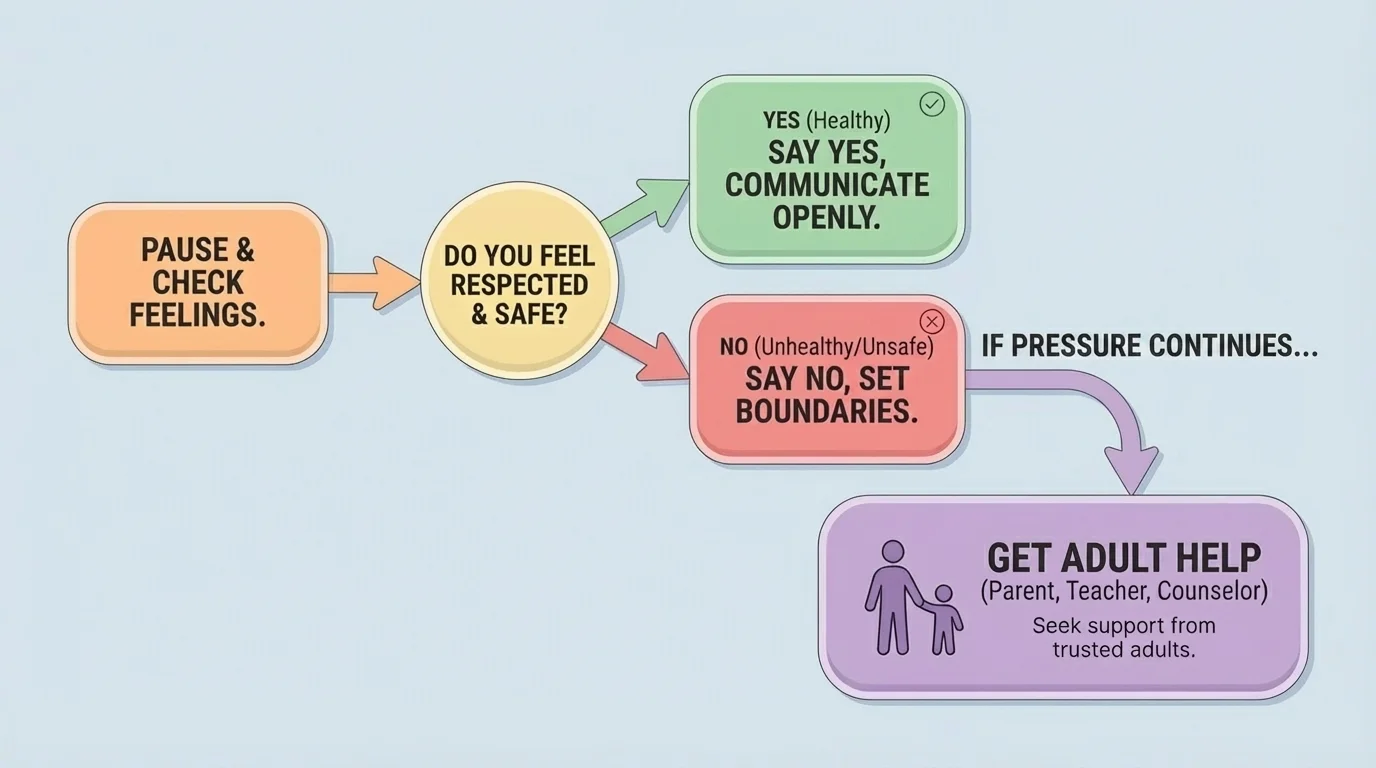
Saying no does not make you rude. Saying no is part of being responsible for yourself. You can be polite and firm at the same time: "No thanks." "I'm not comfortable with that." "Stop." "I said no." "I'm leaving this chat now."
You are also allowed to change your mind. If you agreed to hang out online, share a plan, or be in a photo and then feel uncomfortable, you can speak up. Consent is not a permanent contract.
Many unsafe situations start with small tests of your boundaries, like asking for a secret, a password, or a picture "just this once." People who respect you do not need to test your limits to prove you care.
The same idea from [Figure 2] works in group chats, gaming, and social media. Pause before responding. Pressure often gets stronger when someone wants a quick answer before you have time to think.
If a relationship feels wrong, you do not need a perfect speech. You need a plan. The response path in [Figure 3] works like a safety checklist you can follow when behavior crosses a line online or in your community.
Step 1: Notice the red flag. Maybe you feel tense every time their name pops up. Maybe they keep pushing after you said no. Maybe they want secrecy, control, or personal information.
Step 2: Name the behavior clearly. Instead of thinking "Maybe I'm overreacting," try "They are ignoring my boundary," or "They are pressuring me." Clear words help you trust your own judgment.
Step 3: Respond if it is safe to do so. You might say, "Do not message me like that," "I'm not doing that," or "This conversation is over." You do not owe a long explanation.
Step 4: Save evidence if needed. Take screenshots, save messages, usernames, dates, and times. This matters if the behavior continues or becomes threatening.
Step 5: Block, mute, leave, or get away. On digital platforms, use privacy and blocking tools. In person or in community spaces, move toward trusted adults or safe people.
Step 6: Tell a trusted adult. This could be a parent, guardian, counselor, coach, relative, youth leader, or another responsible adult who takes you seriously.
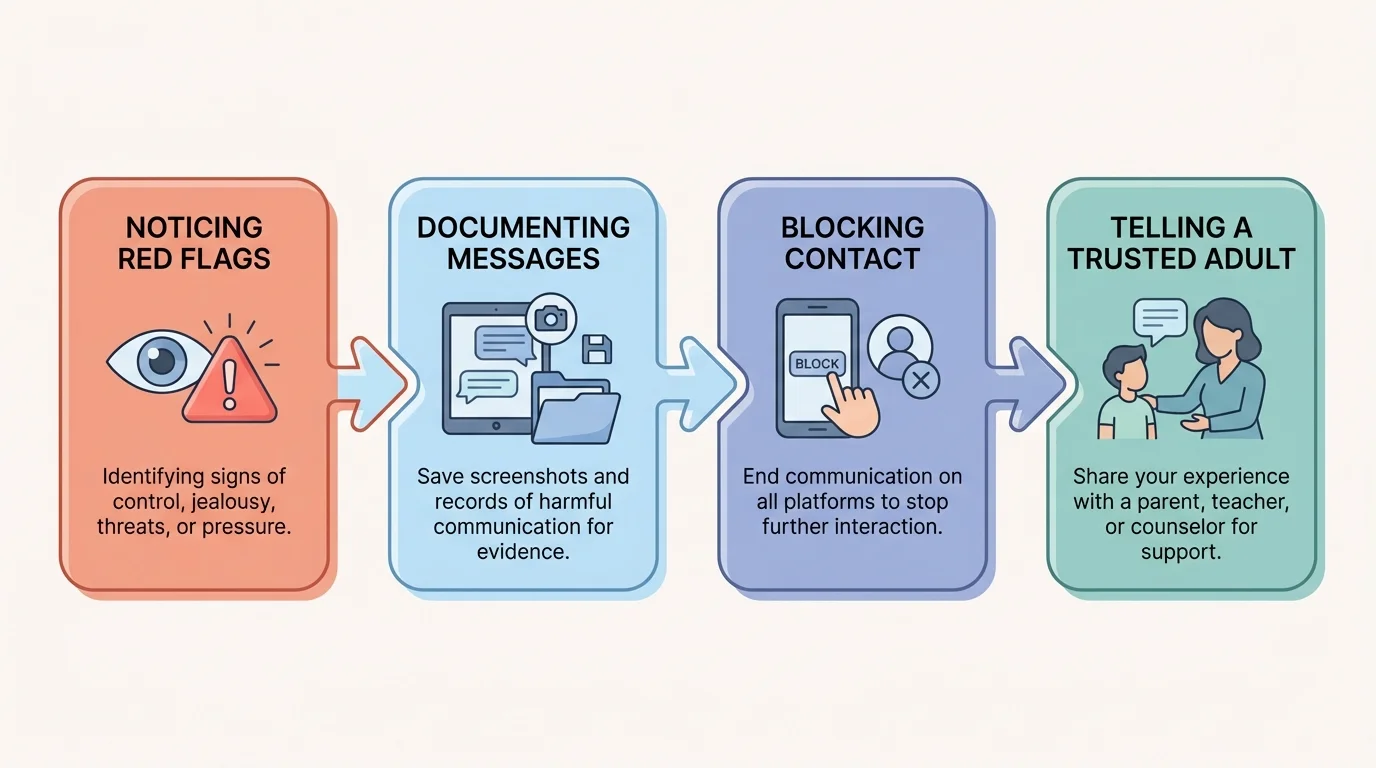
If there is a threat, blackmail, stalking, sexual pressure, or fear of harm, skip arguing. Go straight to help. Unsafe situations are not something you should manage alone.
Example: what to do with threatening messages
A person from a gaming chat says they will post private information if you stop talking to them.
Step 1: Recognize this as unsafe.
This is a threat, not friendship.
Step 2: Do not keep negotiating.
Long arguments often give the person more access to you.
Step 3: Save proof.
Take screenshots of the messages, username, and time stamps.
Step 4: Block and report.
Use the platform's safety tools.
Step 5: Tell a trusted adult immediately.
You deserve support and protection.
As with the process in [Figure 3], the goal is not winning an argument. The goal is reducing contact and increasing safety.
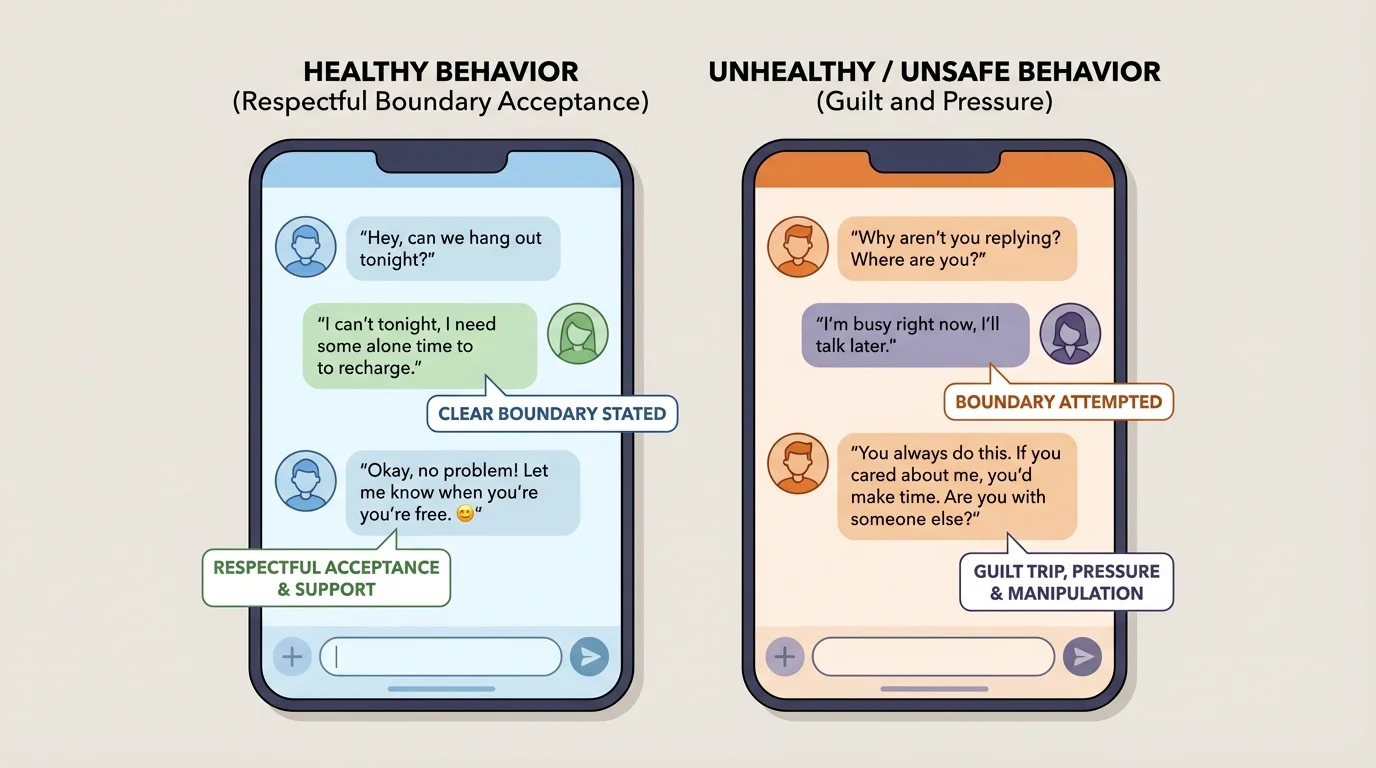
[Figure 4] The same situation can look very different depending on the behavior involved, as respectful and pressuring text exchanges show. The words people choose reveal whether they respect your boundaries or try to control you.
Scenario 1: Photo sharing. You do not want a picture of yourself posted online. A healthy response is, "Got it, I won't post it." An unhealthy response is, "Why are you being so dramatic?" An unsafe response is, "Too late, and if you complain I'll post more."
Scenario 2: Constant messaging. A friend wants instant replies all day. Healthy: "No worries, answer when you can." Unhealthy: "Wow, guess I don't matter to you." Unsafe: dozens of angry messages, fake accounts, or threats when you do not respond.
Scenario 3: Physical affection. Someone goes in for a hug and you pull back. Healthy: they stop and respect that. Unhealthy: they roll their eyes and say you are weird. Unsafe: they keep touching you after you said no or tried to move away.
Scenario 4: Secrets. Someone says, "If you care about me, keep this from your parent or guardian." Sometimes privacy is normal, like planning a surprise. But secrecy that separates you from safe adults can be a red flag, especially when the person is asking for personal information, photos, or one-on-one contact.
Scenario 5: Group chats. Healthy friends do not pressure you to roast someone, pile onto drama, or share screenshots without permission. If a group chat keeps pulling you into harm, leaving it is a smart choice, not a weak one.
The comparison in [Figure 4] matters because pressure often sounds emotional rather than obviously dangerous at first. A guilt trip can be an early warning sign before behavior gets more controlling.
You are not only learning to spot problems. You are also learning how to create healthier relationships yourself. That means being honest, respecting other people's no, and communicating clearly instead of trying to control outcomes.
Try these habits in daily life:
If you hurt someone by accident, repair matters. A real apology sounds like, "I interrupted you and made fun of your idea. That was disrespectful. I'm sorry. I'll do better." It does not sound like, "I'm sorry you got upset," which avoids responsibility.
"A person who respects your boundaries is showing you respect for you."
It also helps to notice patterns over time. Anyone can have one bad moment. What matters is whether they listen, learn, and change. Healthy relationships feel safer because respect is repeated, not random.
Try This: Pay attention to how people respond to a small boundary this week, such as "I can't talk right now" or "Please don't share that." Their response gives you useful information.
Try This: Practice one short boundary sentence out loud: "No thanks." "I'm not comfortable with that." "Please stop." Saying the words ahead of time makes them easier to use when you need them.
Try This: Make a list of three trusted adults you could contact if something online or in person started to feel unsafe. Keep the list where you can find it quickly.
