Running out of food you thought you had, spending money on snacks instead of what you actually needed, or tearing apart your room looking for a charger are not just annoying moments. They are signs that a few practical systems are missing. The good news is that these systems are learnable. You do not need to be an adult to shop smarter, plan meals, and keep track of your stuff. You just need habits that work in real life.
These skills matter because they affect your time, money, stress, and independence. When shopping goes well, you get what you need without wasting money. When meal planning goes well, you are less likely to skip meals, eat random junk, or waste food. When managing belongings goes well, you stop losing important items and you spend less time cleaning up preventable messes.
Think of these three skills as a team. Shopping gets food and supplies into your home. Meal planning tells you how those supplies will actually be used. Managing belongings helps you find what you need when you need it. If one part breaks down, the others get harder. Buying food without a plan can lead to spoiled groceries. Planning meals without checking supplies can lead to missing ingredients. Owning useful things without organizing them can make your day feel chaotic.
Small systems beat big promises
Many people try to get organized by making huge changes all at once. That usually fails. A better approach is to create small repeatable systems: one shopping list, one weekly meal check, one place for keys or chargers, one short daily reset. Small systems are easier to remember, and they keep working even on busy days.
A practical life skill is most useful when it saves you from predictable problems. If you know what tends to go wrong for you, you can set up a routine before the problem happens.
A good shopping trip starts before you go anywhere. A simple budget and list make better decisions than memory and hunger. A shopping process works best when you follow the same order each time, as [Figure 1] shows: check what you already have, decide what you need, set a spending limit, compare choices, and then buy.
Step 1: Check what is already at home. Look in the fridge, pantry, freezer, bathroom, or wherever the items belong. If you skip this step, you may buy duplicates.
Step 2: Make a list. A list is a shopping list of specific items you plan to buy. Instead of writing "snacks," write "apples, yogurt cups, popcorn." Specific lists are easier to follow.
Step 3: Separate needs from wants. Needs are basic things you use or eat regularly. Wants are optional extras. Both can be okay, but if money is limited, needs come first.
Step 4: Set a limit. If you can spend $25, that number helps you make choices. For example, if bread costs $3.50, milk costs $4.00, eggs cost $5.00, apples cost $4.50, and cereal costs $6.00, your total is \(3.50 + 4.00 + 5.00 + 4.50 + 6.00 = 23.00\). That fits under $25, so you still have $2.00 left.
Step 5: Shop when you are calm and not rushed, if possible. Rushing leads to mistakes, forgotten items, and impulse buying.
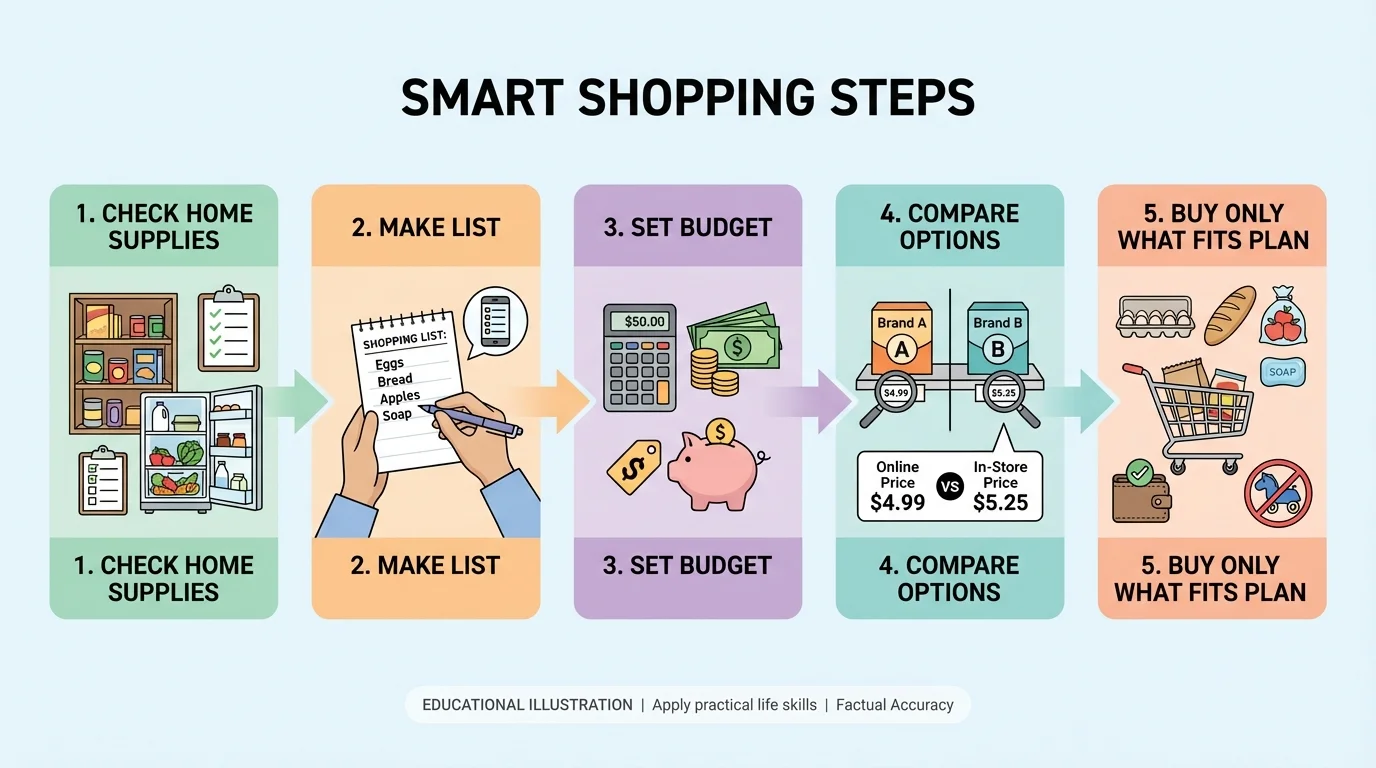
Shopping in person and shopping online both need the same thinking skills. You still check what you have, use a list, compare prices, and avoid buying things just because they look exciting. Online shopping adds a few extra rules: check shipping costs, make sure the site is real, and read item details carefully so you know the size, quantity, or return rules.
Impulse buying means buying something suddenly without planning it first. Unit price is the cost for one standard amount of an item, such as per ounce, pound, or liter, which helps you compare sizes fairly. Expiration date is the date after which a food or product may not be at its best or safest to use.
One of the easiest ways to waste money is by getting tricked by packaging. A large box is not always a better deal, and a sale is not always helpful if you would not normally use the item.
When you compare products, do not only look at the sticker price. Look at the amount you get. This is where unit price helps. Suppose one granola box costs $4.00 for 10 ounces and another costs $5.40 for 15 ounces. The first costs \(4.00 \div 10 = 0.40\) dollars per ounce. The second costs \(5.40 \div 15 = 0.36\) dollars per ounce. The second box gives more food for each dollar.
Still, the cheapest option is not always the smartest option. If the larger box goes stale before you finish it, then you did not really save money. Smart shopping balances price, quality, and usefulness.
Check dates on food, especially dairy, bread, meat, and prepared meals. If you will not use it soon, buying it can become waste. Also think about storage. A giant bag of produce is only a good deal if you have space and a plan to eat it.
As shown earlier in [Figure 1], comparing options belongs near the end of the process, not the beginning. If you compare random products before knowing what you need, you can get distracted and spend more than planned.
Price comparison example
You have $12 to buy a snack for several days and a drink for breakfast. Which choice fits better?
Step 1: List the options.
Option A: 6 single yogurt cups for $6.00 and orange juice for $4.50.
Option B: Large tub of yogurt for $4.50 and orange juice for $4.50.
Step 2: Find each total.
Option A total: \(6.00 + 4.50 = 10.50\)
Option B total: \(4.50 + 4.50 = 9.00\)
Step 3: Decide based on your real situation.
If you can portion the yogurt yourself, Option B saves \(10.50 - 9.00 = 1.50\). But if single cups are more likely to get eaten before spoiling, Option A might work better for you.
The best answer depends on what you will actually use, not just the lowest number.
Another waste trap is shopping while hungry or bored. Hunger can make everything seem necessary. Boredom can make shopping feel like entertainment. A list protects you from both.
Meal planning means deciding ahead of time what you will eat for upcoming meals. It does not need to be fancy. It just needs to match your real week. A weekly plan works well because you can see busy days, leftovers, and grocery needs together, as [Figure 2] illustrates.
Start with your schedule. If one day is packed with activities, choose a quick meal for that day. If another day is more relaxed, that is a better time for something that takes longer. Meal planning is not about cooking from scratch every day. It is about making thoughtful choices before you are tired or rushed.
A simple plan often includes breakfast, lunch, dinner, and snacks. It also helps to include leftovers on purpose. If you cook extra pasta or rice one night, that can become lunch the next day.
Try to use what you already have first. If you have tortillas, cheese, and beans, you already have the start of a meal. This is one reason shopping and meal planning connect so closely. Good planning helps ingredients get used instead of forgotten.
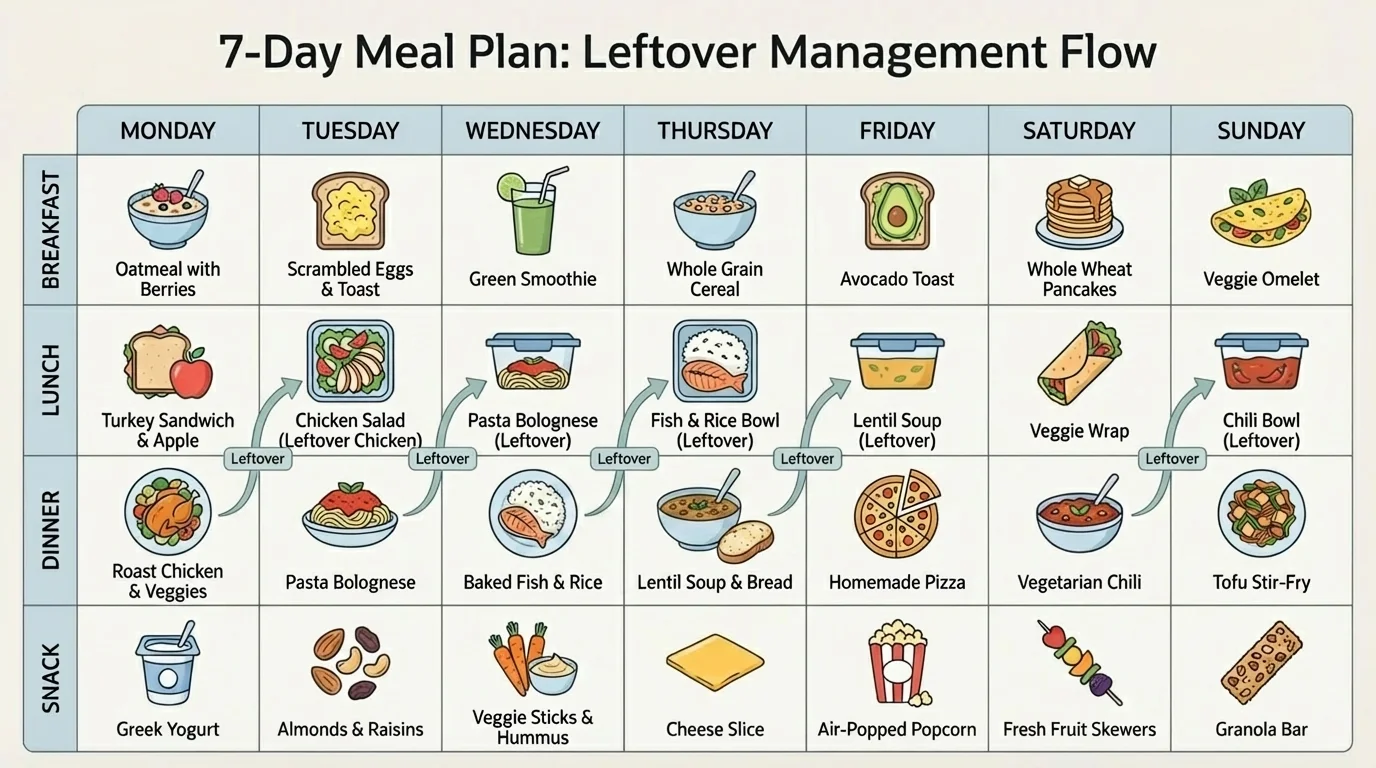
You do not need perfect nutrition to make a strong plan. A practical meal usually includes a source of carbohydrates, some protein, and something fresh when possible. For example, toast with peanut butter and fruit is more filling than eating only chips. Rice, chicken, and vegetables is more balanced than eating only noodles.
People often waste food not because they buy the wrong foods, but because they forget what they bought. A visible plan makes food easier to remember and use.
Think in categories when planning. For breakfast, maybe choose between oatmeal, eggs, yogurt, or toast. For lunch, maybe sandwiches, leftovers, wraps, or soup. For dinner, maybe pasta, tacos, stir-fry, baked potatoes, or salad with protein. Categories make planning faster than inventing meals from nothing.
Here is a realistic way to build a plan.
Step 1: Check what food you already have.
Step 2: Look at your week and mark busy days.
Step 3: Choose a few easy meals you already know how to make or assemble.
Step 4: Plan at least one leftover meal.
Step 5: Turn your meal plan into a shopping list.
Weekly meal plan example
A student has a busy week and wants to keep grocery spending under $30 for a few main items already supported by basics at home.
Step 1: Build meals from what is already available.
At home: pasta, rice, peanut butter, bread, frozen vegetables.
Step 2: Add needed items.
Need to buy: eggs for $5.00, milk for $4.00, bananas for $3.00, yogurt for $4.50, tortillas for $3.50, shredded cheese for $5.00.
Step 3: Find the total.
\[5.00 + 4.00 + 3.00 + 4.50 + 3.50 + 5.00 = 25.00\]
Step 4: Match food to days.
Breakfasts: yogurt and bananas, toast, or eggs. Lunches: peanut butter sandwiches or leftover pasta. Dinners: cheesy bean tortillas, pasta with vegetables, rice bowls with eggs.
This plan stays under the $30 limit and uses existing food before it expires.
If your first plan is too expensive, do not give up. Adjust it. Pick fewer special items, choose one snack instead of three, or swap a brand. Planning is flexible.
As [Figure 2] shows, leftovers are not accidents in a strong plan. They are part of the design. When you plan leftovers on purpose, you save time and reduce waste.
Your belongings are easier to manage when every important item has a designated place. That means a specific home where the item belongs when you are not using it. This system works for chargers, headphones, keys, wallets, glasses, notebooks, sports gear, and important papers. A setup with visible homes for daily-use items, like the one in [Figure 3], makes it easier to reset your space quickly.
Without designated places, your brain has to solve the same problem again and again: "Where should I put this?" That leads to clutter and lost items. With designated places, the answer is already made.
Start by identifying your high-priority items. These are the things you use often or really cannot afford to lose. For many people, that includes a device charger, headphones, ID, house key, medication, water bottle, and any forms or papers that matter.
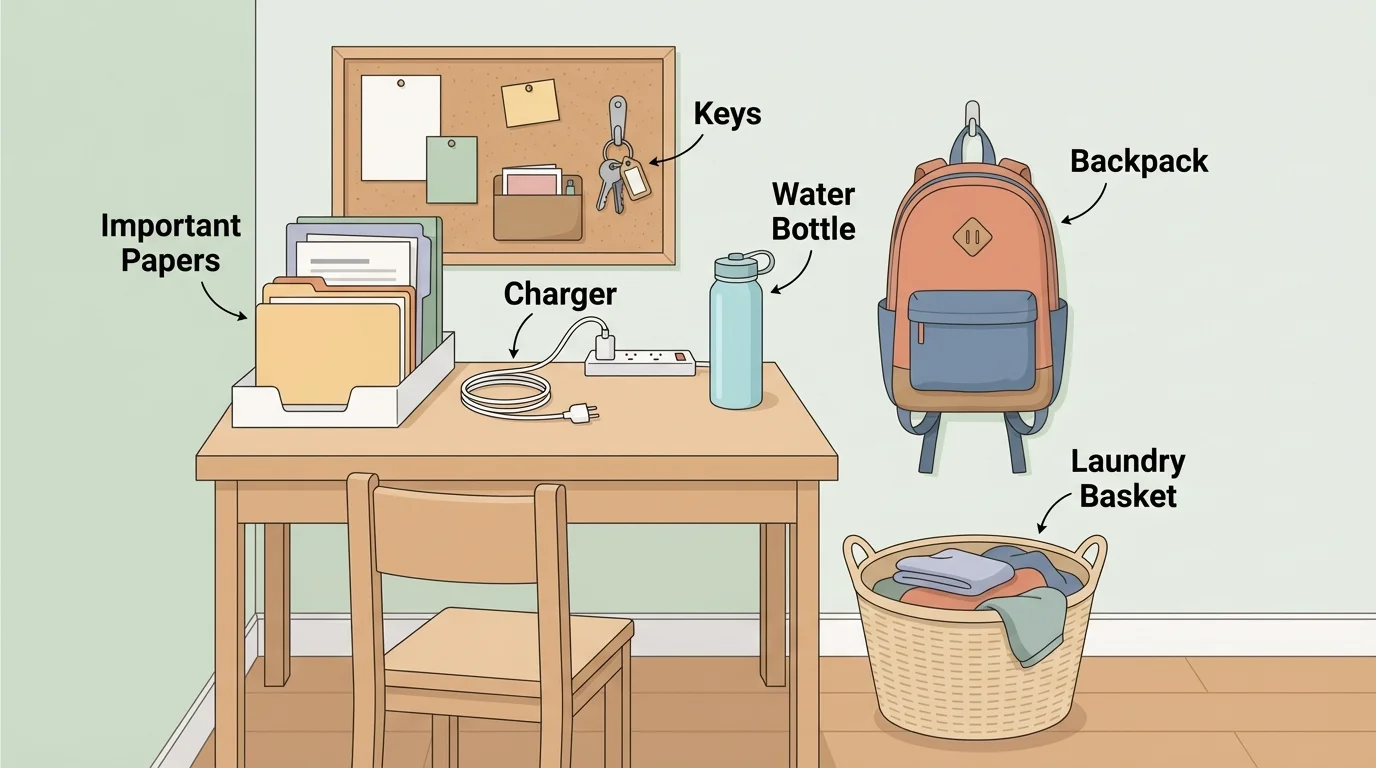
Create small zones. You might have a study zone, a charging zone, a laundry zone, and a drop zone near the door. A zone is just an area with one main purpose. This is easier than trying to organize everything at once.
Organization is about retrieval
A system is organized if you can find what you need quickly and put it back just as easily. A neat-looking room is not enough if you still lose important things. Good organization helps you retrieve, use, and return items with less effort.
Managing belongings also includes digital belongings. School files, passwords, photos, and important messages can also become messy. Use clear folder names, save files in the same place each time, and back up what matters. A lost digital file can cause as much stress as a lost notebook.
Routines matter more than motivation. You might feel organized for one day, but a routine keeps things working for weeks. One helpful routine is a daily reset. A daily reset is a short clean-up and check-in, often taking about 5 to 10 minutes, where you return items to their places and prepare for the next day.
A daily reset can include putting dirty clothes in the basket, plugging in devices, refilling your water bottle, throwing away trash, and checking whether important items are in their usual spots. If your reset takes 8 minutes each evening, that is only a small part of your day, but it can save much more time later.
Another helpful routine is the one-touch rule for certain items. If you finish using your charger, return it immediately. If you take off your headphones, hang them in their spot. The fewer random surfaces an item lands on, the less likely it is to disappear.
The organized setup in [Figure 3] is useful because it reduces decisions. You do not need to wonder where the backpack or papers go. Fewer decisions mean fewer chances for mistakes.
5-minute evening reset example
This routine can help you protect both your belongings and your next day.
Step 1: Clear surfaces.
Throw away trash, stack papers, and return dishes.
Step 2: Return daily items.
Put your charger in the charging zone, headphones in their hook or drawer, and water bottle in its spot.
Step 3: Prepare for tomorrow.
Set out needed materials, refill water if needed, and place important items together.
Step 4: Check laundry and devices.
Put dirty clothes away and plug in any device that needs power.
This short reset prevents small messes from turning into stressful problems.
Shared spaces need extra respect. If you share a kitchen, bathroom, or living area, label your items if needed and ask before moving other people's things. Independence includes being responsible around others.
Sometimes your plan fails, and that is normal. Practical life skills include fixing the problem, not just avoiding it.
If you forgot an item at the store: First ask whether you can substitute something you already have. No bread? Maybe tortillas or rice work with the meal. This keeps one missing item from ruining the whole plan.
If food is close to expiring: Move it to the front where you can see it. Decide quickly how to use it. Fruit can go into smoothies. Vegetables can go into soup, pasta, or eggs. Bread can become toast.
If you keep losing the same item: That usually means the system is weak, not that you are "bad at organizing." Give the item a better home. If your headphones disappear often, create one hook or pouch only for them.
If you buy things you regret: Pause before purchasing and ask three questions: Do I need this? Will I use it soon? Does it fit my budget? If the answer is "no" to two or three of those questions, skip it.
If your room or supplies are already messy: Do not organize everything at once. Start with one category: clothes, papers, cables, or toiletries. Finish that category before starting another.
"Do not let what is urgent crowd out what is important."
— A useful rule for planning daily life
This idea matters because shopping, meal planning, and organization often get ignored until a problem becomes urgent. A little planning earlier prevents a lot of stress later.
Independence is not about doing everything alone. It is about being able to handle everyday responsibilities with less confusion and more confidence. When you know how to shop with a plan, feed yourself sensibly, and keep track of important belongings, daily life becomes more manageable.
Try linking habits together. After you check the kitchen, make your shopping list. After dinner, look at what leftovers can become tomorrow's lunch. After your evening screen time, do your daily reset. Linked habits are easier to remember because one action reminds you to do the next.
You can also use simple tools: notes on your phone, a whiteboard, labels, baskets, folders, or a checklist. Tools do not replace habits, but they support them.
The patterns in [Figure 1], [Figure 2], and [Figure 3] all point to the same idea: plan ahead, make choices on purpose, and give important things a reliable place. These skills may seem small, but they save money, reduce waste, lower stress, and help you take care of yourself more confidently.
