Some groups fail even when everyone is talented. Other groups succeed with ordinary people who know how to listen, include others, and keep moving toward a goal. That is the real power of leadership. It is not about being the boss, being the loudest person on a video call, or getting all the attention. It is about helping people work well together and making it easier for everyone to do their best.
If you have ever helped your siblings finish a task, organized an online gaming team, worked on a community event, joined a club, or managed part of a group project, you have already seen leadership in action. At your age, leadership often starts with small choices: answering messages clearly, noticing who is left out, showing up prepared, and helping a group stay focused when things get messy.
Strong leaders support inclusion, take responsibility, and build shared goals. These three ideas connect. If people do not feel included, they stop participating. If no one is responsible, the work falls apart. If the goal is unclear, people pull in different directions. Leadership brings these pieces together.
Leadership is the ability to guide actions, choices, and relationships in a way that helps a group do well. Inclusion means making sure people feel welcomed, respected, and able to participate. Responsibility means doing what you said you would do and owning the results. Shared goals are goals that everyone in a group understands and works toward together.
One important truth is that leadership is a set of behaviors, not a personality type. You do not have to be super outgoing. Quiet people can be excellent leaders because they notice details, listen carefully, and stay calm. A leader can be the person who asks, "Has everyone had a chance to speak?" or the person who sends a clear update so nobody is confused.
Leadership matters because your actions affect other people. In online spaces, for example, one person's tone can change the whole mood of a group chat. A rude comment can make someone stop contributing. A thoughtful message can help people feel safe enough to share ideas. In a family setting, leadership might mean taking initiative before being asked. In a community group, it might mean noticing what needs to be done and helping organize it.
When leadership is weak, common problems appear fast: unfinished tasks, arguments, unfair workloads, and people feeling ignored. When leadership is strong, people trust each other more. Work gets divided more fairly. Problems are addressed sooner. The group becomes more likely to reach its goal.
Research on teamwork often shows that groups perform better when members feel safe to share ideas and admit mistakes. A leader helps create that kind of safety by being respectful and fair.
This is why leadership is not just useful for "important" moments. It helps in ordinary moments too: planning a study session online, organizing a volunteer activity, helping run a team account for a club, or coordinating chores at home.
Good leadership usually looks simple from the outside. It often sounds like clear instructions, respectful questions, and calm reminders. But underneath those simple actions are important habits: noticing other people, thinking ahead, and choosing what helps the group instead of what only helps you.
A strong leader often does these things:
The word accountability matters here. It means you accept that your choices have effects, and you are willing to respond honestly. If you forget to upload your part of a shared document, accountability sounds like, "I missed the deadline. I'm fixing it now, and next time I'll set a reminder." It does not sound like, "It wasn't really my fault," when you know it was.
Inclusion is not just a nice extra. It is a leadership skill. A group works better when more people feel comfortable contributing through online interactions where tone and response patterns either invite people in or shut them out. In online settings, inclusion often depends on small actions: replying kindly, not ignoring someone's idea, explaining inside jokes, and making space for different opinions.
Think about an online group planning a fundraiser. One person keeps posting ideas, but nobody answers. Another person joins the video call late and gets talked over. A third person is new and does not know the group's usual routines. A leader notices these things. They might say, "Let's pause and hear Maya's idea," or "Jordan is new, so let's quickly explain how we usually divide tasks." Those actions help people feel they belong.
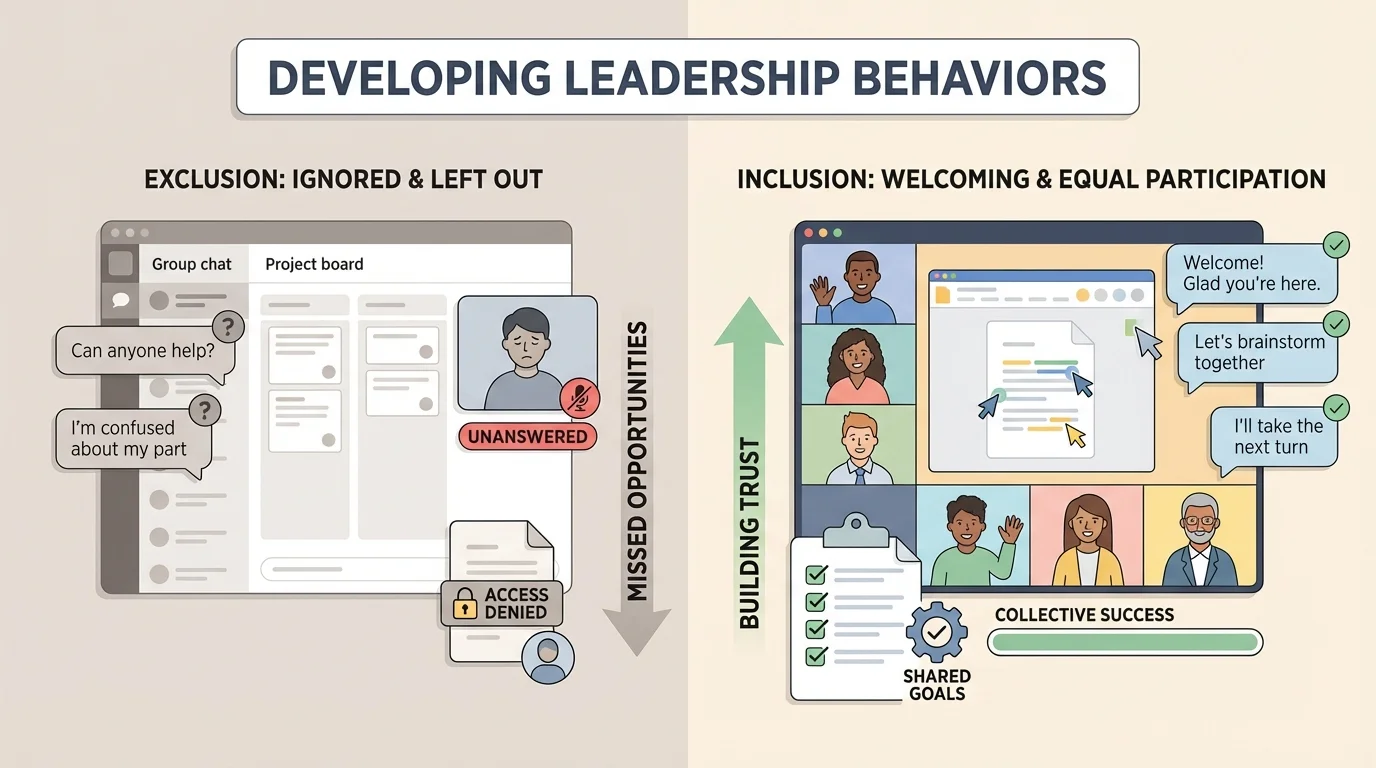
Being inclusive does not mean agreeing with every idea. It means treating people with respect and giving them a fair chance to participate. You can disagree without making someone feel small. For example, instead of saying, "That makes no sense," you could say, "I see your point, but I think this option may work better because it saves time."
Inclusive leaders also notice hidden barriers. Maybe someone has trouble joining long video calls because of home responsibilities. Maybe a group is using slang or references that confuse a new member. Maybe one person types slowly and gets skipped in fast-moving chats. Fair leadership adjusts. You might share notes afterward, pause longer for responses, or make sure important decisions are not made so quickly that some people get left behind.
Real-world example: turning exclusion into inclusion
A student is helping run an online club planning session. One member keeps getting interrupted and stops talking.
Step 1: Notice the pattern
The leader pays attention to who is speaking and who is being overlooked.
Step 2: Interrupt the pattern respectfully
The leader says, "Let's go back for a second. Sam was still speaking."
Step 3: Re-open the space
The leader asks, "Sam, do you want to finish your idea?"
Step 4: Protect future participation
The leader suggests a simple rule: one person speaks at a time, and everyone gets a turn before final decisions.
This response is calm, fair, and focused on the group working better.
Later, the same idea from [Figure 1] still matters: people contribute more when they see that respect is real, not just promised. Inclusion builds trust, and trust improves teamwork.
Responsibility means people know they can rely on you. If you agree to design a slide, call a volunteer, feed a pet, help with dinner, or post an update, responsibility means you do it on time and do it well. Leadership without responsibility is just talk.
Responsible leaders do not wait until the last minute and then blame stress, technology, or other people. They plan ahead. They set reminders. They ask for help early if a problem appears. This is where initiative matters. Initiative means starting helpful action without waiting for someone else to push you.
Here is a practical way to act responsibly when you have a task:
Step 1: Make the task clear. Know exactly what needs to be done.
Step 2: Break it into smaller parts if needed.
Step 3: Decide when you will do each part.
Step 4: Set a reminder on your device or calendar.
Step 5: Update the group if anything changes.
Step 6: Finish, check your work, and confirm that it is done.
Suppose your group needs a shared presentation finished by Friday. If your part is due Thursday night, waiting until Thursday at 11:00 p.m. is risky. A responsible leader might aim to finish by Wednesday, giving time to fix problems. That extra margin reduces stress for everyone.
Responsibility builds trust over time
Trust is not created by one big speech. It grows from repeated actions: being honest, meeting deadlines, answering messages, and doing your share. Every time you follow through, people learn that your word means something.
Responsibility also includes owning mistakes. Everyone makes them. The leadership question is not "Will I ever mess up?" but "What will I do when I do?" A responsible response has three parts: admit it, repair it, and learn from it. If you accidentally share incorrect information in a group chat, you can correct it quickly and clearly. That earns more respect than hiding the mistake.
Digital responsibility matters too. Good leaders think before posting, forwarding, or commenting. They do not spread rumors or private screenshots. They understand that online actions can hurt real people and damage trust.
A group can have energy and good intentions but still struggle if the goal is fuzzy. Strong leadership helps everyone see the same target through the path from one clear goal to roles, deadlines, and check-ins. Shared goals answer three questions: What are we trying to do? What does success look like? Who is doing what?
For example, saying "Let's make this event good" is too vague. Saying "Let's create an online fundraiser page, post three updates this week, and reach 50 supporters by Sunday" is clearer. The second version gives the group something they can actually work toward.
Once the goal is clear, break it into smaller parts. One person writes text, one person checks facts, one person designs visuals, and one person tracks deadlines. This is not about controlling everyone. It is about making work visible and fair.
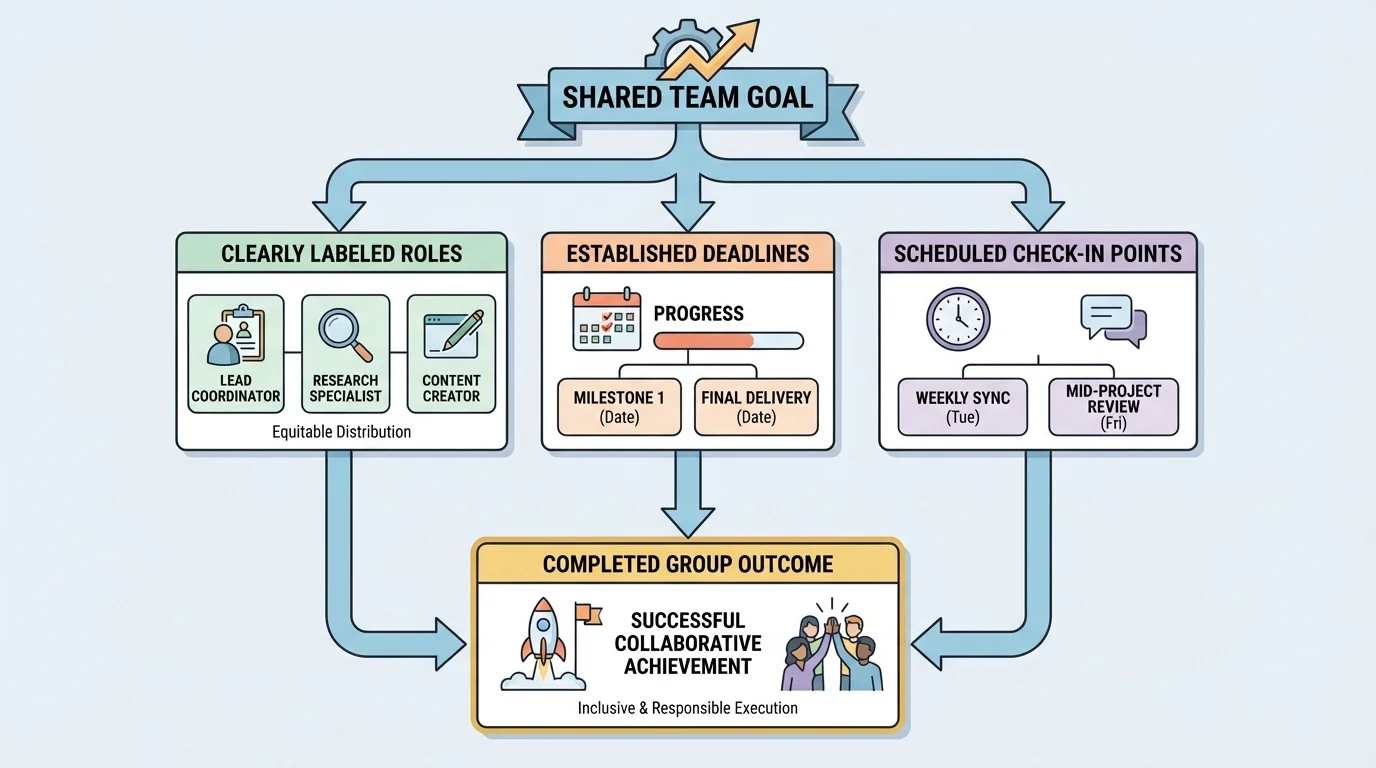
Leaders also create checkpoints. A checkpoint is a time to pause and ask, "Are we on track?" Without checkpoints, groups often discover problems too late. A quick midweek message or short call can prevent confusion from growing.
You can use a simple planning frame:
As you continue leading, return to the visual plan in [Figure 2]. It reminds you that good teamwork is not random. It is built from a clear direction, smaller steps, and regular follow-up.
| Weak Team Planning | Strong Team Planning |
|---|---|
| Goal is unclear | Goal is specific and shared |
| People assume tasks | Roles are named clearly |
| No updates until the end | Check-ins happen during the process |
| Missed work leads to surprise | Problems are noticed early |
| One person does too much | Workload is more balanced |
Table 1. Comparison of weak and strong planning habits in a team.
Leadership depends heavily on communication. You can have good ideas, but if your messages are confusing, harsh, or incomplete, people may not follow through. Clear communication means being specific, respectful, and direct.
Here are communication habits that help:
Compare these two messages. Message A: "Can someone do the post?" Message B: "Ava, can you draft the post by 6:00 p.m.? I can review it by 7:00 p.m." The second message is better leadership because it is clearer, more organized, and easier to act on.
"A leader is one who knows the way, goes the way, and shows the way."
— John C. Maxwell
Good leaders also know how to give feedback. Helpful feedback is specific and kind. Instead of saying, "This is bad," try, "The main idea is strong, but the opening could be clearer. Maybe add one sentence explaining the purpose." That helps the person improve without feeling attacked.
Receiving feedback is part of leadership too. If someone points out a problem in your work, pause before reacting. Ask yourself whether the feedback can help the group. You do not have to agree with every comment, but mature leaders listen before deciding.
Problems happen in every group. Someone misses a deadline. Two people disagree. One person dominates the conversation. Another person disappears and stops replying. Good leaders do not panic or attack. They use a calm process to understand what happened and choose a fair response.
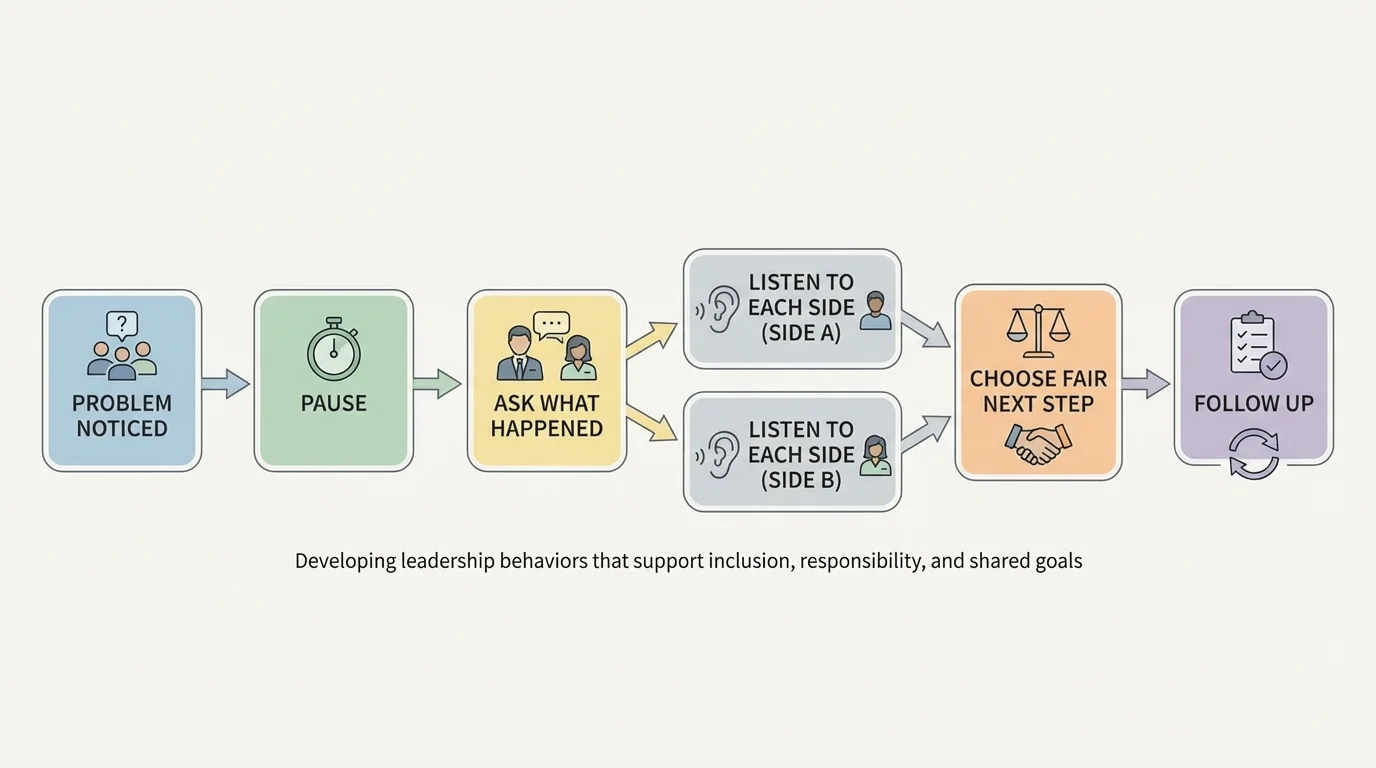
A useful problem-solving pattern is this: pause, gather facts, listen to each side, decide on a next step, and follow up. This keeps you from reacting too fast based on emotion. It also helps people feel heard.
Suppose one team member has not done their part. A poor leadership response would be embarrassing them in the group chat. A better response is sending a private message first: "Hey, we were counting on your section. Are you okay? Can you still finish it by tonight, or should we adjust the plan?" This approach is respectful and still holds the person accountable.
If conflict grows, bring the conversation back to the goal. You might say, "We both want this project to work. Let's focus on what helps us finish well." That sentence lowers the temperature and reminds everyone what matters.
Real-world example: solving a team problem
A community youth group is creating posts for an event, but two members argue about the design.
Step 1: Pause the argument
The leader says, "Let's slow down so we can solve this."
Step 2: Hear both ideas
Each person explains their reasoning without interruption.
Step 3: Return to the shared goal
The leader asks, "Which design is clearer for the audience and easier to read on a phone screen?"
Step 4: Make a fair decision
The group chooses the design that best supports the event goal, not the one supported by the loudest voice.
Step 5: Follow up
The leader thanks both people for contributing and keeps the team moving.
This kind of leadership protects relationships while still getting the work done.
Much later, when you face a new challenge, the calm sequence in [Figure 3] still helps: notice the problem, slow down, listen, decide, and check back. This pattern works in family situations, group projects, clubs, and volunteer teams.
You do not need to wait until you are older to become a strong leader. You build leadership by practicing daily habits. These habits may seem small, but they shape how others experience you.
Try building these routines into your week:
These habits make you more dependable and more thoughtful. Over time, people start trusting your judgment because they see consistency. That trust is one of the strongest tools a leader can have.
Think back to times when someone helped you feel included, or when someone let you down by not doing their part. Those experiences teach you what strong and weak leadership feel like. Use them as a guide for your own choices.
Leadership also includes giving credit. If the team succeeds, do not act like you did everything alone. Notice others' efforts. A simple comment like, "Rina organized the schedule, and Malik fixed the design issue," shows fairness and maturity.
Another leadership habit is reflection. After a project or event, ask yourself: What went well? Where did people seem left out? Did I communicate clearly? Did I follow through? What should I do differently next time? Reflection turns experience into growth.
At its core, leadership is about character in action. Anyone can act helpful when it is easy. Real leadership appears when things are inconvenient: when you are tired, when a mistake is embarrassing, when a disagreement feels personal, or when including someone takes extra effort. Those are the moments that show what kind of leader you are becoming.
You do not need a title to lead. You lead when you help people feel they belong. You lead when you do your part without excuses. You lead when you move a group toward a goal with fairness and clarity. These behaviors matter at home, in online groups, in sports, in clubs, in volunteer work, and later in jobs and community life.
The more you practice inclusion, responsibility, and shared goals, the more natural leadership becomes. It stops feeling like a special performance and starts becoming part of who you are.
