People often say trust takes a long time to build and only a moment to break. That idea matters because your choices shape how other people see you, whether you are texting a friend, helping at home, joining a community group, gaming online, or leading a team activity. Integrity is not just about avoiding big lies. It shows up in small moments: telling the truth when it is awkward, returning something you borrowed, giving credit for someone else's idea, and admitting when you messed up.
Integrity affects three powerful parts of life: trust, reputation, and leadership. If people believe your words match your actions, they are more likely to trust you. If you make responsible choices again and again, you build a stronger reputation. And if others see you as honest and fair, they are more willing to follow your lead. These are life skills you can use right now, not just when you are older.
Integrity matters because people are always deciding whether they can count on you. A younger sibling may trust you to keep a promise. A parent may trust you to finish a task without being reminded five times. A coach, club leader, or volunteer organizer may trust you to show up prepared. Even online, people notice whether you are respectful, truthful, and fair.
Without integrity, relationships become shaky. Maybe someone says, "I was just joking," after sharing private information. Maybe a person copies someone else's work and pretends it is their own. Maybe a team captain blames everyone else for a mistake. In each case, the problem is bigger than one action. The deeper issue is that other people stop feeling safe, respected, and confident in that person.
Integrity means choosing what is honest, responsible, and right, even when it is difficult or when nobody is watching.
Trust is the belief that someone will be reliable, truthful, and responsible.
Reputation is the overall picture people form about your character based on your repeated actions.
Leadership is guiding or influencing others toward a goal through your actions, decisions, and example.
One important part of integrity is consistency. If you are kind in public but cruel in private messages, people eventually notice the difference. If you talk about fairness but cheat when you think you can get away with it, your words lose power. Integrity means your values stay steady across situations.
Integrity is often connected to honesty, but it is broader than that. Honesty means telling the truth. Integrity includes honesty, but it also includes keeping promises, taking responsibility, being fair, respecting boundaries, and doing the right thing when there is pressure to do the wrong thing.
Think of integrity as your inner guide. It helps you ask questions like: "Is this truthful?" "Is this fair?" "Would I still do this if someone important saw it?" "Does this match the kind of person I want to be?" Those questions can help when the easy choice and the right choice are not the same.
For example, suppose you are in a group chat and someone shares a screenshot of a private conversation to embarrass another person. Joining in may feel easier than speaking up. But integrity asks you to think beyond the moment. Is it respectful? Is it fair? Would you want someone doing that to you? A person with integrity may refuse to spread the screenshot, tell others to stop, or check on the person who was targeted.
Integrity is shown through patterns, not just single moments. One good choice is important, but trust and character grow from repeated choices over time. People learn who you are by watching what you do again and again, especially when a situation is uncomfortable or inconvenient.
That is why integrity can feel challenging. It sometimes costs you something in the short term. You may lose popularity in a chat, have to redo work, admit an embarrassing mistake, or disappoint someone who wanted you to cover for them. But in the long term, integrity protects your relationships and your self-respect.
Trust grows from repeated reliable choices, as [Figure 1] illustrates through the idea of building or cracking a bridge. When you tell the truth, follow through, and act fairly, people feel more secure around you. They begin to think, "I know what to expect from this person." That feeling is the foundation of healthy friendships, teamwork, and family relationships.
Trust is built in small pieces. Answering honestly when asked a question builds trust. Returning a borrowed charger when you said you would builds trust. Showing up on time for an online meeting builds trust. Giving credit when a friend helped with an idea builds trust. None of these actions seems huge by itself, but together they create a pattern.
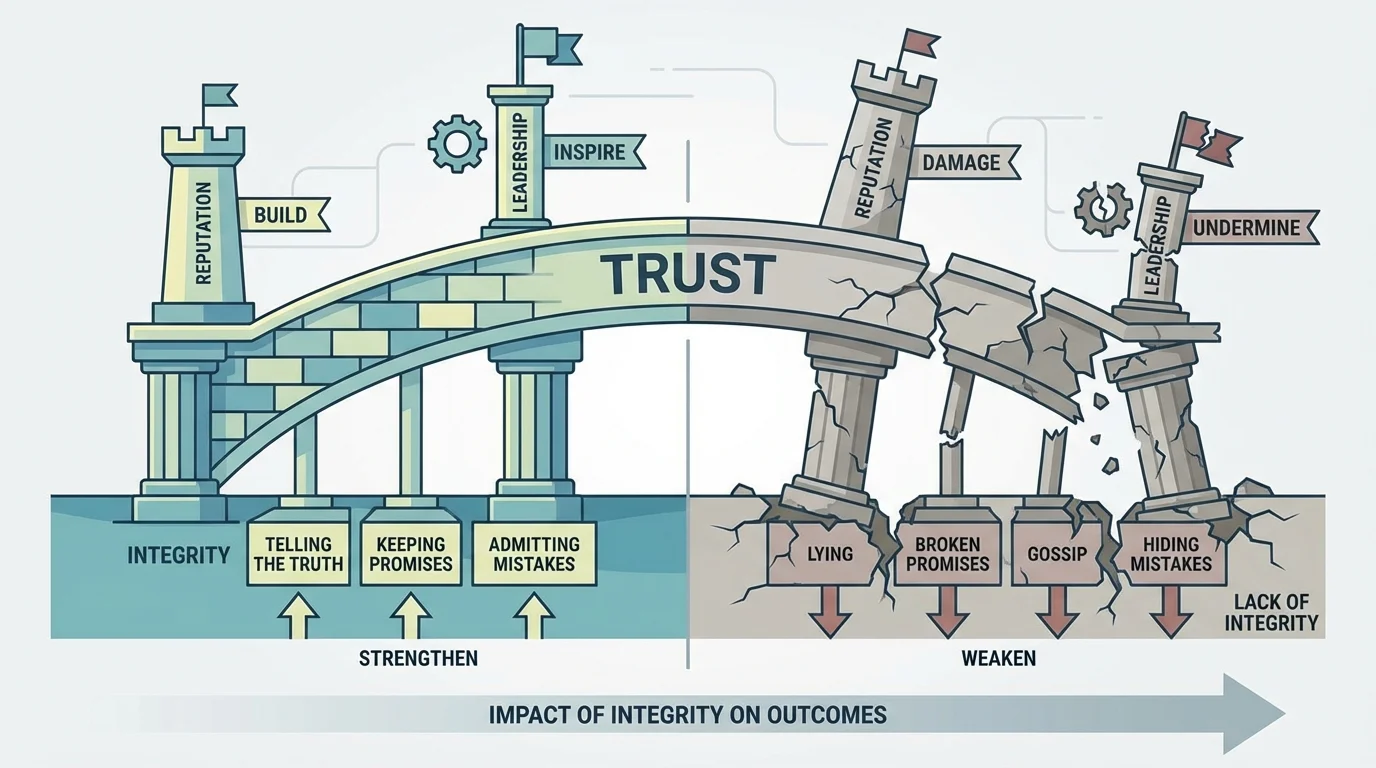
Trust can also be damaged in small pieces. If you frequently make excuses, share private information, copy someone else's work, or say one thing and do another, people become cautious. They may not confront you right away, but they start protecting themselves. They share less, rely on you less, and believe you less.
Here is a simple way to think about it: trust answers the question, "Can I count on you?" If the answer is yes most of the time, trust grows. If the answer becomes uncertain, trust weakens.
Consider two scenarios. In the first, you forget to finish a shared task for a community project. You quickly blame your internet, even though the real reason is that you put it off. In the second, you say, "I didn't manage my time well, and that is on me. I can finish my part by tonight." The mistake is the same, but the second response protects trust because it is honest and responsible.
Later, when you face another tough situation, the lesson from [Figure 1] still applies: people do not only notice whether you make mistakes. They notice whether you own them. In real life, many people are willing to forgive errors, but they struggle to trust someone who hides, denies, or blames.
Case study: broken trust in a group chat
A friend tells you something private during a video call. Later, another person asks what was said.
Step 1: Recognize the pressure.
You may want to fit in, seem interesting, or avoid awkwardness.
Step 2: Pause before answering.
Ask yourself whether sharing the information is honest, respectful, or fair.
Step 3: Protect the trust.
You can say, "That was private, so I'm not going to share it."
Step 4: Notice the result.
Your friend learns you are trustworthy, and others learn you respect boundaries.
Try This: Choose one promise you have made this week, even a small one, and make sure you complete it on time. Integrity often grows through ordinary follow-through.
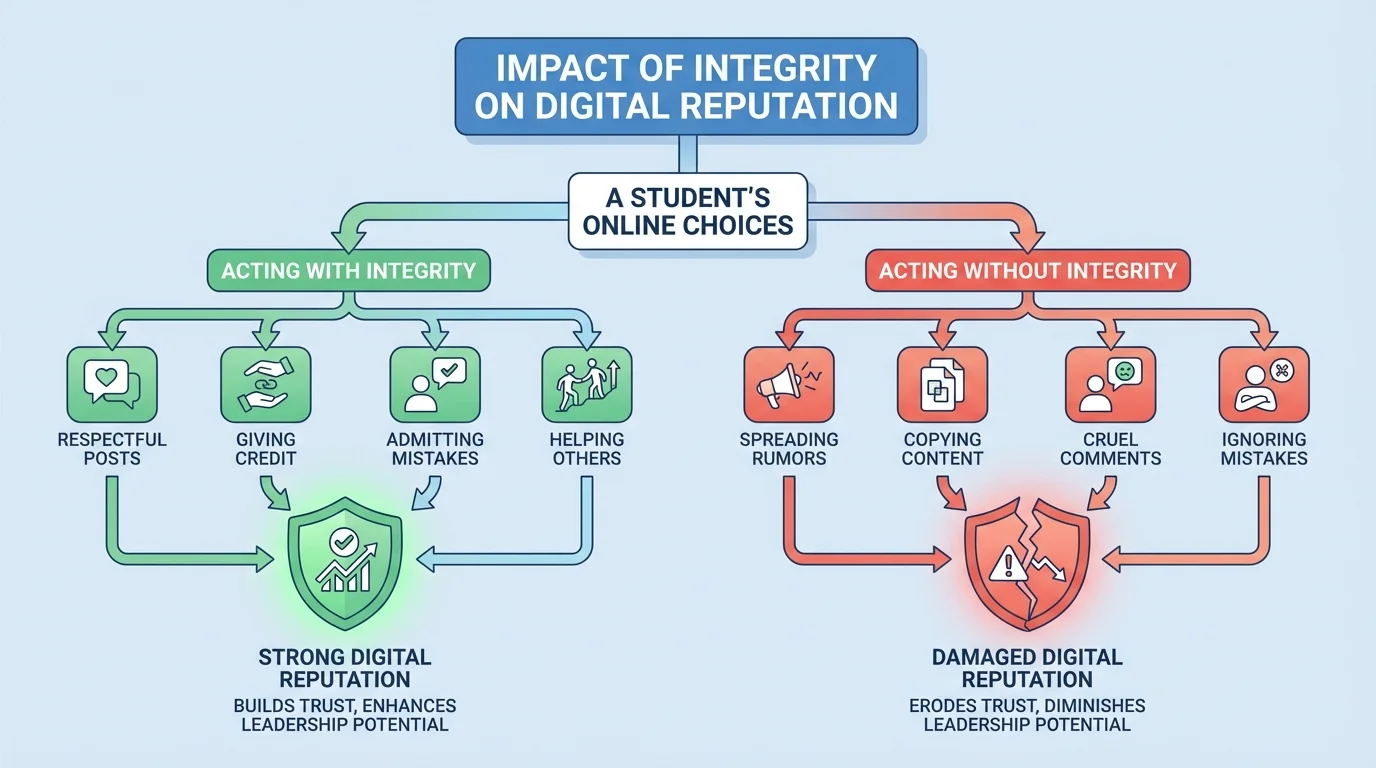
Your reputation is what people come to expect from you over time. In everyday life, and especially online, your actions leave a trail. Choices such as posting respectfully, crediting sources, and admitting mistakes can lead toward a stronger reputation, while mocking others, stealing content, or spreading rumors can lead the other way.
[Figure 2] A reputation is not built by one perfect day. It is built by patterns. If you are usually dependable, one mistake does not erase that. But if someone often lies, breaks promises, and avoids responsibility, people start connecting those actions into a picture of who that person is.
Digital reputation matters too. A rude comment, a dishonest post, or a fake story can travel quickly. Even if something gets deleted later, screenshots and memories remain. On the positive side, your digital choices can also show maturity. Thoughtful comments, respectful disagreement, and honest credit for ideas can make people see you as responsible and trustworthy.
This does not mean your reputation is fixed forever. People can change. But repairing a damaged reputation takes time because people need evidence, not just words. Saying "I've changed" is a start. Showing different choices consistently is what actually rebuilds confidence.
Suppose someone posts art, writing, or music created by another person and acts like it is their own. At first, they may get praise. But once others find out, the damage spreads beyond one post. People may wonder what else that person has faked. That is how integrity and reputation are linked: honesty supports your image, while dishonesty weakens it.
| Choice | Short-term result | Long-term effect on reputation |
|---|---|---|
| Admit a mistake | May feel embarrassing | People see honesty and responsibility |
| Blame others unfairly | May avoid trouble for a moment | People see unfairness and avoidance |
| Give credit for help | Share recognition | People see fairness and confidence |
| Copy without permission | May gain quick attention | People see dishonesty |
| Keep private matters private | May miss gossip | People see maturity and trustworthiness |
Table 1. Common choices and how they affect reputation over time.
Much later, if someone is deciding whether to include you in a leadership role, help with a project, or trust your opinion, your history matters. The pattern in [Figure 2] reminds us that reputation forms from many small choices that point in a direction.
Your brain often remembers negative experiences more strongly than positive ones, which is one reason a dishonest act can damage reputation so quickly. That does not mean recovery is impossible, but it does mean rebuilding requires patience and consistency.
Try This: Before posting, commenting, or forwarding something, ask: "Would I be okay if a parent, future coach, or community leader saw this?" That one question can protect your reputation.
Leadership is not only about being in charge. You lead whenever your actions influence what others do. If you stay calm in conflict, others may copy that. If you cheat, others may think cheating is acceptable. If you take responsibility, you make responsibility more normal.
Integrity is the core of strong leadership because people follow what they believe. A person who gives orders but does not live by the same rules loses credibility. A leader who demands respect but mocks others and asks for teamwork but takes all the credit weakens the group.
Think about a team captain in an online gaming tournament, a student organizing a neighborhood event, or a teen helping lead a youth group activity. These leaders need more than confidence. They need fairness, truthfulness, and accountability. If they make decisions honestly and explain them clearly, people are more likely to cooperate. If they play favorites or hide information, the group becomes frustrated.
"Character is what you do when no one is watching."
— Often used to describe integrity
A leader with integrity does several things well. They listen before judging. They tell the truth, even when it is awkward. They keep standards fair for everyone. They admit mistakes instead of pretending to be perfect. These habits make people feel respected, and respected people are more willing to work together.
Notice something important: integrity-based leadership is not loud. It does not always look dramatic. Sometimes it looks like giving someone else credit, stopping a rumor, refusing to cheat, or saying, "That was my mistake." Those moments may seem small, but they build deep respect.
You do not usually get warned before your integrity is tested. The choice simply appears. Here are some common situations where integrity matters:
Copying work: You find an answer online and think about using it as if it is yours. Integrity means using sources honestly and doing your own thinking.
Broken promises: You say you will help with something, then want to back out without explanation. Integrity means being truthful and taking responsibility for your commitment.
Gossip: Someone sends private information and expects you to join in. Integrity means protecting people instead of using their vulnerability for attention.
Hiding mistakes: You accidentally delete part of a shared file or forget an important task. Integrity means admitting the problem early rather than hoping no one notices.
Pressure from friends: Others tell you, "It is not a big deal," or, "Everybody does it." Integrity means you do not let group pressure replace your values.
Pressure does not remove responsibility. Feeling nervous, wanting approval, or fearing embarrassment may explain why a bad choice feels tempting, but those feelings do not make the choice right. Integrity grows when you notice pressure and still choose responsibly.
Sometimes the hardest integrity tests are the ones no one else may ever discover. That is exactly why they matter. If you only do the right thing when there is a risk of getting caught, you are protecting your image, not building your character.
When a situation feels confusing, use a simple process, as [Figure 3] shows. You do not need a perfect speech or a complicated rulebook. You need a few strong questions that slow you down and point you in the right direction.
Step 1: Pause. Do not answer, post, agree, or react immediately if something feels wrong.
Step 2: Ask, "Is it honest?" If the choice depends on hiding, twisting, or faking the truth, that is a warning sign.
Step 3: Ask, "Is it fair?" Think about whether someone could be hurt, excluded, embarrassed, or treated unfairly.
Step 4: Ask, "Would I be okay if important people knew?" If you would feel the need to hide it from someone you respect, pay attention to that feeling.
Step 5: Ask, "What kind of person am I becoming if I keep doing this?" Integrity is not just about one event. It is about the direction of your character.
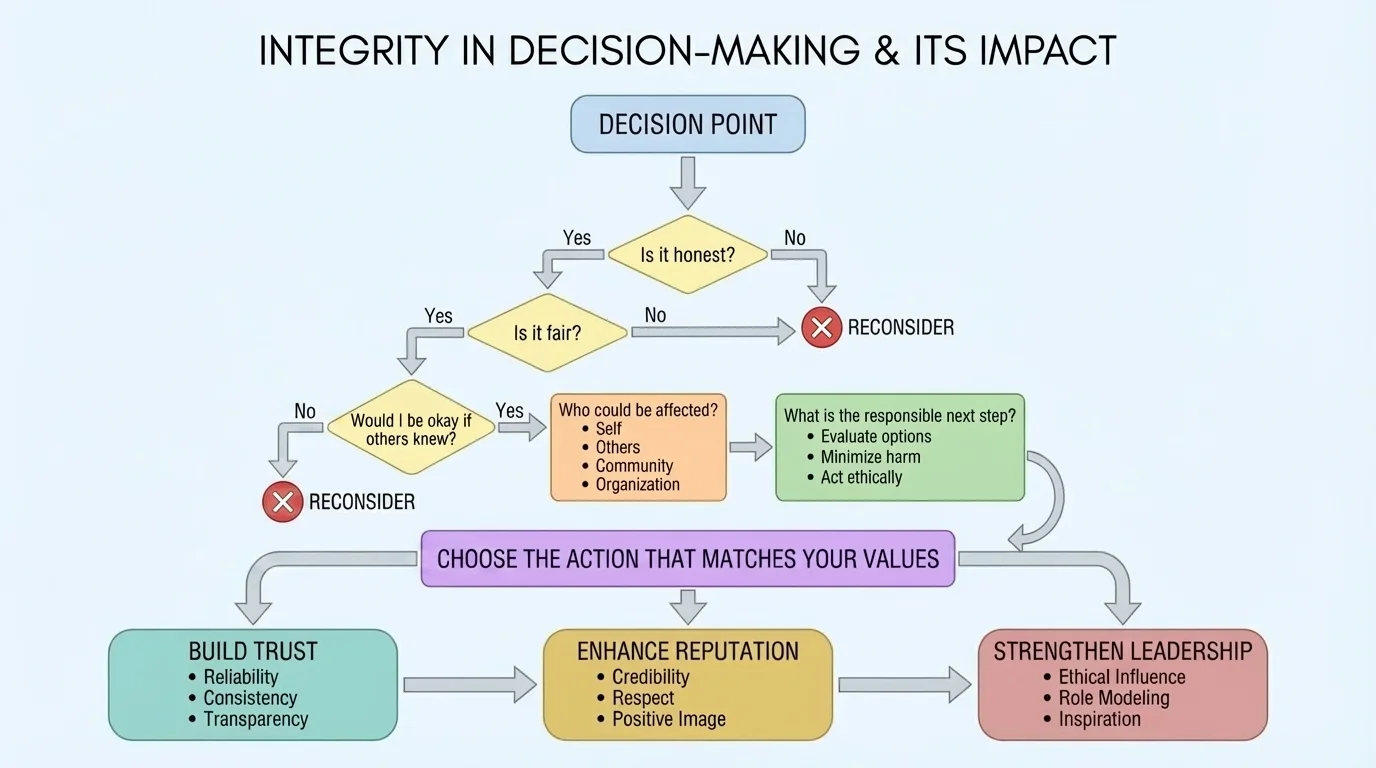
Step 6: Choose the most responsible action, even if it is uncomfortable. That may mean telling the truth, saying no, giving credit, apologizing, or asking an adult for guidance.
Decision example: your friend wants you to cover for them
Your friend skipped an online meeting for a project and asks you to tell the group they had a family emergency, even though that is not true.
Step 1: Pause and avoid answering immediately.
You do not need to lie just because someone wants a fast response.
Step 2: Test the choice.
It is not honest, and it is unfair to the rest of the group.
Step 3: Choose a response with integrity.
You might say, "I'm not comfortable lying. You should tell them you missed it and explain what happened."
Step 4: Accept short-term discomfort for long-term trust.
Your friend may be annoyed, but you protect your integrity and the group's trust.
Later, when another difficult choice appears, the questions in [Figure 3] still work because they focus on honesty, fairness, and responsibility instead of excuses.
Try This: Write three questions on a note or phone reminder: "Is it honest?" "Is it fair?" "Would I be okay if others knew?" Use them the next time you feel pressure to make a quick choice.
Everyone makes mistakes. Integrity does not mean being perfect. It means handling mistakes in a truthful and responsible way. In fact, sometimes you learn more about a person's character from how they respond to failure than from how they act when everything is going well.
If you have damaged trust, hurt your reputation, or failed as a leader, there is a path forward. It usually includes four parts: admit what happened, avoid excuses, make repairs where possible, and show change over time.
How to repair trust after a mistake
Step 1: Name the mistake clearly.
Say what you did without hiding behind vague words. For example: "I shared something private that was not mine to share."
Step 2: Take responsibility.
Avoid phrases that push blame away, such as "Everyone was doing it" or "You made me angry."
Step 3: Apologize sincerely.
A strong apology shows understanding of the impact: "That was disrespectful, and I understand why it hurt you."
Step 4: Repair what you can.
Delete the post, correct the false information, replace what was damaged, or complete the work you failed to do.
Step 5: Be consistent afterward.
Trust returns slowly. Your later choices must support your apology.
One apology does not automatically fix everything. People may need time. That can feel frustrating, but it is fair. If trust was damaged over several choices, it may take several better choices to rebuild it.
Integrity becomes easier when you practice it regularly. You do not need to wait for a huge moral test. Build the habit in ordinary life.
Tell the truth early. Problems usually grow when you hide them.
Keep small promises. Following through on little things trains you for bigger responsibilities.
Give credit. If someone helped, say so. Sharing credit shows confidence and fairness.
Think before posting. Online actions affect real people and real reputations.
Choose friends who respect honesty. The people around you can strengthen or weaken your standards.
Reflect on your choices. At the end of the day, ask yourself whether your actions matched your values.
Responsibility means owning your choices and their consequences. Integrity strengthens responsibility because it pushes you to act honestly, not just conveniently.
As your life becomes more independent, integrity matters even more. People may not always check your work, monitor your decisions, or remind you what to do. That is why character matters. It helps you guide yourself.
The good news is that integrity is not something you either have or do not have. It is something you build. Every honest answer, every fair choice, every responsible correction, and every kept promise makes that part of you stronger.
