Sometimes the hardest choices are not about what you want to do. They are about what you should do when every option feels uncomfortable. A friend asks you to keep a secret that could hurt someone. A group wants you to help with something dishonest "just this once." A rule seems unfair, but breaking it could create a bigger problem. These moments are called ethical dilemmas, and learning how to handle them is a real-life skill that can protect your safety, your relationships, and your reputation.
An ethical dilemma feels difficult because more than one important value is involved. You might care about loyalty, but also honesty. You might want to fit in, but also follow a rule. You might want to help a friend, but also protect someone from harm. When values pull in different directions, your brain can feel rushed, confused, or stuck.
This is why people do not always make their best choices in the moment. Pressure, fear, embarrassment, and urgency can push you toward the fastest answer instead of the wisest one. The goal is not to be perfect. The goal is to slow down enough to make a decision you can stand by later.
Ethics are ideas about right and wrong that guide behavior. An ethical dilemma is a situation where choices involve conflicting values, duties, or possible harms. A rule is an expectation or guideline set by a family, organization, app, team, or law. Pressure is influence that pushes you toward a choice, even when you are unsure. Responsibility means being accountable for your choices and their effects on yourself and others.
Not every hard choice is an ethical dilemma. Choosing between two fun activities is a preference. Choosing whether to lie to protect yourself from consequences is an ethical question, because honesty and responsibility are involved. A useful question is: Who could be affected, and what values are in conflict? This decision process is summarized in [Figure 1].
You are likely facing a ethical dilemma when at least one of these is true: someone could get hurt, a rule may be broken, trust could be damaged, honesty is at risk, or responsibility is unclear. Ethical dilemmas often hide behind ordinary moments, especially online. A message disappears after viewing. Someone says, "Don't tell anyone." A person jokes about something harmful so it seems less serious. A choice that looks small can still have real consequences.
Look for warning signs. If you feel the need to hide your action, rush your choice, blame someone else in advance, or hope no one finds out, that is a strong signal to pause. Good decisions usually survive questions. If a choice only works in secret, that matters.
Many poor choices happen not because a person planned to be dishonest, but because they felt rushed, isolated, or afraid of disappointing someone. Slowing down even for a minute can improve judgment.
Another clue is whether the situation changes depending on who is watching. If something seems "fine" in a private chat but not fine if a parent, coach, club leader, or future employer saw it, your values may already be warning you.
When stress rises, a clear process helps you think instead of react. You do not need a perfect speech or a dramatic stand. You need a steady method.
Step 1: Pause. Do not answer immediately. Take a breath. Put the device down for a moment if you need to. Pressure loses power when you create a little space.
Step 2: Name the real problem. Ask, "What makes this wrong, risky, or unfair?" Be specific. Is it lying, cheating, exclusion, bullying, stealing, unsafe behavior, or breaking trust?
Step 3: Check the consequences. What could happen right away, and what could happen later? Think about safety, trust, reputation, and whether the problem could spread.
Step 4: Check the rule. Is there a family rule, team rule, app rule, club rule, or law involved? Rules are not the only guide, but they matter because many exist to protect people.
Step 5: Identify the pressure. Who wants what from you? Are they using guilt, fear, flattery, secrecy, or urgency?
Step 6: Think about responsibility. What is your part? What do you owe to yourself, the other person, and anyone who could be harmed?
Step 7: Choose the safest honest action. That may mean saying no, refusing to help, leaving a chat, saving evidence, asking an adult for help, or reporting something serious.
Step 8: Reflect afterward. Ask what worked, what you would do differently next time, and whether any repair is needed.
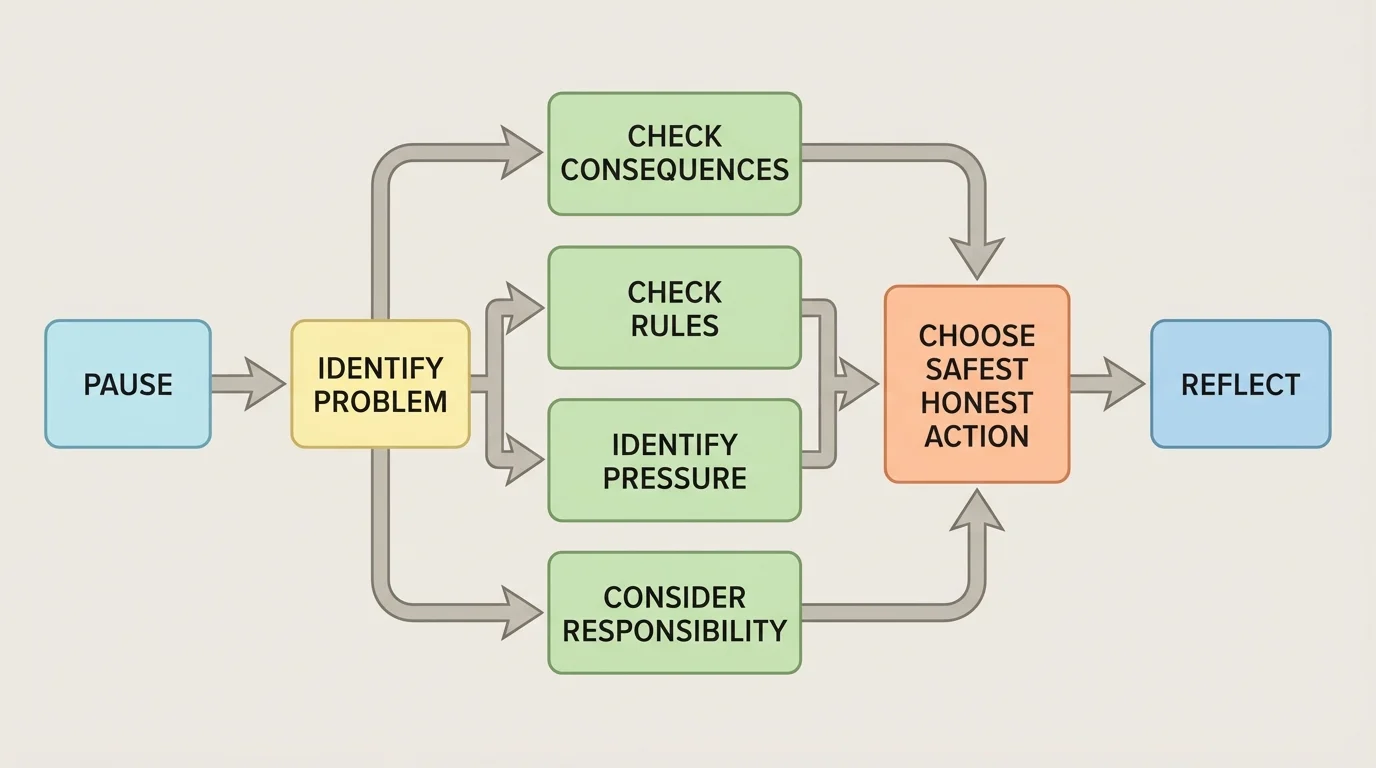
This process does not make every choice easy, but it makes your response stronger. It helps you act from values instead of panic. Later in difficult situations, you can return to the same path from [Figure 1] instead of starting from confusion.
The best immediate choice is often not the easiest choice. In ethical dilemmas, the "easy" option may avoid discomfort for a few minutes, but create larger problems later. The stronger option usually protects safety, truth, and trust, even if it feels awkward in the moment.
A useful test is the future-you test: Will I respect this choice tomorrow? Another is the headline test: Would I be okay if this action were shown to the people who matter to me? If the answer is no, listen to that signal.
Rules are not just random limits. Many are designed to prevent harm, protect privacy, keep things fair, or build trust. For example, rules against cheating protect fairness. Rules about passwords protect privacy and security. Rules about not sharing harmful content protect people from humiliation or danger.
Still, not all rules feel fair all the time. Sometimes a rule may seem too strict, inconvenient, or poorly explained. When that happens, the ethical response is usually to question it in a respectful way, not secretly break it. You can ask for clarification, ask for a reason, or ask whether there is a better option.
There is also an important difference between a normal rule and an unsafe demand. If someone tells you to keep abuse, threats, blackmail, self-harm risk, or dangerous behavior secret, that is not a rule you must obey. Safety comes first. When serious harm is possible, getting trusted adult help is responsible, not disloyal.
Case study: A friend asks for your login so they can "fix" your game progress
Step 1: Name the issue.
Sharing a password breaks privacy and security rules. It also makes it easy for someone to impersonate you.
Step 2: Notice the pressure.
The friend may say, "If you trusted me, you would do it." That is guilt pressure.
Step 3: Choose a response.
You can say, "I don't share passwords. If you want to help, tell me what to try instead."
Step 4: Protect yourself.
If you already shared it, change the password right away and tell a trusted adult if anything suspicious happened.
When you question a rule respectfully, you are still acting ethically. Ethics is not blind obedience. It includes fairness, safety, and honesty. But questioning should be open, calm, and responsible, not sneaky. Common forms of social pressure are shown in [Figure 2].
Pressure often comes in recognizable patterns through common messages and social cues. It may sound friendly, but it still tries to control your choice.
One type is peer pressure, when people your age push you to do something so you can fit in or avoid exclusion. Another is loyalty pressure: "If you are really my friend, prove it." There is also urgency pressure: "Do it now." Urgency is powerful because it tries to block thinking time.
Online, pressure can spread fast. Group chats may reward risky behavior with attention. Social media can make harmful actions seem normal if lots of people like, repost, or laugh at them. But popularity does not turn a bad choice into a good one.
Pressure also works through silence. Maybe nobody directly tells you to join in, but everyone acts like the behavior is normal. That can make it harder to speak up. Staying silent may feel safer in the short term, but silence can still support harm.
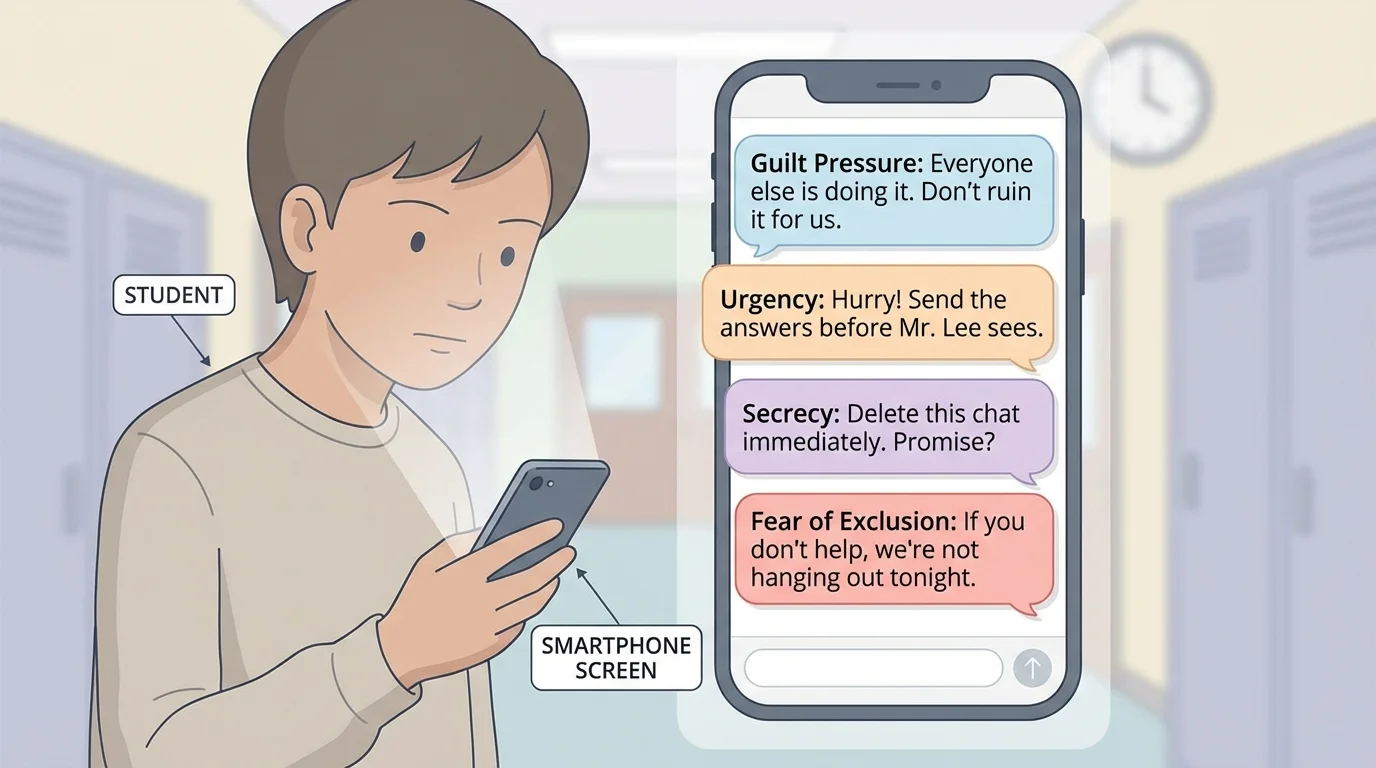
You can respond to pressure without starting a fight. Short, calm responses work well: "No, I'm not doing that." "That's not okay." "Leave me out of it." "I'm not risking that." "I need time to think." "I'm telling an adult because this could hurt someone." The widening effects of responsibility are illustrated in [Figure 3].
Pressure is strongest when you are tired, upset, excited, or worried about belonging. If you notice big emotions, pause before replying. A delayed response is often smarter than a fast one.
If you want to protect a friendship while saying no, you can separate the person from the action. For example: "I care about you, but I'm not helping with that." This keeps your boundary clear. The pressure patterns in [Figure 2] matter because once you can spot them, they lose some of their power.
Responsibility is bigger than just "Did I break the rule?" It includes the wider effect of your choices. Your decision can affect one person, a group, and even future trust.
Start with personal responsibility: what you choose, say, post, share, or hide. Then think about shared responsibility: if a group is doing harm, each person still has a part. "Everyone was doing it" does not erase your role. Then consider bystander responsibility: if you witness harm, you may not have caused it, but you still have choices about whether to ignore it, interrupt it, support the target, save evidence, or get help.
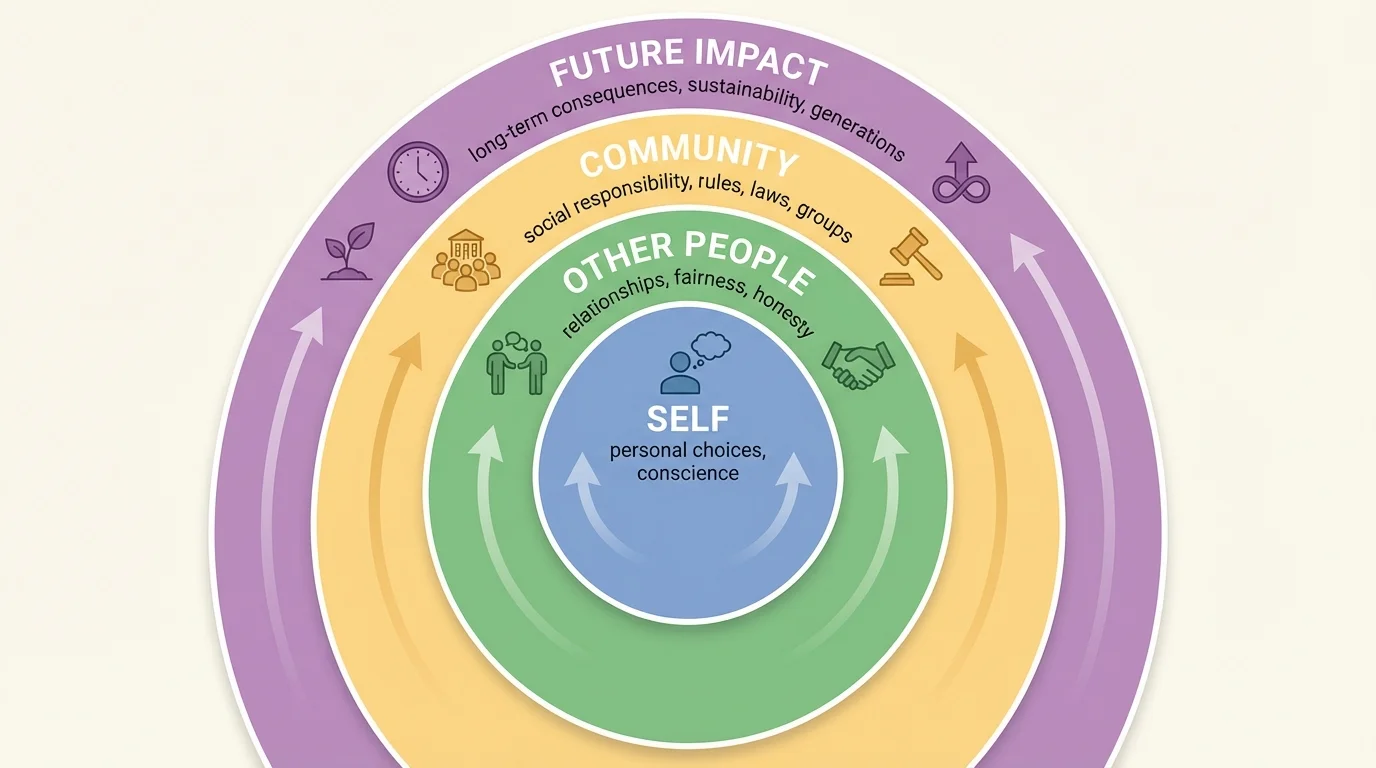
Responsibility also includes repair. If you made a poor choice, the next ethical step is not hiding it. It is admitting what happened, stopping the harm, apologizing honestly, and helping fix what can be fixed. Repair does not erase consequences, but it shows character.
"Character is what you do when the moment is difficult, not just when the choice is easy."
Sometimes responsibility means accepting that someone may be upset with you for doing the right thing. A friend may be angry if you refuse to cover for them. But protecting someone from the consequences of dishonesty can actually help the problem grow. The wider circles in [Figure 3] remind you to think beyond the next few minutes.
Let's apply the process to situations you could really face.
Situation 1: Cheating during an online quiz. A friend messages you answers and says everyone shares them. The rule is fairness. The pressure is belonging. Your responsibility is to do your own work and not help dishonesty spread. A strong response: "I'm not using answers from other people. Please stop sending them." If needed, leave the chat or mute notifications until the quiz is over.
Situation 2: A private group chat mocks someone. Maybe the target is not there, and people say it is "just joking." The issue is harm and humiliation. Even if you did not start it, staying and reacting positively can support it. A strong response: "This is going too far." Then stop engaging, save evidence if needed, support the person targeted, and tell a trusted adult if the harm continues.
Case study: You posted something hurtful as a joke
Step 1: Stop the harm.
Delete the post if possible and do not defend it with "I was only joking."
Step 2: Take responsibility.
Say clearly what you did: "I posted something hurtful about you, and that was wrong."
Step 3: Repair.
Apologize without excuses, ask what would help, and accept that trust may take time to rebuild.
Step 4: Learn.
Ask what pressure or habit led to the mistake so you can change it next time.
Situation 3: Covering for a friend. A friend wants you to tell their parent they were with you when they were somewhere unsafe. This puts loyalty against honesty and safety. If there is any risk of harm, you should not lie. A strong response: "I'm not lying about where you were. If you need help talking about it, I can stay with you while you tell the truth."
Situation 4: An adult or older teen tells you to keep something serious secret. If the secret involves threats, touching that feels wrong, unsafe driving, substance use around minors, self-harm risk, or blackmail, this is not a promise you should keep. The responsible action is to tell a trusted adult immediately.
Situation 5: A rule feels unfair. Suppose a community club has a rule that devices stay off during meetings, but you are waiting for an important family health update. Instead of secretly checking messages, explain the situation ahead of time and ask for a respectful exception. Ethical action can include speaking up honestly.
When you are under stress, it helps to have simple scripts ready. You do not need a long explanation. In fact, too much explaining can invite more arguing.
Try these types of responses: "No." "I'm not comfortable with that." "That breaks the rules." "That could hurt someone." "I'm leaving this chat." "Don't use my name in that." "I need help with this situation." These short statements are clear and calm.
You can also buy time. Say, "I'm not deciding right now." Time helps your thinking catch up with your emotions. The decision path from [Figure 1] is especially useful here: pause, identify the issue, and choose the safest honest action.
Boundaries are ethical tools. A boundary is a limit you set on what you will do, share, accept, or stay around. Boundaries protect safety, honesty, privacy, and self-respect. When you state a boundary clearly, you make future dilemmas easier to handle.
If someone keeps pushing after you say no, repeat yourself instead of debating. This is sometimes called the broken-record technique for holding a boundary. "No. I'm not doing that." Repeating a calm answer can be more powerful than giving ten reasons.
Good responses are easier when you build good habits before a problem shows up. Choose friends and groups that respect honesty. Avoid spaces where cruelty is treated like entertainment. Keep passwords private. Think before posting. Do not forward content that embarrasses someone. If you make a mistake, own it quickly.
It also helps to know your non-negotiables. These are actions you decide in advance you will not do, even under pressure. Examples: I will not share passwords. I will not cheat. I will not join in bullying. I will not keep a secret about serious danger. When your values are already clear, pressure has less room to push you around.
| Situation | Unhealthy response | Strong ethical response |
|---|---|---|
| A friend wants answers during a quiz | Send answers to stay liked | Refuse and protect fairness |
| Someone is mocked in a chat | Watch silently or add jokes | Stop engaging, support the target, get help if needed |
| You are asked to keep a dangerous secret | Stay silent to prove loyalty | Tell a trusted adult immediately |
| A rule seems unfair | Break it secretly | Ask respectfully for explanation or exception |
| You made a harmful mistake | Hide it or blame others | Admit it, apologize, and repair harm |
Table 1. Comparison of weak responses and stronger ethical responses in common real-life dilemmas.
One more habit matters: choose trusted adults before you need them. Make a short list of people you could contact if something serious happens. This might be a parent, guardian, relative, coach, counselor, youth leader, or neighbor your family trusts. Deciding this in advance saves time in urgent situations.
Try This
Make a private note on your device with three parts: "My non-negotiables," "People I can ask for help," and "My go-to response when pressured." Keep the wording short so you can actually use it.
Ethical decision-making is a skill, not a personality trait you either have or do not have. You build it by noticing problems early, slowing down under pressure, respecting fair rules, questioning unsafe or unjust demands, and taking responsibility for what you do next.
