Have you ever noticed that a community can feel very different depending on whether people follow rules, respect each other, and speak up when something is wrong? The same street, online group, sports team, library, or neighborhood event can feel safe and welcoming—or stressful and unfair—based on how people use their freedoms and handle their responsibilities. For young people, this matters every day, whether you are chatting online, walking to a park, joining a club, or helping in your neighborhood.
You may not vote yet, serve on a city council, or sign legal contracts on your own, but laws still affect you. They shape where you can go safely, what support adults must provide, how people are expected to treat you, and what happens when someone causes harm. At the same time, your choices affect other people too. When you act responsibly, you help create the kind of community you want to live in.
Community life is not only about adults making decisions. It is also about how younger people learn to be trustworthy, respectful, informed, and involved. Those habits start early. If you learn now how to understand a rule, ask questions, protect your rights, and respect other people's rights, you build skills that will matter for years.
Law is a rule made and enforced by government to protect people and keep order.
Right is a freedom or protection people should have.
Responsibility is a duty to act in a safe, fair, and respectful way.
Community is a group of people who share a place, interest, or common life, such as a neighborhood, town, online group, team, or volunteer organization.
These ideas are connected. A law may protect a right, and that right is often linked to a responsibility. For example, you may have the right to speak, but you also have the responsibility not to threaten, bully, or spread lies. The connection between these ideas in everyday situations is easier to understand when you see how they support one another, as [Figure 1] shows.
Think of laws as the outside structure of community life. They set limits and protections. Rights are what people should be able to expect within that structure. Responsibilities are the actions each person must take so the system works fairly. If one part is missing, the whole community becomes weaker.
For example, a law might say that harassment is not allowed. That supports your right to safety and dignity. Your responsibility is to avoid harassing others and to report serious harm to a trusted adult or proper authority. A strong community is not built by laws alone. It depends on people using their rights wisely and taking responsibility for their actions.
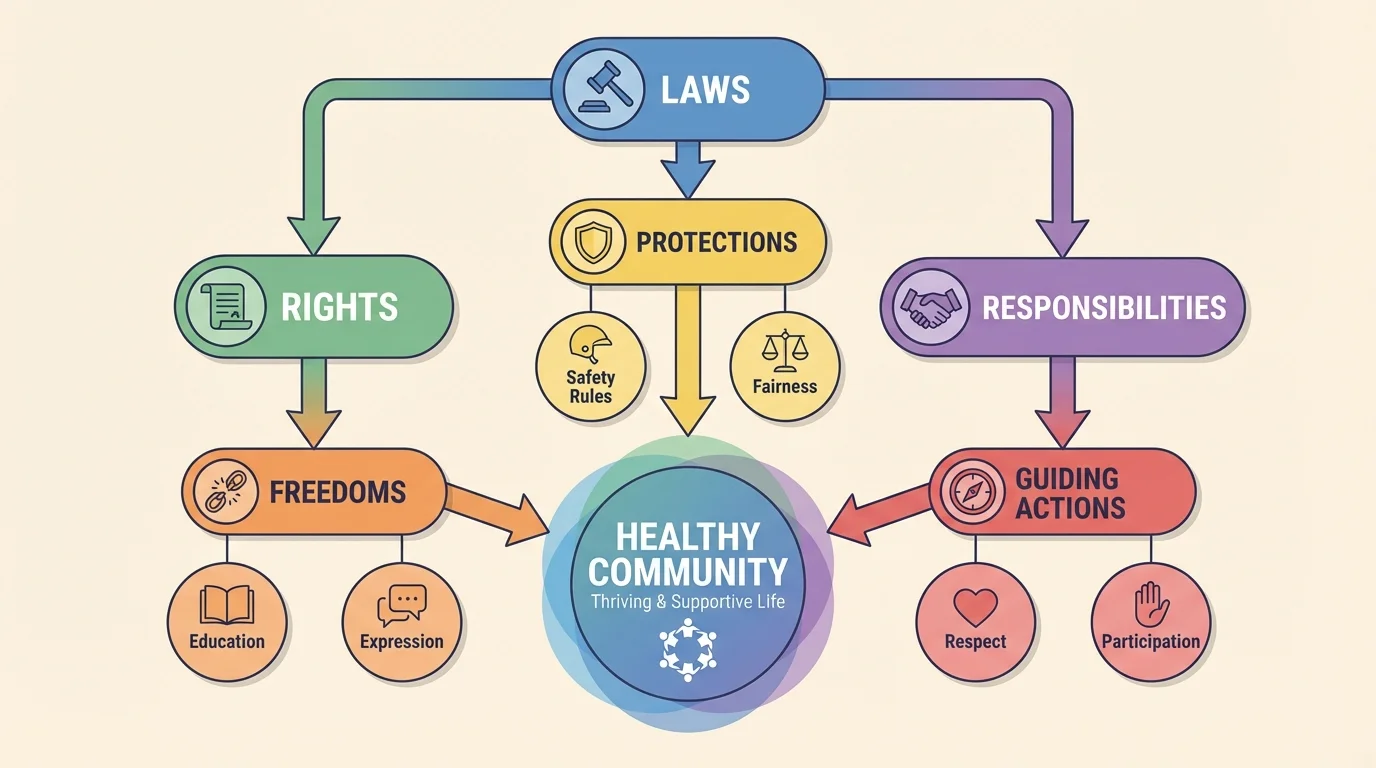
If people only focus on rights and ignore responsibilities, communities can become unfair or unsafe. If people only focus on responsibilities and ignore rights, communities can become controlling or unjust. Healthy community life needs balance. That balance is one of the most important civic skills you can learn.
Many laws exist because young people need protection while they are still growing, learning, and gaining independence. Some laws help make sure children and teens receive care, education, and protection from abuse or neglect. Other laws deal with online safety, public behavior, work rules for minors, and access to public spaces and services.
Even if you do not know the exact legal wording, you can still understand the practical purpose. Laws often try to answer questions like these: How do we reduce harm? How do we protect people who may be more vulnerable? How do we handle conflict fairly? How do we keep shared spaces respectful and usable for everyone?
Why communities need laws
Laws are not just about punishment. Their main purpose is to organize life in a way that protects people, sets expectations, and gives a process for solving problems. Without laws, stronger or louder people could take advantage of others more easily, and there would be less fairness when conflicts happen.
Here are a few ways laws shape community life for young people:
| Area of community life | How laws help | Why it matters to you |
|---|---|---|
| Safety | Set rules against violence, threats, theft, and harassment | You can participate in community spaces with more confidence |
| Protection | Require adults to protect children from abuse and neglect | You have legal support if someone harms you |
| Public spaces | Guide behavior in parks, libraries, streets, and events | Shared places work better when everyone follows basic rules |
| Online behavior | Address serious threats, exploitation, or illegal sharing | Digital spaces are part of real community life too |
| Work and money | Limit unsafe labor and protect minors in jobs | You are less likely to be pressured into harmful situations |
Table 1. Examples of how laws shape daily community life for young people.
Sometimes young people think laws only matter when someone gets in trouble. Actually, laws also shape the things you may take for granted: safer playgrounds, required reporting of abuse, fairer access to services, and rules that make community programs more accountable.
One important part of civic awareness is knowing that rights are not abstract ideas floating far away in government books. They show up in ordinary life. You have rights connected to safety, fairness, privacy, support, and respectful treatment. In many places, young people also have rights related to education, medical protection in emergencies, and access to certain public services.
A right does not mean getting everything you want. It means having protections and freedoms that should not be ignored without a good reason. For example, being treated fairly does not mean avoiding every consequence. It means consequences should be handled in a reasonable and just way.
Your rights may include being protected from abuse, being heard when something affects your well-being, expressing your ideas respectfully, and having personal information handled carefully. Privacy matters, but privacy is not absolute. If someone is in danger, adults may need to step in. That is one reason community life can feel complicated: one person's privacy may need to be limited to protect someone else's safety.
Real-life case: Privacy and safety
You tell a trusted adult that a friend has posted messages about wanting to self-harm. Your friend might feel upset that you shared private information.
Step 1: Identify the right involved.
Your friend has a right to privacy and respectful treatment.
Step 2: Identify the responsibility involved.
You have a responsibility to act when someone may be in serious danger.
Step 3: Weigh the greater need.
Safety comes first when there is a risk of real harm.
Step 4: Act through the right channel.
You tell a trusted adult, counselor, guardian, or emergency service if needed, instead of trying to handle the crisis alone.
This is a strong example of how rights matter, but responsibilities help you decide what to do when the situation is urgent.
Knowing your rights also helps you ask better questions. If a rule seems unfair, you can ask: Is this for safety? Is it being applied equally? Is there a respectful way to challenge it? Civic awareness does not mean obeying without thinking. It means understanding how to question things responsibly.
A responsibility is what you are expected to do so that other people can live safely and fairly too. Responsibilities are not just chores or tasks from adults. They are part of being someone others can trust in a shared community.
Your responsibilities include following reasonable rules, telling the truth, respecting shared spaces, considering how your words affect others, and responding appropriately when someone needs help. Online, responsibilities include not spreading rumors, not posting private information, not joining harassment, and thinking before you share.
This matters because community harm often grows in small steps. One joke becomes bullying. One rumor becomes social damage. One careless repost spreads false information to many people. Responsible choices can stop those chains early.
Many serious community problems start with small actions that people dismiss as "not a big deal." A harmful post, a false accusation, or sharing someone's private photo can spread far faster online than most people expect.
Here is a practical way to test whether your action is responsible: ask yourself four quick questions. Is it true? Is it respectful? Is it safe? Is it fair? If the answer to even one of these is clearly no, pause before you act. That pause can protect both you and others.
Responsibilities also include accepting consequences. If you make a mistake, taking responsibility usually means admitting it, apologizing honestly, fixing what you can, and learning from it. Blaming everyone else may feel easier in the moment, but it damages trust.
Some situations are simple, but others require careful judgment. A conflict happens when two important values seem to pull in different directions. In community life, you may feel tension between free expression and kindness, privacy and safety, loyalty and honesty, or fairness and forgiveness. A practical way to sort through these tensions appears in [Figure 2], which lays out a decision path you can follow before acting.
Suppose you want to post a joke about someone after an online argument. You may feel you have the right to express your opinion. But if the post humiliates, threatens, or falsely accuses someone, your responsibility to avoid harm matters too. Rights are real, but they do not erase the effects of your choices on other people.
Or suppose your friend asks you to keep a secret that involves stealing, vandalism, or a plan to hurt someone. Loyalty may feel important, but community safety matters more. Responsible action may mean telling a trusted adult even if your friend gets angry.
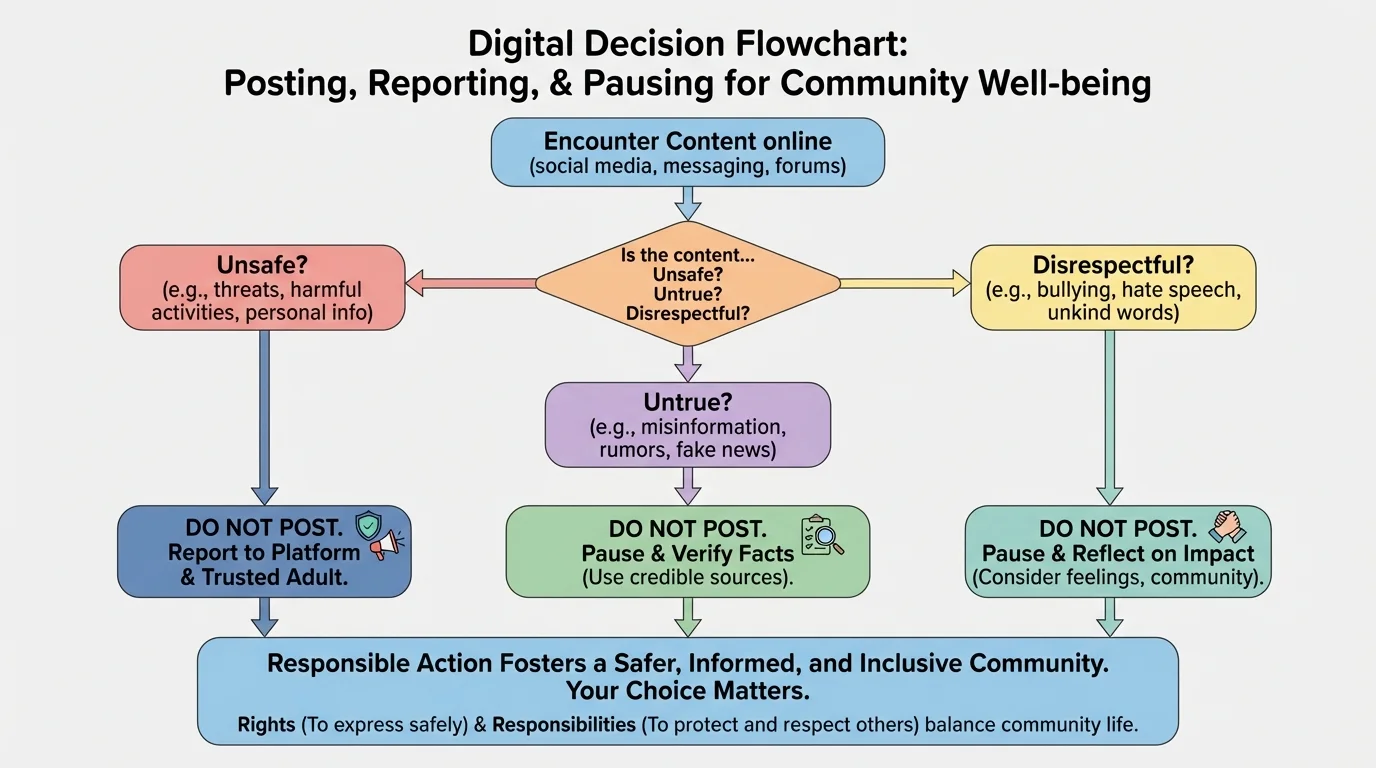
When two values clash, do not ask only, "What am I allowed to do?" Also ask, "What action protects people, respects fairness, and prevents harm?" That question leads to better decisions.
Balancing rights with responsibilities
A mature civic decision is not based only on personal feelings. It considers rules, effects on others, safety, fairness, and whether the same action would still seem acceptable if someone else did it to you.
You can use this simple decision guide:
Step 1: Name the issue clearly. What happened?
Step 2: Identify the rights involved. Who needs protection or fair treatment?
Step 3: Identify the responsibilities involved. What duties do the people in this situation have?
Step 4: Consider consequences. What could happen now and later?
Step 5: Choose the safest, fairest action.
Step 6: Get help from a trusted adult if the issue involves harm, threats, or illegal behavior.
Notice that this process is not about winning an argument. It is about making a strong decision when emotions are high. The decision path in [Figure 2] becomes especially useful when you feel pressure to act quickly online.
Let's apply that process to a realistic example. A group chat starts mocking a new student in a community sports program. Someone asks you to post an embarrassing screenshot from a private message.
Case study: Group chat pressure
Step 1: Name the issue.
This is not harmless teasing. It is turning into humiliation and invasion of privacy.
Step 2: Identify rights.
The new student has a right to dignity, fair treatment, and reasonable privacy.
Step 3: Identify responsibilities.
You have a responsibility not to spread harm, not to share private content, and to respond safely.
Step 4: Consider consequences.
Posting the screenshot could deepen the harm, damage trust, and possibly create serious adult intervention.
Step 5: Take action.
Do not post it. If needed, tell the group you are not participating. Save evidence and tell a trusted adult or program leader if the behavior continues.
This is what civic responsibility looks like in real life: not dramatic speeches, but steady choices that protect people and improve the community around you.
Good choices are not always the easiest ones. You may lose social approval in the short term. But communities become healthier when people are willing to choose integrity over pressure.
Civic engagement means taking part in ways that improve your community. That can include volunteering, helping neighbors, participating in cleanup projects, joining community groups, speaking respectfully to leaders, reporting problems, or learning about local issues. Young people can contribute in real ways, and this can happen in many everyday settings.
[Figure 3] You do not need to wait until adulthood to make a difference. You can join a neighborhood project, help at a food drive, attend a virtual town meeting with a parent or guardian, write a respectful message to a local official about a park or road safety issue, or support a community cause with accurate information and responsible action.
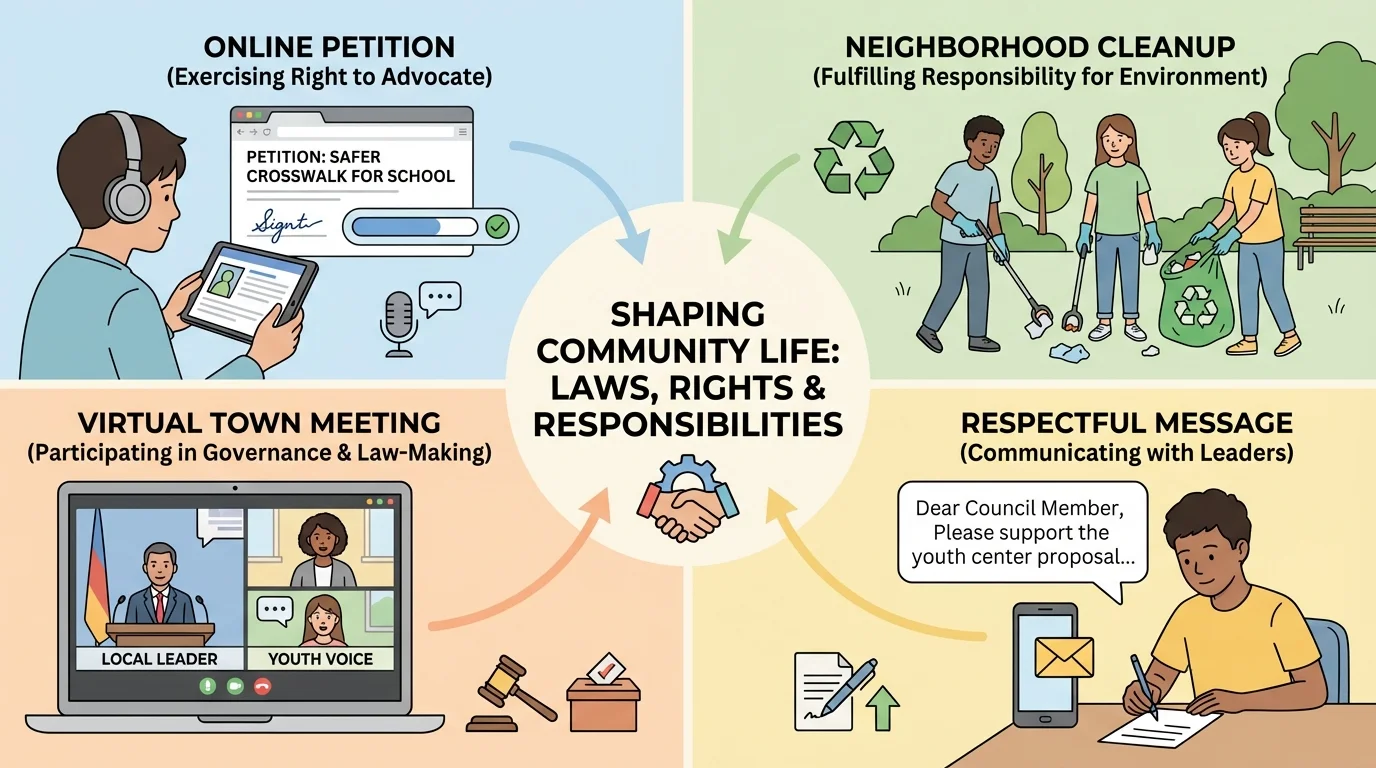
The key word is responsible. Civic action is strongest when it is informed, respectful, and focused on solutions. Complaining without facts usually changes little. Clear communication, evidence, and respectful persistence are much more effective.
Here are some practical ways to engage:
| Action | What it looks like | Why it matters |
|---|---|---|
| Volunteer | Help at a food bank, cleanup, or animal shelter | Supports real needs in the community |
| Report problems | Tell an adult about unsafe conditions or harmful behavior | Helps prevent bigger problems |
| Speak respectfully | Write a clear message about an issue you care about | Builds your voice and influence |
| Learn before sharing | Check facts before reposting claims online | Reduces misinformation |
| Include others | Welcome new people in community groups | Makes spaces more fair and connected |
Table 2. Practical forms of civic engagement available to young people.
Notice how these actions connect back to laws, rights, and responsibilities. Reporting an unsafe situation respects the rights of others. Volunteering strengthens the community. Fact-checking helps prevent harm. Respectful communication makes it easier for communities to solve problems without creating new ones.
"The way you treat people is part of the kind of community you build."
If you ever feel too young to matter, remember this: communities are shaped by repeated actions, not only big public moments. Showing respect, protecting others, and speaking up wisely are civic acts. The same basic pattern we saw earlier in [Figure 1] still applies: laws provide structure, rights protect people, and responsibilities turn values into action.
The choices you make now affect more than today's situation. They shape your reputation, your judgment, and the kind of person others believe they can trust. A person who respects rules thoughtfully, stands up for others, and takes responsibility builds strong habits for future work, friendships, leadership, and citizenship.
As you grow older, community life will become more complex. You may work, drive, vote, sign agreements, or take on leadership roles. The habits you build now—asking good questions, balancing rights with responsibilities, and acting with integrity—prepare you for those future responsibilities.
Being part of a community does not just mean belonging to it. It means helping shape it through your choices, your words, and the way you respond when something is unfair or unsafe.
Try This: The next time you face a rule, conflict, or online disagreement, pause and ask: What rights are involved? What responsibilities do I have? What choice protects people and keeps the situation fair? That short check can lead to much better decisions.
Try This: Choose one small civic action this week, such as helping with a local project, reporting a real safety concern, or learning more about a community issue before sharing opinions about it.
