Some community projects fail even when people care a lot. Why? Often, the problem is not a lack of effort. It is that the plan is unfair, wasteful, or puts too much work on only a few people. A neighborhood cleanup, an online fundraiser, a shared garden, or a pet supply drive can all start with good intentions and still go wrong if people are left out, supplies are wasted, or no one knows who is responsible for what. Learning how to build a strong participation strategy helps you make a real difference instead of creating confusion.
Community participation means people working together to improve something they all care about. Your community might be your neighborhood, an online group, a sports team, a religious group, a library program, or even the people in your apartment building. You do not need to be an adult to participate. At your age, you can help organize, communicate, notice needs, and contribute ideas that adults may miss.
When community participation is done well, people feel respected, problems get solved more effectively, and the results last longer. When it is done poorly, people may feel ignored, used, or frustrated. For example, if one person creates an online donation project without asking what items are actually needed, the group may collect the wrong supplies. If the organizer expects the same few volunteers to do everything, those volunteers may quit. Good strategy turns caring into useful action.
Fairness means giving people a real chance to take part and be heard, not just treating everyone exactly the same.
Sustainability means making choices that can continue over time without wasting resources or harming people or the environment.
Shared responsibility means the work, decisions, and accountability are divided in a balanced way instead of falling on one person.
These three ideas belong together. A project cannot truly be fair if only a few people carry the work. It is not sustainable if it burns people out or creates a lot of trash. And shared responsibility is weak if decisions are made by only one voice. Strong community participation connects all three.
Fairness does not always mean "everyone gets the exact same thing." Sometimes people need different kinds of support to participate equally. If a community meeting is online, fairness may mean offering clear instructions for joining, allowing typed responses for people who do not want to speak on video, or making sure the meeting time works for different schedules. If a supply drive asks everyone to donate expensive items, that may seem equal, but it is not fair to people who cannot afford that.
Sustainability is about more than the environment, though that matters too. It also means asking, "Can we keep this going?" A project that depends on one person staying up late every night is not sustainable. A fundraiser that uses large amounts of disposable decorations may raise awareness but also create unnecessary waste. A better strategy uses time, energy, money, and materials wisely.
Shared responsibility means no one person is "the entire project." People may have different jobs, but everyone should know what they are responsible for. This builds trust. It also makes the project stronger because if one person gets sick, loses internet access, or has a family emergency, the work can still continue.
Small changes in participation rules can make a huge difference. Something as simple as offering two ways to respond—such as a form and a group chat—often increases involvement because more people can participate in the way that works best for them.
One useful way to think about participation is this: a strong project helps people join, contribute, and stay involved. If people cannot easily enter, their ideas are ignored once they join, or the work becomes exhausting, the strategy needs improvement.
A good plan begins with listening. Too many projects begin with assumptions: "People probably want this," or "I already know the problem." But communities are made of different people with different needs, schedules, and concerns. The first step is to find out what the actual need is and who is affected by it.
[Figure 1] shows one simple way to gather ideas. You can do this in practical ways. Ask a few clear questions in an online form. Talk with family members or neighbors. Read local community posts carefully. Notice repeated problems: litter in a shared park area, a lack of pet food donations at a shelter, younger kids needing homework help, or community members confused about a new rule. Patterns matter more than one person's guess.
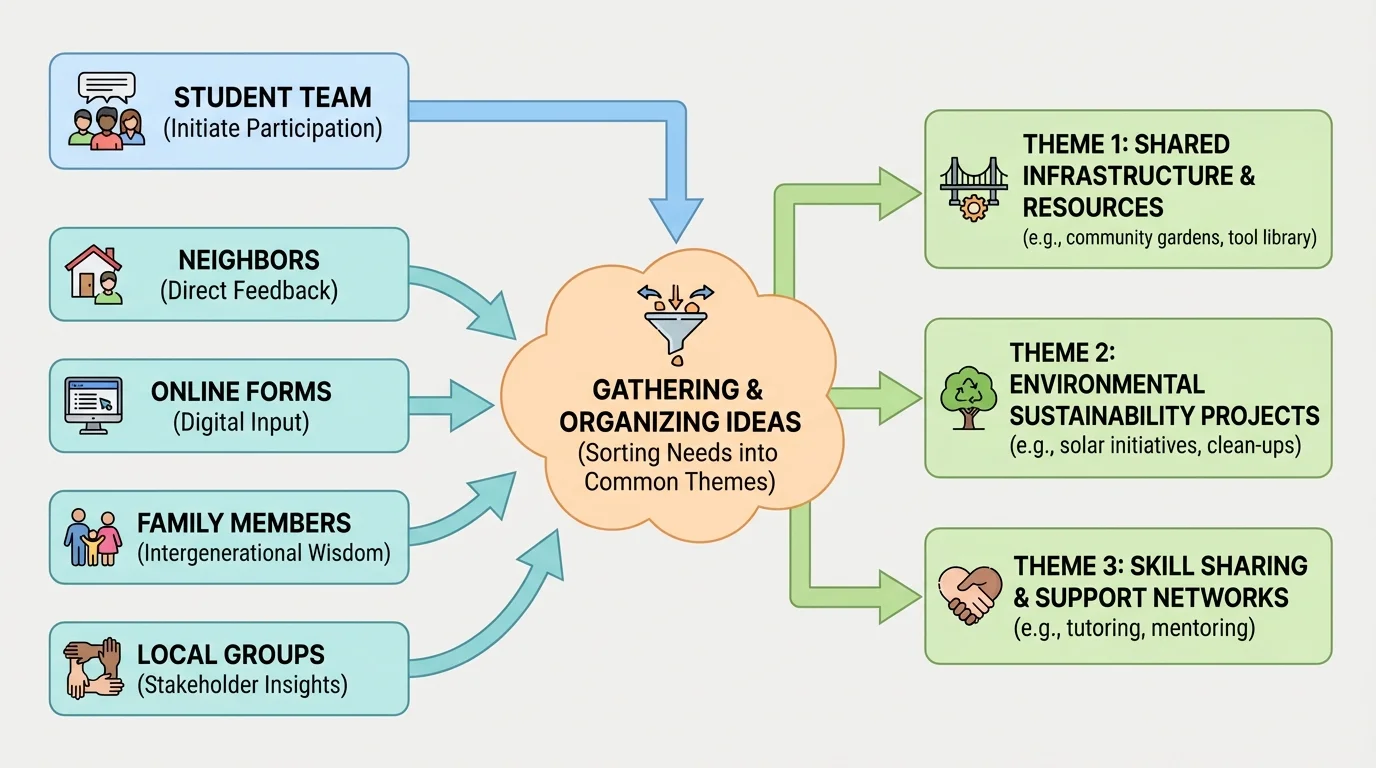
As you gather information, pay attention to who is not speaking. Maybe people with busy schedules do not answer live video calls. Maybe younger kids are affected but adults answer for them. Maybe some people do not feel comfortable posting publicly. Listening well means creating more than one way for people to share their views.
This is where stakeholders become important. Stakeholders are the people affected by a decision or project. In a community garden, stakeholders might include residents, building managers, volunteers, and families who will use the space. In an online donation drive, stakeholders might include donors, organizers, and the people receiving supplies. If you ignore key stakeholders, your plan may look good on paper and still fail in real life.
Case study: noticing the real need
A student wants to help a local animal rescue and first thinks, "I should collect toys." After asking the rescue through email and checking its public updates, the student learns the biggest need is cleaning supplies and pet food.
Step 1: Notice the goal
The student wants to help animals in a meaningful way.
Step 2: Ask instead of assume
The student contacts the organization and reads recent posts to find current needs.
Step 3: Adjust the plan
The student changes the project from a toy drive to a supply drive.
The project becomes more useful because it responds to the actual situation, not just the student's first idea.
Listening first does not slow a project down. It saves time by preventing mistakes that would cost more effort later.
Equity is a helpful idea here: fairness is not just giving everyone the same thing, but making sure people have what they need to participate. A fair strategy asks, "What might stop someone from joining or being heard?"
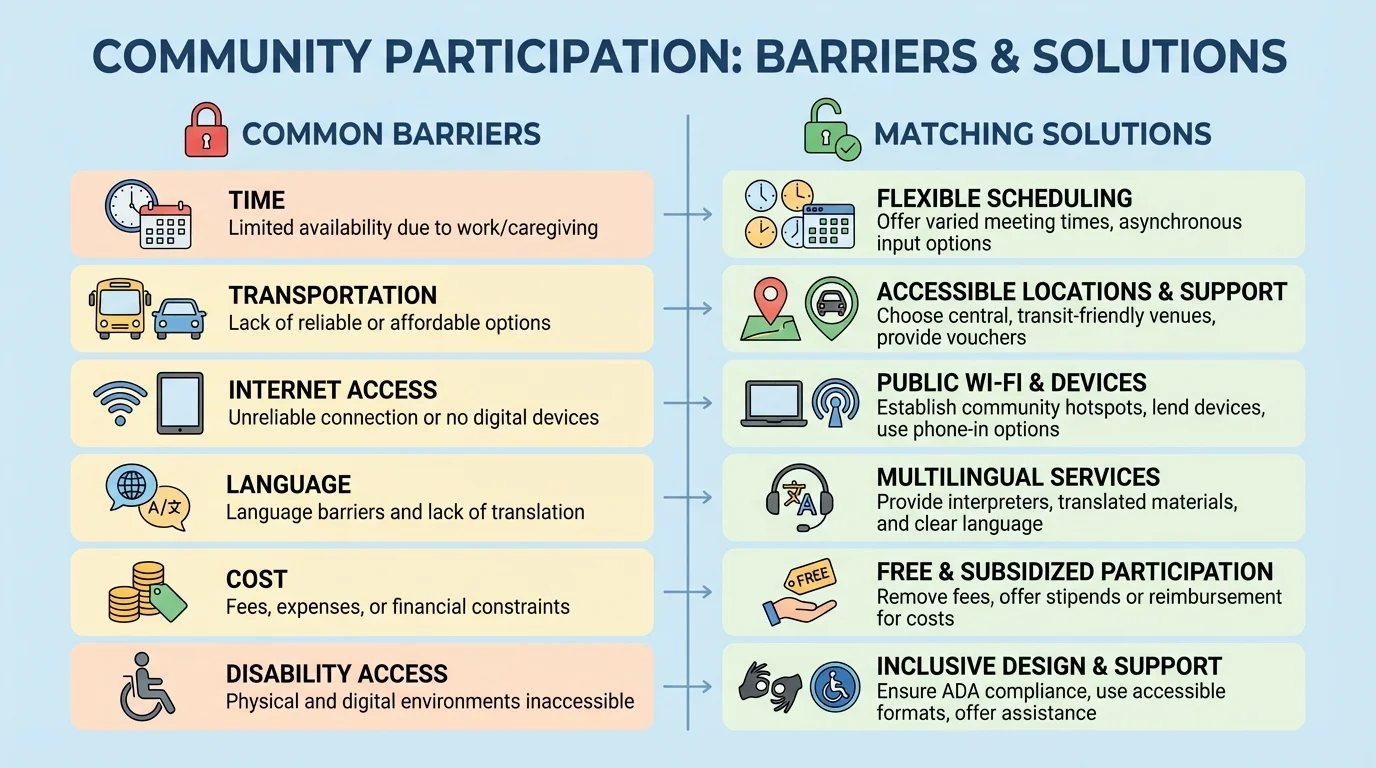
[Figure 2] highlights common barriers and matching solutions. Common barriers include time, transportation, internet access, cost, language, and disability access. Even in online projects, fairness matters. If your group only uses one app that some families do not allow, that is a barrier. If updates are full of confusing language, that is a barrier. If meetings happen at only one time, that is a barrier.
You can build fairness by lowering these barriers. Offer simple instructions. Share information in short messages and visuals. Use free tools when possible. Give flexible ways to contribute, such as helping with design, research, reminders, or organizing donations. Let people choose jobs that match their skills and resources. A student who cannot travel may still be excellent at creating a sign-up sheet or writing clear update posts.
Fair strategies also include respectful decision-making. If one loud voice makes every choice, others may stop participating. A better approach is to collect input, explain how decisions will be made, and be honest about limits. You may not be able to do every suggestion, but people deserve to know they were heard.
Another part of fairness is credit. If several people contribute ideas or effort, recognize that openly. Give thanks in group messages. Name who handled design, outreach, organizing, or deliveries if they are comfortable being named. When people feel invisible, they are less likely to help again.
| Unfair approach | Fairer approach |
|---|---|
| One person chooses the project alone | Several people give input before the goal is set |
| Only one way to participate | Multiple ways to help based on time and ability |
| Updates are hard to understand | Messages are short, clear, and easy to access |
| Same volunteers do all the work | Tasks are divided and checked regularly |
| No one gets recognition | Contributions are acknowledged respectfully |
Table 1. Comparison of unfair and fairer participation choices in community projects.
When you look back at the barriers in [Figure 2], notice that fairness is practical. It is not just about being nice. It is about removing obstacles so more people can truly contribute.
Sustainability means your project can continue without wasting materials, harming the environment, or exhausting the people involved. It asks you to think beyond the first exciting moment. Before starting, ask: How long will this take? What supplies will we use? What cleanup will be needed? Who keeps this going next week or next month?
One easy way to check sustainability is to look at resources in four categories: time, energy, materials, and money. If your project needs a lot of all four, it may be too ambitious. A smaller project done well is usually better than a huge project that collapses.
For example, suppose you want to create welcome kits for new families in your area. A wasteful version might use many printed pages, plastic wrapping, and expensive items nobody asked for. A more sustainable version might include a digital information guide, a few essential supplies, reusable bags, and donations based on an actual list of needs. The second version helps people while creating less waste and lower cost.
Think long term, not just fast
A project is stronger when it can continue or be repeated without causing strain. Sustainability means planning for reuse, repair, low waste, realistic schedules, and people's well-being. It also means asking whether the project solves the problem at its source or only covers it for a very short time.
Sustainability also protects people. If one organizer stays awake too late answering messages every night, that person may become stressed, irritable, or unable to continue. A sustainable plan includes boundaries, shared tasks, and realistic deadlines.
You can test a plan with a simple question: "Could we still do this next month?" If the answer is no because it uses too much time, money, or energy, redesign the plan.
Accountability means people are answerable for what they agreed to do. Shared responsibility works best when roles are clear. Without that, everyone assumes someone else is handling it. Then deadlines are missed, messages go unanswered, and trust drops.
A useful strategy is to divide tasks by category: communication, supplies, scheduling, record-keeping, outreach, and follow-up. Then assign each task to a person or small team. It also helps to set check-in times. These do not need to be long. A short update message can answer three questions: What is done? What still needs to happen? What problem needs help?
Shared responsibility does not mean every person does the same amount at every moment. People have different skills and different schedules. What matters is that the workload is balanced over time and that everyone understands their part. If one person has strong design skills and another is great at organizing lists, that is fine. Balance is more important than sameness.
"Many hands make light work."
That saying is simple, but it only works when the hands know what to do. Clear roles prevent burnout. They also reduce arguments because expectations are visible instead of hidden.
Shared credit matters too. If a project succeeds, do not let one person take all the praise. Thank contributors privately and publicly when appropriate. This builds trust and keeps the group healthy for future projects.
A community strategy works best when you can follow a repeatable process. You do not need a complicated system. You need a clear one.
[Figure 3] shows a practical planning cycle you can use again and again. Use these steps whenever you want to plan a community effort, whether it is online, in your neighborhood, or through a local organization.
Step 1: Notice a real need. Be specific. "Help the community" is too broad. "Collect school supplies requested by a local support center" is clearer.
Step 2: Identify the stakeholders. Who is affected? Who should be asked before a decision is made?
Step 3: Set one fair goal. Keep it realistic. A focused goal is easier to organize and evaluate.
Step 4: Remove barriers. Think about cost, timing, access, language, and technology.
Step 5: Plan for sustainability. Use resources carefully. Avoid waste. Choose a schedule people can keep.
Step 6: Divide responsibilities. Make jobs clear. Set deadlines. Decide how updates will be shared.
Step 7: Review and improve. Ask what worked, what did not, and what should change next time.
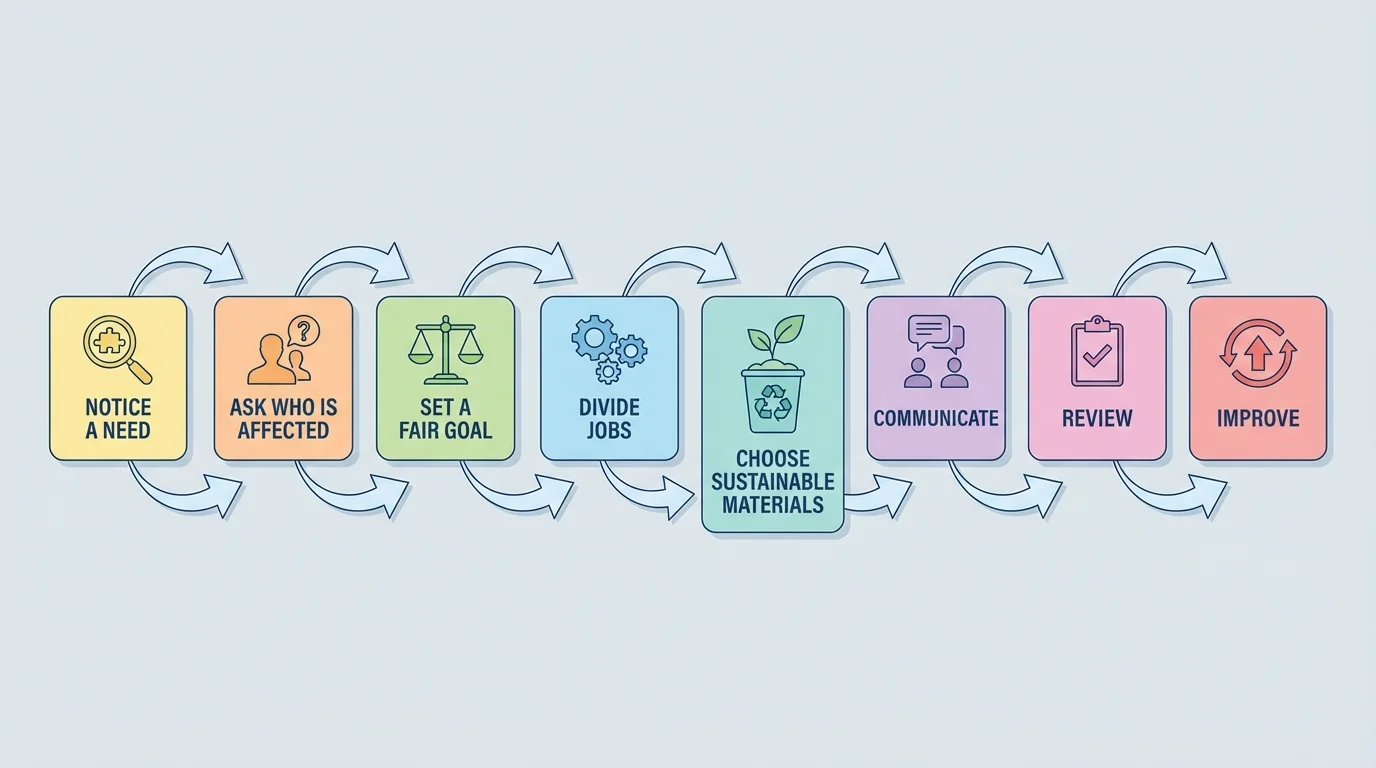
This method helps you avoid two common mistakes: starting too fast and trying to do too much. It also gives you a way to explain your plan clearly to others.
Example: planning a neighborhood book swap
Step 1: Notice the need
Several families have books their children have outgrown, while others want free reading materials.
Step 2: Check fairness
The organizer shares information online and on a community board so people without social media can still learn about it.
Step 3: Plan sustainability
Instead of printing many flyers, the organizer uses one reusable sign and digital messages.
Step 4: Share responsibility
One person tracks donations, one person organizes categories, and one person manages pickup times.
The result is a simple event that is easier to run, easier to repeat, and more welcoming to different families.
Later, when you evaluate your project, the cycle in [Figure 3] still helps. Review is not extra. It is part of responsible participation.
Consider two students organizing an online hygiene-product drive. The first student posts one message, asks for random donations, and never explains what the items are for. A few people donate things that cannot be used, and no one knows where to bring them. The project fades out. The second student contacts the receiving organization first, gets a list of approved items, creates a clear sign-up message, offers a digital drop-off schedule, and asks two helpers to manage reminders. The second strategy works better because it is clearer, fairer, and more organized.
Or think about a community cleanup. A weak strategy asks the same three people to bring all supplies, do all the cleanup, and post all updates. By the end, those people are tired and annoyed. A strong strategy shares jobs, uses reusable gloves and sorting bins when possible, explains safety rules, and plans a reasonable time limit. More people stay involved because the plan respects their effort.
When a plan is practical, people are more likely to follow through. Clear communication, realistic deadlines, and simple systems usually work better than complicated plans that sound impressive but are hard to maintain.
The difference between strong and weak strategies is usually not talent. It is planning, listening, and responsibility.
Conflict does not mean a project failed. It means people care, have different views, or are confused about the process. What matters is how you handle the disagreement. If someone feels left out, if people argue about supplies, or if private information is shared carelessly, stop and address the issue calmly.
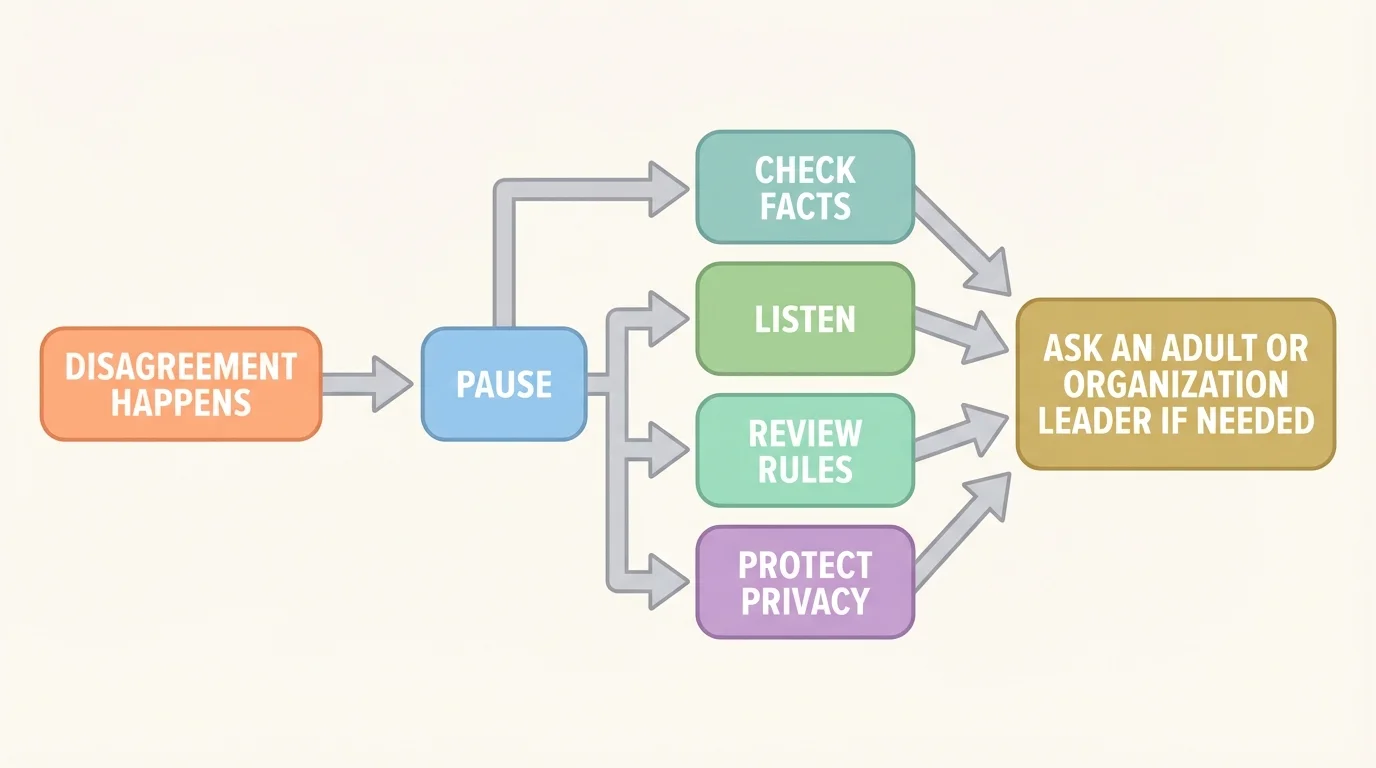
[Figure 4] outlines a smart response path. Start by checking facts. What happened? Who was affected? What rule or expectation was unclear? Then listen before reacting. Use respectful language, even online. Avoid public shaming, sarcasm, and angry posting. If the conflict involves safety, harassment, threats, or private information, bring in a trusted adult or organization leader right away.
Legal and civic awareness matters too. Community action still has rules. You may need permission to collect items in a shared space, post flyers, use a logo, or photograph people. Never assume that because a project is "for a good cause," every action is automatically allowed. Respect privacy. Do not post someone's address, phone number, or photo without consent. Do not promise things on behalf of an organization unless you have been authorized to do that.
This is where consent becomes important. Consent means permission that is clearly given. If you want to share a photo of a volunteer or tell a story about a family receiving help, ask first. Respecting consent protects people and builds trust.
Later, if conflict appears again, return to the response path in [Figure 4]. Pause, check facts, protect privacy, and ask for help when needed. Responsible participation is not only about doing good things. It is also about doing them safely and respectfully.
You do not need a huge project to practice these skills. You can start small. Help your family organize a fair chore system where jobs are shared and expectations are clear. Help a local group create a simple digital sign-up form. Join a neighborhood event and notice whether the plan includes different voices. Offer one practical improvement, such as clearer instructions or more flexible ways to contribute.
Try this in real life: before joining or planning any community effort, ask yourself five questions. Who is affected? Who might be left out? What waste or stress might this create? How will jobs be shared? How will we know if it worked? Those questions turn good intentions into responsible action.
Strong community participation is not about being the hero who does everything alone. It is about helping people work together in ways that are fair, sustainable, and shared. That is how communities become stronger over time.
