You do not need to have your whole future figured out at age 12. That's the good news. The more important truth is this: the choices you make now can start building doors you may want to walk through later. The classes you take, the habits you build, the skills you practice, and the people you ask for help from all shape what becomes possible for you in high school and beyond.
Future educational choices are not just about "being smart." They are about knowing yourself, setting goals, and using support wisely. Some students already have a strong idea of what they want. Others are still exploring. Both are normal. What matters is learning how to make decisions that fit you, not just following what other people expect.
Think about two students learning from home. One signs up for an online coding club because she likes solving puzzles. Another joins a local animal shelter volunteer group because he loves caring for pets. Neither student has chosen a career yet, but both are learning something important about themselves. Interests often leave clues about the kinds of future paths that may feel meaningful and motivating.
When you assess your interests, goals, and supports, you are doing a kind of personal planning. You are not locking yourself into one future forever. You are gathering information so your next choices make more sense. This helps you avoid drifting toward decisions based only on pressure, trends, or what other people are doing online.
Educational choices are decisions about learning opportunities, such as courses, training, clubs, volunteer experiences, certifications, and plans for high school, college, or other post-secondary options.
Post-secondary means any education or training after high school, including college, trade school, certificate programs, apprenticeships, military training, and other career preparation.
A smart choice is not always the most popular one. It is the one that fits your abilities, interests, goals, and situation well enough to help you grow.
Your first job is to understand yourself better. A self-assessment is a careful look at your interests, strengths, values, and learning preferences. When you organize those parts clearly, future options become easier to compare, as [Figure 1] shows through a student profile map that connects personal traits to possible directions.
Interests are the things that naturally grab your attention. You may enjoy drawing, fixing bikes, helping younger kids, making videos, cooking, reading about space, or learning how apps work. Interests matter because people usually stay motivated longer when they care about what they are doing.
Strengths are things you do well right now or skills that improve quickly with practice. You might explain ideas clearly, stay calm in stressful moments, organize tasks well, notice small details, or work patiently on long projects. Strengths do not have to be school subjects only. Being dependable, creative, or a good listener can also matter a lot.
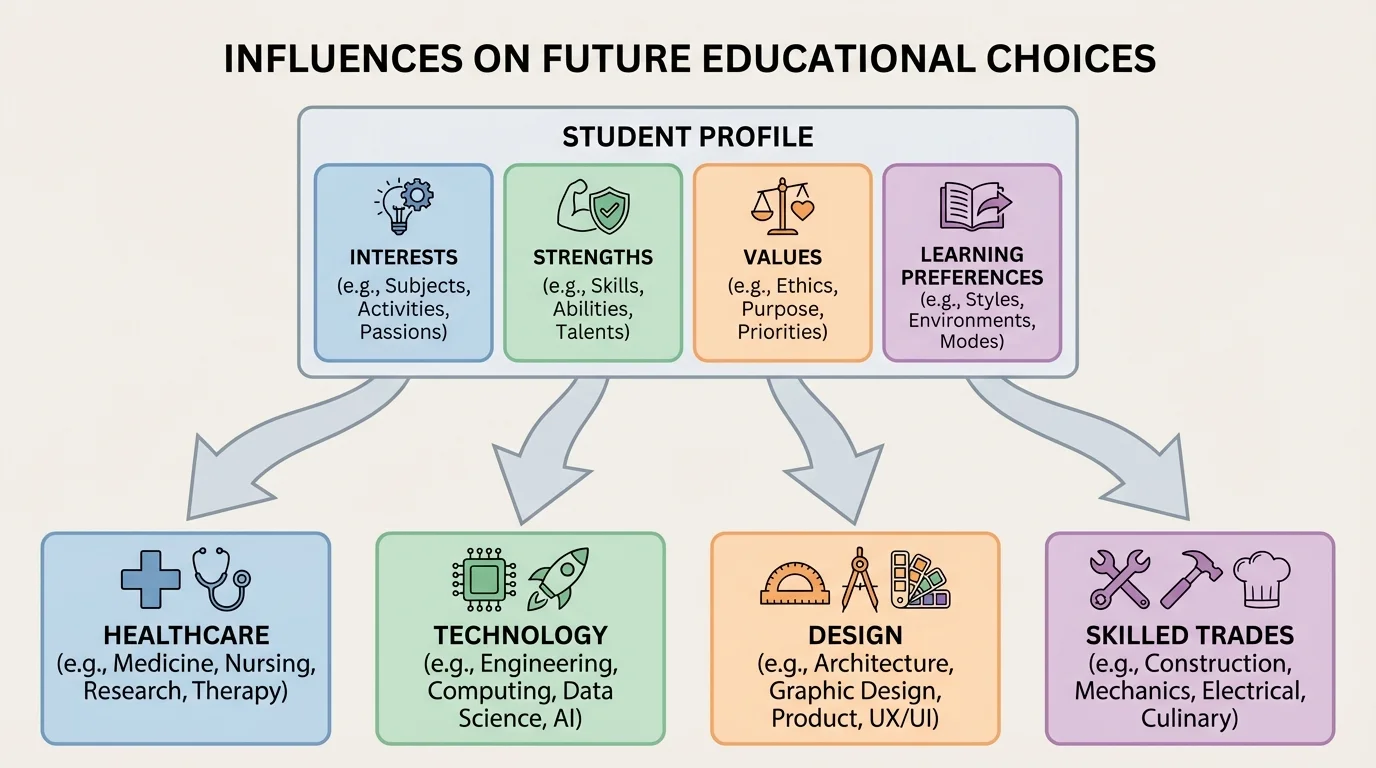
Values are what feels important to you. For example, you may value helping others, earning good money later, having a flexible schedule, working outdoors, solving hard problems, or creating things with your hands. Two students can both like science but choose different futures because one values research while the other values direct hands-on work.
Learning preferences describe how you learn best. Since you attend school online, this is especially important. Some students focus better with videos and notes. Others need checklists, quiet space, movement breaks, or one-on-one help on video calls. Knowing this helps you choose study methods and future programs that fit you better.
One useful way to assess yourself is to ask four simple questions: What do I enjoy? What am I good at? What matters to me? What kind of environment helps me do my best? If you answer honestly, patterns usually appear. Those patterns do not decide your future for you, but they give you strong clues.
Later, when you compare educational options, the categories in [Figure 1] still matter. A choice may look impressive from the outside, but if it does not match your interests, values, or learning needs, it may be harder to stick with.
Many adults end up in jobs that connect to hobbies or interests they had when they were young, even if the connection was not obvious at first. A student who likes editing videos might later explore marketing, film, journalism, or online business.
You also need to be honest about areas where you still need growth. That is not a weakness. It is useful information. If you want a future that involves strong writing, math, teamwork, or technology skills, noticing gaps now gives you time to improve.
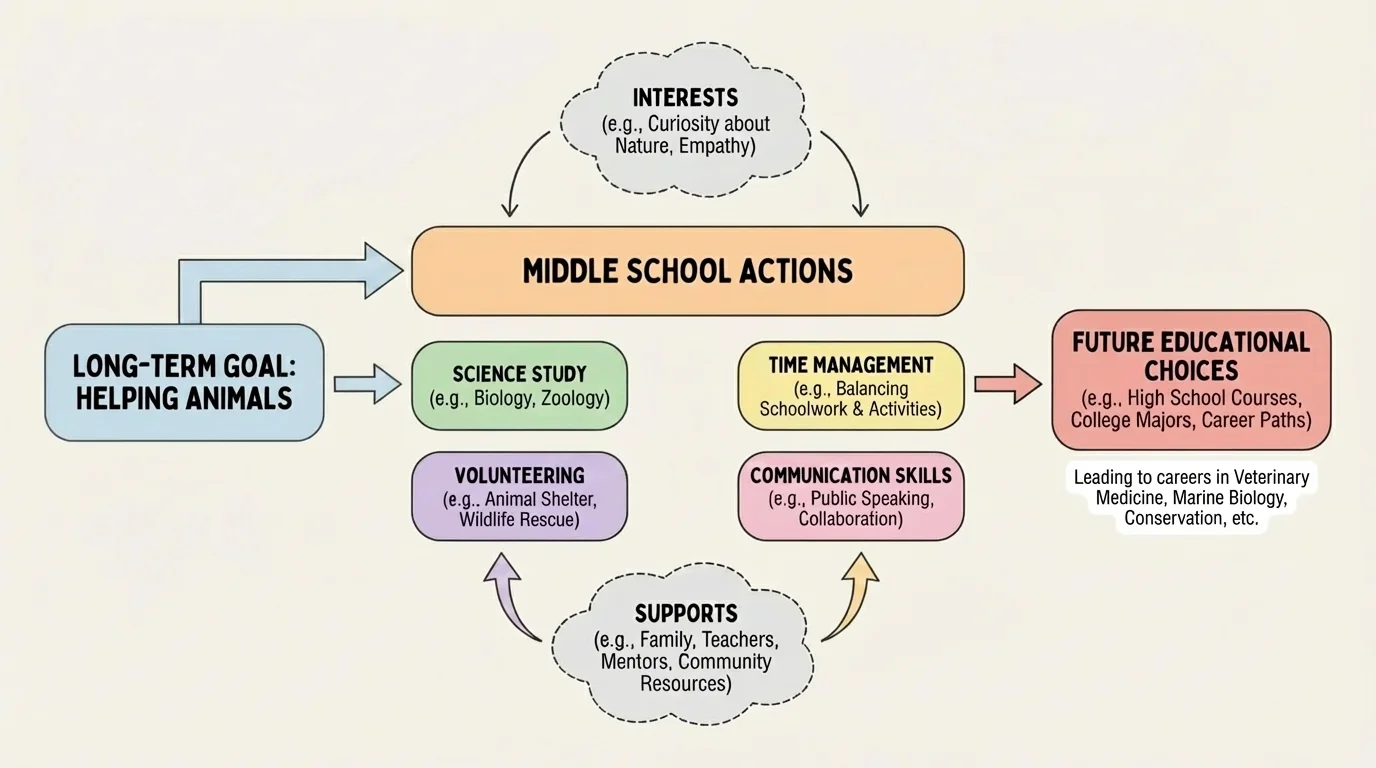
A goal is something you are working toward. Goals help turn interests into action. They work best when you can trace a path from a future dream back to the choices you can make now, as [Figure 2] illustrates with a long-term aim broken into smaller steps.
Short-term goals are goals you can work on soon, such as this week, this month, or this school year. Examples include improving your reading routine, finishing assignments on time, joining a community activity, learning basic coding, or asking for help in math.
Long-term goals are goals that may take years. You might want to become a nurse, a welder, a game designer, a mechanic, a chef, an entrepreneur, or a wildlife biologist. Long-term goals often change as you grow, and that is okay. Their job is to give you direction, not trap you.
The best planning happens when short-term goals support long-term ones. If your long-term goal is to work with animals, useful short-term goals might include reading about animal care, keeping up in science, volunteering locally, and practicing responsibility at home by caring for a pet consistently.
Here is a practical way to test a goal: ask whether it is specific enough to guide your next step. "I want to be successful" is too vague. "I want to explore jobs that help people and use science" is clearer. "I will attend one virtual career talk and research two health-related training paths this month" is even better because it leads to action.
Goals also help you say no to distractions. If one of your goals is improving your grades, spending every evening scrolling social media works against that plan. When your goals are clear, your choices become easier.
Big goals need smaller steps. Most future plans succeed because of regular habits, not one giant moment. A student who wants college options later may need steady attendance online, completed assignments, reading practice, and communication skills long before filling out any application.
As shown in [Figure 2], goals create a chain: future dream, middle steps, and today's actions. If one link is missing, the plan feels confusing. If the links connect, progress becomes much more realistic.
When people talk about future educational options, they often mean college only. But there are many different paths after high school. Some careers require a four-year college degree. Others need a two-year college program, a certificate, an apprenticeship, military training, or on-the-job learning with special exams or licenses.
College can be a good fit for careers like teaching, engineering, medicine, law, and many science or business fields. Community college can offer lower-cost classes, job training, or a pathway to transfer later. Certificate programs often focus on job skills for a specific field. Trade or technical programs prepare students for hands-on careers such as electrical work, welding, automotive repair, cosmetology, or heating and cooling systems. Apprenticeships combine training with paid work in some fields.
The important point is not to memorize every path right now. It is to understand that your future options are wider than one single route. If you enjoy making, fixing, designing, performing, helping, organizing, building, or analyzing, there may be more than one educational path that gets you there.
Your current choices can keep pathways open. For example, strong reading, writing, math, digital skills, and time management help in almost every future program. Even if your exact dream changes, these skills still matter.
| Type of future path | Often focuses on | Examples |
|---|---|---|
| Four-year college | Academic study plus career preparation | Teacher, engineer, psychologist |
| Community college | Transfer courses or job training | Nursing support, business, graphic design |
| Certificate program | Specific job skills | Medical assistant, IT support |
| Trade or technical school | Hands-on career training | Welder, electrician, automotive technician |
| Apprenticeship | Earn while learning | Construction, skilled trades |
Table 1. Common post-secondary pathways and the kinds of preparation they often provide.
Looking at choices this way can reduce pressure. You do not need one perfect answer right now. You need awareness, curiosity, and a plan to keep learning about what fits you.
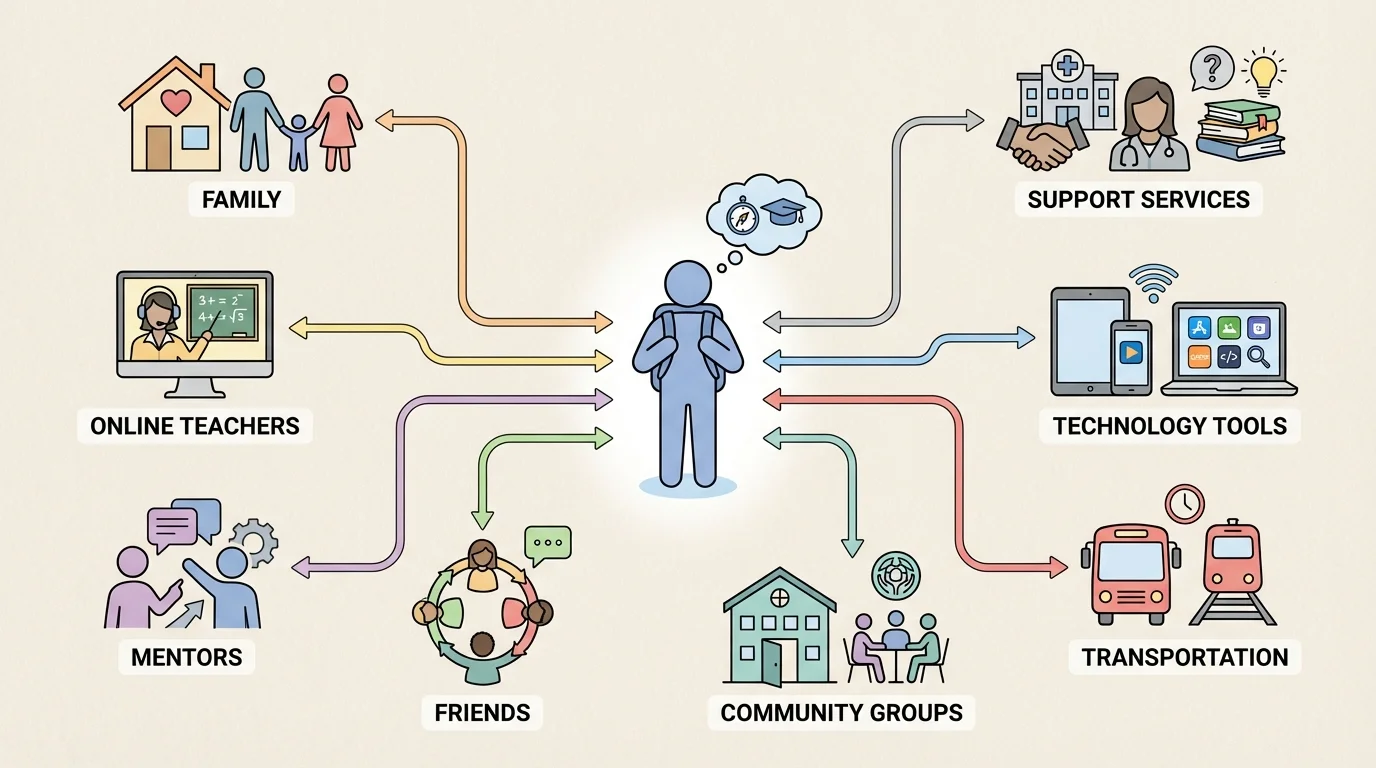
Your future is shaped not only by what you want, but also by the support system around you. Success usually depends on a network, not just one person doing everything alone, and [Figure 3] shows how different kinds of support can connect around a student.
Support can come from family members, guardians, online teachers, school counselors, tutors, coaches, youth leaders, mentors, neighbors, employers, community groups, libraries, and trusted adults in activities outside school. Support can also include tools, such as internet access, quiet study space, calendars, text reminders, speech-to-text software, and transportation to community opportunities.
Some supports are emotional. These are people who encourage you, believe in you, and remind you not to quit after one setback. Some supports are practical. These include help with assignments, rides to volunteer work, advice about programs, or help filling out forms later on. Some supports are academic. These include tutoring, check-ins with teachers, study plans, and accommodations if you have learning needs.
Asking for support is a skill. Many students wait until they are overwhelmed. A better approach is to ask early and clearly. For example, instead of saying, "I'm bad at this," try saying, "I want to improve. Can we set up a weekly check-in?" That gives the other person something specific they can do.
You should also learn which supports are reliable. A friend may cheer you on, but a mentor in the field you care about may give more useful advice. A social media influencer may sound confident, but an actual school counselor or working professional usually gives stronger information.
Example: finding your supports
A student wants to explore computer repair but feels unsure where to begin.
Step 1: Identify one adult helper.
The student messages an online teacher and says, "I'm interested in technology careers. Do you know any beginner resources?"
Step 2: Add one community support.
The student checks the local library website for a beginner technology workshop.
Step 3: Add one tool.
The student creates a weekly calendar reminder for practice time.
Step 4: Review what helps.
After two weeks, the student notices that video tutorials plus teacher check-ins work better than trying to figure everything out alone.
This support network makes the goal more realistic.
Later, when you face a challenge, the network in [Figure 3] can remind you that support is not weakness. It is part of good planning.
A barrier is something that gets in the way of progress. Barriers are real, and pretending they do not exist does not help. But noticing them early gives you a better chance to work around them.
Common barriers include weak time management, low confidence, missing assignments, limited internet access, family responsibilities, lack of transportation, money concerns, not knowing where to find information, or feeling pressure to choose what others want.
Here is the key: a barrier is not the same as an ending. It is a problem to solve. If your internet is unreliable, you may need offline materials, library access, or downloaded resources. If you struggle with focus, you may need shorter work sessions and fewer distractions. If you feel behind in a subject, you may need tutoring or extra practice instead of deciding you are "not good at it."
Planning around barriers also means being realistic. If you want to join an activity across town, transportation matters. If a program costs money later, that matters too. Not every problem can be solved immediately, but many can be broken into smaller actions.
Goals work best when they match real conditions. A strong plan includes both ambition and honesty about what resources you have right now.
Students sometimes compare themselves unfairly with others online. One person may have more support, more money, or more free time. Comparison can make you feel stuck. A better question is: "Given my situation, what is my smartest next step?"
When several options seem possible, a clear decision-making process can keep you from choosing based only on pressure, guessing, or fear. [Figure 4] shows how these steps organize the questions you should ask before making an educational choice.
Step 1: Identify the choice. Are you deciding whether to join an activity, take a harder class, explore a career area, improve a skill, or talk with a counselor about future plans?
Step 2: Check your interests and strengths. Does this option connect to things you enjoy or do well? If not, are you still curious enough to explore it?
Step 3: Check your goals. Does this move help a short-term goal, a long-term goal, or both? If the answer is no, the option may be less useful right now.
Step 4: List your supports. Who can help? What tools or resources do you have? What information do you still need?
Step 5: Notice barriers. What could make this difficult? Time? Cost? Skill level? Confidence? Internet? Family schedule?
Step 6: Choose one next action. Do not try to solve everything at once. One action could be researching a program, emailing a teacher, trying a beginner course, or setting a weekly routine.
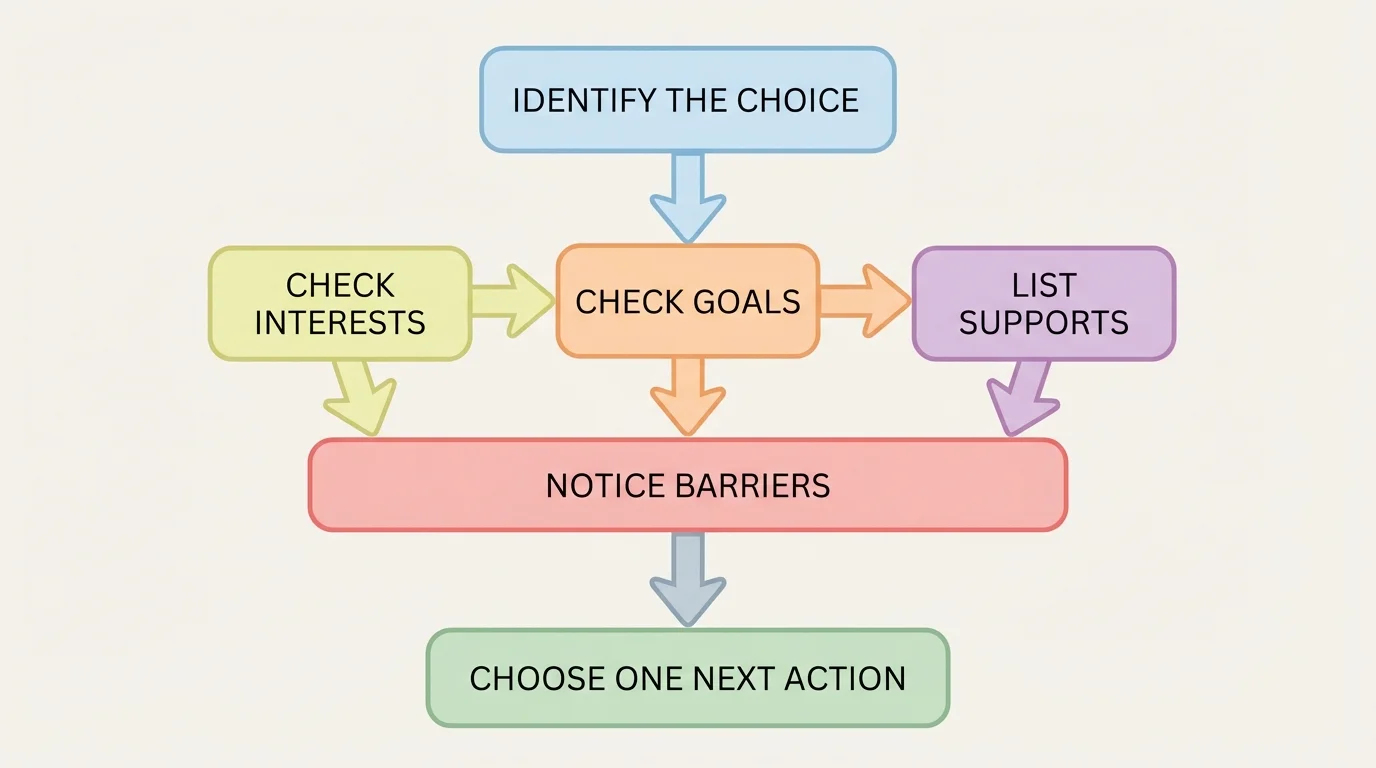
This process works because it turns a huge future question into a series of smaller questions. It helps you think clearly instead of reacting quickly.
If you use [Figure 4] each time you face a new educational decision, patterns become easier to notice. You may realize that your best choices are the ones that match both your interests and your available support.
"You do not have to see the whole path to take the next step."
That idea matters because students often freeze when they feel uncertain. Good decision-making is not about perfect certainty. It is about thoughtful action.
Consider three students with different interests and situations. Each one may need a different path, and that is exactly the point.
Student A loves art, storytelling, and editing short videos. She notices she is creative and patient, and she values self-expression. Her goal is not "be famous online." Instead, she sets a stronger goal: build digital media skills. Her supports include a parent who lets her use editing software, an online teacher who encourages her writing, and a local library workshop. Her next educational choices might include media clubs, digital design courses, and researching communication or design programs later.
Student B likes taking things apart and learning how machines work. He is not always excited about long reading assignments, but he is very persistent with hands-on tasks. He values practical work and wants a future where he can fix real problems. His supports include an uncle in construction and a community center workshop. Educational choices that fit him might include technical courses, trade exploration, math improvement, and learning about apprenticeships.
Student C enjoys science and helping people, but she feels nervous about difficult classes. She has strong empathy and good study habits. Her support system includes a guardian, a tutor, and an online counselor. She may choose to strengthen math and science now while learning more about health careers. Her path could eventually lead to college, community college, or certificate training depending on which healthcare role fits best.
None of these students need to know every future detail right away. What they need is self-knowledge, realistic goals, and the willingness to use support.
Different fit does not mean different worth. One student may aim for a university, another for technical training, and another for a certificate program. These are not "better" or "worse" in a simple way. They are different routes that fit different goals, strengths, and life situations.
If you compare these examples carefully, you can see the same pattern in each one: interests point to possibilities, goals provide direction, and supports make action more likely.
You do not need a perfect life plan today. You need a useful next-step plan. Start by writing down three interests, three strengths, and three values. Next, write one short-term goal and one long-term goal. After that, list the supports you already have and the supports you still need.
Your plan might look like this: "I enjoy technology, problem-solving, and helping people. I am patient, organized, and good at explaining steps. I value independence and usefulness. My short-term goal is to improve my digital skills this semester. My long-term goal is to explore careers in technology support or engineering. My supports are my online math teacher, my cousin who works in IT, and the public library. I still need better time management and more information about training options."
Once you have that information, choose one action for this week. Keep it small and real. You could message a teacher, research one career, create a homework schedule, sign up for a free workshop, or ask an adult about their education path.
Try This: Set a timer for 15 minutes and make a simple four-column list labeled interests, strengths, values, and supports. Do not worry about being perfect. Just start. The goal is to notice patterns.
Try This: Ask one trusted adult, "What educational choices helped you get where you are now?" Their answer may show you that there are many ways to build a future.
Try This: Pick one barrier that affects you right now and write two possible solutions. If one does not work, try the other. Planning improves when you treat problems as things to work through instead of signs to stop.
When you assess your interests, goals, and supports, you are building a map for your future. The map may change, but it gives you direction. And direction is powerful.
