Some students think success is mostly about being smart or talented. But in real life, many people succeed because they know what to do when things get hard. They ask for help before a problem gets bigger. They make a plan before time runs out. They speak up when they need support. These are called transition skills, and they matter because your life keeps changing. As you grow, you will face new expectations in online learning, activities, friendships, family responsibilities, and future plans after high school.
A transition is a change from one stage, role, or situation to another. Right now, you are already practicing transitions: moving from needing lots of reminders to managing your own schedule, from depending on adults for every answer to solving some problems yourself, and from waiting for others to notice your needs to explaining those needs clearly. That is where help-seeking, planning, and self-advocacy come in.
Help-seeking means asking the right person for support when you need it, after making a reasonable effort on your own.
Planning means thinking ahead, organizing steps, and using time and resources wisely.
Self-advocacy means understanding your needs and speaking up respectfully to get the support, information, or space you need.
These three skills work together. If you do not plan, you may wait until the last minute and feel overwhelmed. If you do not ask for help, a small problem can turn into a big one. If you do not advocate for yourself, other people may not realize what support would help you do your best. None of this means being perfect. It means being active in your own life.
Transition skills are important because life becomes more independent over time. In online school, no teacher is standing next to you watching every step. You may need to check messages, keep track of deadlines, join live sessions on time, and complete work while also managing home responsibilities. Later, in college or a training program, people will expect you to read directions carefully, ask thoughtful questions, and handle your schedule with much less supervision.
These skills also reduce stress. When you know how to respond to a problem, you waste less energy panicking. For example, if your internet goes out before a class meeting, a student with transition skills does not just freeze. They quickly think: Who should I contact? What proof do I have? What is my backup plan? That kind of response saves time and protects your reputation for being responsible.
Independence does not mean doing everything alone. Real independence means knowing when to work on your own, when to use tools and supports, and how to communicate clearly. People who seem very independent often have strong systems: calendars, reminders, checklists, and trusted adults or mentors they contact when needed.
Another reason these skills matter is that they affect how others see you. If you miss deadlines without communicating, adults may think you do not care. If you send a clear message early, explain the situation honestly, and ask what to do next, adults are more likely to trust you. Trust opens doors in school, jobs, volunteer work, and leadership roles.
Help-seeking is not the same as giving up. It means you first try reasonable steps, then ask for support in a way that helps the other person actually help you. Planning is not just writing tasks down. It means making a realistic path from where you are now to where you want to be. Self-advocacy is not being rude or demanding. It means speaking clearly and respectfully about your needs, limits, goals, or questions.
Think of these skills like a team. Planning helps you avoid problems. Help-seeking helps you respond to problems. Self-advocacy helps you explain what you need so you can keep moving forward. When students practice all three, they usually feel more confident because they know they have options.
Many adults still work on these same skills. College students, employees, athletes, and business owners all need to ask questions, make plans, and speak up for themselves. These are not "kid skills" you outgrow. They are life skills you keep improving.
A good way to remember this is: Pause, plan, communicate. When something goes wrong, pause instead of reacting emotionally. Make a simple plan. Then communicate with the people who need to know.
Good help-seeking follows a process. The goal is not to prove you can do everything alone. The goal is to keep moving forward.
[Figure 1] Start by naming the problem clearly. "I do not get it" is too vague. A better description is: "I do not understand how to upload my assignment," or "I read the directions twice, but I am confused about which article to use." When you can name the problem, you are already closer to solving it.
Next, try one or two independent steps. You might reread directions, check the course page, look at an example, review your notes, or test a basic solution. This matters because it shows effort and often solves the problem quickly. But do not stay stuck for too long. If you keep going in circles, it is time to ask for help.
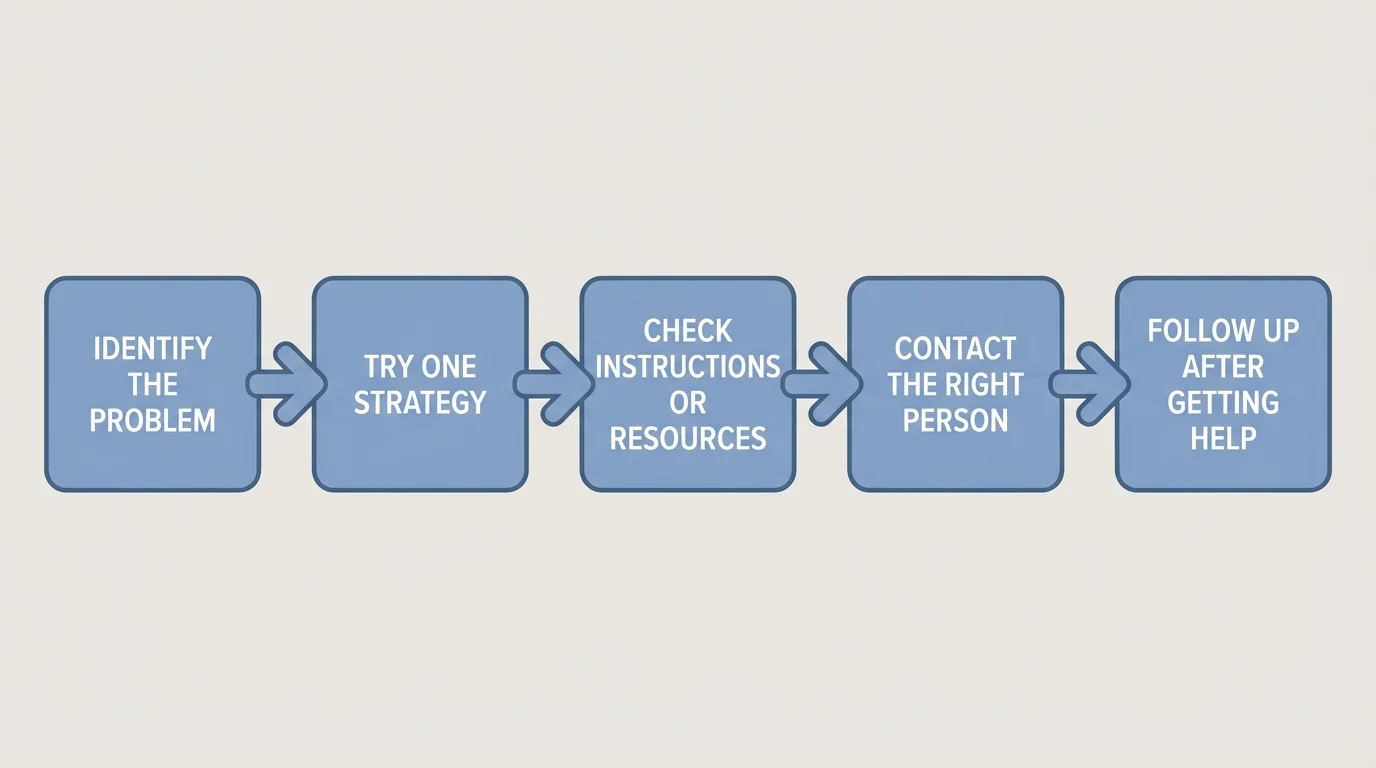
Who you ask matters. If the issue is about assignment instructions, contact the teacher. If it is a technology issue, contact tech support or the adult who helps with your online learning setup. If you are overwhelmed and do not know where to start, a parent, guardian, counselor, or trusted mentor may help you make a first step plan.
The way you ask also matters. A strong message includes four parts: what the problem is, what you already tried, what specific help you need, and when the deadline or urgent time matters. For example: "Hi, I am having trouble opening the quiz link. I refreshed the page and signed out and back in, but it still will not load. Could you tell me what to do next? The quiz is due tonight." That message is much easier to answer than "It doesn't work."
Example: weak message vs. strong message
Step 1: Weak message
"I'm confused. Help."
Step 2: Why it is weak
The reader does not know what class, what assignment, what part is confusing, or what you already tried.
Step 3: Strong message
"Hello, I am working on the science discussion post, and I'm confused about whether we need one source or two. I checked the directions, but I still am not sure. Could you clarify this before tonight?"
The strong message is polite, specific, and easier to answer.
After you get help, follow through. Read the reply carefully. Complete the next step. If the answer is still unclear, ask one more specific question. This follow-up matters because support only helps if you use it. The same process in [Figure 1] works outside school too, such as asking a coach, club leader, librarian, or family member for guidance.
One mistake students make is waiting until the last minute because they feel embarrassed. But needing help is normal. The bigger issue is staying silent so long that the problem becomes urgent. Asking early usually leads to better results.
A good plan turns a big job into a series of smaller actions. Planning is really decision-making ahead of time: what needs to happen, when it needs to happen, and what tools or people can help.
[Figure 2] Start by identifying the final goal. Maybe you need to submit a project, attend a virtual meeting, prepare for a community event, or finish chores before a family appointment. Then work backward. Ask: What has to happen first? What can I do today? What can wait until tomorrow? This keeps your brain from treating everything like one giant problem.
Breaking a task into smaller steps is one of the most useful planning habits. A research project is not just "do project." It might be: choose topic, find two sources, take notes, make outline, write first draft, revise, and submit. Each small step feels more doable, and it is easier to notice progress.
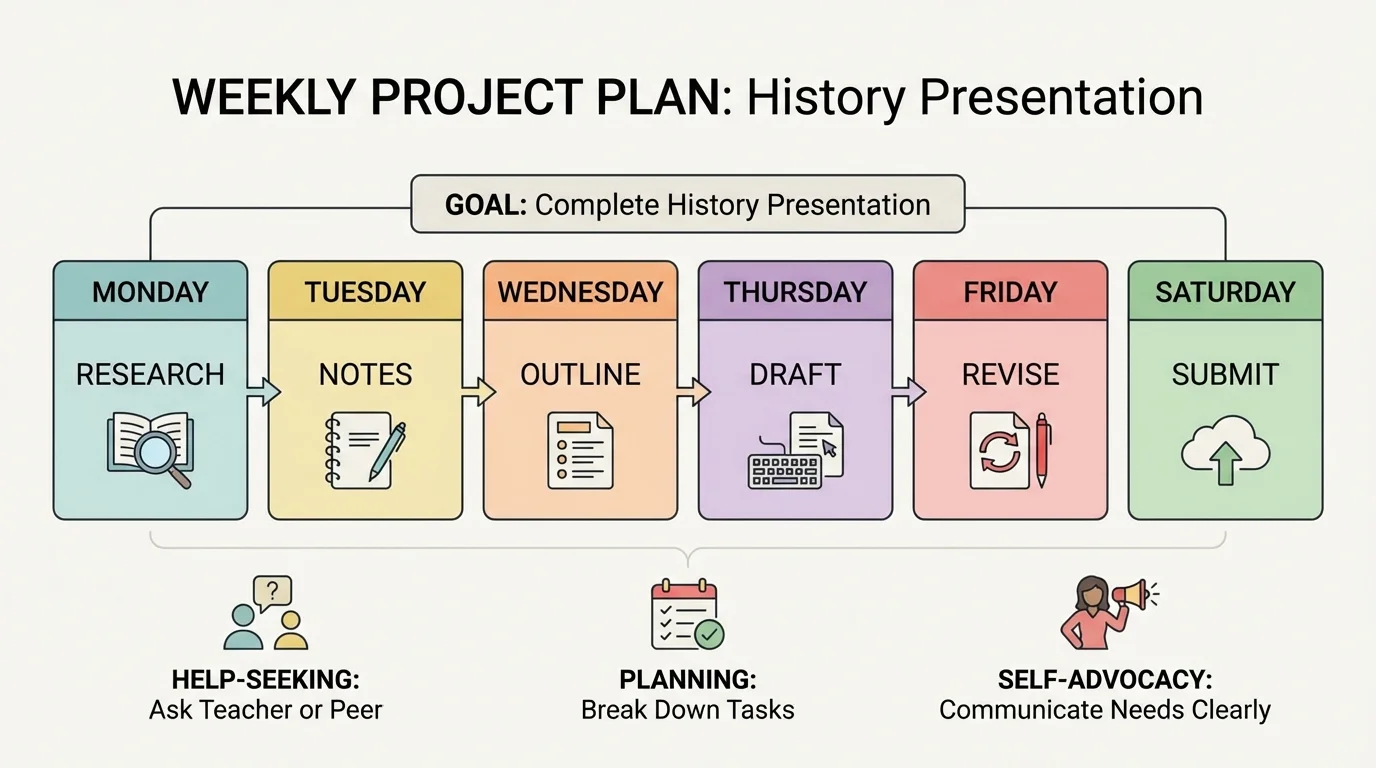
You also need realistic time estimates. Many people underestimate how long tasks take, especially when technology problems, distractions, or tiredness show up. If you think something will take about twenty minutes, it may help to give yourself thirty. That extra space is called a buffer. A buffer protects your plan when life is not perfectly smooth.
Planning tools can be simple. You might use a paper planner, sticky notes, a wall calendar, phone reminders, or a digital checklist. The best tool is the one you will actually use. Some students like a daily to-do list. Others prefer a weekly calendar. Some need both: calendar for deadlines, checklist for daily tasks.
You may already know that a goal is easier to reach when it is broken into smaller steps. Planning takes that idea and adds time, order, and backup options.
Here is a practical planning routine: each evening, check what is due soon. Pick your top three priorities for the next day. Estimate how long each one will take. Decide when you will do them. Gather what you need before you begin. That might mean charging your device, finding login information, or setting out materials in advance.
Plans also need adjustment. If a sibling needs help, a family errand comes up, or your internet is slow, your original schedule may need to change. That does not mean the whole plan failed. It means you revise. Flexible planning is stronger than perfect planning because real life changes fast.
| Planning problem | What it looks like | Better move |
|---|---|---|
| Vague task | "Work on assignment" | Write the exact next step |
| No time estimate | Starting late with no schedule | Choose a start time and a buffer |
| Too many priorities | Everything feels urgent | Pick the top three tasks first |
| No backup plan | One problem stops everything | Decide what to do if something changes |
Table 1. Common planning problems and practical ways to fix them.
Later, when you have larger responsibilities, this same skill becomes even more important. College students plan readings, assignments, and study time. Employees plan shifts, deadlines, transportation, and meetings. Learning to plan now gives you a huge advantage.
Self-advocacy begins with self-knowledge. You need to notice what helps you do well and what makes things harder. Maybe you focus better in a quiet space. Maybe you need instructions repeated in writing. Maybe you need extra time to organize your thoughts before replying. Maybe you need to explain that a family responsibility affected your schedule. If you do not understand your own needs, it is much harder to explain them to someone else.
The words you choose matter. Strong self-advocacy is calm, specific, and honest. It does not blame people. It does not expect others to read your mind. It focuses on what is true and what would help.
[Figure 3] One useful sentence frame is: "I am having difficulty with ___, and it would help me if ___." Another is: "I understand the expectation. I need clarification about ___." These sentence starters help you sound confident without sounding disrespectful.
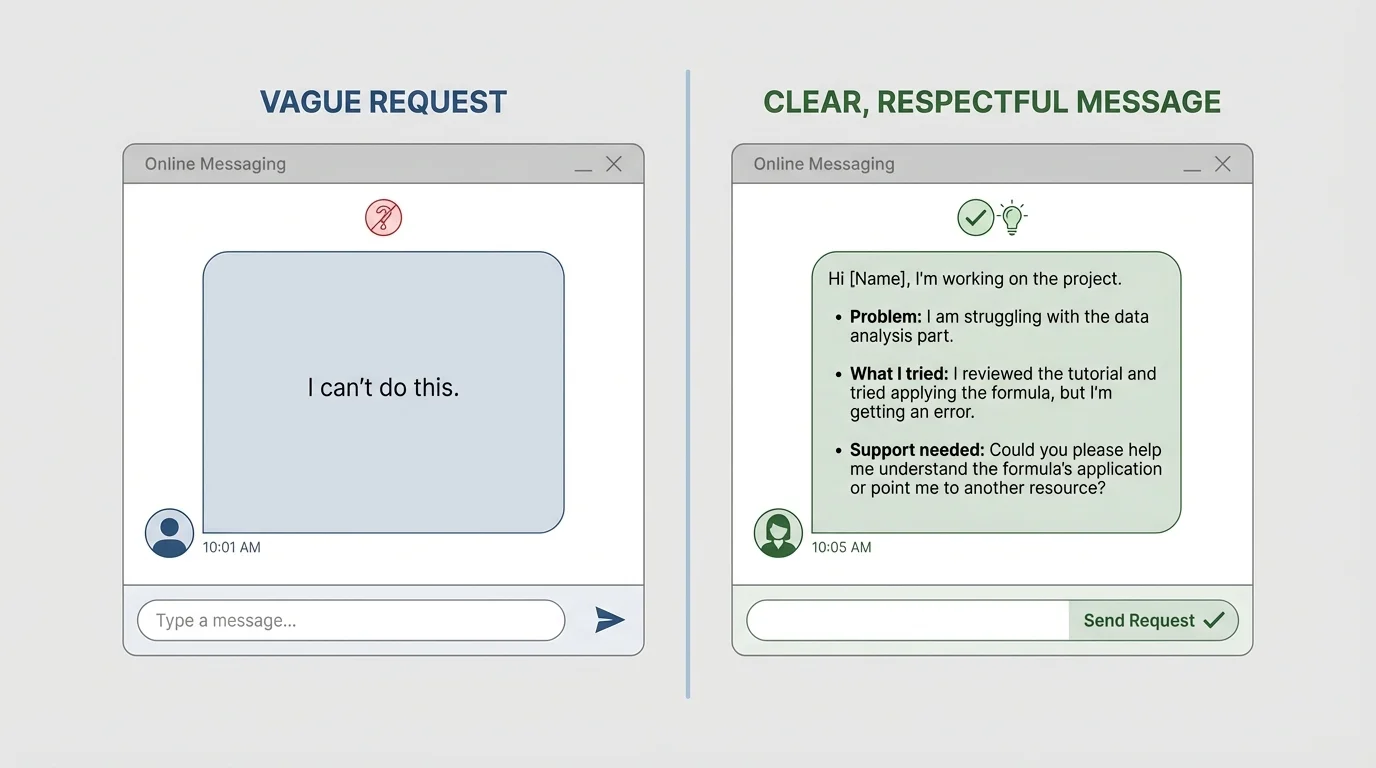
Self-advocacy can include asking for clarification, requesting support, explaining a challenge, setting a boundary, or sharing a goal. For example, if a live session overlaps with a medical appointment, self-advocacy means messaging early, explaining the conflict, and asking how to make up the missed work. If group communication in an activity chat becomes rude, self-advocacy might mean saying, "I want to stay involved, but I need the conversation to stay respectful."
Self-advocacy is respectful, not selfish. Speaking up for your needs does not mean your needs are more important than everyone else's. It means you are taking responsibility for communicating honestly so that problems can be solved fairly.
Sometimes students stay quiet because they worry they will sound demanding. But silence can create bigger problems. If you do not say that you are confused, people may assume you understand. If you do not explain a challenge, others may assume you are not trying. Self-advocacy helps people respond to the real situation instead of guessing.
There is also a difference between an excuse and an explanation. An excuse tries to avoid responsibility. An explanation gives truthful information and looks for the next step. For example, "I forgot, so I guess I can't do anything now" is an excuse. "I mismanaged my time. I have completed half the work and would like to know the best next step" is more responsible.
"Speak up for yourself in a way that helps people help you."
As you get older, self-advocacy becomes essential in college, jobs, health care, and everyday adult life. People may not automatically know what you need. Being able to explain your situation clearly is a strength.
These skills are strongest when you use them together. Suppose you have a history project due in four days, and you also have family responsibilities this week. First, you plan: break the project into smaller tasks and assign them to each day. Next, you self-advocate: let a parent or guardian know when you need focused work time. Then, if you get stuck on one requirement, you use help-seeking by sending a clear question to your teacher before the deadline gets too close.
Here is another example. You join an online club meeting and are asked to present next week. You feel nervous and unsure. Planning means deciding when to prepare and practice. Help-seeking means asking the leader what the presentation should include. Self-advocacy means saying, "I can do the presentation, but I would like to know the time limit and whether slides are required." That one message can reduce confusion right away.
Scenario: A missing assignment problem
Step 1: Notice the issue
You see that an assignment is marked missing, but you thought you turned it in.
Step 2: Use planning
Check the submission page, screenshot any proof, and review the due date and instructions.
Step 3: Use help-seeking
Send a message that explains what happened and what you found.
Step 4: Use self-advocacy
Politely ask what action you should take next and mention any important timing.
This approach is calmer and more effective than sending an angry message or doing nothing.
Notice how the decision path from [Figure 1], the task breakdown in [Figure 2], and the message comparison in [Figure 3] connect. One helps you decide when to ask, one helps you organize what to do, and one helps you communicate clearly.
These same skills also help in non-school situations. If you want to join a sports team, music group, volunteer project, or part-time opportunity later on, you may need to track dates, ask questions, and explain your availability. Transition skills are useful wherever responsibility grows.
You do not need to wait until high school or college to practice these skills. Every week gives you chances. You can plan your work before free time. You can ask for help after trying two strategies. You can speak up respectfully when directions are unclear or when you need support. Small repetitions build strong habits.
Deadline management is one part of this. A deadline is the time when something must be finished. Missing a deadline once is a problem to solve; missing deadlines often can affect grades, trust, and opportunities. Planning ahead protects you from avoidable stress. Help-seeking early protects you when problems come up. Self-advocacy helps others understand your real situation.
Accommodation is another word you may hear as you get older. An accommodation is a support or adjustment that helps someone access learning or work fairly. If you ever need one, self-advocacy helps you explain that need clearly and respectfully. That does not mean demanding special treatment. It means asking for the support that helps you participate successfully.
Many colleges and workplaces expect students and employees to start the communication themselves. That is why practicing now matters so much. The person who can write a clear message, make a realistic plan, and explain a need respectfully often stands out in a positive way.
Try this: before tomorrow begins, list your top three tasks, the first step for each, and one person you could contact if you get stuck. Then, if a problem comes up, use one clear message instead of waiting silently. Small actions like that build transition skills faster than just reading about them.
You are not trying to become someone who never needs support. You are becoming someone who knows how to move through change with responsibility. That is a powerful skill set for online learning now and for your future in college, training, work, and adult life.
