Lots of people say they want something: better grades, stronger soccer skills, a cleaner room, more money saved, or less stress. But wanting a goal and reaching a goal are not the same thing. The difference usually is not talent or luck. It is often what you do on ordinary days when no one is watching. A goal is shaped by your choices, your routines, and how you spend the hours you have.
That matters even more in online school and at home, where you often manage your own schedule. No bell reminds you to begin. No teacher is standing nearby. If your devices, hobbies, chores, and schoolwork all happen in the same place, staying on track takes real skill. The good news is that goal achievement is not magic. It can be understood, checked, and improved.
A goal becomes real when it moves from a thought to a plan. Saying, "I want to get better at drawing," is a start. Saying, "I will practice drawing faces for twenty minutes four times this week," is stronger. A clear goal gives you a direction. But direction alone is not enough. You also need energy to begin, routines to repeat, and smart use of time.
Think of goal achievement like building a bridge. Motivation helps you step onto the bridge. Habits help you keep walking. Time use decides whether you actually have space in your day to cross it. If one part is weak, your progress slows down. If all three work together, goals become much more likely.
Goal is something you want to achieve in the future.
Motivation is the reason or drive that pushes you to act.
Habit is a behavior you repeat so often that it starts to feel automatic.
Time use means how you spend the hours and minutes in your day.
When you assess goal achievement, you are looking honestly at what helps and what gets in the way. This is not about blaming yourself. It is about noticing patterns. If you know why something is not working, you can change it.
Goal achievement does not always mean finishing perfectly or quickly. Sometimes it means making steady progress. For example, if your goal is to save $40 for a game or a gift, success may come from saving $5 each week until you reach it. If your goal is to improve in math, success might mean doing your practice work on time for three weeks and asking for help when you get stuck.
Good goals are usually clear, realistic, and measurable. "Be healthier" is hard to track. "Walk for twenty minutes after lunch on Monday, Wednesday, and Friday" is easier to follow. When a goal is measurable, you can tell whether your effort is working.
Your brain likes repeated patterns. The more often you do a useful action in the same way, the less energy it can take to begin it.
That is why daily choices matter so much. A huge dream with no daily action usually stays a dream. A modest goal with steady action often gets finished.
Intrinsic motivation comes from inside you. You do something because it feels meaningful, fun, interesting, or important. You might practice guitar because you love music. Extrinsic motivation comes from outside you. You do something for a reward, praise, money, a good grade, or to avoid a negative result. You might finish chores to earn screen time.
Both kinds of motivation can help. Intrinsic motivation is often stronger over time because it connects to who you are and what you care about. Extrinsic motivation can still be useful, especially for tasks that are not exciting. For example, you may not feel thrilled about cleaning your study area, but you might do it because you know it helps you work faster later.
One important truth is that motivation changes. Some days you feel ready. Other days you do not. If you depend only on feeling motivated, your progress can become uneven. That is why successful people do not just wait for motivation. They build systems that help them act even when their energy is low.
Motivation is a starter, not the whole engine. Motivation can spark action, but it is not always steady. A strong goal plan includes ways to begin even on low-energy days, such as a short timer, a checklist, or a prepared workspace.
You can increase motivation by connecting a goal to a reason that matters to you. Instead of saying, "I have to finish this online lesson," you might say, "Finishing this lesson tonight gives me a more relaxed Friday." Instead of, "I should exercise," you might say, "Exercising gives me more energy and confidence." The closer a goal feels to your real life, the easier it is to care.
Another useful strategy is to make the starting point small. A goal can feel too big when you look at the whole thing at once. Reading one page feels easier than reading a whole chapter. Doing five minutes of practice feels easier than doing an hour. Starting small lowers resistance, and once you start, continuing often feels easier.
[Figure 1] A cue is something that triggers a behavior, and many habits follow a loop of cue, routine, and reward. For example, hearing a phone notification can be the cue, opening the app is the routine, and seeing a funny post or message is the reward. This loop can build habits that help you or habits that distract you.
Helpful habits make goals easier because they reduce decision-making. If you always review your task list right after breakfast, you do not have to argue with yourself each morning about when to begin. If you place your notebook and charger in the same spot every night, you waste less time the next day. Habits save mental energy.
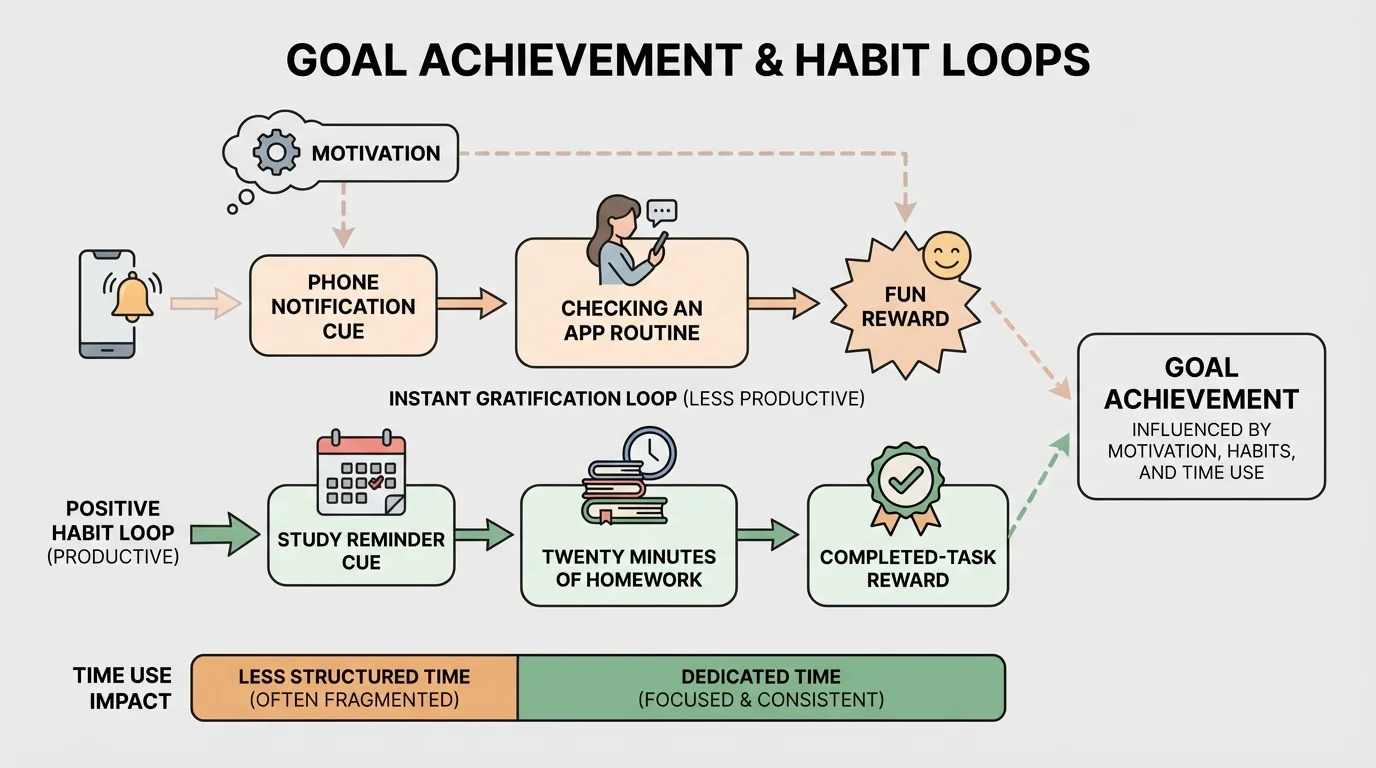
Bad habits can quietly damage a goal. You may not notice the problem because each action seems small. Ten extra minutes of scrolling here, skipping one practice session there, staying up too late one night—none of these looks huge alone. But repeated patterns add up. A habit repeated often becomes a direction.
The good news is that habits can be changed. Usually, it is easier to replace a habit than to simply erase it. If checking your phone is your automatic move when work feels boring, try replacing that action with a two-minute stretch, a sip of water, or a quick walk to reset. If you always forget an assignment, connect it to an existing routine: after logging in, open your planner first.
Strong habits often share three features: they are specific, small, and repeatable. "Be more organized" is vague. "Put tomorrow's materials in one folder every evening at 8:00" is specific. Small habits are easier to keep, and repeatable habits grow stronger over time.
Case study: building a study habit
Jordan wants to stop turning in late work.
Step 1: Pick one clear action.
Jordan chooses: "At 4:00 each weekday, I check the online platform and write down my tasks."
Step 2: Add a cue.
Jordan sets a daily alarm and places headphones and notebook on the desk before lunch.
Step 3: Make the action small.
The first goal is only ten minutes of focused work, not a perfect afternoon.
Step 4: Add a reward.
After the ten minutes, Jordan marks the task complete on a tracker and takes a short break.
This works better than waiting to "feel like it" because the habit has a clear start and repeats daily.
Later, when Jordan increases the study time, the habit stays useful because the beginning is already automatic. That is one reason habits matter so much for long-term goals.
[Figure 2] Prioritizing means deciding what matters most first, and a daily schedule can make hidden patterns visible. Many people think they "do not have time," but sometimes the bigger problem is that time slips away in small pieces. A few extra minutes on videos, a long break that keeps going, or starting tasks late can break a plan apart.
Good time use does not mean filling every minute with work. It means using time on purpose. Rest, hobbies, chores, family time, and exercise all matter. But if your main goal never gets a protected time slot, it often gets pushed aside by easier or more fun activities.
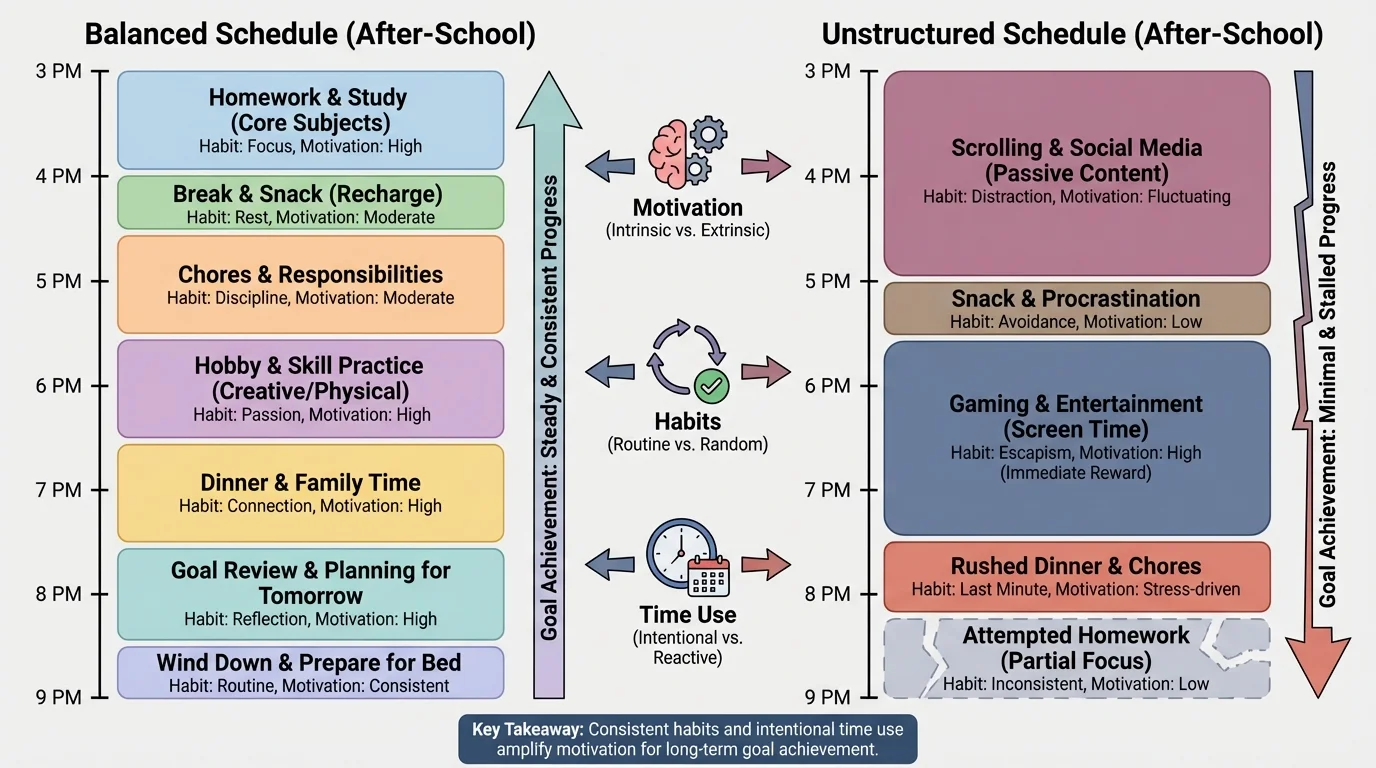
A practical way to assess time use is to track one normal day. Write down what you do in blocks of time. You may notice patterns you did not expect. Maybe homework takes longer because you switch tabs often. Maybe your best focus happens earlier in the day. Maybe you lose time looking for supplies or deciding what to do first.
Once you know your patterns, you can plan better. Start with your top priorities. If your goal is to improve in a subject, schedule that work when your mind is freshest. If your goal is to practice a sport or instrument, choose a time that realistically fits your home life. If your goal is to help more in your family or community, set a regular time for that too.
It also helps to estimate time honestly. Students often assume a task will take ten minutes when it really takes thirty. Leaving a small extra buffer can protect your plan. For example, if an assignment usually takes about twenty-five minutes, you might schedule thirty-five. That extra space lowers stress.
| Time-use problem | What it looks like | Better choice |
|---|---|---|
| Starting late | You keep saying "in five minutes" | Use a timer and start with one small step |
| Too many distractions | Tabs, messages, games, videos interrupt work | Close extra tabs and place your phone away for a set time |
| No clear priority | You do easy tasks and avoid important ones | Pick the most important task first |
| Overplanning | You make a huge schedule you cannot keep | Plan fewer tasks and leave buffer time |
Table 1. Common time-use problems and practical ways to respond.
As the schedule comparison in [Figure 2] makes clear, two people can have similar amounts of free time but very different results depending on how intentionally they use it.
[Figure 3] These three factors act like one system. Motivation helps you care. Habits help you repeat useful actions. Time use gives those actions a place in your day. When all three line up, reaching a goal becomes much more likely.
Suppose your goal is to get stronger at coding. Motivation might come from wanting to create your own game. A habit might be doing twenty minutes of coding practice after dinner. Time use might mean putting that practice on your calendar and keeping that slot free from gaming until the practice is finished.
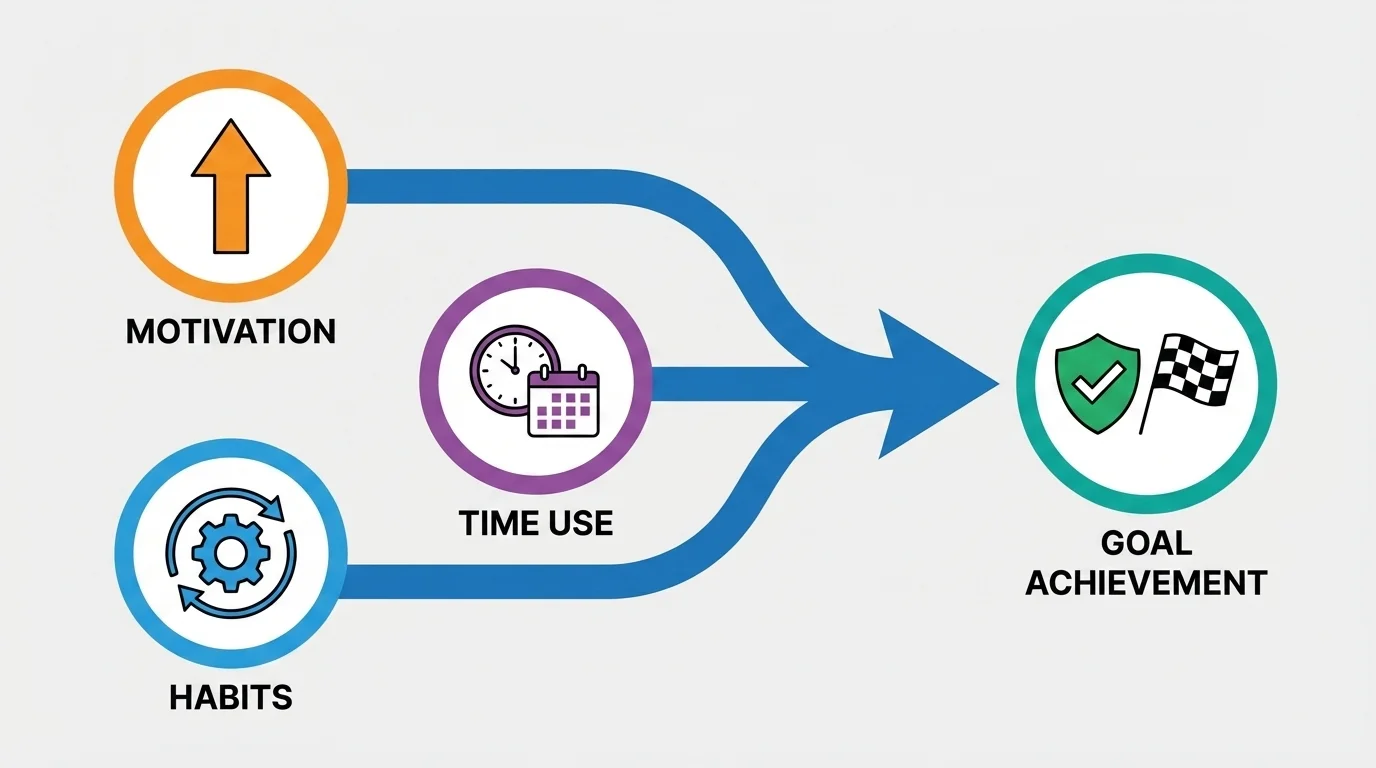
If one part is weak, the system struggles. You may have strong motivation but poor time use, so your practice keeps getting squeezed out. You may use time well but have weak habits, so you skip work whenever the task feels hard. You may have good habits and decent time use but no real reason for the goal, so you lose interest and stop caring.
This is why assessing goals requires honesty. Instead of saying, "I failed because I am lazy," try asking better questions. Was the goal clear? Was the habit too big? Did distractions take over? Was I relying only on motivation? Better questions lead to better solutions.
Weak links matter. Goal achievement often fails at the weakest point in the system. Improving one weak link—such as creating a regular study cue or protecting thirty minutes from distractions—can create a big change.
The relationship shown in [Figure 3] also explains why small improvements matter. You do not need a perfect life plan. You often need one stronger reason, one better routine, and one smarter use of time.
To assess your progress, check both your results and your process. Results are what happened. Process is how you worked. For example, maybe you did not finish your reading goal this week. The result is clear. But the process question is more useful: did you schedule reading time, or just hope it would fit in?
Ask yourself practical questions: What exactly is my goal? Why does it matter to me? What habit supports it? When will I work on it? What usually interrupts me? What is one change I can make this week? These questions turn a fuzzy problem into something you can act on.
When you are evaluating progress, focus on patterns instead of one rough day. A single bad day does not decide your future. Repeated choices create the bigger picture.
It also helps to watch for signs that a goal plan needs adjustment. Warning signs include forgetting the goal often, avoiding the task, running out of time again and again, or making the plan so big that you stop trying. A plan that looks impressive but never gets used is not a strong plan.
Sometimes the best fix is to shrink the goal for now. If your current plan is to read for an hour every night and you have not done it once, changing the goal to fifteen minutes may be smarter. Smaller does not mean weak. Smaller can mean realistic.
Here are a few common situations. A student wants better quiz scores in online science. Motivation is strong because they care about earning more trust from their family. But they study only the night before quizzes. The problem is not desire. The problem is habit and time use. A better plan would be fifteen minutes of review four times a week.
Another student wants to save money for headphones. They are motivated, but every time they get cash from helping neighbors or relatives, they spend it quickly on snacks and digital purchases. Their habit is spending right away. Their time-use issue is not about hours but about planning moments. A better strategy is to put half of any money received into a labeled envelope or savings app immediately.
A third student wants to get faster at basketball. They feel very motivated after watching highlights online, but that excitement fades after two days. They need a habit, such as dribbling drills for fifteen minutes every afternoon, and a time plan that fits around family responsibilities. In this case, motivation starts the plan, but habit and scheduling keep it alive.
Case study: improving a personal goal
Mia wants to finish assignments earlier so weekends feel less stressful.
Step 1: Identify the real problem.
Mia notices that she is motivated on Monday, but by Wednesday she is behind because she checks messages every few minutes.
Step 2: Choose one habit change.
She decides to place her phone in another room during two work sessions each afternoon.
Step 3: Protect time.
She blocks two sessions of twenty minutes each on her planner, with a ten-minute break between them.
Step 4: Review progress.
At the end of the week, she checks whether more work was finished before Friday.
Mia does not need more willpower alone. She needs a better system.
These examples show that goals in school, money, health, home responsibilities, and hobbies all depend on the same basic pattern: reason, routine, and realistic time.
Step 1: Pick one goal, not five. Too many goals split your attention. Start with the one that matters most right now.
Step 2: Make it specific. Replace "do better in school" with "finish assignments by 6:00 on weekdays." Replace "get fit" with "walk for twenty minutes three times a week."
Step 3: Write your reason. Your reason might be less stress, more confidence, saving money, helping others, or preparing for the future. A strong reason helps when the task feels boring.
Step 4: Build one small habit. Choose an action you can repeat. Good examples include checking your planner after breakfast, practicing a skill for ten minutes after lunch, or preparing tomorrow's materials each evening.
Step 5: Give the habit a time and a cue. Do not just say "later." Say when it happens and what starts it.
Step 6: Protect the time. Reduce distractions during that period. Silence notifications, close extra tabs, or ask family members not to interrupt unless necessary.
Step 7: Review after a week. Ask what worked, what did not, and what should change. A plan should be adjusted, not abandoned, when needed.
"You do not rise to the level of your goals. You fall to the level of your systems."
— James Clear
This idea is powerful because it reminds you that a goal is important, but your daily system often decides the outcome.
One common mistake is making goals too big too fast. A student decides to wake up early, work out every day, practice an instrument, keep a perfect room, and finish all assignments ahead of time. That plan may sound impressive, but it often collapses because it demands too much change at once. Fix it by choosing one or two priorities first.
Another mistake is depending only on motivation. At the beginning of a goal, you may feel excited. But excitement is temporary. If your goal has no routine attached to it, progress can disappear as soon as life gets busy. The fix is to create a habit that does not rely on mood.
A third mistake is ignoring time drains. Some distractions are obvious, like gaming or social media. Others are less obvious, like spending too long deciding where to start or leaving materials scattered around. The fix is to notice the hidden delays and remove them.
A final mistake is being too hard on yourself after one setback. If you miss one day, that is a problem to solve, not proof that you cannot succeed. Strong goal achievers restart quickly. They do not turn one missed step into a full stop.
When you look honestly at motivation, habits, and time use, you become more in control of your future. You stop guessing. You start noticing. And once you notice what is really happening, you can make better choices on purpose.
