Have you ever had a day where you needed to finish schoolwork, help at home, text a friend back, maybe attend a practice or club meeting online, and still somehow get enough sleep? That crowded feeling is normal. The hard part is not having goals. The hard part is balancing them. When you learn how to balance your academic, personal, and social goals, you become more reliable, less stressed, and more ready for the future.
Balance does not mean every part of your life gets the exact same amount of time every day. It means your choices match what matters most. If school takes all your energy, you may feel lonely, tired, or frustrated. If social time takes over, assignments can pile up. If you ignore personal goals like sleep, exercise, or organizing your space, everything else gets harder. A strong strategy helps you take care of all three areas without feeling pulled apart.
This matters now, not just when you are older. Middle school is a time when responsibilities grow. You may have more independent online assignments, more say in how you spend free time, and more chances to join communities outside school. Learning to manage these choices helps you build priorities, self-control, and trust with the people around you.
Academic goals are goals related to learning, assignments, skill-building, and school progress.
Personal goals are goals that help you care for yourself and grow as a person, such as exercising, sleeping well, improving a hobby, or managing emotions.
Social goals are goals connected to relationships and community, such as staying in touch with friends, helping family, or participating in a club, team, or volunteer activity.
When these areas support each other, life feels more stable. For example, getting enough sleep is a personal goal, but it also helps your academic focus and your patience in social situations. Helping with chores is personal responsibility, but it also supports your family community. Good balance is really about seeing how your goals connect.
Your academic goals might include finishing weekly lessons on time, raising a grade in one subject, reading for twenty minutes a day, or asking your teacher a question during office hours. In online school, these goals often require extra independence because no one is standing beside you reminding you what to do every minute.
Your personal goals might include cleaning your room every Saturday, practicing guitar three times a week, walking the dog, limiting late-night scrolling, or drinking more water. These goals shape your daily habits and health.
Your social goals might include checking in with a friend, joining a youth group, participating respectfully in online discussions, calling a grandparent, or being a dependable teammate in an activity outside school. Social goals are not just about fun. They are also about being kind, reliable, and connected to a community.
Your brain handles tasks better when you do not try to treat everything as equally urgent. Choosing what matters most first can lower stress and improve the quality of your work.
One mistake students make is thinking one area should always come first. That usually does not work. Some days school is the top priority because a project is due. Other days a family responsibility or your health needs more attention. A good strategy is flexible, not rigid.
Not all goals deserve the same amount of time at the same moment. A simple way to decide is to sort them by urgency and importance, as shown in [Figure 1]. A quiz tomorrow is both urgent and important. Cleaning your entire photo gallery might feel productive, but it is probably not urgent. When you sort goals this way, you stop treating every task like an emergency.
Ask yourself three questions: What must be done soon? What matters most for my future or well-being? What can wait? Those questions help you focus. If you have five tasks, but only two truly need attention today, your plan becomes much clearer.
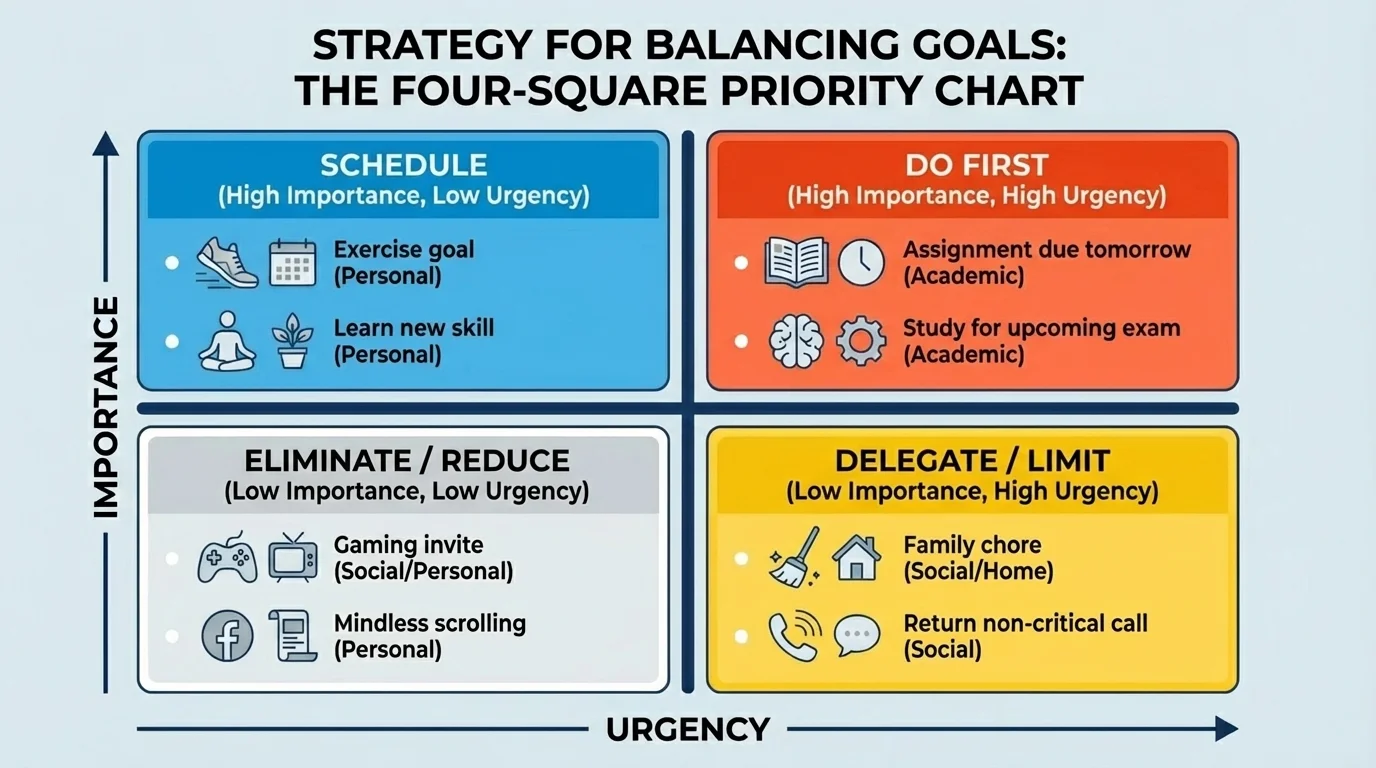
Here is a useful rule: do the most important task before the most tempting task. The tempting task is often the one that feels easier or more fun, like watching videos or chatting online. The important task is the one that protects your grades, health, or relationships.
You can also make a short list with three labels: must do, should do, and could do. That is often easier than writing one giant to-do list. Giant lists can make you feel defeated before you even start.
Quick priority sort
A student has these tasks for today: finish a science assignment due at midnight, message a friend back, clean part of the bedroom, practice basketball for thirty minutes, and start a project due next week.
Step 1: Mark the urgent and important task.
The science assignment due today goes first.
Step 2: Choose one personal responsibility.
Cleaning part of the bedroom or practicing basketball can come next, depending on what has been postponed lately.
Step 3: Fit in a short social action.
Messaging a friend back may take only a few minutes and can be scheduled after the top task is done.
Step 4: Move the less urgent task.
The project due next week can be started for a short amount of time later today or planned for tomorrow.
Try This: Before dinner tonight, write down three things you need to do. Label each one as must do, should do, or could do.
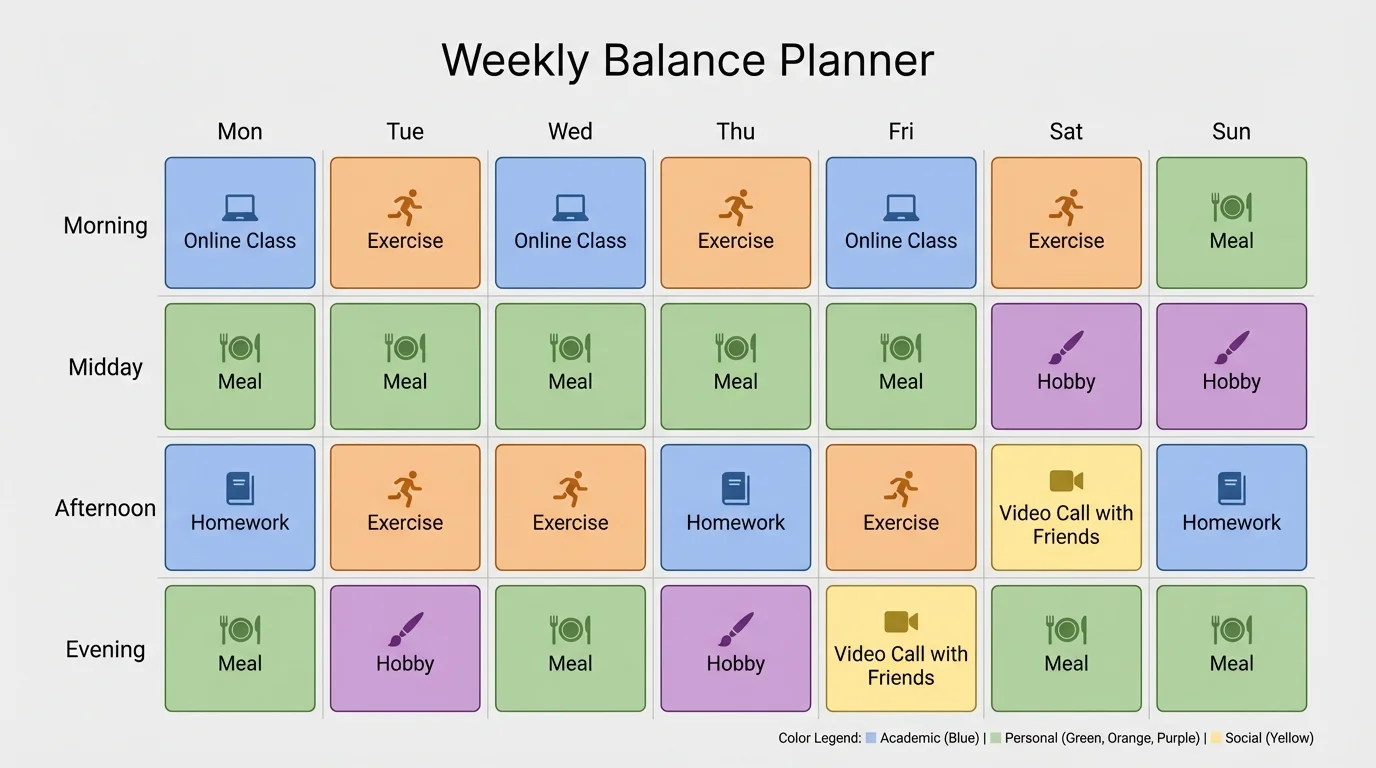
Balancing goals works better when you look at a whole week, not just one day. Time mapping, shown in [Figure 2], helps you see where your hours are already going. Start with the things that are fixed: online class sessions, assignment deadlines, meals, sleep, chores, appointments, and activities. Then add flexible time for homework, hobbies, movement, and social connection.
A realistic plan includes rest. If you schedule every minute, your plan will probably fail. Leave open space for breaks, surprises, and extra time on hard assignments. A plan that is too perfect is often not practical.
Many students do well with time blocks. For example, after a morning online lesson, you might block one hour for schoolwork, twenty minutes for a snack and break, thirty minutes for exercise, and later a short time for texting friends or joining a call. The exact schedule can vary, but the point is to give each goal area a place.
If you want to estimate time, keep it simple. Suppose your homework, reading, and review for one day usually take about \(45 + 30 + 20 = 95\) minutes. That is about \(1\) hour and \(35\) minutes. Seeing the total helps you decide where it fits instead of guessing and getting surprised later.
It also helps to choose a few routine anchors. These are actions you try to do at the same time most days, such as waking up, starting schoolwork, eating lunch, or shutting off devices before bed. Routines save mental energy because you do not have to decide everything from scratch every day.
| Goal Area | Example Goal | Possible Weekly Plan |
|---|---|---|
| Academic | Finish assignments on time | Check due dates every morning and use a \(30\)-minute work block after lessons |
| Personal | Exercise more | Walk, stretch, or practice a sport for \(20\) to \(30\) minutes on four days |
| Social | Stay connected with friends | Schedule one video call and send two check-in messages during the week |
Table 1. Examples of balanced goals and how they can fit into a weekly plan.
Try This: Pick one day this week and map it out by hour or half-hour. Notice whether one area is taking over everything else.
Big goals are easier to manage when you break them into small, clear actions. A strategy is a plan for how you will reach a goal, not just the goal itself. Instead of saying, "I want to do better in school," you can say, "I will turn in all assignments on time for the next two weeks and ask for help if I get stuck." That is clearer and easier to act on.
Good goals are specific. Compare these two goals: "be healthier" and "go to sleep by \(9{:}30\) on school nights." The second one tells you exactly what to do. The same is true socially. "Be a better friend" becomes "reply kindly within a day and check in with one friend this weekend."
Small actions beat big promises. Your brain trusts goals more when they feel doable. A tiny action repeated many times can change your life more than one huge effort followed by quitting. Consistency is stronger than intensity.
When planning, it helps to ask: What is the next action? If your goal is to improve in math, the next action may be opening the assignment list, watching one lesson video, or completing five practice questions. If your goal is to strengthen friendships, the next action may be sending one thoughtful message.
You can track progress with a checklist, planner, or notes app. You do not need anything fancy. What matters is being able to answer: What did I plan? What did I actually do? What needs to change?
Sometimes two important things happen at once. Maybe you have an assignment due, but your cousin is having a birthday dinner. Maybe a friend wants to talk right when you need to study. This is where decision-making matters, and the choice path in [Figure 3] helps. The question is not "Which do I want?" but "Which choice is most responsible right now?"
Start with deadlines. If one task has a close deadline and serious consequences, it usually comes first. Next, ask whether the other activity can be moved. Many social plans can shift by thirty minutes or even to another day. Some cannot, like a family event or team commitment. Then ask how long the important task really takes. Sometimes you only need \(20\) focused minutes to finish something that has been stressing you out.
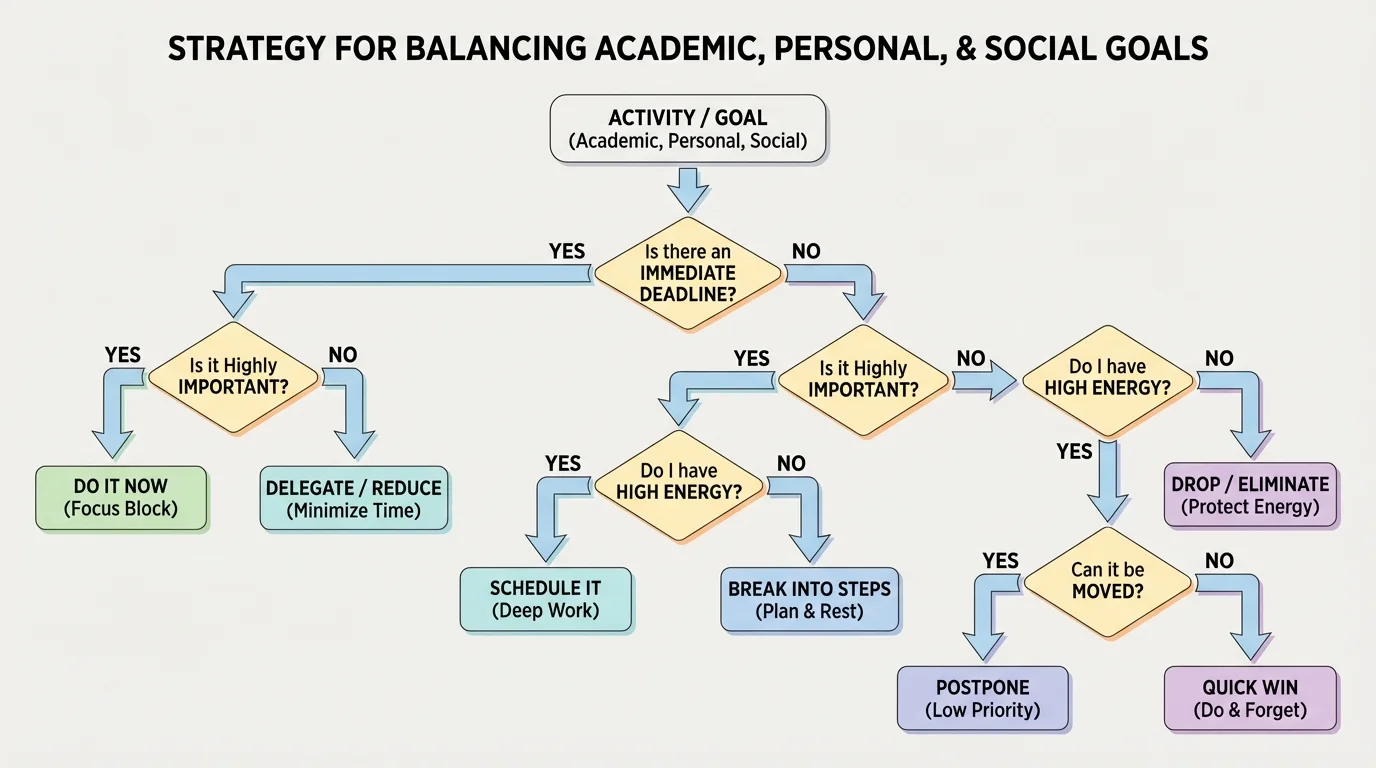
Trade-offs are a normal part of growing up. Making a responsible choice does not always feel fun in the moment. But repeated responsible choices build trust. People learn that you mean what you say, finish what you start, and can manage freedom well.
Earlier, the priority chart in [Figure 1] showed that urgent and important tasks come first. That same idea helps when your goals compete. You are not giving up on the other goals forever. You are choosing the right order.
When goals collide
You planned to join an online game night with friends at \(7{:}00\), but at \(6{:}15\) you remember an essay response is due by \(8{:}00\).
Step 1: Identify the non-movable deadline.
The essay response has a firm due time.
Step 2: Estimate the time honestly.
If it will take about \(40\) minutes, you still may be able to join late.
Step 3: Communicate clearly.
Send a message: "I need to finish an assignment first. I can join around \(7{:}10\) or \(7{:}15\)."
Step 4: Follow through.
Work without distractions until the task is done.
Try This: The next time you feel stuck between two choices, ask yourself, "What will matter more tomorrow?"
Balancing goals is not only about time. It is also about energy. You can have two free hours and still get very little done if you are exhausted, distracted, or upset. That is why sleep, food, movement, breaks, and screen habits matter. They are not extras. They support everything else.
Be careful with multitasking. Listening to a teacher video while scrolling messages and trying to answer a friend may feel efficient, but it often lowers your focus. Doing one thing at a time usually saves time overall because you make fewer mistakes and remember more.
Notice warning signs of imbalance: staying up too late, missing deadlines, feeling irritated all the time, avoiding friends, or feeling guilty even during free time. These signs do not mean you have failed. They mean your plan needs adjustment.
Responsibility is not about being busy every minute. It is about making choices you can stand behind. Rest, sleep, and healthy limits are responsible choices too.
If you are low on energy, shorten the task instead of quitting completely. Read for ten minutes instead of thirty. Clean one shelf instead of the whole room. Send one kind message instead of trying to keep up with every conversation. Smaller steps keep momentum going.
Balanced students do not do everything alone. They communicate. If you are overwhelmed, tell a parent, guardian, or trusted adult. If you do not understand an assignment, message your teacher early instead of waiting until the last minute. If you need to miss part of a social activity, be honest and respectful.
Clear communication protects relationships. A short message like, "I want to hang out online, but I need to finish my work first. Can we talk after \(6{:}30\)?" is better than disappearing without explanation. People may not love your answer, but they can usually respect honesty.
"You do not have to do everything. You do have to choose what matters most and do it well."
Support can also mean using tools. Calendars, alarms, reminders, checklists, timers, and shared family schedules can all help. The weekly planner in [Figure 2] shows how a visible plan makes your choices easier because you can actually see where your time goes.
No plan stays perfect. Maybe a new activity starts, your schoolwork gets harder, or a family schedule changes. That is why you need a short weekly check-in. Once a week, ask yourself: What went well? What felt rushed? What got ignored? What should change next week?
This is where trade-offs become easier to understand. If you spent lots of time socializing and your work slipped, you may need firmer school blocks. If you did schoolwork all week and felt isolated, you may need to protect time for friends or family. Balance is not a one-time fix. It is a skill you keep adjusting.
A quick review can be very short. You might rate each area from \(1\) to \(5\): academic, personal, and social. If your ratings are \(5\), \(2\), and \(1\), that tells you something important. Even without complicated math, the pattern helps you see what needs more attention.
Weekly check-in example
A student reviews the week and notices: all assignments were submitted, but there was little exercise and almost no time talking with friends.
Step 1: Keep what worked.
Continue the homework block that helped assignments get done.
Step 2: Fix one weak area.
Add a \(20\)-minute walk after lessons on three days.
Step 3: Fix one connection area.
Plan one call or group chat time for the weekend.
Step 4: Check whether the new plan is realistic.
Do not add six new habits at once. Start with two changes.
Try This: At the end of this week, write one sentence for each area: school, personal life, and social life. Then decide one improvement for next week.
Here is one possible weekday plan for an online student: morning lessons, lunch, one focused schoolwork block, a break, a chore, free time, exercise or hobby practice, dinner, and later a short social check-in. Another student may prefer to do schoolwork in two shorter blocks instead of one longer one. There is no single perfect schedule.
What matters is whether your plan matches your real life. If your family needs help in the afternoon, you may move your independent schoolwork earlier. If you focus better after movement, you might exercise before homework. The best strategy is the one you can actually follow.
As the decision flow in [Figure 3] shows, when plans clash, you can pause and make a thoughtful choice instead of reacting in the moment. That skill will help you far beyond middle school. It helps with future deadlines, jobs, relationships, and community responsibilities.
Balancing goals is really about building a life that works. You are learning how to be dependable to yourself, useful to others, and ready for bigger choices later on.
