Have you ever noticed that two people can face the exact same choice and respond in completely different ways? One person posts a bold opinion online, another stays silent. One joins a new activity, another backs away. One says no when a group pushes too far, another goes along with it even when it feels wrong. That difference is not random. It often comes from three powerful forces inside your life: identity, belonging, and confidence.
Your choices are not just about what looks fun in the moment. They are shaped by how you see yourself, where you feel accepted, and whether you trust yourself enough to act. Learning to evaluate these influences helps you make decisions that fit who you really are instead of decisions you regret later.
Every day, you make personal choices: what to say in a group chat, how to respond to a rumor, whether to try out for a team, what kind of content to post, whether to speak honestly with a family member, or whether to avoid something because you feel unsure. Some choices seem small, but small choices often build habits, and habits shape your life.
When you understand self-awareness, you become better at noticing what is driving your decisions. Maybe you choose something because it truly matters to you. Maybe you choose it because you want approval. Maybe you avoid it because your confidence drops. None of that makes you weak or strange. It makes you human. The goal is to become more aware, more intentional, and more honest with yourself.
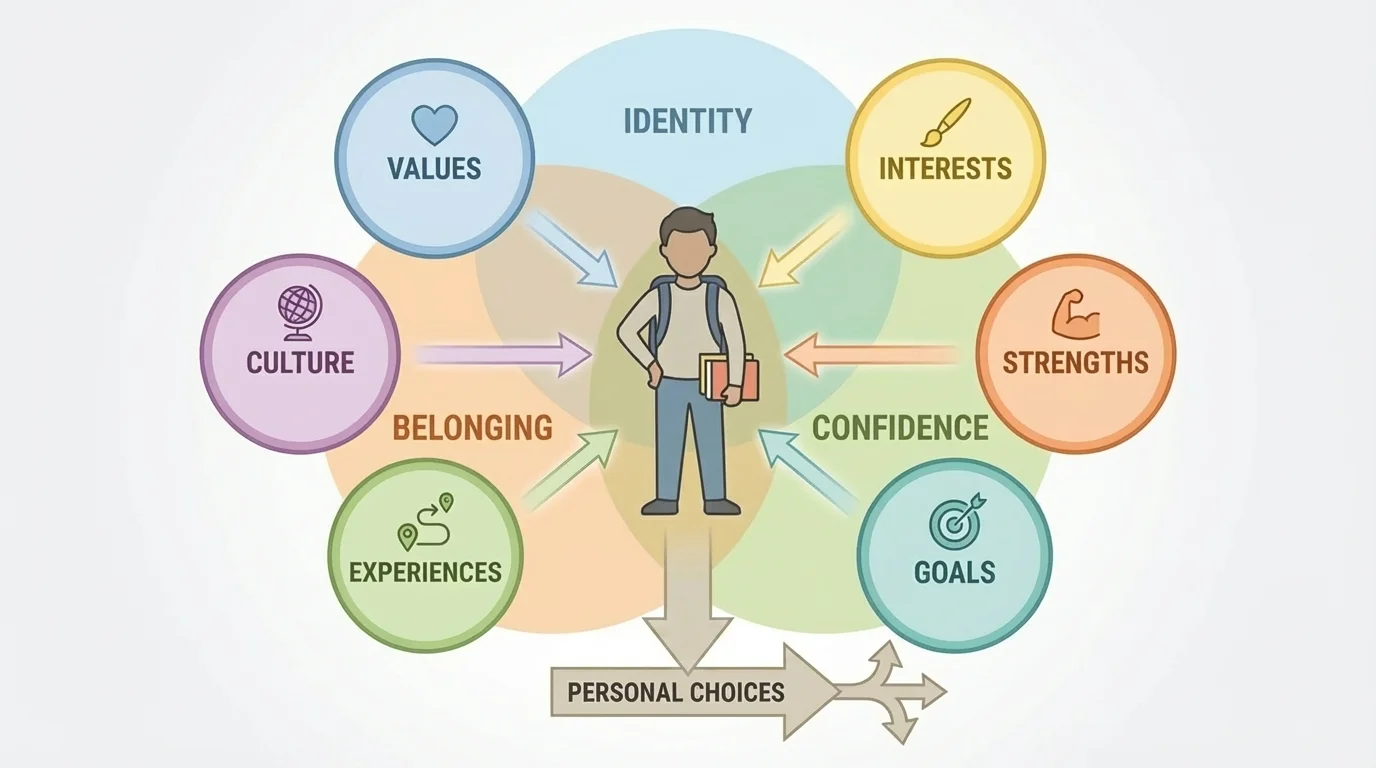
Identity is your sense of who you are, including your values, interests, culture, experiences, strengths, and goals.
Belonging is the feeling that you are accepted, included, and connected with other people or groups.
Confidence is trust in your ability to think, decide, act, and handle challenges.
These three parts of your life do not stay separate. They constantly interact. If your identity is strong, belonging can feel healthier because you are not trying to become someone else to be accepted. If your confidence grows, you are more likely to make choices that match your values. If you feel excluded, you may become more tempted to make choices just to fit in.
Your identity is not just a label. It is more like a set of layers, including what you care about, what you are good at, where you come from, what matters in your family or community, and what kind of person you want to become. When you know these parts of yourself, decisions get clearer.
For example, if you value honesty, you may decide not to share a fake story online even if everyone else is reposting it. If creativity matters to you, you may choose to spend time making music, coding, drawing, or editing videos instead of doing something just because it is popular. If being dependable matters to you, you may keep a promise even when canceling would be easier.
Identity also includes things that are still developing. At age 13, you are not expected to have everything figured out. In fact, part of growing up is testing interests, asking questions, and noticing what feels true for you. But there is a difference between exploring and pretending. Exploring means trying something because you are curious. Pretending means acting like someone else just to win approval.
One useful question is: Would I still choose this if nobody were watching? That question can reveal a lot. If the answer is yes, your choice may be connected to your real identity. If the answer is no, you may be acting mostly for attention, approval, or fear of being left out.
Identity gives decisions direction. When you know your values, you do not need every choice to feel easy. You simply need a clear reason. A strong sense of identity helps you choose based on what matters long-term, not just what feels safe or popular in the moment.
Identity can influence major choices too. Maybe your family values education and responsibility, so you choose to finish your work before gaming. Maybe you care deeply about fairness, so you decide to defend someone being mocked online. Maybe you are discovering that you enjoy helping others, so you volunteer in your community. As [Figure 1] shows, your values and goals are not extra details. They are central parts of how decisions form.
Belonging can be one of the strongest influences on behavior. The same need for connection can lead either to healthy support or unhealthy pressure. Human beings want connection. You want to feel accepted by friends, family, teams, clubs, faith communities, gaming groups, or creative communities. That is normal and important.
Healthy belonging feels like this: you are respected, included, and able to be yourself. You do not have to hide your values to stay connected. You can disagree sometimes without being pushed out. In a healthy group, people may influence you, but they do not control you.
Unhealthy belonging feels different. You may feel pressure to laugh at something cruel, share personal information, copy risky behavior, or stay silent when something feels wrong. The message is often, "If you want to stay part of us, prove it." That is not true belonging. That is pressure dressed up as connection.
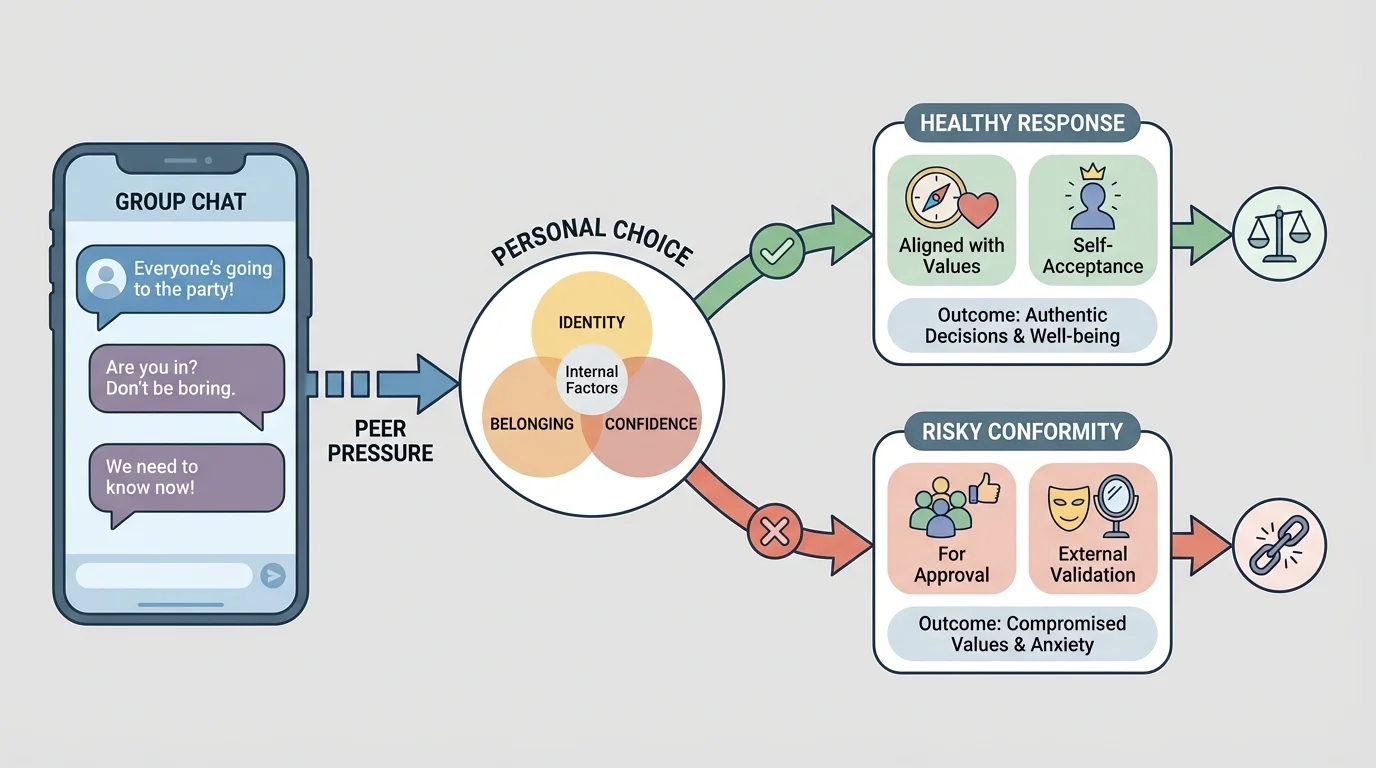
Think about a group chat where friends dare each other to post embarrassing content about someone else. A student might know it is wrong but still join in because being included feels urgent. As [Figure 2] shows, that choice is strongly influenced by belonging. The fear is not always "I want to be mean." Often it is "I do not want to be excluded." Recognizing that difference matters, because then you can deal with the real issue.
Belonging is not bad. In fact, healthy belonging can protect you. When you are around people who respect your boundaries, you may feel more able to say no to harmful choices. Supportive relationships can strengthen identity and confidence. The danger comes when you think acceptance must be purchased by giving up your values.
A strong clue that pressure is taking over is when your body feels tense but you still go along. Maybe your stomach drops, your chest tightens, or your thoughts race. That discomfort can be a warning sign that your need for connection is pulling harder than your judgment.
People often copy group behavior even when they privately disagree. That means "everyone is doing it" is not always true. Sometimes many people are simply following one another without stopping to think.
Later, that same group pressure may affect different choices: whether you try a new activity, whether you speak on a video call, whether you change your style to match others, or whether you hide an interest because it seems "uncool." The decision path in [Figure 2] matters because it shows that belonging can either support your growth or push you away from yourself.
Confidence is not about acting superior. Real confidence is quiet. It sounds like, "I can handle this," "I can learn," or "I can say no even if it is awkward." Confidence affects choices because it changes what seems possible.
If your confidence is low, you may avoid trying things you actually want. You might stay silent in an online discussion, not because you have nothing to say, but because you assume your ideas are not good enough. You might refuse to join a club, apply for an opportunity, or ask for help because failure feels too embarrassing.
If your confidence is healthy, you are more willing to take smart risks. You can try out for something, submit your work, ask a question, or admit a mistake. Healthy confidence does not promise success every time. It simply tells you that your worth does not disappear when something is hard.
There is also a difference between real confidence and fake confidence. Fake confidence often tries to look fearless, loud, or perfect. It may lead someone to act reckless just to seem strong. Real confidence allows honesty. It can say, "I am nervous, but I am still doing the right thing."
This matters in personal choices. Suppose you are invited to join a video call where people plan to prank someone in a harmful way. Low confidence may whisper, "If you say no, they will judge you." Real confidence says, "They might judge me, but I can live with that better than I can live with doing something wrong."
"Confidence is not 'I will never fail.' Confidence is 'I can handle what happens next.'"
Confidence grows through action. Every time you make a choice that matches your values, even in a small way, you build trust with yourself. That self-trust makes the next honest choice easier.
These three influences rarely act alone. Most real decisions involve all of them at once. You may know who you are, want to stay connected, and still feel unsure. Or you may feel very confident in one area and not in another. For example, you might feel confident in art but insecure in social situations. That can affect which choices feel easy and which feel stressful.
Picture this situation: you love writing and want to post your original work online. Your identity says, "This matters to me." Your belonging need says, "What if people in my group think it is weird?" Your confidence says either, "Share it anyway," or "Hide it to stay safe." The final choice depends on which voice becomes strongest.
Another example: your family expects you to choose an activity that seems practical, but you are strongly interested in music production. Identity shapes what feels meaningful. Belonging shapes how much family approval matters. Confidence shapes whether you can respectfully speak up for your interest. Evaluating the choice means noticing all three influences instead of pretending the decision is simple.
When you do not evaluate these forces, you may make confusing choices. You might say, "I do not know why I did that." Often there is a reason. Maybe you wanted acceptance, feared embarrassment, or felt disconnected from your values. Once you identify the reason, you have more control.
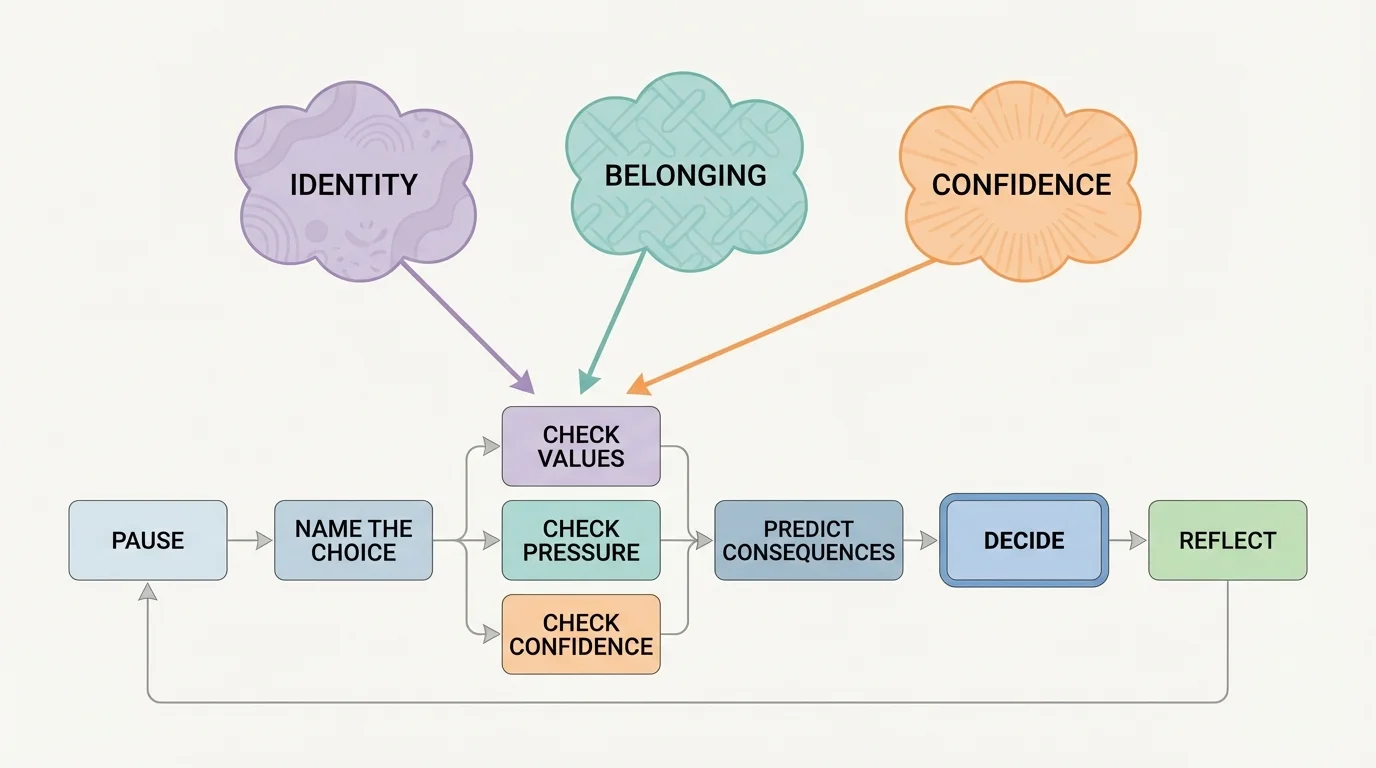
When a choice feels stressful, use a decision-making framework. The process in [Figure 3] helps you slow down before reacting. You do not need to make every decision perfectly. You just need a method that helps you think clearly.
Step 1: Pause. If possible, do not answer immediately. Pressure becomes stronger when you rush.
Step 2: Name the choice. Be specific. Instead of "What should I do?" say, "Should I repost this?" or "Should I join this call?"
Step 3: Check identity. Ask, "Does this fit my values, goals, and the kind of person I want to be?"
Step 4: Check belonging. Ask, "Am I doing this because I truly want to, or because I am afraid of being left out?"
Step 5: Check confidence. Ask, "If I trusted myself more, what would I choose?"
Step 6: Predict consequences. Think short-term and long-term. What happens today? What happens tomorrow? What happens to trust, safety, reputation, or peace of mind?
Step 7: Decide and reflect. After the choice, notice how it felt. Reflection helps you learn from real life.
Real-life decision example
A friend asks you to share answers on an online quiz.
Step 1: Pause instead of replying instantly.
You give yourself time to think rather than reacting to the pressure.
Step 2: Check identity.
If honesty matters to you, sharing answers does not match that value.
Step 3: Check belonging.
You notice you want to help your friend and avoid conflict, but that pressure is not the same as making a good choice.
Step 4: Check confidence.
You remind yourself that you can handle a disappointed reaction and still be a good friend.
Step 5: Decide.
You might say, "I can help you study, but I'm not sending answers."
This response protects both your integrity and your boundaries.
The more often you use a process like this, the faster it becomes. Over time, the pattern in [Figure 3] can become almost automatic.
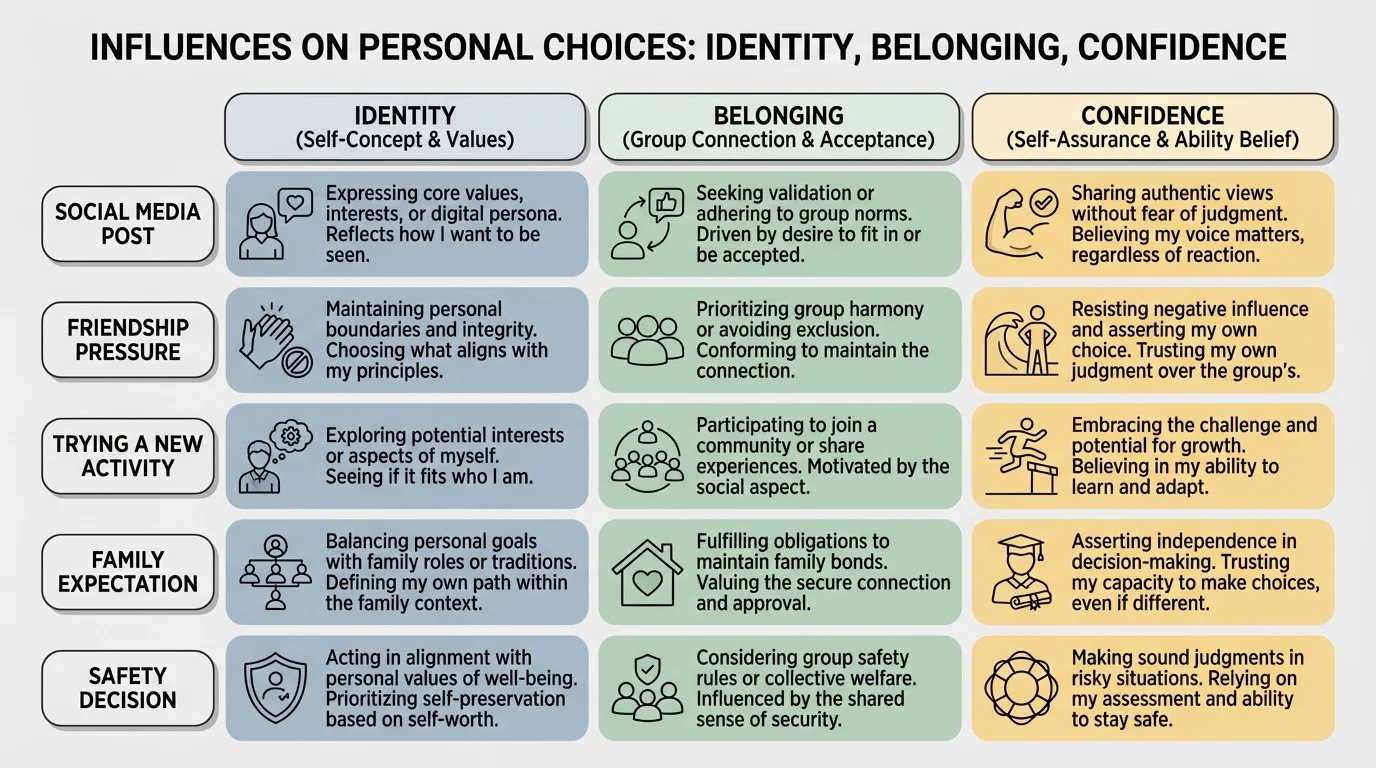
The same three forces appear in many everyday situations, and [Figure 4] organizes them side by side so you can compare how they work. Once you start noticing patterns, your choices become less confusing.
Social media posting: Identity affects what you want your account to say about you. Belonging affects whether you copy trends just to fit in. Confidence affects whether you can post something genuine without needing everyone's approval.
Friendships: Identity affects what qualities matter to you in a friend. Belonging affects how much you fear losing a group. Confidence affects whether you can set boundaries, say no, or leave a harmful friendship.
Trying something new: Identity affects whether the activity matches your real interests. Belonging affects whether you join because your friends are doing it or because you truly care. Confidence affects whether you can risk being a beginner.
Family expectations: Identity affects what feels true to your goals and values. Belonging affects your desire to stay connected and respectful. Confidence affects whether you can express yourself calmly instead of shutting down.
Safety decisions: Identity affects whether you see yourself as someone who respects limits and personal safety. Belonging affects whether you ignore red flags to avoid feeling left out. Confidence affects whether you can leave, block, report, or ask for help.
| Situation | Identity question | Belonging question | Confidence question |
|---|---|---|---|
| Posting online | Does this reflect who I am? | Am I posting for approval? | Can I handle mixed reactions? |
| Joining a group | Do I actually enjoy this? | Am I afraid to be left out? | Can I be new and still be okay? |
| Saying no | What value am I protecting? | Is this pressure disguised as friendship? | Do I trust myself to speak up? |
| Future plans | What matters to me long-term? | Whose approval am I chasing? | Can I choose my path respectfully? |
Table 1. Questions you can ask yourself to evaluate how identity, belonging, and confidence affect common choices.
Suppose you are thinking about hiding an interest because others might judge it. The comparison in [Figure 4] helps you see that the issue may not really be the interest itself. The deeper issue may be fear of exclusion or fear of embarrassment. That insight changes how you respond.
You do not build good judgment in one day. You build it through habits. Start by noticing your reactions. After a choice, ask: "Why did I do that?" and "How did I feel afterward?" If a decision leaves you feeling inauthentic, pressured, or disappointed, that information matters.
Here are some practical ways to strengthen yourself:
Name your values. Pick a few that matter most to you, such as honesty, kindness, creativity, responsibility, courage, or loyalty.
Pay attention to energy. Notice which choices make you feel more like yourself and which make you feel like you are performing.
Choose supportive people. Spend more time with people who respect your boundaries and less time with those who constantly test them.
Practice small brave actions. Speak up once in a video call, share one honest opinion, ask one question, or say one clear no. Small actions train confidence.
Reflect instead of attacking yourself. If you make a choice you regret, do not label yourself as a failure. Study what influenced you and plan a better response next time.
Try This
For one week, pause after one important choice each day and ask yourself three questions: "Was that really me?" "Was I trying to belong?" "Did confidence help or hurt?" Short, honest reflection can teach you a lot very quickly.
Self-awareness gets stronger with practice. You begin to notice patterns such as, "I take bad risks when I feel excluded," or "I stay quiet when I am afraid of sounding wrong," or "I make my best choices when I remember my long-term goals." Those patterns are powerful because once you see them, you can change them.
Sometimes a choice feels too heavy to handle alone. If someone is pressuring you to do something unsafe, secretive, illegal, sexually inappropriate, humiliating, or harmful to yourself or others, pause and get help. A trusted adult, family member, counselor, coach, mentor, or community leader can help you think clearly and stay safe.
Getting support does not mean you are weak. It means you understand that some situations involve more pressure than one person should carry alone. Real strength includes knowing when to ask for backup.
It also helps to remember that one decision does not define your whole identity. If you made a choice you regret, you can learn, repair what you can, and choose differently next time. Growth is not about being perfect. It is about becoming more honest, steady, and aware.
Personal growth is not just about what you achieve. It is also about how you decide. The strongest choices usually come from knowing yourself, protecting your values, and choosing relationships that do not require you to betray who you are.
When you evaluate your choices through the lens of identity, belonging, and confidence, you gain something important: freedom. Not freedom to do whatever gets attention in the moment, but freedom to act with purpose. That kind of freedom leads to better relationships, stronger self-respect, and wiser decisions over time.
