One hard thing about school stress is that it rarely arrives one problem at a time. A late assignment, a message you do not know how to answer, a video call you are nervous about, and the feeling that everyone else has it together can all hit on the same day. When that happens, it can seem like your brain stops cooperating. You may procrastinate, snap at someone, shut down, or keep scrolling even though you know it is making you feel worse. That does not mean you are weak. It means you need a system.
A personal regulation plan is a system you build for yourself before stress gets too big. It helps you notice what is happening, lower the intensity, and make better choices. This matters in online school because you often have more independence, more screen time, and fewer automatic routines than students in an in-person school setting. You need tools that work in your room, at your desk, on your device, and in your everyday conversations.
Self-regulation means managing your thoughts, feelings, energy, and actions in a way that helps you meet your goals. It does not mean never feeling stressed. It means noticing stress and responding on purpose instead of reacting automatically.
Stress trigger is anything that sets off pressure or worry, such as a difficult assignment, too many notifications, a tense conversation, or comparing yourself to others online.
Social pressure is the feeling that you must act, look, respond, or agree in a certain way so other people will approve of you.
Resilience is the ability to recover, adapt, and keep going after challenges, mistakes, or uncomfortable emotions.
A good plan is not complicated. In fact, the best plans are short enough to remember when you are upset. If your plan is three pages long and full of perfect advice you never use, it is not helping. If it is simple, realistic, and easy to follow, it can change how your whole week feels.
Think of your plan as a personal playbook. Athletes do not wait until the middle of a game to decide how they will react under pressure. They practice responses ahead of time. You can do the same with school stress, awkward messages, deadlines, and moments when your emotions start to take over.
Stress usually builds in stages, not all at once, as [Figure 1] shows. If you can catch it early, you have a much better chance of handling it well. The earlier you notice a problem, the fewer repairs you usually need later.
Your warning signs can show up in four areas: your body, your thoughts, your emotions, and your behavior. In your body, you might feel a tight chest, a fast heartbeat, a stomachache, tired eyes, or tense shoulders. In your thoughts, you might start thinking, "I am behind," "I cannot do this," or "Everyone else is doing better than me." Emotionally, you may feel irritated, embarrassed, overwhelmed, or numb. In your behavior, you might avoid logging in, stop answering messages, overcheck grades, or scroll for a long time to escape.
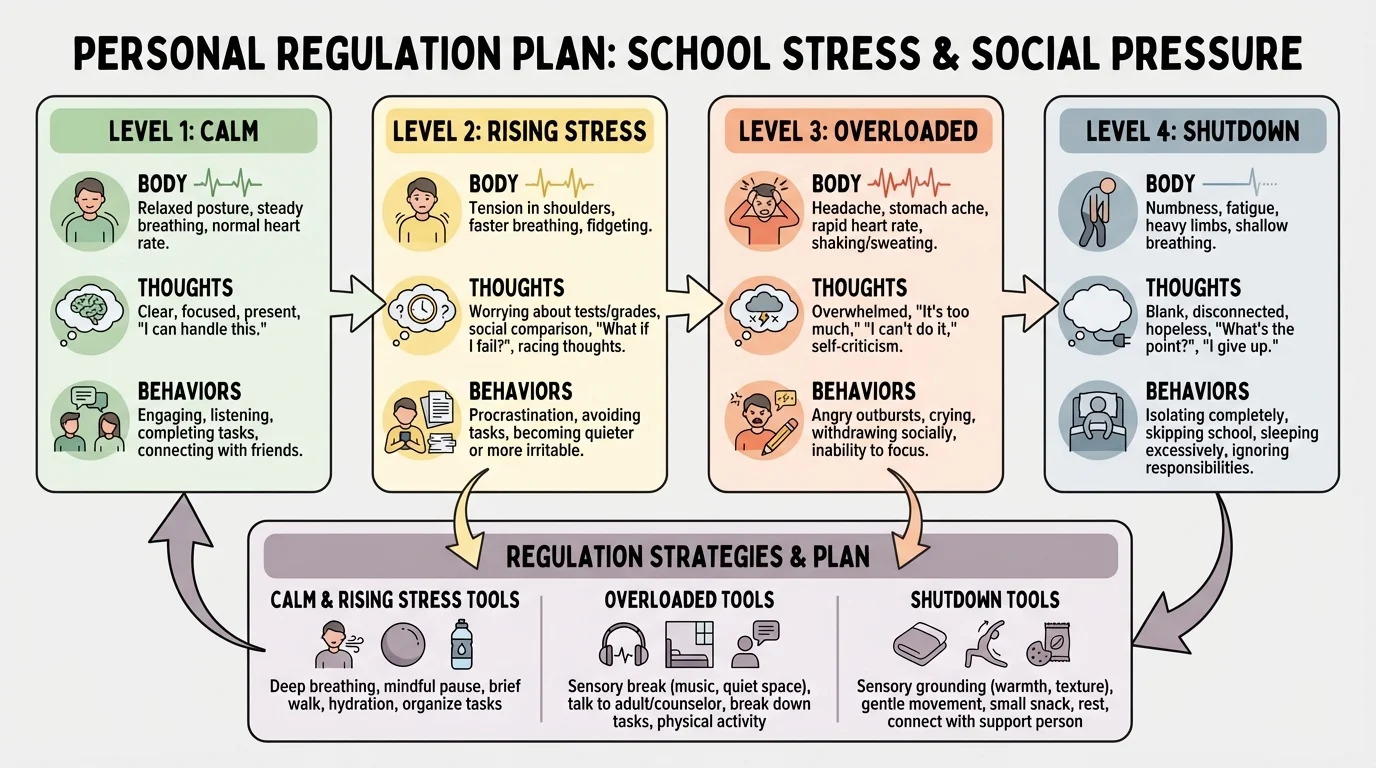
One mistake many students make is waiting until they are already overwhelmed before doing anything. At that point, even small tasks can feel huge. A better approach is to learn your personal "yellow light" signs. These are clues that stress is rising but still manageable.
For example, maybe your yellow light signs are rereading the same directions three times, getting annoyed by tiny things, and checking your phone every few minutes. Someone else might get unusually quiet, start rushing, or think in all-or-nothing ways. There is no single correct pattern. The important thing is knowing your pattern.
Real-life sign spotting
Jordan notices that before stress during a busy week gets out of control, the same pattern happens almost every time.
Step 1: Body clue
Jordan feels tense in the neck and forgets to take full breaths.
Step 2: Thought clue
Jordan starts thinking, "If I do not finish everything perfectly, I will disappoint everyone."
Step 3: Behavior clue
Jordan avoids the hardest assignment and spends too long switching between tabs.
Step 4: Action
Because Jordan recognizes the pattern early, they use a short reset before the stress leads to shutdown.
When you know your signs, you can stop treating every bad day like a mystery. You begin to see patterns, and patterns are useful because they can be planned for.
Trigger tracking is one of the fastest ways to make your plan more effective. If you only say, "School stresses me out," the problem stays too vague. If you say, "I get stressed when I have two deadlines in one day, unclear instructions, and ten unread messages," now you have something specific to work with.
Common online school stressors include a heavy workload, procrastination, perfectionism, worry about grades, feeling isolated, technical issues, and losing track of time. Social pressure can come from group chats, social media comparison, pressure to respond immediately, fear of missing out, wanting approval, or being pulled into drama that does not actually help your life.
It helps to separate stressors into categories.
| Category | Examples | What it can feel like |
|---|---|---|
| School tasks | Deadlines, large projects, unclear directions | Overwhelm, avoidance, frustration |
| Time pressure | Too much in one day, poor sleep, last-minute work | Panic, racing thoughts, shutdown |
| Social pressure | Group chats, social media comparison, pressure to agree | Anxiety, insecurity, people-pleasing |
| Self-pressure | Perfectionism, harsh self-talk, fear of mistakes | Stress, shame, never feeling finished |
| Environment | Noise, clutter, interruptions, too many tabs open | Distraction, irritability, mental fatigue |
Table 1. Common categories of school stress and social pressure, with examples and likely effects.
Notice that some stress comes from outside you, and some comes from inside you. Outside stress might be a due date or a rude message. Inside stress might be the story you tell yourself about what that means. Both matter. Your plan should deal with both.
Your brain handles stress better when you name it specifically. Saying "I am stressed" is less useful than saying "I am stressed because I have two assignments due, I slept poorly, and I am worried about one text conversation."
Once you know your stressors, you can match them with tools instead of hoping the stress disappears on its own.
A strong plan includes a coping strategy toolbox, and different tools work for different kinds of stress, as [Figure 2] illustrates. If your body is activated, you need body tools. If your thoughts are spiraling, you need thought tools. If your environment is chaotic, you need environment tools. Matching the tool to the problem is smarter than using the same strategy every time.
Body tools help your nervous system slow down. These include drinking water, stretching, standing up, relaxing your shoulders, splashing cool water on your face, or taking slow breaths. One simple breathing pattern is breathing in for a count of \(4\), holding for \(4\), and breathing out for \(6\). The longer exhale can help your body shift out of high alert.
Thought tools help you challenge extreme thinking. If your brain says, "I am failing at everything," pause and ask, "What are the facts?" Maybe the facts are that you are behind on one assignment, not everything. Maybe you need help, not a panic spiral. A more balanced thought might be, "This is stressful, but I can do one part now and ask for support if I need it."
Attention tools help when your focus is scattered. You can close extra tabs, silence non-urgent notifications, set a timer for 10 or 15 minutes, or write the next tiny step instead of staring at the whole task. Tiny steps are powerful because they reduce the feeling of being crushed by the entire workload.
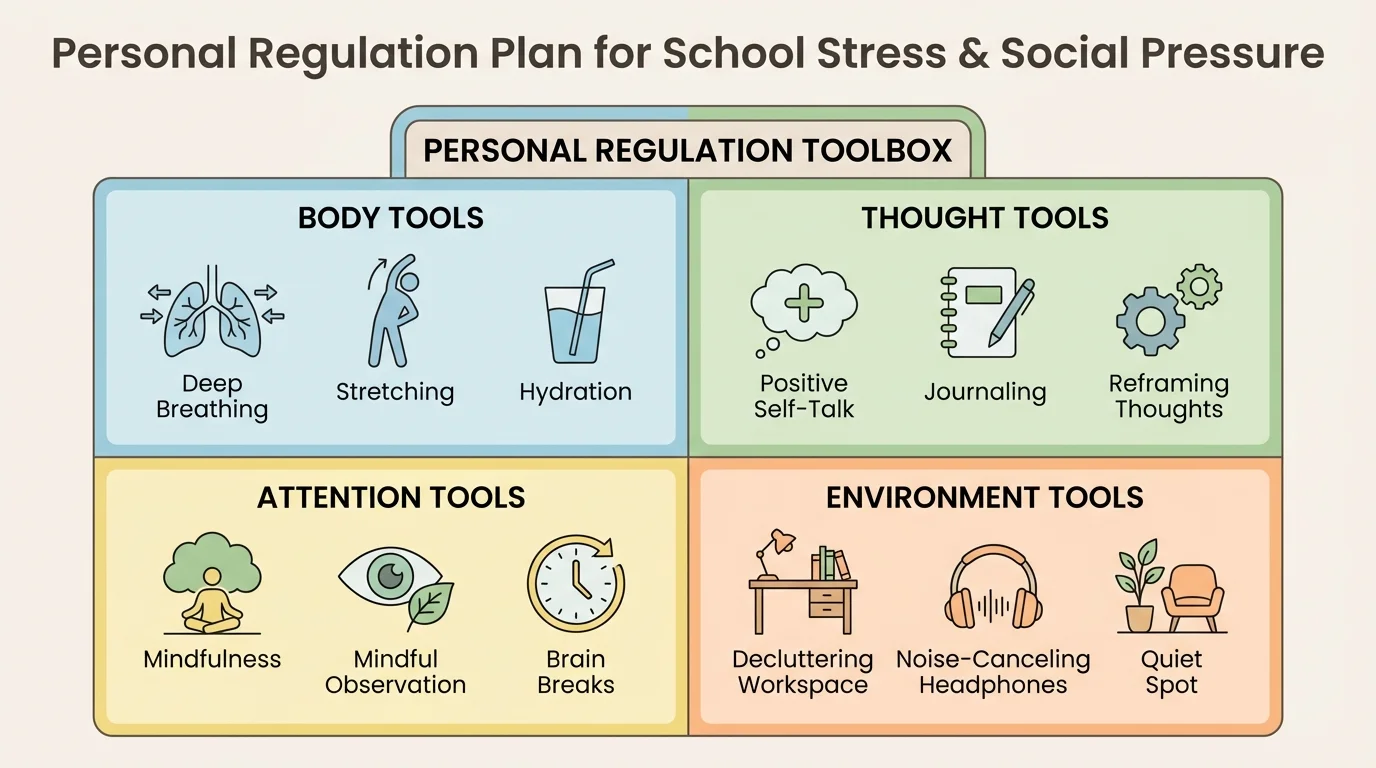
Environment tools help when your space is adding stress. You might clear your desk, put your phone out of reach, use headphones, move to a quieter spot, or tell family members you need uninterrupted time for the next 20 minutes.
The goal is not to feel amazing instantly. The goal is to get regulated enough to make your next good decision. That might mean going from a stress level of 9 down to 6. That drop matters. Once your brain is less flooded, you can think more clearly.
Regulation is not the same as avoidance. Watching videos for three hours to escape one difficult assignment might make stress disappear for a little while, but it usually comes back larger. True regulation lowers the emotional intensity so you can return to the problem with more control.
As you saw in [Figure 2], a good toolbox is varied. If one strategy does not work, that does not mean you are bad at regulating yourself. It usually means you need a different tool for that moment.
Try This: Pick one body tool, one thought tool, one attention tool, and one environment tool that you can realistically use this week. Keep the list short enough that you will actually remember it.
Boundary setting is a big part of regulation. Social pressure often feels powerful because it pushes on your need to belong. You may feel like you have to reply immediately, agree with the group, go along with a joke, share something personal, or stay available all the time. But not every invitation deserves a yes, and not every message deserves an instant response.
One of the best ways to handle pressure is to build a pause between the pressure and your response. If a message makes you anxious, annoyed, or rushed, do not answer at your most reactive moment. Step away for a few minutes. Breathe. Check the facts. Decide what response fits your values, not just your fear.
Helpful boundary scripts can be short and respectful. You might say, "I cannot talk right now, but I can reply later." Or, "I am not comfortable with that." Or, "I am focusing on school tonight." Or even, "No thanks." Short does not mean rude. Clear is kind.
Group chats deserve special attention. They can be fun, but they can also create constant pressure. If a chat is distracting you, increasing drama, or making you compare yourself to others, it is okay to mute it, leave it, or check it only at certain times. Protecting your attention is not selfish. It is responsible.
"You do not have to attend every argument you are invited to."
Social media can also increase pressure by making other people's lives look smoother, happier, and more successful than they really are. Remember that you are often comparing your full reality to someone else's highlight reel. That comparison is not fair and usually not accurate.
Try This: Before replying to a stressful message, ask yourself three questions: "Do I need to answer now?" "What response matches my values?" "What will I think about this choice tomorrow?" Those questions slow down impulsive decisions.
Your regulation plan should be short, clear, and easy to use when stress is high, as [Figure 3] shows. If possible, keep it on one page, in a notes app, or on a card near your workspace. You are creating something practical, not something impressive.
Your plan needs six parts: triggers, warning signs, go-to tools, support people, boundary scripts, and reset steps after a rough moment. These parts work together. If one part is missing, the plan becomes harder to use under pressure.
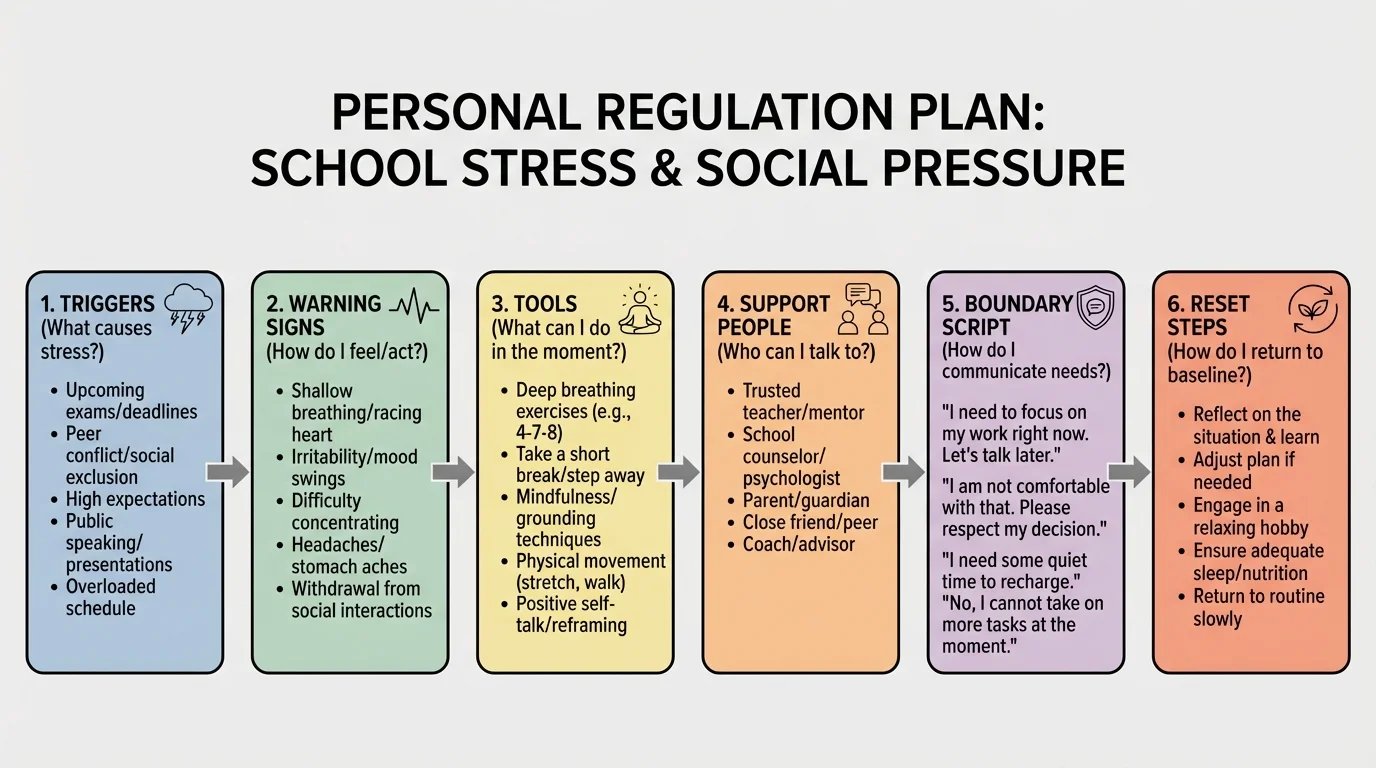
Part 1: My triggers. List the situations that most often throw you off. Be specific. Examples: "unclear assignments," "too many late tasks at once," "feeling ignored in a group chat," "seeing everyone else post about being productive," or "someone pushing me to answer right away."
Part 2: My warning signs. List your yellow light signs. Examples: "tight shoulders," "doom-thinking," "snapping at people," "avoiding work," or "opening lots of tabs without starting."
Part 3: My go-to tools. Choose a few tools that are realistic. Examples: "drink water and breathe for one minute," "write the next smallest step," "move my phone away," "ask for clarification," or "mute the chat until homework is done."
Part 4: My support people. Include adults and peers you can contact if you need help. This could be a parent, guardian, teacher, school counselor, coach, mentor, or trusted friend. Asking for help early is usually easier than asking when everything feels urgent.
Part 5: My boundary scripts. Write a few exact phrases you can use. This matters because stress makes it harder to find words quickly. Prepared words reduce pressure.
Part 6: My reset steps. Plan what to do if you have already had a rough moment. For example: "Pause," "stop negative self-talk," "apologize if needed," "make a two-step recovery plan," and "restart with one task." Recovery is part of regulation too.
Sample personal regulation plan
Step 1: Triggers
Maya writes: "last-minute assignments, comparison on social media, pressure to reply right away, and confusion about directions."
Step 2: Warning signs
Maya writes: "jaw tension, fast scrolling, thinking 'I am behind in everything,' and avoiding the hardest task."
Step 3: Tools
Maya chooses: "breathe for one minute, put phone across the room, write one tiny next step, and ask one question instead of guessing."
Step 4: Support and scripts
Maya adds one trusted adult, one friend, and two scripts: "I cannot answer right now" and "I need clarification before I continue."
Step 5: Reset
If Maya gets overwhelmed, the reset is: water, stretch, reopen only one tab, and complete one small action within \(10\) minutes.
As shown in [Figure 3], the plan is useful because it turns a blurry problem into clear actions. When stress rises, you do not need to invent a solution from scratch. You follow your plan.
A plan becomes powerful when you use it in ordinary moments, not just major crises. If you only try it when everything is falling apart, it may feel unnatural. Practice during smaller stressful moments so the steps become familiar.
Suppose you log in and see three tasks due soon. Your chest tightens and your brain says, "There is no point. I cannot catch up." This is the moment to use your warning signs. Like the progression in [Figure 1], stress is moving upward. Instead of spiraling, use a body tool, then an attention tool. Sit back, inhale slowly, exhale longer, close extra tabs, and write the first task you can complete in \(10\) minutes.
Now imagine a friend sends repeated messages asking why you are not answering, and the tone feels pushy. Your regulation plan reminds you to pause before replying. Use a boundary script: "I am busy right now. I will respond later." Then return to your main priority instead of carrying the pressure all afternoon.
Another situation: you see posts that make it look like everyone else is productive, social, and confident. Your thought tool matters here. Replace "I am the only one struggling" with something more truthful: "People usually post their best moments, not their full reality. I need to focus on my own next step."
Strong self-management does not mean doing everything alone. It means knowing when to use your own tools and when to reach out for support before stress becomes a bigger problem.
When your tools work, the result is not always dramatic. You may simply recover faster, stay kinder, finish one task, or avoid saying something you regret. Those are real wins.
No plan works perfectly every day. You are a changing person with changing stressors, so your plan should change too. Review it once in a while and ask: "Which triggers showed up this week?" "Which tools helped?" "Which ones did not?" "What should I simplify?"
Be careful not to turn reflection into self-criticism. Reflection sounds like, "The phone across the room helped, but I need a better plan for late-night stress." Self-criticism sounds like, "I messed up again." One helps you improve. The other just adds more pressure.
Resilience grows when you recover, learn, and try again. It is not about being calm all the time. It is about building trust that you can handle hard moments with more skill than before.
If your stress ever feels too big to manage alone, or if you feel stuck in anxiety, panic, hopelessness, or constant shutdown, tell a trusted adult right away. A personal plan is a strong tool, but it is not a substitute for support when you truly need help.
