A coping choice can change the direction of your whole day in just a few minutes. One response to stress might help you calm down, protect your safety, and solve the problem. Another might feel good for a moment but make the problem bigger by tonight. That is why coping is not just about "feeling better." It is also about protecting your future choices.
As you grow more independent, you are making more decisions on your own: how to respond to a rude message, what to do when schoolwork piles up, whether to join in on risky online behavior, or how to handle a conflict with a friend. In each situation, the way you cope affects three big things: your ability to bounce back, your personal safety, and the quality of your decisions.
Coping means the thoughts and actions you use to deal with stress, disappointment, pressure, anger, fear, or frustration. Some coping choices help you recover and think clearly. Others may only distract you for a short time. Some can put you in danger.
If you get a harsh comment during a group chat, for example, you might pause, log off for a few minutes, breathe slowly, and message a trusted adult or friend. That choice gives your mind time to settle. But if you instantly send a cruel reply, post something embarrassing about the other person, or keep reading angry messages for an hour, your stress usually grows. The problem spreads instead of shrinking.
Resilience is your ability to recover, adapt, and keep going after stress, mistakes, setbacks, or challenges.
Decision-making is the process of choosing what to do by thinking about options, consequences, and goals.
Emotional regulation is the skill of noticing feelings and managing them in a healthy way instead of letting them completely control your actions.
These three ideas work together. When you regulate emotions well, you usually make safer decisions. Safer decisions often protect your resilience, because they keep one hard moment from becoming a much bigger problem.
Think of coping as the bridge between a stressful event and what you do next. The event might be outside your control. Your coping choice is the part you can influence. That choice affects whether you feel more trapped or more capable.
Resilience does not mean never getting upset. It means you can struggle, feel real emotions, and still return to balance. A resilient person may need support, time, rest, and better strategies. Resilience is built through repeated healthy responses, not through pretending everything is fine.
Emotional regulation helps you slow down enough to think. Without it, strong emotions often push people toward impulsive choices. When that happens, a person may focus only on escaping the feeling right now instead of considering what will happen later.
Decision-making gets weaker when stress takes over. You may miss warning signs, ignore consequences, or follow pressure just to stop feeling uncomfortable. That is why coping skills are also safety skills.
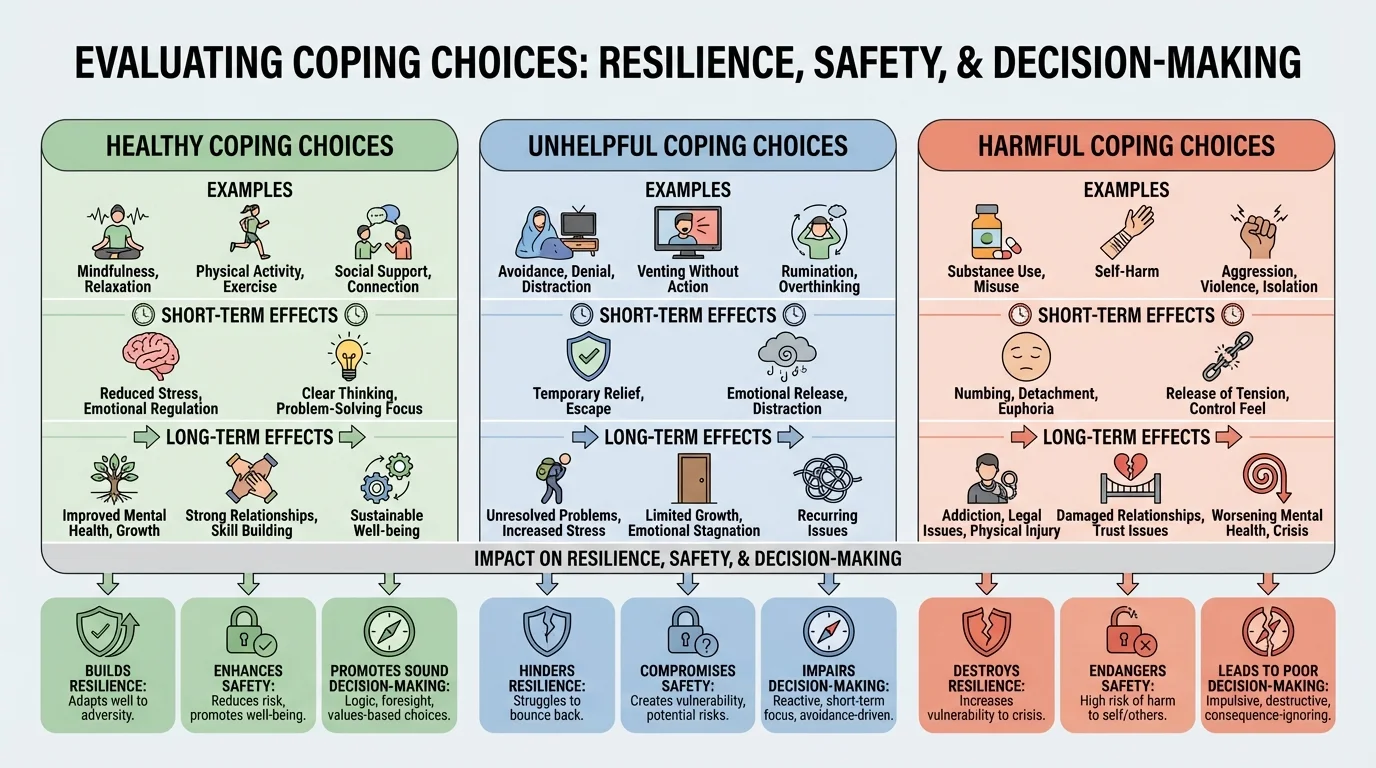
Coping choices are not all equal. Some strategies support recovery and clear thinking, some only delay the problem, and some increase risk. A useful way to judge a coping choice is to ask: "What does this do to me in the next few minutes, and what does it do to my life later?"
As [Figure 1] shows, a healthy coping choice lowers stress without creating a new problem. An unhelpful coping choice may not be dangerous, but it does not really solve anything. A harmful coping choice raises the chances of emotional, social, digital, or physical danger.
Here are some examples:
| Type of coping | Examples | Short-term effect | Long-term effect |
|---|---|---|---|
| Healthy | Taking a walk, deep breathing, journaling, talking to a trusted adult, muting notifications, making a plan | Calms your body and mind | Builds confidence, resilience, and safer choices |
| Unhelpful | Scrolling endlessly, procrastinating, pretending nothing is wrong, isolating for too long | May distract you briefly | Stress often returns stronger |
| Harmful | Self-harm, threatening others, sharing private information, reckless dares, substance use, running away without a safe plan | May feel intense or numbing for a moment | Increases danger, regret, and serious consequences |
Table 1. Comparison of coping choices and their likely short-term and long-term effects.
Notice that "feels better fast" is not the same as "is good for you." Some harmful choices give a quick burst of relief, control, or distraction. But they often damage trust, safety, health, or future options. Healthy coping may take a little more effort in the moment, yet it usually leads to more control and less regret.
This matters online too. Turning off a device for twenty minutes can be healthy. Posting a screenshot of a private conversation to get revenge is harmful. Staying up late re-reading upsetting comments might seem harmless, but it can become an unhelpful pattern that drains sleep, focus, and mood. The categories in [Figure 1] help you look beyond the moment and judge the real effect.
When you are overwhelmed, your body prepares for action. Your heart may beat faster, muscles tighten, your breathing may change, and thoughts speed up. This stress response is useful in a real emergency, but it can cause trouble when you need to think carefully.
Under stress, your brain tends to focus on immediate relief. That can make extreme choices look more tempting. You might think, "I have to fix this right now," or "I cannot stand this feeling." Those thoughts can lead to impulsive behavior, especially if you are tired, embarrassed, angry, or scared.
Why strong feelings can narrow thinking
When emotions surge, your attention often shrinks. You may notice only the threat, the insult, or the pressure in front of you. Healthy coping widens your thinking again. It gives you enough space to remember your values, notice consequences, and choose a response instead of reacting automatically.
This is why pausing matters so much. Even a short pause can interrupt the chain of reaction. If you wait, breathe, move, or get support, the feeling may still be there, but it is less likely to control your actions.
When emotions are high, [Figure 2] shows a process that is simple enough to remember. This routine works because it slows the moment down and turns coping into a set of choices instead of a blur of reactions.
Step 1: Pause. Do not answer immediately. Put the phone down, step away from the screen, or sit somewhere quieter. Count slowly to ten if needed.
Step 2: Notice what you feel. Name the emotion: angry, embarrassed, jealous, panicked, hurt, disappointed, overloaded. Naming the feeling helps reduce confusion.
Step 3: Check safety. Ask, "Am I in danger? Is someone else in danger? Am I about to do something risky?" If the answer might be yes, get help first.
Step 4: Think about consequences. Ask, "What happens if I do this in the next ten minutes? What happens by tomorrow?" This question can reveal whether a coping choice is healthy, unhelpful, or harmful.
Step 5: Choose one healthy action. Pick something realistic, such as drinking water, going outside, muting a chat, writing your thoughts, stretching, or calling a trusted person.
Step 6: Review the result. After a short time, check in with yourself. Are you calmer? Safer? Thinking more clearly? If not, choose another healthy support.
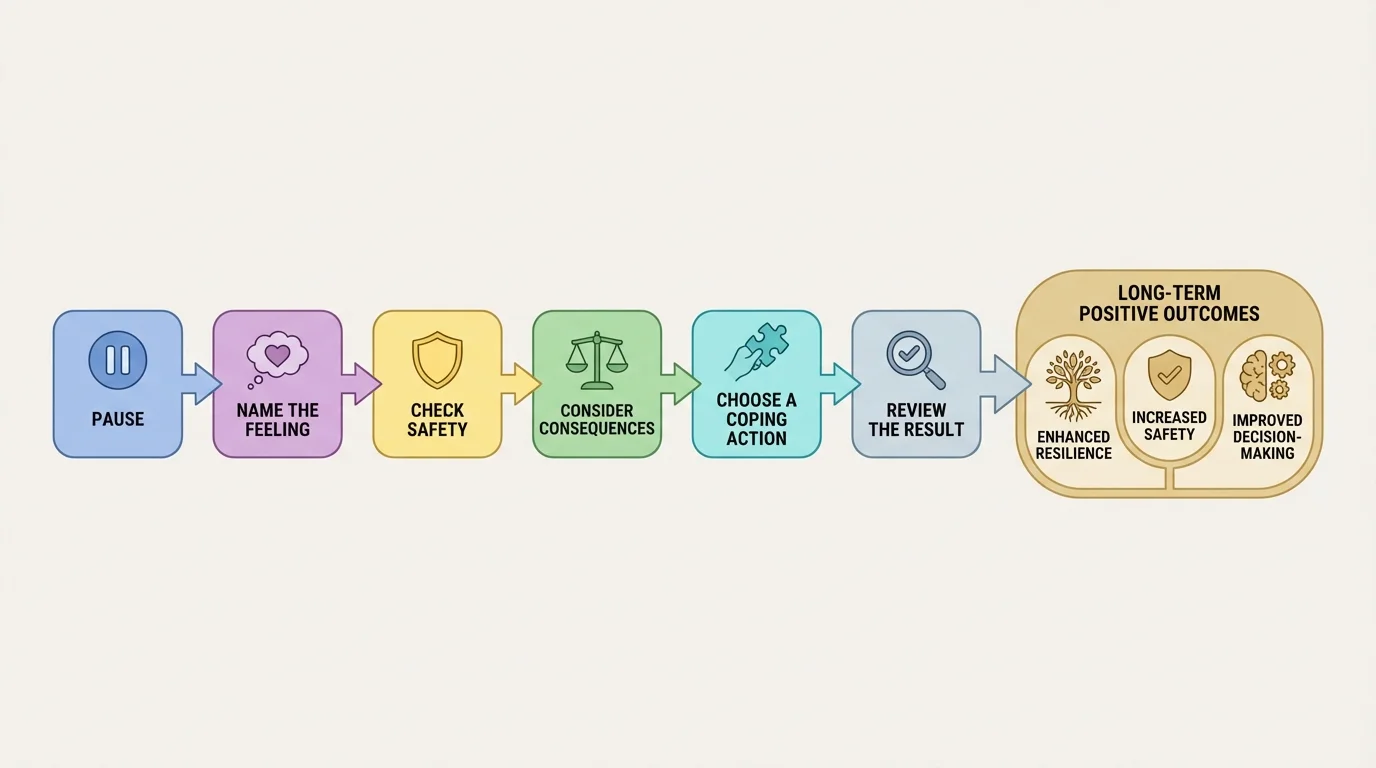
This process does not make problems disappear instantly. It helps you avoid making them worse. That is a big win. Many strong decisions begin with not acting on the first impulse.
Example: You get a hurtful message
A class project partner sends a rude message blaming you for something that was not your fault.
Step 1: Pause instead of replying.
You put your device down for fifteen minutes and breathe slowly.
Step 2: Name the feeling.
You realize you feel angry and embarrassed, not just "mad."
Step 3: Check safety and consequences.
You notice that sending a screenshot to others would spread the conflict and hurt trust.
Step 4: Choose a healthy response.
You draft a calm reply, ask to talk later, and show the message to a trusted adult before sending anything.
The problem is still annoying, but your coping choice protects your safety and supports better decision-making.
The more often you use this kind of process, the more natural it becomes. Over time, you train yourself to respond instead of react. That is one way resilience grows.
Stress does not always look dramatic. Sometimes it builds quietly through overload, disappointment, or social pressure. Healthy coping helps in all of these situations.
Situation 1: Too much schoolwork. You are behind on assignments and feel like giving up. An unhelpful response is avoiding everything and watching videos for hours. A healthier response is to list tasks, choose the smallest first step, and work for a short focused block like twenty minutes. Finishing one part often lowers stress enough to keep going.
Situation 2: Online conflict. A friend leaves you out of a group chat. A harmful response is creating a fake account to spy or starting rumors. A healthy response is stepping back, checking assumptions, and talking directly and calmly when you are ready. You may also decide that muting the chat for a while protects your peace.
Situation 3: Pressure to do something risky. Someone online dares you to share a personal photo or meet without telling a parent or guardian. A safe coping choice is to leave the conversation, block the person, save evidence if needed, and tell a trusted adult right away. Strong coping sometimes means exiting the situation, not staying to prove anything.
Situation 4: Big disappointment. You tried out for something important and did not get in. Healthy coping might include crying, talking with someone, resting, and then asking what to improve next time. Harmful coping would be attacking yourself, attacking others, or doing something dangerous to escape the pain.
Your body often calms faster when you combine two coping tools instead of using just one. For example, slow breathing plus walking, or journaling plus talking to someone, can work better than either strategy alone.
One key sign of a strong coping choice is that it keeps future options open. A good choice helps you think tomorrow, not just survive the next five minutes. The pause-and-choose process from [Figure 2] is useful in all four situations because it helps you move from emotion to intention.
Coping strategies are more powerful when you practice them before a crisis. If you only try to manage stress when you are already overwhelmed, it is harder. Building resilience is a little like training for a sport: small repeated actions matter.
Helpful habits include getting enough sleep, moving your body, eating regularly, limiting overload from notifications, staying connected to supportive people, and noticing early warning signs of stress. None of these makes life perfect. Together, they make you steadier.
Resilience also grows when you learn from mistakes instead of defining yourself by them. If you handled something badly last week, that does not mean you are bad at coping forever. Ask: What set me off? What warning signs did I miss? What would I do earlier next time? Reflection turns mistakes into tools.
"You do not have to control your feelings to control your next step."
Another important part of resilience is support. Strong people are not people who never need help. Strong people recognize when support makes them safer and wiser. Reaching out is a coping skill, not a weakness.
Some situations are too serious to handle alone. If a coping choice involves danger to yourself or someone else, immediate support matters more than privacy or embarrassment.
Get help right away if you are thinking about hurting yourself, someone threatens you, an online contact asks for sexual images or secret meetings, you feel unable to stay safe, or you are using coping methods that are becoming dangerous. In those moments, the goal is not to solve everything by yourself. The goal is to get to safety.
Trusted support can include a parent, guardian, counselor, doctor, coach, group leader, or another responsible adult. If there is immediate danger, contact emergency services or a crisis resource in your area right away. If one person does not respond, tell another. Keep going until someone helps.
If a situation feels urgent, confusing, or unsafe, choose real-world support over secrecy. A private problem can become a serious emergency when it stays hidden.
You never need to wait until a problem is at its worst before asking for help. Early help often prevents bigger harm later.
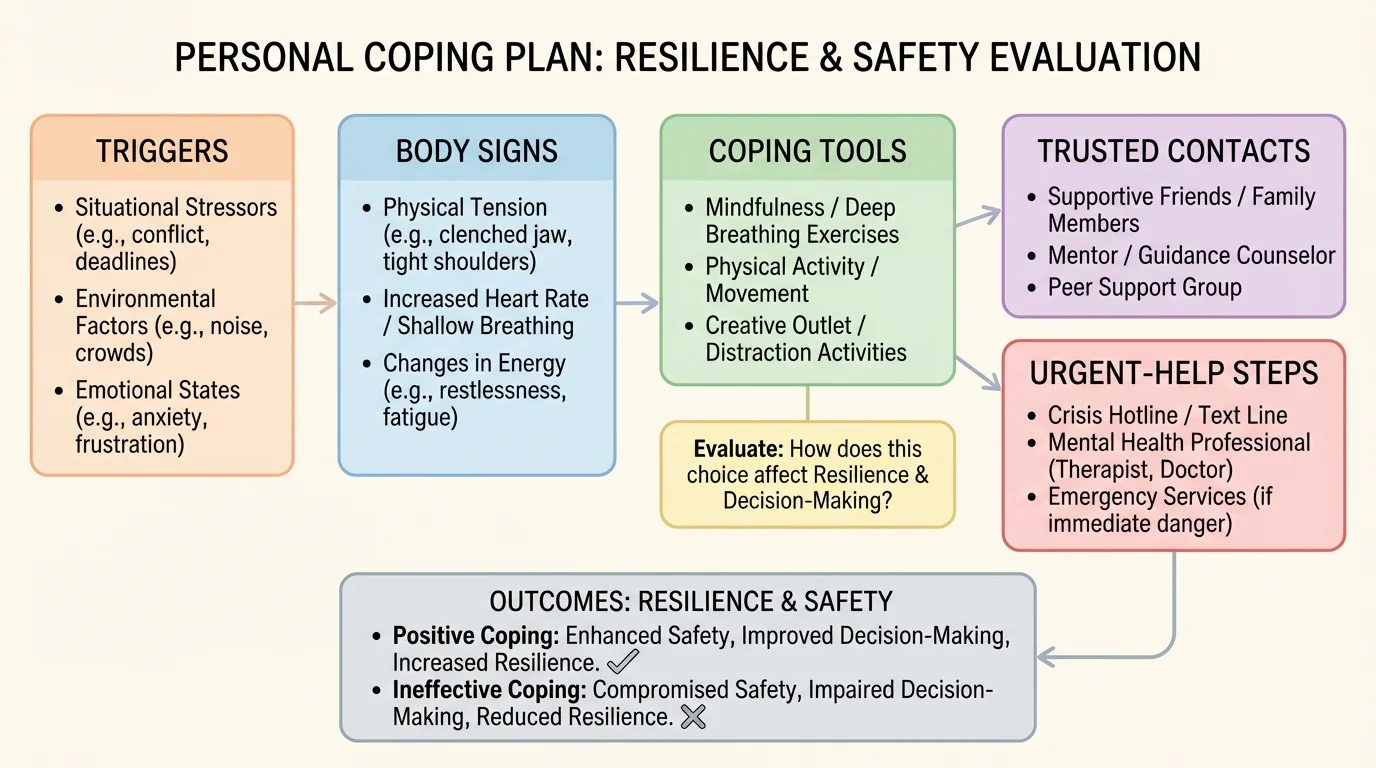
[Figure 3] shows how a personal plan makes healthy coping easier because you do not have to invent your next step while stressed. The template organizes the most important parts of a coping response before emotions get intense.
Build your plan around real situations from your life. Keep it simple and practical so you will actually use it.
Include these parts:
Common triggers: What usually sets off strong stress for you? Examples: conflict, too many tasks, feeling left out, criticism, lack of sleep, family stress.
Warning signs: What happens in your body and thoughts? Examples: fast heartbeat, clenched jaw, stomach ache, racing thoughts, urge to quit, urge to lash out.
Healthy coping tools: List at least three choices you can realistically do. Examples: take a walk, breathe slowly for two minutes, write what happened, listen to calming music, stretch, message a trusted person.
Support people: Write down names and contact methods for adults and friends who help you stay grounded and safe.
Safety steps: Decide what you will do if stress becomes intense. Examples: leave the chat, hand your device to an adult, move to a shared space in your home, call for help.
Example of a personal coping plan
Trigger: A friend ignores my messages and I start assuming the friendship is over.
Warning signs: I keep checking my phone, feel shaky, and want to send angry texts.
Healthy coping tools: Put the phone away for twenty minutes, write down the facts, talk to my older cousin, and go outside.
Safety step: If I feel like posting something mean or risky, I give my device to my parent and ask for help calming down.
This plan reduces the chance that one stressful moment will lead to a harmful decision.
Your plan can change over time. As you learn more about yourself, you can update it. The point is not perfection. The point is preparation. When stress rises, prepared choices protect resilience, safety, and judgment.
Every coping choice teaches your brain something. If you repeatedly choose actions that calm, protect, and help you think clearly, those actions become easier to reach for. If you repeatedly choose actions that intensify problems, those patterns also grow. Your daily choices are practice for future hard moments.
