Ever notice how two people can watch the same video call, read the same messages, and still come away with very different interpretations about what happened? That is not just random confusion. It is often a sign that people are seeing the same situation from different angles. In diverse groups, that happens all the time. The groups that work well are not the ones where everyone thinks the same way. They are the ones where people learn how to understand each other well enough to move forward together.
If you work with other people online, in a club, on a team, in a volunteer project, or even in your own family, collaboration depends on more than sharing tasks. It depends on how people respond when they disagree, misunderstand each other, or bring different experiences into the conversation. One of the most useful skills for handling that is perspective-taking. It helps you slow down, understand what may matter to someone else, and make decisions that work better for the whole group instead of just one person.
Perspective-taking matters because diverse groups are powerful, but they can also be complicated. A diverse group may include people with different ages, cultures, schedules, personalities, strengths, needs, and ways of communicating. One person may want fast decisions. Another may want more time to think. One may speak directly. Another may choose words carefully to avoid sounding rude. If nobody tries to understand those differences, the group can become frustrated very quickly.
When perspective-taking is missing, people often make unfair guesses. They might think, "She does not care," when the real issue is that she is nervous about speaking up. They might think, "He is controlling," when he is actually worried the deadline will be missed. These mistaken stories can damage trust. Once trust drops, even small problems feel bigger.
When perspective-taking is present, the opposite happens. People ask better questions, divide work more fairly, and solve problems faster. They are less likely to take things personally. They can still disagree, but the disagreement becomes more productive because they are trying to understand, not just win.
Perspective-taking means trying to understand how a situation looks, feels, or makes sense from another person's point of view. It does not mean you must agree with them. Empathy is the ability to care about another person's feelings and experiences. Diverse groups are groups made up of people with different identities, experiences, abilities, viewpoints, or roles.
A practical way to think about this is simple: perspective-taking helps you collect missing information before you judge someone's behavior. That makes your response smarter, calmer, and more respectful.
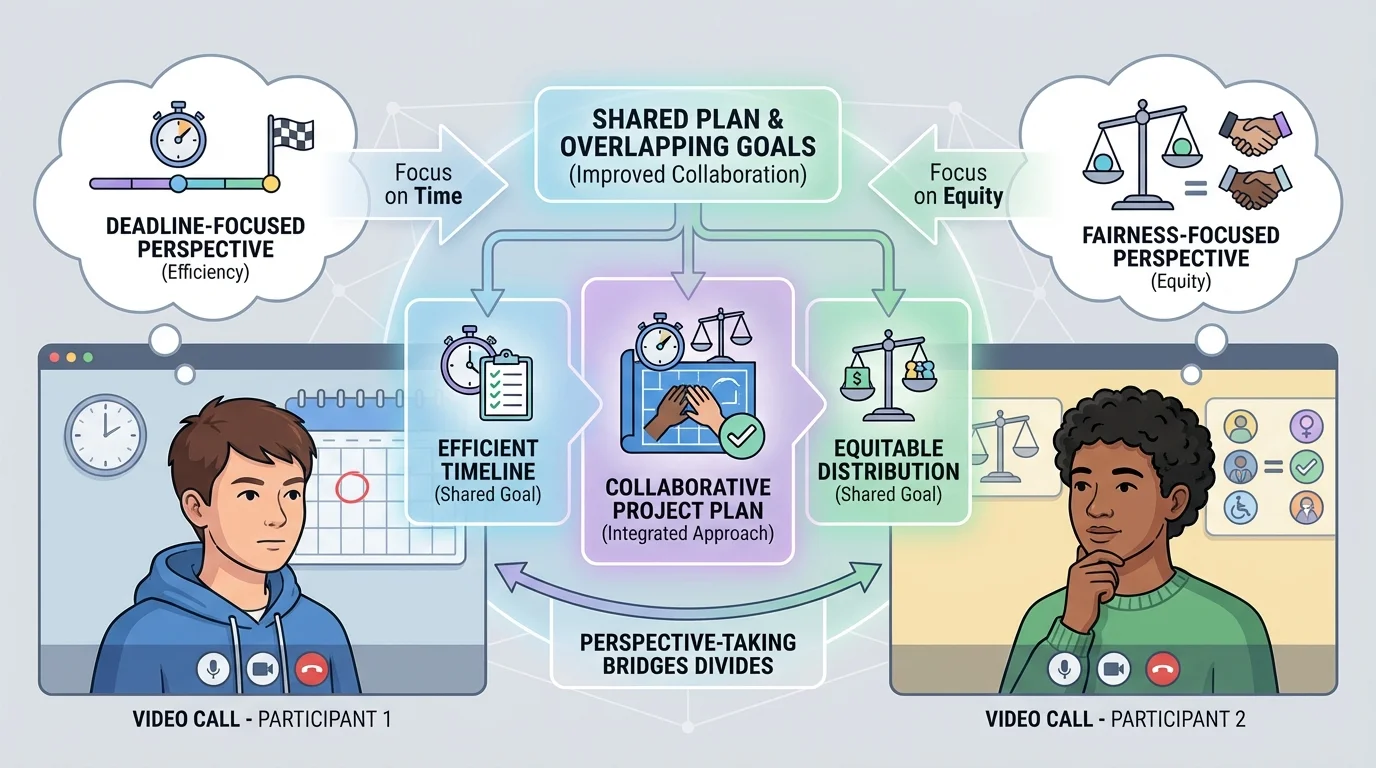
Perspective-taking, as [Figure 1] shows, is not about guessing wildly or pretending you know exactly what another person feels. It means you actively try to understand what might be influencing their reaction, priorities, or choices. You look beyond your own point of view and ask, "What might this situation be like for them?"
This skill connects closely to empathy, but they are not exactly the same. Empathy is more about emotionally connecting and caring. Perspective-taking is more about mentally stepping into someone else's position to understand their view. You often use both together. For example, if a teammate seems annoyed in a group chat, perspective-taking helps you consider possible reasons, and empathy helps you respond kindly instead of harshly.
It also does not mean agreement. You can understand why someone wants more time, more credit, or a different plan and still decide that their idea is not the best option. But when you understand their reasons, you can respond in a way that respects them. That usually leads to better teamwork than simply dismissing them.
Another important point: perspective-taking is not mind-reading. You are not supposed to know exactly what someone thinks. Instead, you use clues, ask questions, and stay open to correction. If you assume too much, you may create a new misunderstanding. Good perspective-taking sounds like, "I might be wrong, but are you worried about...?" or "It seems like this matters to you because... Is that right?"
That last step matters because people are experts on their own experiences. The goal is not to invent a story for them. The goal is to understand them more accurately.
A diverse group can produce stronger ideas because different people notice different problems and solutions. Someone with strong organization skills may spot scheduling issues early. Someone creative may suggest a fresh idea. Someone who has dealt with a similar challenge before may notice a risk others miss. Perspective-taking helps the group actually use those differences instead of fighting over them.
Without perspective-taking, diversity can feel like constant friction. People may assume that different means difficult. But with perspective-taking, different starts to mean useful. A group can combine strengths instead of treating differences like threats.
For example, suppose four teens are planning a community fundraiser online. One wants a attention-grabbing social media campaign. One wants clear rules so the event stays organized. One is worried about making the project inclusive for younger kids and families. One is concerned about cost. If they only defend their own ideas, the planning gets stuck. But if they try to understand each person's priorities, they can build a plan that is creative, organized, welcoming, and affordable.
Perspective-taking also helps groups make fairer choices. If the loudest or fastest speaker always gets their way, other people may stop contributing. But when group members intentionally ask whose voice has not been heard yet, they create more balanced participation. That leads to stronger decisions because the group uses more of the knowledge available.
Why better understanding leads to better teamwork
When people feel understood, they are more likely to share honestly, listen in return, and stay engaged. That increases trust. Trust makes it easier to divide tasks, ask for help, admit mistakes, and handle disagreement without attacking each other. In other words, perspective-taking improves both the emotional side of teamwork and the practical side.
You can see this in digital communication too. Messages are short. Tone is easy to misread. A person who sends "Fine" may be upset, busy, or just typing quickly. Perspective-taking reminds you not to jump straight to the worst explanation.
Perspective-taking works best when you use a repeatable method, as [Figure 2] illustrates. You do not need a perfect script. You just need a process that helps you pause before reacting and collect better information.
Step 1: Pause. Before responding, notice your first reaction. Are you annoyed, embarrassed, defensive, or impatient? Strong emotions can make your view feel like the only reasonable one. A short pause gives your brain time to think instead of just react.
Step 2: Name your own viewpoint. Ask yourself, "What am I assuming right now?" Maybe you assume the other person is lazy, rude, or trying to control the group. Saying your assumption silently helps you recognize that it is only one possible explanation.
Step 3: Look for other possible reasons. Think of at least two other explanations. Maybe they are confused. Maybe they are worried. Maybe they have less free time than you realized. Even generating two alternatives helps your thinking become more flexible.
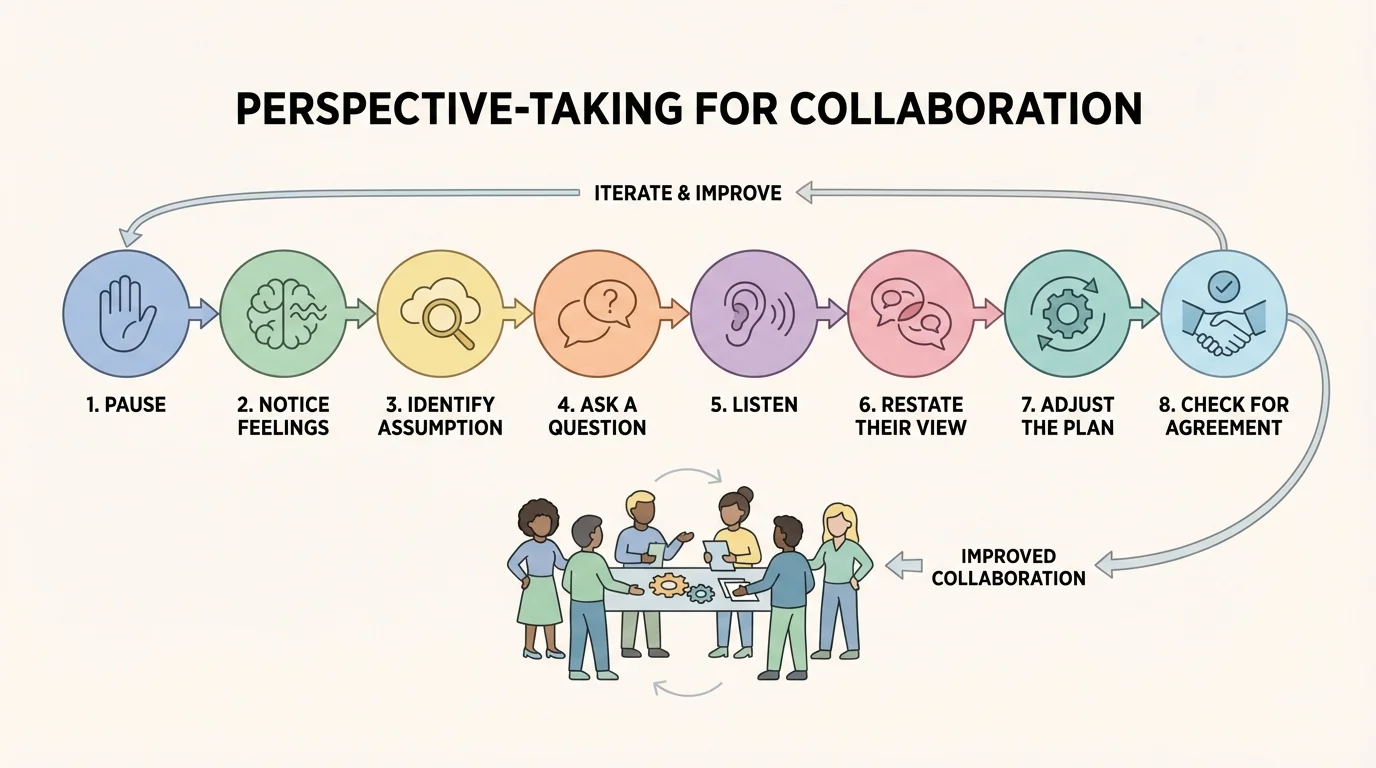
Step 4: Ask instead of assume. Use calm, respectful questions. Try: "Can you tell me what's making this option feel better to you?" or "What concern are you trying to solve?" These questions invite explanation instead of creating a fight.
Step 5: Listen for needs, not just words. Sometimes the exact request is not the real issue. A person asking for more time may really need support, clarity, or fairness. Listening for the deeper need helps the group solve the real problem.
Step 6: Restate what you heard. Say, "So you're worried that if we rush, the quality will drop. Did I get that right?" Restating helps the other person feel heard and gives them a chance to correct you.
Step 7: Adjust the plan. Once you understand different viewpoints, change the plan if needed. Good collaboration is not just about hearing people out. It is about using what you learned to improve the group's next step.
This process does not take long. In many situations, it only takes a minute or two. But that short pause can prevent hours of conflict later.
Example: Online project disagreement
You and two other students are creating a shared presentation for a youth organization. One person keeps rewriting your slides, and you feel irritated.
Step 1: Pause and identify your first story.
Your first thought is: "They think my work is bad."
Step 2: Generate other explanations.
Maybe they are stressed about quality. Maybe they are used to doing too much. Maybe they did not realize this felt disrespectful.
Step 3: Ask a clear question.
You send: "I noticed the slides changed a lot. I want us to work well together. What are you most concerned about with the presentation?"
Step 4: Restate and adjust.
They explain they are worried the instructions were unclear. You reply: "Got it. You're trying to make sure we match the goals. Let's divide who edits what so everyone keeps ownership."
The problem shifts from personal frustration to shared problem-solving.
As you saw earlier in [Figure 1], collaboration improves when people move from separate concerns toward a shared plan. That shift often begins with one person choosing to ask instead of accuse.
Perspective-taking is useful in more places than formal teamwork. It matters in gaming teams, family planning, friendships, clubs, volunteer work, and online communities.
In a gaming team, someone may stop using voice chat. One explanation is "They are not committed." Another is "They feel talked over." If the team asks and listens, it may discover that quieter players need more space to contribute. That can improve team strategy because more information gets shared.
In a family decision, maybe you want to go somewhere on the weekend while another person wants to stay home. Perspective-taking helps you notice that what looks like "boring" behavior to you may actually be exhaustion for them. Knowing that changes the conversation. You can discuss energy levels and needs instead of turning it into a personal conflict.
On social media, perspective-taking can stop arguments from growing. Text strips away facial expressions and tone, so people often read messages in the harshest way. Before replying, you can ask yourself, "What are three ways this comment could be meant?" That question helps you respond more carefully.
Online communication makes misunderstandings more likely because your brain fills in missing tone and emotion on its own. That means perspective-taking is not extra in digital spaces; it is basic protection against false assumptions.
Try this: the next time a message bothers you, wait a few minutes before replying. Reread it once as if the person is annoyed, once as if they are rushed, and once as if they mean well but wrote it poorly. Your response will probably become calmer and more accurate.
Perspective-taking sounds simple, but several obstacles get in the way. One major barrier is assumption. An assumption is a belief you treat like a fact without checking it. Assumptions save time, but they also create mistakes, especially in groups where people have different experiences.
Another barrier is stereotype. A stereotype is an oversimplified belief about a group of people. Stereotypes are harmful because they make you interpret a person through a label instead of paying attention to who they actually are. If you rely on stereotypes, you are not really taking perspective. You are replacing the real person with a shortcut.
Defensiveness is another challenge. If someone gives feedback that affects your idea, your brain may hear it as a threat. In that moment, perspective-taking gets harder because you are focused on protecting yourself. A useful strategy is to separate your worth from the idea being discussed. If one plan needs changing, that does not mean you are a failure.
Text-only communication can also cause problems. Short replies, delayed responses, and missing tone make misunderstandings more common. In those moments, switch to more direct communication if possible, such as a voice note or video call. Richer communication gives you more clues.
Power differences matter too. If one person is older, more confident, more skilled, or more outspoken, others may hesitate to share their real perspective. Good collaboration means creating space for quieter voices. That can sound like, "We've heard two ideas already. I want to check whether anyone sees this differently."
"Seek first to understand, then to be understood."
— Stephen R. Covey
Try this: when you notice yourself feeling instantly certain that someone is wrong, add the sentence, "What might I be missing?" That one sentence can lower defensiveness and open your thinking.
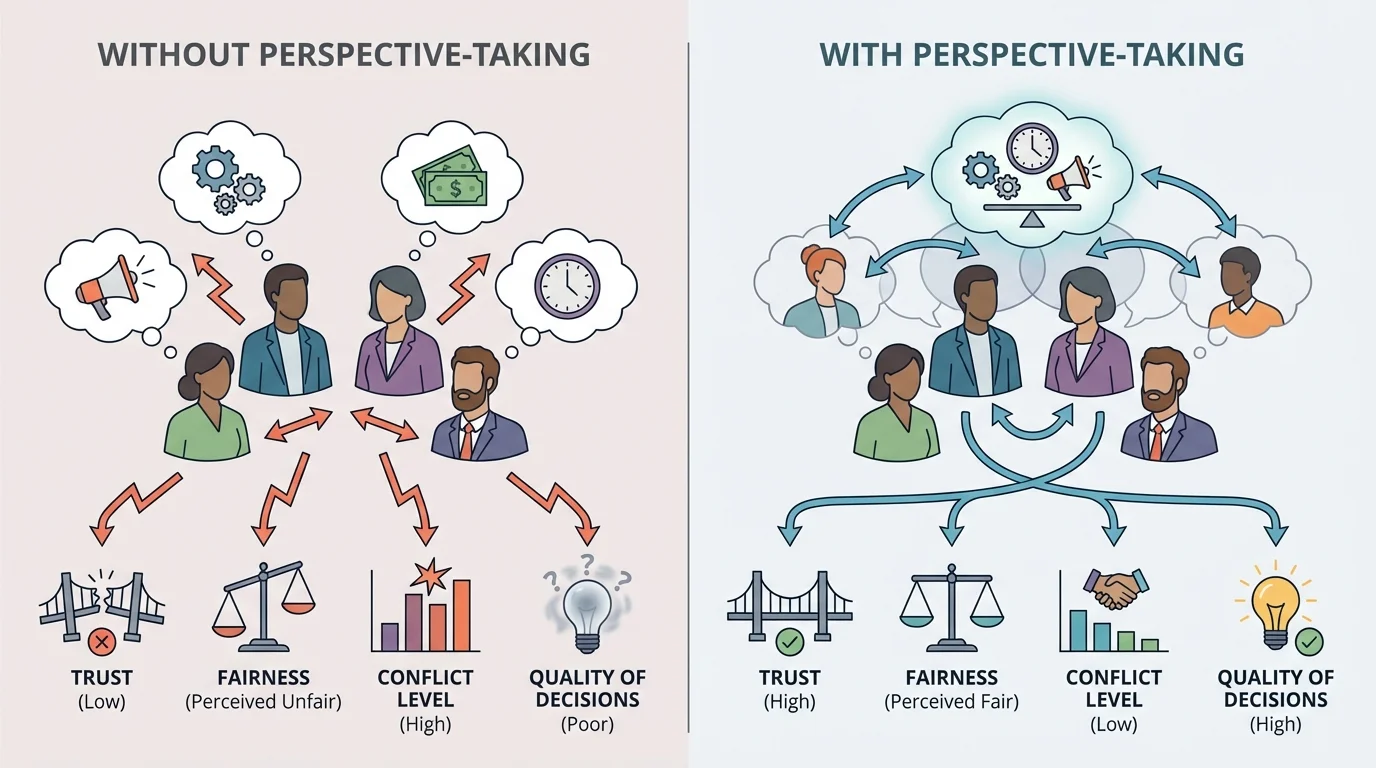
You can actually evaluate whether perspective-taking improved the group's work, and [Figure 3] compares the difference clearly. Do not judge it only by whether everyone feels happy in the moment. Sometimes good collaboration still includes disagreement. Instead, look at the results in how the group communicates, decides, and follows through.
One sign is clearer understanding. Can people explain each other's concerns accurately? Another sign is fairer participation. Are more voices included, or is one person still dominating? Another is stronger decision quality. Did the final plan improve because more viewpoints were considered? You can also look at commitment. Are people more willing to support the decision because they felt heard?
Here are useful questions to ask after a group discussion: Did we check our assumptions? Did we understand the reason behind each person's position? Did anyone get ignored? Did the final plan reflect more than one viewpoint? Did conflict go down because people felt respected, or did it just get buried?
That last question is important. A group can look calm on the surface while someone feels dismissed. Real collaboration is not fake peace. It is honest communication plus mutual respect.
| What to Look For | When Perspective-Taking Is Weak | When Perspective-Taking Is Strong |
|---|---|---|
| Listening | People interrupt or prepare their comeback instead of listening | People ask questions and restate what they heard |
| Decision-making | One viewpoint controls the outcome | Different viewpoints shape the final plan |
| Conflict | Misunderstandings repeat | Problems get clarified earlier |
| Participation | Quieter members withdraw | More members contribute ideas |
| Trust | People feel judged or ignored | People feel respected even during disagreement |
Table 1. Comparison of group behaviors and outcomes when perspective-taking is weak versus strong.
Later, when you think back to the process shown in [Figure 2], notice that the final step is not just agreement but checking whether the plan actually improved. That is what evaluation is: looking at evidence, not just intentions.
Example: Evaluating a planning meeting
A youth group is organizing a cleanup event. At first, two members disagree about the meeting time.
Step 1: Identify the viewpoints.
One prefers early morning because it is cooler outside. Another prefers later because family responsibilities make mornings hard.
Step 2: Use perspective-taking.
The group asks questions instead of choosing the first suggestion. They learn that transportation and family schedules are part of the issue.
Step 3: Adjust the plan.
The group chooses a mid-morning time and creates a ride-sharing option.
Step 4: Evaluate the result.
More people attend, fewer members feel left out, and the group avoids the argument getting personal.
The improvement is visible in both fairness and effectiveness.
A good rule is this: if perspective-taking helped, the group usually becomes more accurate, more fair, and more effective at the same time.
Perspective-taking gets stronger with practice. You do not suddenly become great at it in one day. You build it through small repeated choices.
Try this when watching a disagreement online: pause before deciding who is right. Ask what each person may be protecting, fearing, or valuing. This does not mean both sides are equally correct. It means you are training yourself to understand motives before reacting.
Try this in daily conversations: if someone makes a choice you do not understand, replace "Why would they do that?" with "What might make that choice reasonable from their point of view?" That question builds mental flexibility.
Try this in your own groups: once during a discussion, summarize someone else's idea before sharing your own. This shows respect and checks understanding. It also increases the chance that they will listen carefully when it is your turn.
Over time, this skill changes the kind of teammate, friend, family member, and leader you become. You become less reactive, less trapped by first impressions, and better at bringing people together. In diverse groups, that is a major strength. It helps people feel seen, and it helps the group do better work.
Understanding another person's perspective does not erase your own needs. Healthy collaboration means balancing your viewpoint with other people's viewpoints so the group can make wise, fair decisions.
When you evaluate perspective-taking honestly, the biggest question is not "Did we all agree?" The bigger question is "Did understanding each other help us work better together?" In strong groups, the answer is often yes.
