A group chat can go silent after one rude joke. A gaming team can stop working together because someone keeps getting ignored. A person can start holding back their ideas after hearing the same stereotype again and again. Small moments like these do not stay small. They affect how people feel about themselves, how safe they feel around others, and whether a group becomes supportive or toxic.
This matters because well-being is not just about health in a medical sense. It includes your emotions, confidence, relationships, stress level, and feeling that you belong somewhere. When people are excluded or judged unfairly, the damage can reach both the individual and everyone around them. When people are treated with fairness and respect, the opposite happens: trust grows, participation increases, and communities become stronger.
Exclusion means leaving someone out unfairly or making it hard for them to participate. This can be obvious, like not inviting someone into a group project for a community club, or subtle, like always talking over the same person in a video call.
Bias is a tendency to judge unfairly, often without noticing it. Sometimes people show bias on purpose, but often it appears in quick assumptions, different expectations, or treating people differently based on identity, appearance, background, language, ability, religion, gender, or culture.
Stereotype means a simplified belief about a whole group of people. Stereotypes may sound like shortcuts, but they erase individual differences. They can seem "small," yet they often lead to bigger problems because they shape how people are treated.
Prejudice is a negative judgment or feeling about someone before getting to know them. Discrimination is unfair action based on those judgments. A stereotype can feed prejudice, and prejudice can lead to discrimination.
These ideas are connected. If someone assumes a stereotype is true, they may start expecting less from certain people, trusting them less, or excluding them from opportunities. That is how private thoughts can turn into real harm.
Exclusion, bias, and stereotypes can hurt one person in several ways at once through a chain from unfair treatment to emotional stress and withdrawal. A person may feel embarrassed, angry, lonely, anxious, or unsafe. They may start wondering, "Is something wrong with me?" even when the problem is someone else's unfair behavior.
These experiences also affect confidence. If a student shares an idea in an online club meeting and gets ignored again and again while others are praised for similar ideas, that student may stop speaking up. Over time, unfair treatment can lower motivation and make a person avoid spaces where they should feel welcome.
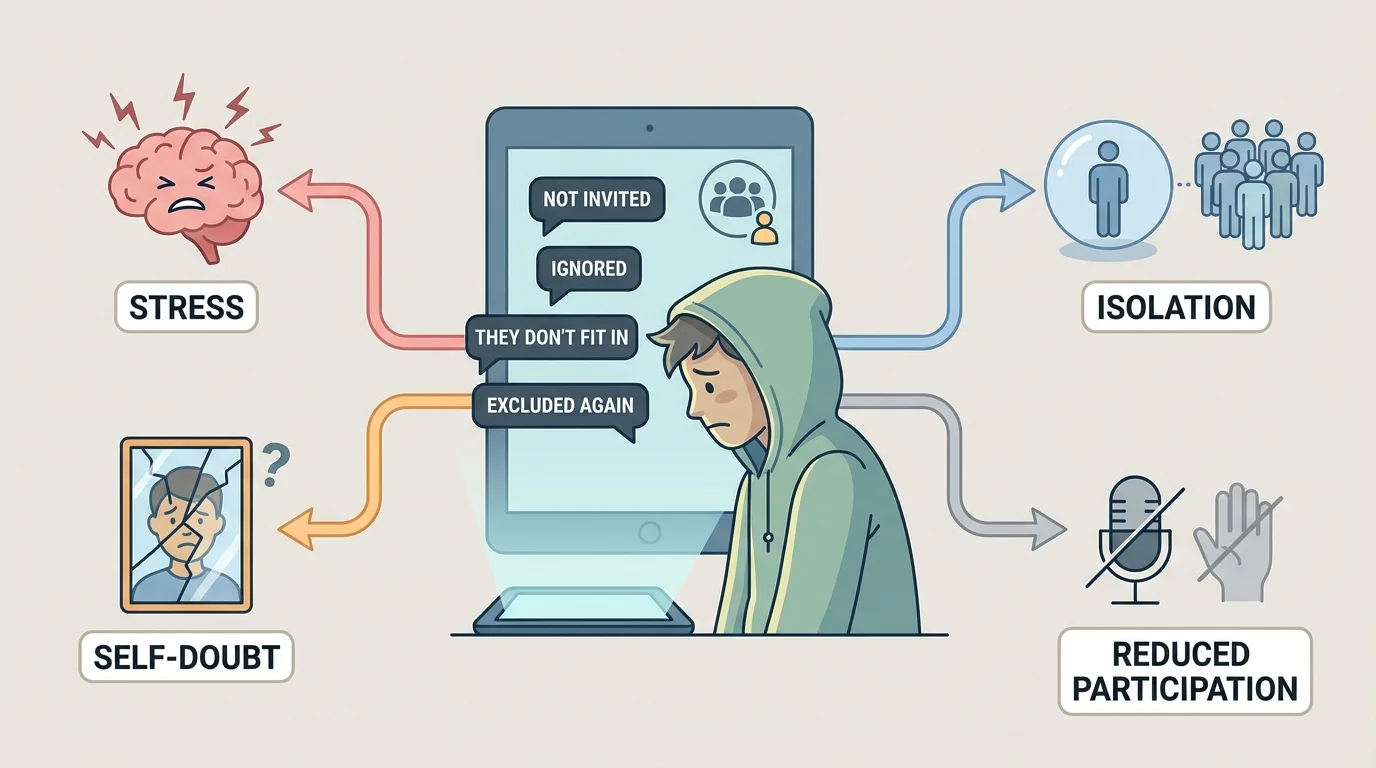
There can also be physical effects. Stress is not "just in your head." It can lead to headaches, trouble sleeping, stomach discomfort, muscle tension, or feeling tired all the time. When unfair treatment keeps happening, the body can stay on alert, which makes it harder to relax and focus.
Another important concept is belonging. Belonging means feeling accepted, valued, and safe enough to be yourself. When someone is repeatedly excluded, they may begin to expect rejection everywhere. That can change how they act even in new situations where people might actually be kind.
You can see this clearly in online spaces. Suppose a teen joins a creative writing server. People welcome most new members, but when this student posts, no one responds, or they get comments based on stereotypes about where they come from. Even if no one uses a direct insult, the message is clear: "You are not fully included here." As we saw in [Figure 1], that kind of treatment can lead to self-doubt and silence.
Repeated social rejection activates some of the same stress systems in the brain and body that respond to physical danger. That is one reason exclusion can feel so intense even when no one touches you.
One unfair event can hurt. Repeated unfair events can shape a person's identity, choices, and future opportunities.
These behaviors do not only affect individuals. They also change the health of a whole group by shaping inclusive or exclusionary group dynamics. In any online team, club, volunteer group, friend circle, or neighborhood activity, people notice what gets rewarded, what gets ignored, and who gets protected.
If biased jokes are allowed, people learn that disrespect is normal. If one person is regularly left out and no one speaks up, others may worry they could be next. Trust drops. Participation drops. Honest conversation becomes harder. People may pretend everything is fine while quietly pulling away.
Groups with unfair patterns also make worse decisions. Why? Because people share fewer ideas when they think they will be mocked or dismissed. A group that excludes different viewpoints loses creativity, problem-solving power, and honesty.
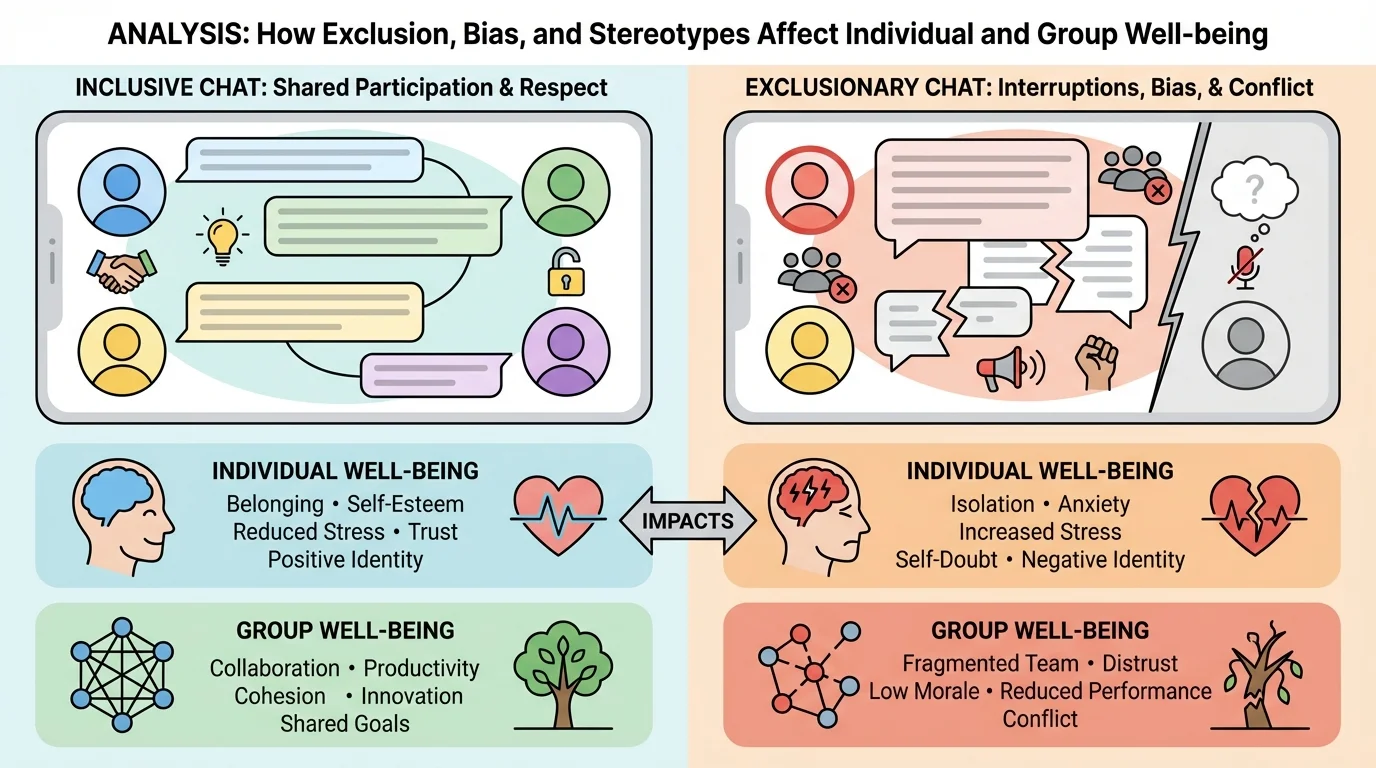
Think about a volunteer youth project planning an event online. In one version, everyone is asked for input, names are pronounced correctly, and questions are welcomed. In another version, a few people dominate the call, someone's identity becomes the target of jokes, and certain members are left off key messages. The second group may still finish the event, but it will likely have more stress, more resentment, and less teamwork.
Communities are healthier when people feel seen and respected. That does not mean everyone always agrees. It means disagreement happens without demeaning anyone's identity or worth. The contrast in [Figure 2] helps show why fairness is not just a "nice extra." It is part of what makes groups function well.
| Group Pattern | What It Looks Like | Likely Result |
|---|---|---|
| Inclusive behavior | Inviting input, respectful language, fair chances to participate | Trust, cooperation, stronger ideas |
| Exclusion | Ignoring, leaving out, controlling access to information | Isolation, resentment, lower engagement |
| Bias | Different treatment based on identity or assumptions | Unfair opportunities, tension, reduced confidence |
| Stereotyping | Assuming group traits apply to each person | Misunderstanding, harmful labels, poor decisions |
Table 1. Common group patterns and their effects on well-being and teamwork.
Sometimes harmful behavior is obvious. Sometimes it hides behind phrases like "I was just joking," "You're too sensitive," or "That's just how they are." Learning to spot patterns matters.
Here are signs to watch for:
Online examples are especially important because text, comments, and reaction icons can spread quickly. A stereotype in a meme, a dismissive comment during a livestream, or excluding someone from a planning chat can all shape whether people feel respected.
Intent and impact are not the same thing. A person may say, "I didn't mean to be hurtful." That may be true about intent, but the impact still matters. If words or actions push someone out, increase stress, or reinforce unfair treatment, harm has still happened.
Noticing impact helps you move beyond arguments about whether someone is "a bad person." The goal is to recognize what happened and improve what happens next.
Many people think bias always looks loud and obvious. Sometimes it does. But often it works quietly through habits and quick judgments. This is where the concept of implicit bias becomes important. Implicit bias is an automatic mental shortcut that can affect how you react before you have fully thought things through.
For example, someone might assume one person is more responsible, friendly, athletic, or intelligent based on appearance, accent, name, clothing, or identity markers. Even when no insult is spoken, these assumptions can change who gets trusted, invited, or listened to.
Digital spaces can strengthen this problem. Social media feeds often repeat the same kinds of content. If a person mostly sees stereotypes, their brain may start treating those repeated images like "normal" evidence, even when the content is inaccurate or unfair. Repetition does not make a stereotype true.
That is why it is important to pause before making snap judgments. Ask yourself: What facts do I actually know? What am I assuming? Would I treat another person the same way in this situation?
If exclusion, bias, or stereotypes are directed at you, your first job is not to "win" the argument. Your first job is to protect your well-being. You deserve safety and respect.
Step 1: Notice what happened clearly. Name it in simple words: "I was interrupted three times." "They made a stereotype-based joke." "I was left out of the planning thread." Being specific helps you decide what to do next.
Step 2: Check safety. If the situation feels threatening, log off, leave the chat or call, block the person if needed, and contact a trusted adult, moderator, coach, group leader, or family member. Safety comes before explanation.
Step 3: Save evidence when appropriate. Screenshots, dates, times, and exact quotes can help if you need support. This is especially useful in online spaces where messages may be deleted.
Step 4: Decide whether to respond directly. Sometimes a short statement works: "That comment stereotypes people." "Please don't talk over me." "I want to be included in the planning messages." You do not owe a long debate.
Step 5: Reach out for support. Talk to a trusted adult, mentor, counselor, club organizer, faith leader, or another supportive person. Isolation makes harm heavier. Support makes it easier to think clearly.
Example: Responding to exclusion in an online project group
You notice that everyone but you was added to a planning message thread for a community event.
Step 1: Identify the behavior
You write down the facts: "I was not included in the thread where tasks were assigned."
Step 2: Use a calm direct message
You send: "I saw that task planning happened in a thread I wasn't added to. Please include me in future planning messages so I can contribute too."
Step 3: Escalate if needed
If it keeps happening, you contact the adult coordinator and share the pattern with screenshots.
This approach stays clear, respectful, and focused on action.
Also pay attention to your inner voice. Unfair treatment can make you blame yourself. Remind yourself: being stereotyped or excluded does not define your value.
You do not have to be the target to make a difference. A witness can shift the whole situation by choosing a safe and constructive response. Speaking up does not always mean making a dramatic speech. Often it means doing one steady, useful thing.
Here are practical options:
Being a witness also means using judgment. If stepping in directly would make things less safe, choose another path, such as documenting what happened, reaching out to the person privately, or contacting someone with authority.
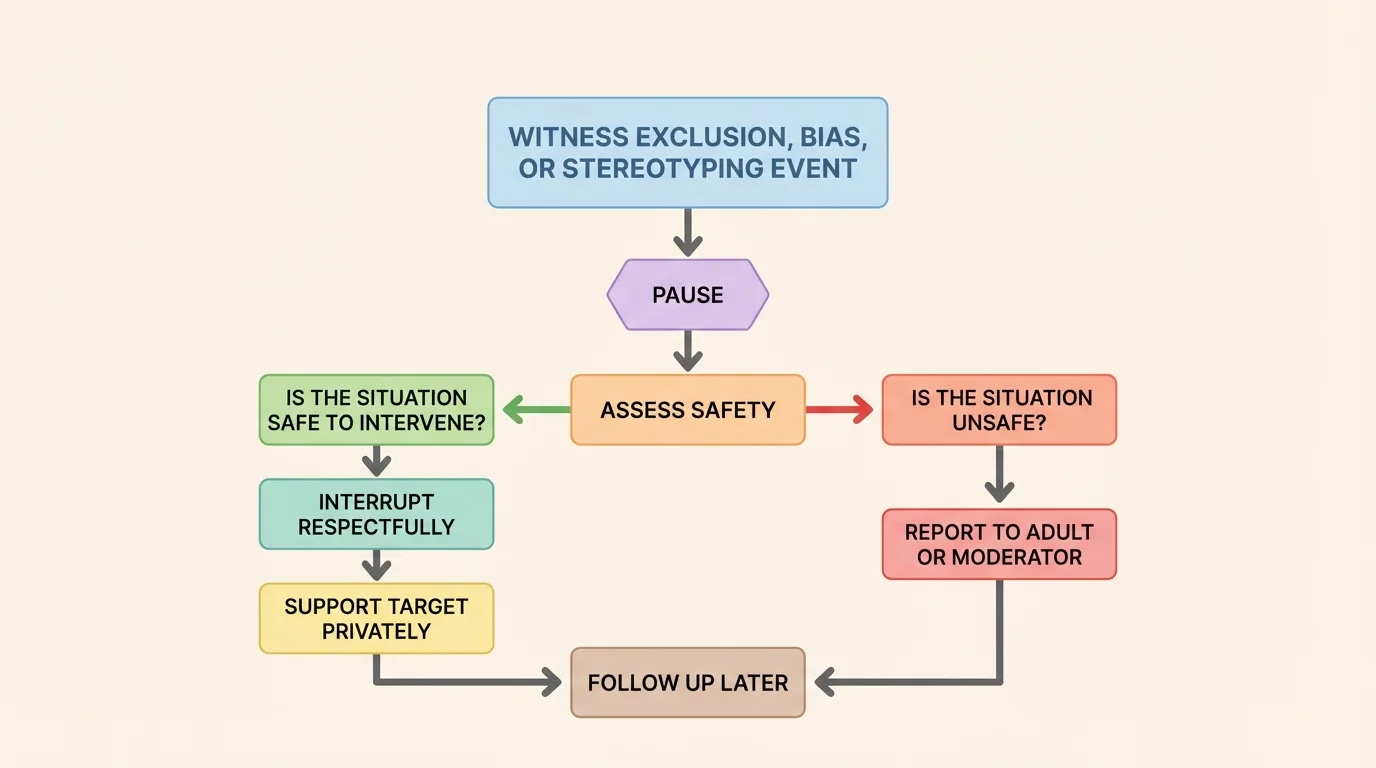
For example, if someone in a gaming voice chat mocks another player using a stereotype, you might say, "Cut that out," and then privately check on the player who was targeted. If the behavior continues, report it. Later, the group often remembers not only who caused harm, but who helped create safety. The decision path in [Figure 3] works because it gives you more than one safe option.
"If you are neutral in situations of injustice, you have chosen the side of the oppressor."
— Desmond Tutu
You may not be able to fix everything, but your response can reduce harm and show others what respectful behavior looks like.
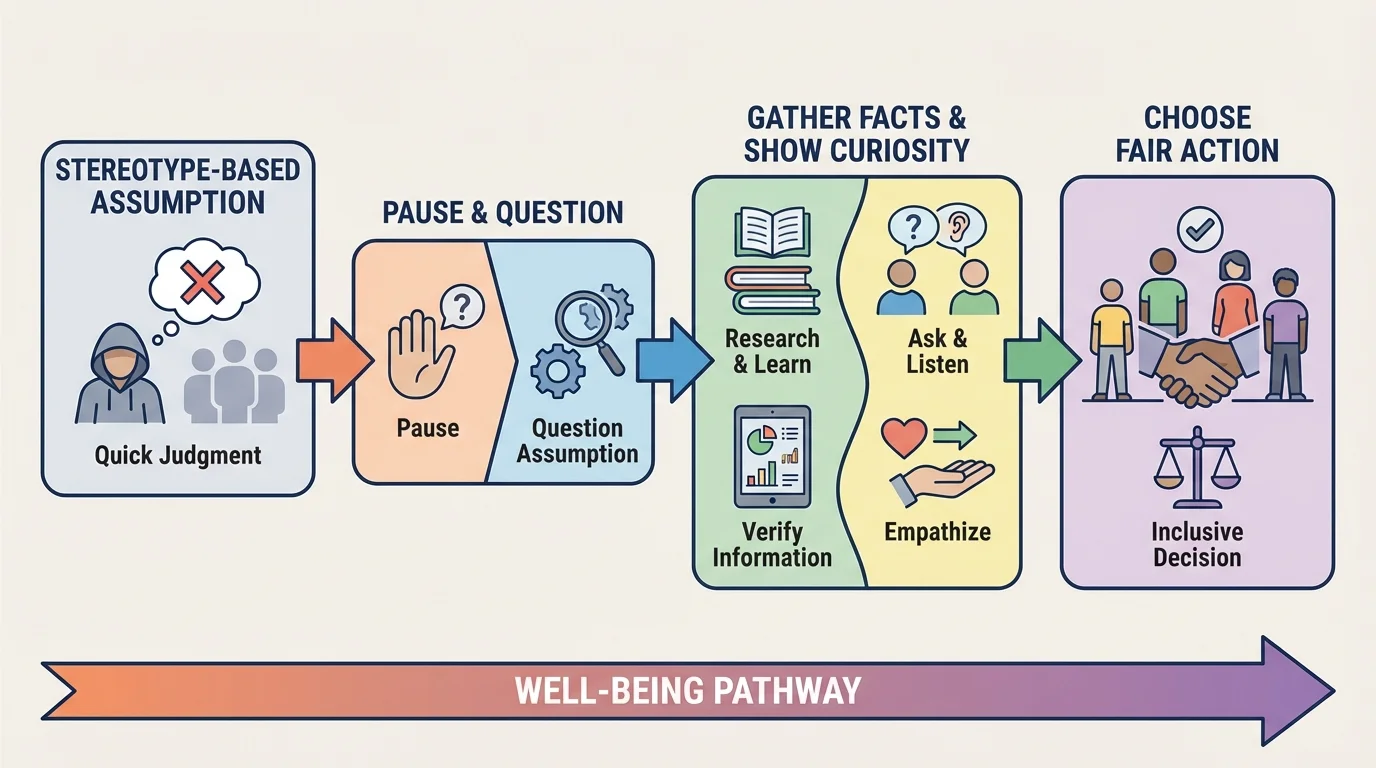
Everyone absorbs messages from family, media, friends, and culture. That means anyone can pick up unfair assumptions. The important skill is not pretending you are perfect. It is catching a fast assumption before it turns into unfair behavior and moving from snap judgment to respectful action.
When you notice yourself making a quick assumption, pause. Ask: "What am I basing this on?" "Do I have evidence?" "Am I reducing a person to one label?" This pause creates space between thought and action.
Next, replace certainty with curiosity. Instead of assuming, ask respectful questions when appropriate. Listen to individual experiences. Let people define themselves. Stereotypes shrink people; curiosity makes room for the full person.
This also means correcting yourself when needed. If you realize you interrupted someone more than others, overlooked a person's contribution, or laughed at a harmful joke, do not get stuck in defensiveness. A better move is: recognize it, apologize clearly, and change the behavior.
An effective apology sounds like this: "I interrupted you and that was unfair. I'm sorry. I want to hear your full point." Notice that this apology names the action and the repair. It does not make excuses.
Empathy is not just feeling bad when someone is hurt. It is understanding their experience enough to respond with care and fairness.
As shown in [Figure 4], one pause can prevent a stereotype from becoming a harmful choice.
Respectful communities are built from repeated actions. You do not create inclusion with one poster, one speech, or one rule. You build it through habits.
Useful habits include learning how to pronounce people's names, inviting quieter members into conversations, checking who has not been included in messages, avoiding jokes that target identity, and challenging generalizations when you hear them.
You can also help set group norms. In an online club or community project, that might sound like: "Let's not interrupt." "Let's give credit for ideas." "Let's keep humor respectful." "Let's add everyone to planning messages." Clear norms make respectful behavior easier to maintain.
Another habit is microaggression awareness. A microaggression is a small comment or action that communicates disrespect or a harmful assumption, often repeatedly. One comment may seem minor to the speaker, but repeated microaggressions can wear down a person's sense of safety and value.
Inclusive habits also matter outside organized groups. They matter in family conversations, neighborhood events, team sports, part-time jobs, faith communities, and online friendships. Wherever people interact, fairness affects well-being.
Consider these short scenarios and what happens when people respond well or poorly.
Scenario 1: In a shared online study space, one student's ideas are ignored until another person repeats them. If no one notices, the student may stop contributing. If someone says, "That was their idea originally—let's give credit," the group becomes more fair and trustworthy.
Scenario 2: A stereotype-based joke is posted in a group chat. If people react with laughing emojis or silence, the target may feel alone and the group learns the joke is acceptable. If someone says, "That stereotype is harmful—delete it," the norm changes.
Scenario 3: A community sports coach expects less from one player because of assumptions about their background. If this continues, the player loses opportunities and confidence. If the coach examines the bias and uses fair criteria for feedback, the whole team benefits from better trust and performance.
Case study: Repairing harm after a stereotype
During a video call, a teen makes a stereotype-based comment about another student's family background.
Step 1: Interrupt the harm
A witness says, "That stereotype is not okay."
Step 2: Re-center the person harmed
Another student messages privately: "I heard that. Are you okay?"
Step 3: Repair and reset norms
The person who made the comment apologizes without excuses, and the group leader reminds everyone that identity-based jokes are not acceptable.
The result is not perfect, but it is much healthier than ignoring the problem.
When harmful patterns go unchallenged, they become culture. When people respond with fairness, culture changes.
You will probably not handle every moment perfectly. Few people do. What matters is learning to notice harm, care about impact, and choose better actions next time.
Exclusion, bias, and stereotypes are not only "social issues" somewhere far away. They show up in comment sections, group chats, livestreams, teams, neighborhoods, and everyday decisions about who gets included and respected. That means you have real chances to respond in real life.
Every time you include someone, question a stereotype, speak up as a witness, or repair harm honestly, you help create conditions where people can participate without fear. That is good for individuals, and it is good for every group you are part of.
