Two people can both end up with great jobs and take completely different paths to get there. One might complete a four-year college degree. Another might start an apprenticeship, get paid while learning, and begin working sooner. That matters because choosing a career is not just about picking a job title. It is also about choosing the right path to prepare for that job.
As you start thinking about your future, you do not need to know exactly what career you want forever. But you do need to learn how to compare your options. If you can assess education and training choices now, you will make smarter decisions later about courses, programs, money, and time.
Some careers require years of school and a license. Others need a short training program, a test, or strong job experience. A nurse, a web developer, a mechanic, a chef, and an electrician all need preparation, but not the same kind.
That is why it helps to think of careers as having a pathway. A pathway is the route you take from where you are now to the skills and qualifications needed for a job. A good pathway fits the career, but it also fits you: your strengths, your budget, your schedule, and how you learn best.
Education usually means structured learning, such as classes in a school, college, or training program.
Training means learning specific job skills through practice, instruction, or supervised work.
Qualification means a skill, document, or achievement that helps prove you are ready for a job.
If you choose a pathway that does not match your goal, you may waste time or money. For example, if a job only requires a short certificate, spending years in the wrong program would slow you down. On the other hand, if a job legally requires a degree or license, skipping that step could block you from getting hired.
When people talk about preparing for careers, they often mix up several important ideas. Knowing the difference helps you compare options more clearly.
A certificate is usually awarded after finishing a short program that teaches a specific skill. Examples include programs for medical assisting, welding, cosmetology, or information technology support.
A certification is often a document earned by passing a test or meeting industry standards. A person might complete training first and then earn a certification to prove job readiness.
An apprenticeship combines paid work with training. You learn by doing the job while being guided by experienced workers. This is common in skilled trades such as plumbing, electrical work, and carpentry.
A degree is awarded by a college or university after completing a longer program of study. An associate degree often takes about two years, while a bachelor's degree often takes about four years.
A license is official permission to work in certain jobs. Nurses, teachers, barbers, and many other workers may need a license, depending on the career and location.
Finally, on-the-job training means you learn the job after being hired. A store worker, delivery helper, office assistant, or restaurant employee may begin with employer training rather than a long school program.
Some high-paying jobs do not require a four-year degree, while some careers absolutely do. The smartest choice is not the longest path. It is the path that matches the real requirements of the job.
These terms matter because career decisions become easier when you ask, "What kind of proof does this career require?" The answer might be a degree, a license, a portfolio, experience, a certificate, or a combination.
Career preparation can branch in several directions. You might move toward career-focused classes, short-term training, college, military service, or direct work experience. The key idea is that there is more than one route forward.
As [Figure 1] suggests, even while you are still in school, you can start preparing by building strong habits: meeting deadlines, communicating clearly online, managing your time, and choosing classes that match your interests. If you like solving practical problems, building things, helping people, designing, or working with technology, those interests can point toward different pathways.
One pathway is career and technical education. These programs focus on practical job skills in areas like health care, agriculture, construction, information technology, or business. They can lead to certificates, internships, or job-ready skills.
Another pathway is a short-term training program. Some careers can be entered after a program that lasts a few months to about a year. These programs are often more focused and cost less than a full college degree, though costs vary.
A college pathway can mean either a two-year or four-year program. Two-year colleges often offer associate degrees and certificates. Four-year colleges offer bachelor's degrees and may be required for careers such as engineering, teaching, or accounting.
The military can also provide training in areas such as mechanics, technology, medical support, logistics, and aviation. This pathway includes service commitments, so it should be researched carefully.
Some careers begin with direct employment and employer-based training. A teen job or entry-level job can help you learn responsibility, teamwork, and customer service while helping you understand what type of work you like.
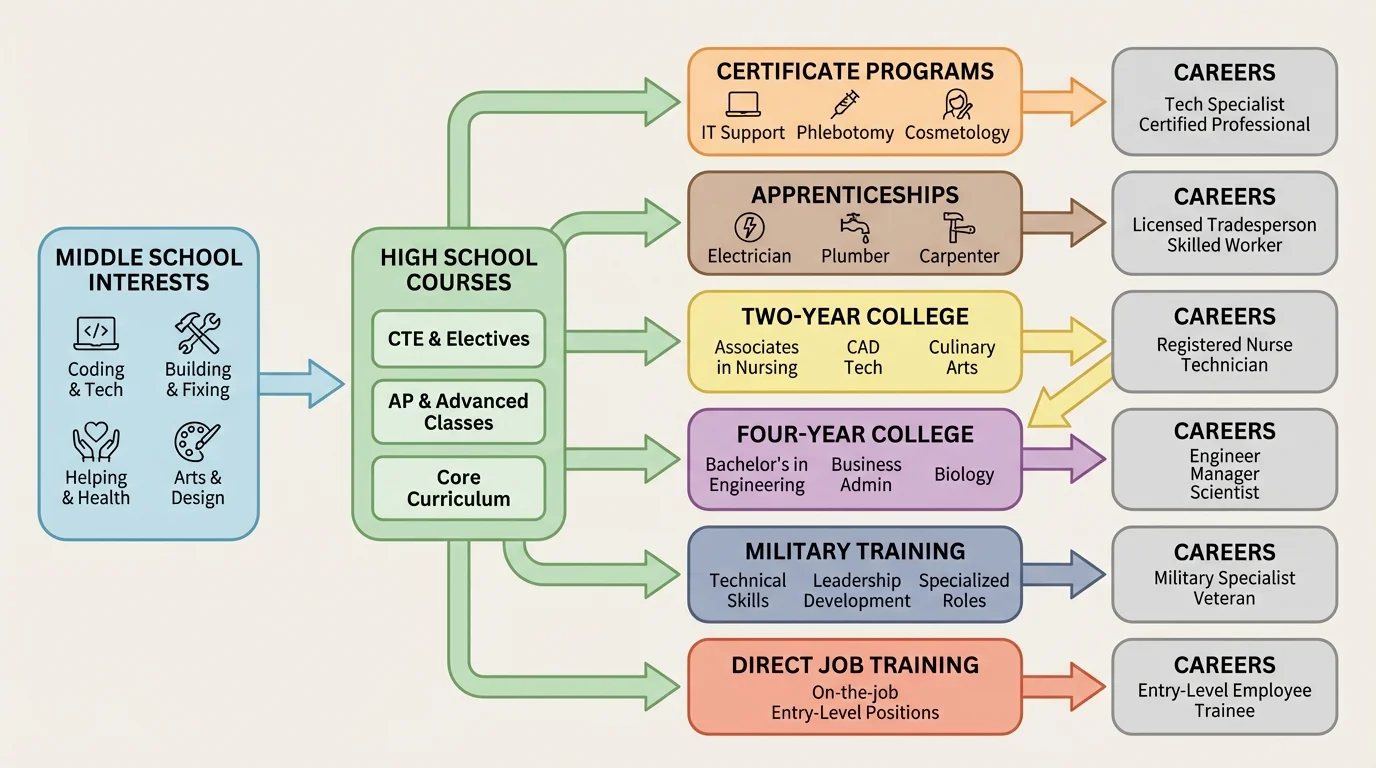
No single pathway is "best" for everyone. A great fit depends on the career goal and your situation. If you want to become a veterinarian, you will need many years of advanced education. If you want to become a welder, a shorter hands-on program may be the better match.
That is one reason the branching routes in [Figure 1] matter. They remind you that different goals lead to different kinds of preparation, and smart planning starts by knowing the difference.
You can use a simple decision system to narrow your options. Instead of guessing, ask a few focused questions about the career and the training route.
[Figure 2] Question 1: What does the job require to get started? Look for words like degree, certificate, license, experience, or certification in real job postings.
Question 2: How long will the preparation take? A pathway that takes six months is very different from one that takes eight years.
Question 3: How much will it cost? Compare tuition, fees, tools, uniforms, test costs, transportation, and lost earning time.
Question 4: How do you learn best? If you learn better by doing, a hands-on program or apprenticeship may fit you better than a mostly lecture-based path.
Question 5: Does the pathway leave you options? Some programs lead to several careers, while others prepare you for one very specific job.
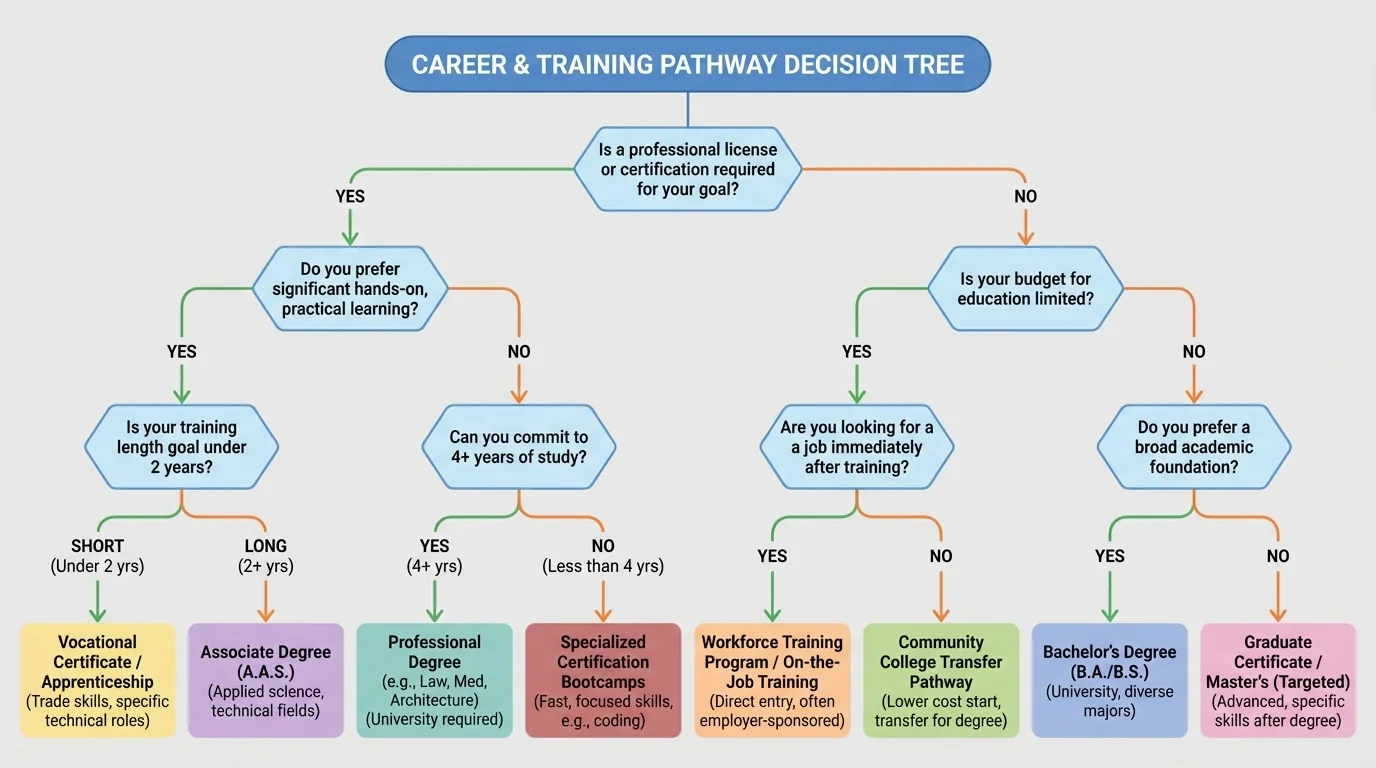
These questions help you avoid common mistakes. For example, some students focus only on salary and forget to check whether they are willing to complete the required training. Others choose the cheapest option without checking if it actually qualifies them for the job.
Fit matters as much as effort. A pathway should match the career's requirements, but it should also match your strengths, interests, and daily reality. A path that looks impressive on paper may not be a good fit if it is unaffordable, too long for your goal, or built around a way of learning that does not work well for you.
A strong decision balances your goal with practical facts. For example, if two pathways can lead to similar work, but one lets you gain experience sooner and costs much less, that may be worth serious attention.
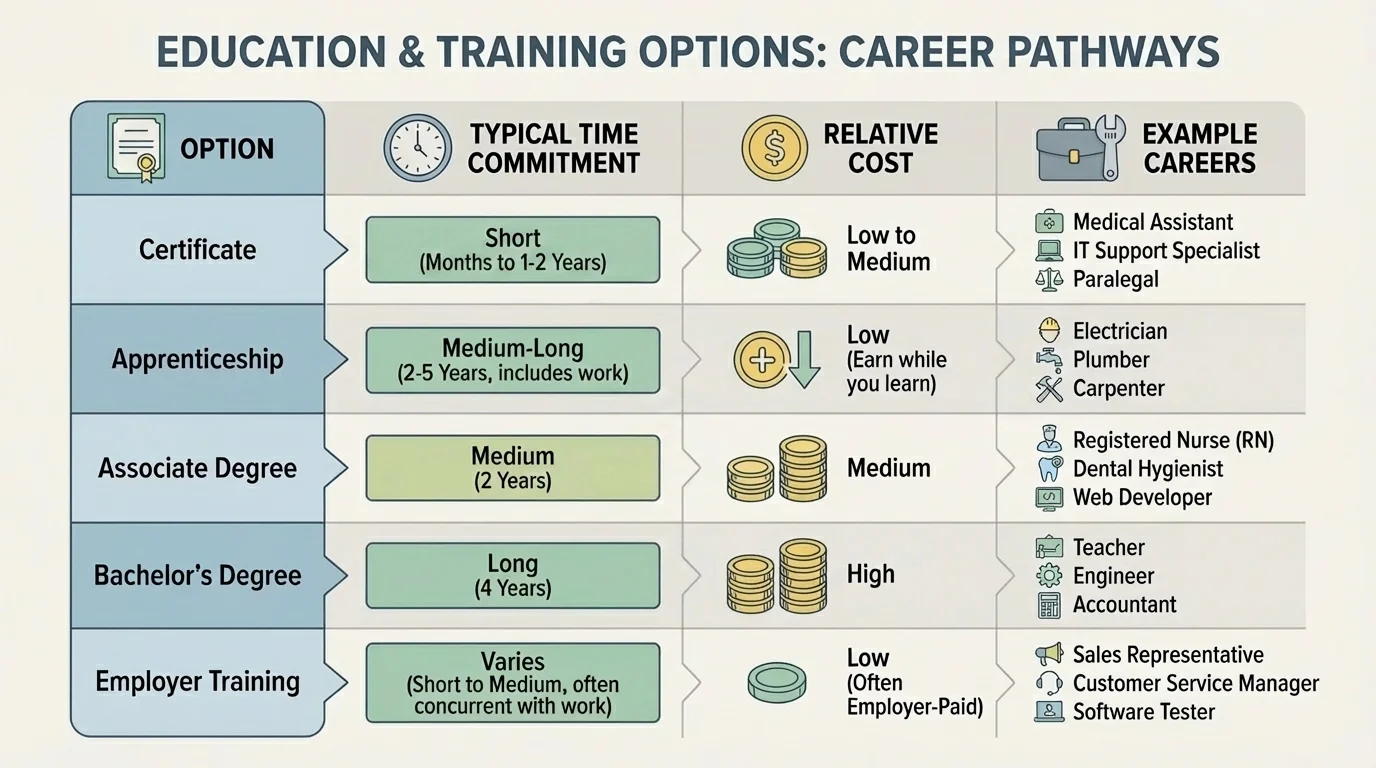
When you compare options, you should look at three things together: time, cost, and payoff. This bigger picture helps you make a smarter decision than looking at only one factor.
[Figure 3] Time means how long it takes before you are ready to work. Cost includes money for tuition, supplies, exams, and sometimes housing or transportation. Payoff means what you get back, such as job opportunities, starting pay, career growth, stability, and personal satisfaction.
| Pathway | Typical Length | Cost Level | Examples |
|---|---|---|---|
| Certificate program | A few months to about 1 year | Low to medium | Medical assistant, welder, IT support |
| Apprenticeship | Often 2 to 5 years while working | Usually lower upfront cost | Electrician, plumber, carpenter |
| Associate degree | About 2 years | Medium | Dental hygienist, paralegal, technician |
| Bachelor's degree | About 4 years | Medium to high | Teacher, engineer, accountant |
| Employer training | Days to months | Low | Retail worker, office assistant, food service |
Table 1. Comparison of common career preparation pathways by length, cost level, and sample careers.
You can also compare simple numbers. Suppose Program A costs $2,000 and takes 6 months. Program B costs $16,000 and takes 2 years. The cost difference is $14,000, since \(16,000 - 2,000 = 14,000\). The time difference is 18 months, since \(24 - 6 = 18\) months. That does not automatically make Program A better, but it tells you to ask whether Program B leads to better opportunities that are worth the extra time and money.
Here is another way to think about payoff. If one pathway leads to a job that starts at $38,000 and another leads to a job that starts at $52,000, the difference is $14,000 per year because \(52,000 - 38,000 = 14,000\). But you still need to compare the extra schooling, required debt, and whether you actually want that kind of work.
Comparing two career preparation choices
Jordan likes technology and is deciding between two options after high school.
Step 1: List the pathways
Option A is a 9-month IT support certificate costing $4,500. Option B is a 4-year computer science degree costing $32,000.
Step 2: Compare the time
The degree takes 39 more months because \(48 - 9 = 39\).
Step 3: Compare the cost
The degree costs $27,500 more because \(32,000 - 4,500 = 27,500\).
Step 4: Compare the goals
If Jordan wants to start working quickly in tech support, Option A may fit well. If Jordan wants careers that often require deeper programming knowledge, Option B may open more doors.
The best choice depends on the specific job target, not just on which path sounds bigger or faster.
The categories in [Figure 3] help you compare pathways fairly. Looking at only cost, only time, or only pay can lead to a poor decision.
Looking at actual jobs makes these ideas easier to understand.
Electrician: Many electricians train through apprenticeships. This pathway is often hands-on and may allow students to earn money while learning. A four-year college degree is usually not the main requirement.
Registered nurse: Nurses usually need formal education, clinical training, and licensure. This is a career where legal requirements matter a lot.
Graphic designer: Some graphic designers earn degrees, but others build strong skills through shorter programs and a portfolio of work. In creative fields, showing what you can do is often very important.
Welder: Welding often connects to certificate programs, technical schools, or apprenticeships. Employers may care about skill tests and safety training.
Software developer: Some employers prefer degrees, while others hire based on coding skill, projects, and experience. This is a good example of a field with multiple possible paths.
Veterinarian: This career requires many years of higher education. If someone wants this job, they need to be realistic about the long educational commitment.
"Choose your preparation based on the real job, not on what sounds impressive."
These examples show why general advice can be risky. Saying "everyone should go to college" or "college is never necessary" misses the point. The correct question is: What does this specific career require, and what pathway gives me the best fit?
A smart research process keeps you from choosing based only on guesswork or social media opinions. You can do most of this research from home using career websites, employer pages, training program sites, and online interviews.
[Figure 4] Start with one career idea. Then read several real job postings. Write down repeated requirements such as certification, degree level, software skills, communication skills, or years of experience. Repeated patterns matter more than one random listing.
Next, compare programs. Check what each one teaches, how long it lasts, what it costs, whether it is accredited, and whether it prepares students for required exams or licenses.
Then talk to a real person if you can. You might message a family friend, community member, coach, club leader, or local professional and ask for a short video call or email interview. Ask what training they needed, what they wish they knew earlier, and what common misconceptions beginners have.
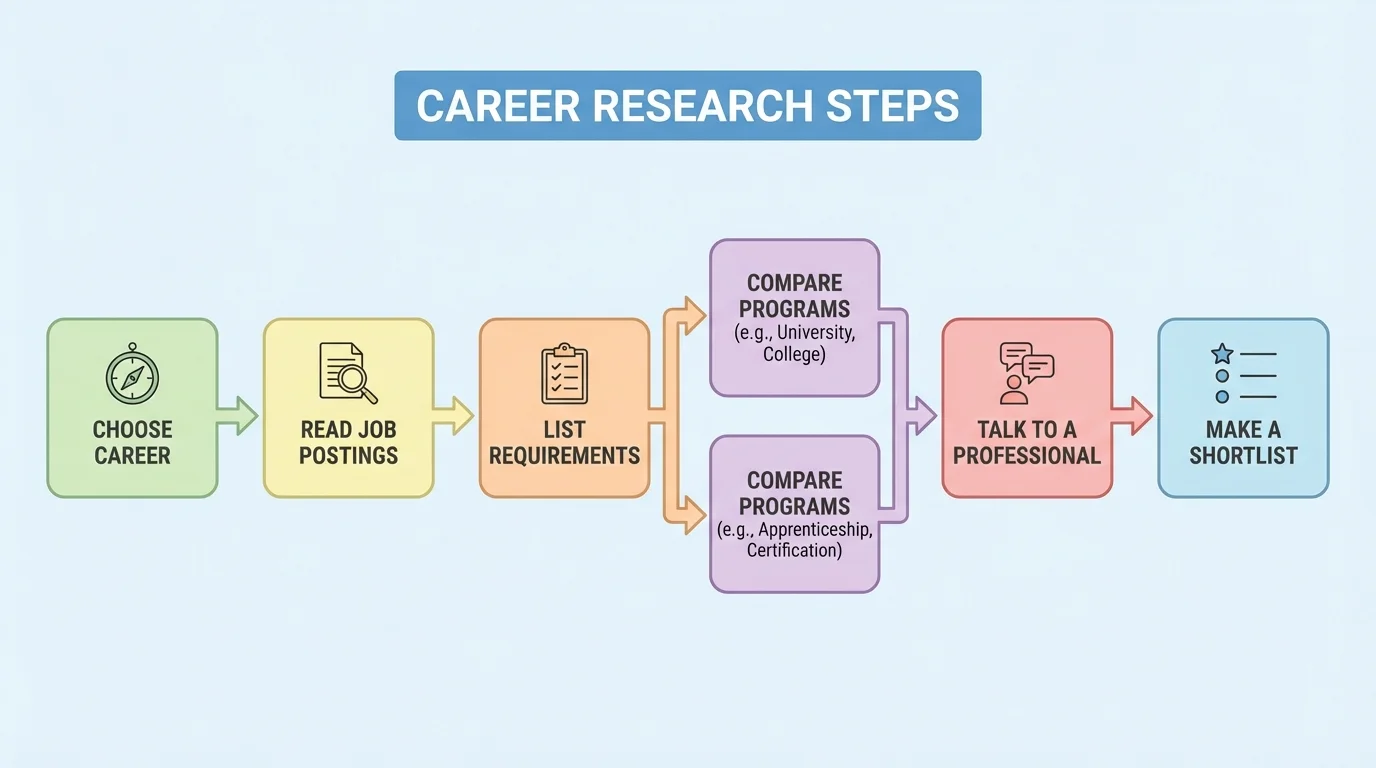
It also helps to keep notes in one place. You can make a simple digital chart with columns for career, required training, time, cost, skills needed, and questions you still have.
Simple research checklist
Step 1: Pick one career to investigate.
Step 2: Find at least three job postings for that career.
Step 3: Highlight repeated requirements.
Step 4: Find two training options that prepare people for that role.
Step 5: Compare time, cost, and qualifications earned.
Step 6: Write one sentence explaining which option currently seems like the best fit and why.
Later, when you revisit your notes, the sequence in [Figure 4] helps you see whether you actually researched the career or just reacted to a title, trend, or salary number.
Not every program is a good choice. Some are too expensive for the value they offer. Some make big promises without clear proof. Learning to spot warning signs protects your time and money.
Be careful if a program promises quick success but does not clearly explain what qualification you earn. Be cautious if costs are hard to find, if reviews are consistently poor, or if the program does not match what employers ask for in job postings.
Ask smart questions such as: What jobs does this training actually prepare me for? Is this credential recognized by employers? Are there extra fees? Do I need more training after this? What percentage of students finish? What support is available if I struggle?
When you evaluate choices, remember the difference between an opinion and evidence. A friend saying a program is "good" is an opinion. Real job requirements, clear program details, and multiple sources of information are stronger evidence.
This matters in real life. A smart choice can move you toward a career efficiently. A poor choice can leave you with frustration, bills, or qualifications that do not help you get the job you wanted.
You do not need to wait until adulthood to start. Career readiness begins with small steps you can take now. Focus on exploration, skill-building, and organized decision-making.
Step 1: List three careers you are curious about. They do not have to be perfect choices; they are starting points.
Step 2: For each career, find the usual entry requirements. Look for training, licenses, certificates, or degrees.
Step 3: Compare the pathways using time, cost, and fit. Think honestly about what seems realistic and interesting.
Step 4: Build useful skills now. Communication, digital organization, reliability, teamwork, and problem-solving help in almost every career.
Step 5: Try small experiments. Watch a career interview online, take a beginner course, create a small project, volunteer, or talk to someone in the field.
Students who explore careers early are often less stressed later because they have already practiced comparing options instead of making rushed decisions at the last minute.
Try This: Open a notes app or document and make a three-column chart labeled "Career," "Training Needed," and "Questions I Still Have." Fill in one row today. That one small action turns a vague future into a real plan.
Try This: Choose one adult skill to strengthen this month, such as replying to emails professionally, managing a weekly schedule, or learning a basic software tool. These habits support almost any pathway you choose.
Try This: Ask one trusted adult or community member about their career path. You may be surprised by how non-linear real careers are. Many adults change direction, gain skills in unexpected ways, or combine different experiences over time.
