One person can make a group better or worse without being the loudest person there. An online class discussion can help everyone learn. A rude post can shut people down. Reporting a broken streetlight can help neighbors stay safer. Spreading a rumor about a local issue can create confusion instead. That is why responsible participation matters: your choices do not stay private when you are part of a school community, a neighborhood, or a larger society.
At your age, you are already practicing the habits that shape adult life. You may not be voting yet, but you are learning how to communicate, how to follow through, how to solve problems with others, and how to use your voice. Those habits affect your online school experience now, and they also prepare you for future jobs, community roles, and civic responsibilities.
Participation means more than just showing up. It means taking part in a way that helps a group function well. Responsible participation is joining in with honesty, respect, effort, and awareness of how your actions affect other people. It includes speaking up when needed, listening when needed, and following through on what you say you will do.
When people participate responsibly, groups work better. In an online school setting, discussions stay focused, group projects become fairer, and learning becomes less stressful. In a community, shared spaces become safer, cleaner, and more welcoming. In civic life, better participation can lead to better decisions, more trust, and stronger problem-solving.
Participation means taking part in something rather than staying completely uninvolved.
Responsibility means being dependable and understanding that your choices have consequences.
Civic life includes how people help shape the rules, decisions, and well-being of their town, city, state, or country.
Outcomes are the results that come from actions and decisions.
A helpful way to think about this is simple: responsible participation is not about being perfect; it is about being useful, honest, and respectful in shared spaces. People do not need you to know everything. They do need you to act in ways that make teamwork, trust, and improvement more likely.
Responsible participation has a few basic parts. First, you show up consistently. Second, you pay attention and try to understand the issue or task. Third, you act respectfully, even when you disagree. Fourth, you accept accountability, which means owning your part of the result. Fifth, you look beyond yourself and consider how others are affected.
Accountability is especially important. It means you do not blame everyone else when something goes wrong. If you miss a deadline, post something hurtful, or share information without checking it, responsible participation means correcting the mistake. That might look like apologizing, fixing the problem, or being more careful next time.
Rights and responsibilities work together
You have rights, such as the right to express your ideas and to be treated fairly. But rights are strongest when people also act responsibly. For example, freedom of expression does not mean posting harmful lies or personal attacks. Responsible participation protects both your voice and other people's dignity.
Another key part is understanding consequences. Some consequences are immediate, like losing trust after sending a disrespectful message. Others build slowly, like a community becoming stronger because many people help solve problems over time. When you analyze outcomes, ask yourself two questions: What happened because people participated responsibly? and What happened because they did not?
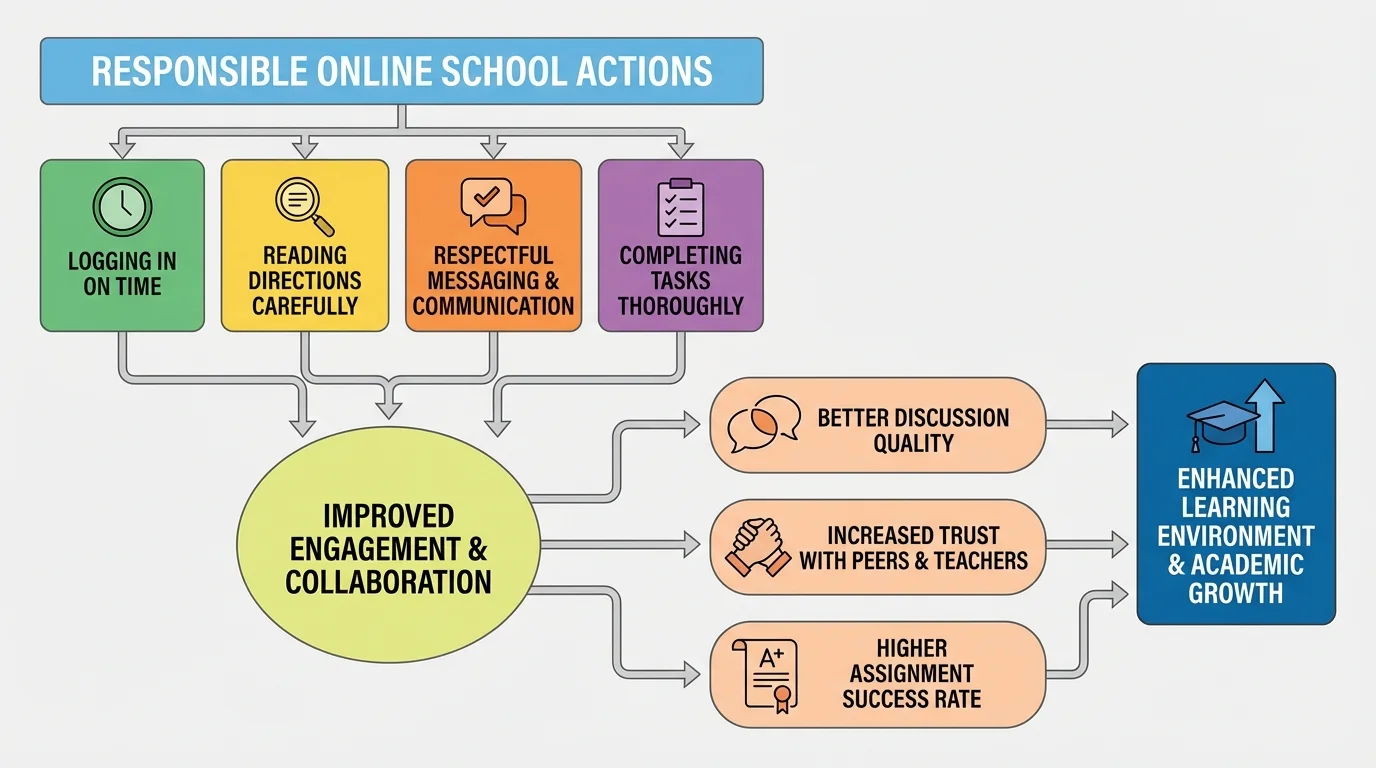
In online school, your habits shape the learning environment for everyone, as [Figure 1] shows through a chain of cause and effect. Responsible participation includes logging in on time, reading directions carefully, replying politely, doing your share of work, and communicating clearly if there is a problem.
These choices improve school outcomes in practical ways. Class discussions become more useful when students stay on topic and support their ideas with reasons. Group work becomes fairer when each person completes assigned tasks. Teachers can help more effectively when students ask specific questions instead of saying only, "I don't get it." Even a small action, like checking your messages once a day, can prevent confusion and missed deadlines.
Think about two students in an online group project. One answers messages late, does not read instructions, and uploads incomplete work. The other checks the project plan, asks clarifying questions, and updates the group if something changes. The second student reduces stress for everyone. That is not just "being nice." It improves the outcome because the group can plan, divide tasks, and submit stronger work.
Responsible participation online also includes digital citizenship. That means using technology in safe, respectful, and ethical ways. Examples include protecting passwords, avoiding plagiarism, giving credit for ideas, and thinking before posting. If you would not say something respectfully in a serious conversation, do not type it into a chat, comment, or email.
Here are practical ways you can participate responsibly in online school:
When these habits become normal, the whole online learning space improves. As we saw in [Figure 1], one responsible action often leads to another: better communication creates more trust, and more trust makes teamwork stronger.
Real-life school scenario
You are working with two other students on a shared slide presentation.
Step 1: Read the task and divide the work clearly.
Each person gets one section, one due date, and one way to check in.
Step 2: Communicate early.
If your internet goes down or you are confused, send a message before the deadline instead of disappearing.
Step 3: Review before submitting.
Check that the slides match in style, facts are accurate, and everyone's part is included.
This kind of participation improves the final project and also builds your reputation as someone others can rely on.
Try This: Before your next online assignment, write a mini checklist with three items: "read directions," "ask one clear question if needed," and "submit or update early." Small systems create better habits.
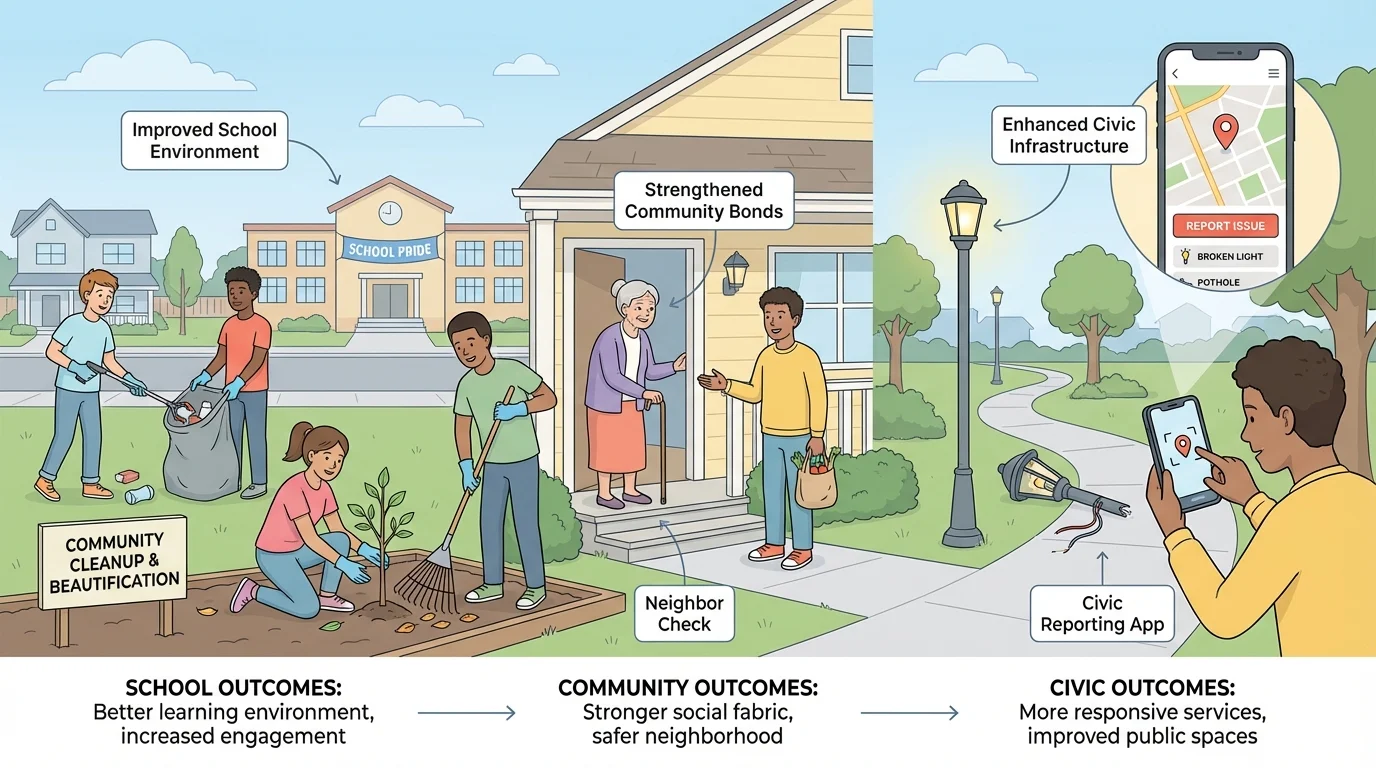
Your community includes the people and places around you: neighbors, local parks, libraries, recreation programs, faith groups, volunteer organizations, and online local groups. Responsible participation here means noticing needs, helping in realistic ways, and treating shared spaces and people with respect. Local action matters because, as [Figure 2] illustrates, everyday choices can improve both relationships and physical spaces.
You do not need a big title to make a difference. Helping at a food drive, picking up litter during a local cleanup, checking on an older neighbor during bad weather, or reporting graffiti or a broken light to the correct local office are all forms of responsible participation. These actions support safety, trust, and care.
Responsible community participation also means avoiding harm. For example, if you see misinformation spreading in a neighborhood social media group, sharing it without checking can cause panic or anger. If you hear that a local service is changing, it is smarter to verify it through an official source before reposting it.
Another important part is understanding shared responsibility. If everyone assumes "someone else will handle it," problems often stay unsolved. But when people contribute small, realistic efforts, the results add up. A cleaner park, a better-attended local event, or a safer block often comes from many people doing modest things consistently.
Community engagement means taking part in activities that improve the area where you live. It can be formal, like joining a service project, or informal, like helping a neighbor carry groceries. Both count when they strengthen the community.
Here is a comparison of irresponsible and responsible community participation:
| Situation | Irresponsible response | Responsible response | Likely outcome |
|---|---|---|---|
| Trash in a shared space | Ignore it and complain online | Clean some up or report the issue | Cleaner, safer area |
| Rumor about a local event | Share it immediately | Verify before reposting | Less confusion |
| Neighbor needs help | Assume others will help | Offer reasonable support | Stronger trust |
| Community concern | Attack people personally | Discuss the issue respectfully | Better problem-solving |
Table 1. Comparison of irresponsible and responsible participation in common community situations.
Notice that responsible participation does not always mean doing everything yourself. Sometimes it means connecting a problem to the right person or service. As shown earlier in [Figure 2], responsible action can include direct help, teamwork, or reporting a problem through the proper channel.
Local governments and community groups often rely on reports from residents to notice problems quickly. A single accurate report about a broken sign, dangerous road condition, or damaged public space can lead to a fix that helps many people.
Try This: Look around your local area this week and identify one realistic way to help. Keep it small and specific, such as picking up litter, thanking a volunteer, or learning where to report a safety concern.
Civic engagement is how people help shape public life and public decisions. It includes learning about issues, discussing them respectfully, following laws, understanding rights, and taking action in legal and constructive ways. It is not limited to elections.
As [Figure 3] shows, at your age, responsible civic participation might include following reliable news sources, learning how local government works, attending a community meeting online, joining a student-led service effort, or contacting a public official with a respectful message about an issue. It can also include supporting causes through awareness campaigns or helping others understand important information accurately.
A huge part of civic responsibility is checking sources. Misinformation can spread fast, especially online. If you share a false claim about a law, election, public health issue, or local rule, you can mislead people and damage trust. Responsible civic participation means asking: Who published this? Is there evidence? Is the source current? Can I confirm it somewhere else?
Respectful disagreement is another major skill. Civic life includes debate because people have different values and ideas. Responsible participation does not mean agreeing with everyone. It means disagreeing without insulting, threatening, or spreading false claims. If you want better outcomes, focus on the issue, use evidence, and stay calm enough to listen.
Legal awareness matters too. You should know that rules and laws affect daily life, and that there are proper ways to challenge unfair situations. For example, if a community rule seems unfair, responsible civic action might include researching the policy, gathering facts, writing a respectful message, joining others with the same concern, and proposing a change instead of breaking the rule impulsively.
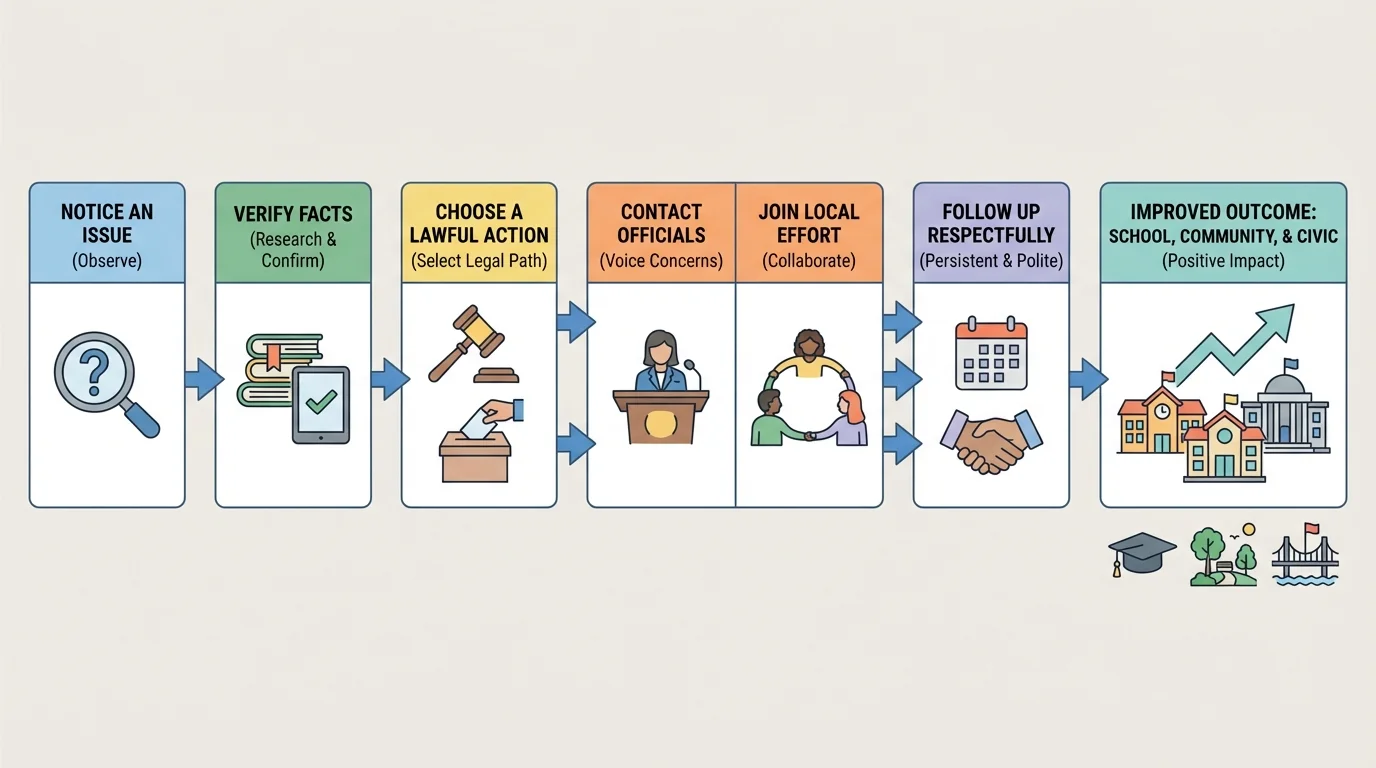
As [Figure 3] makes clear, good civic action usually follows a sequence: notice a problem, verify the facts, choose a constructive response, and follow through. This process helps turn strong feelings into useful action.
"The way to change things is to be informed and involved."
— Civic participation principle
Try This: The next time you see a claim online about a public issue, pause before reacting. Check whether the information comes from a reliable source and whether the claim is current, complete, and fair.
To analyze outcomes, look for patterns. Responsible participation usually improves trust, communication, fairness, safety, and problem-solving. Irresponsible participation often increases confusion, conflict, wasted time, and unfairness.
For example, in online school, doing your share and communicating early creates trust. Trust makes collaboration easier. Easier collaboration often leads to stronger projects and less stress. In a community, reporting a real problem or helping with a local effort can make spaces safer and relationships stronger. In civic life, informed and respectful action can lead to better decisions and a more connected public.
Small actions can create large results
Responsible participation often works like a chain reaction. One clear message prevents confusion. One verified fact stops a rumor. One helpful action encourages other people to help too. This is why small choices matter more than they seem to in the moment.
The opposite chain reaction also happens. One careless post can spread false information. One person refusing to do their part can slow down an entire group. One disrespectful exchange can make people stop participating altogether. That is why responsibility is not just personal. It has group effects.
Sometimes people do not participate responsibly because they feel nervous, unsure, busy, or convinced that their actions will not matter. Those feelings are real, but they do not have to control your choices.
Here are common barriers and practical responses:
Constructive action means doing something that helps move a situation toward a solution. Complaining without facts, insulting others, or quitting immediately usually does not help. Constructive action is more focused: report, repair, organize, ask, verify, or cooperate.
Handling a frustrating situation responsibly
A local online group is arguing about a new rule for a public park, and people are sharing angry comments.
Step 1: Pause before joining in.
Avoid reposting emotional claims you have not checked.
Step 2: Find reliable information.
Look for the official rule, date, and reason behind it.
Step 3: Choose a useful response.
You might ask a respectful question, write a calm comment, or contact the proper office.
Step 4: Focus on solutions.
Instead of attacking people, suggest a reasonable improvement or request clarification.
This approach protects your credibility and increases the chance of being taken seriously.
Responsible participation is often quieter than irresponsible participation, but it is usually more effective. Calm, informed, steady people often have more influence than loud people who act without thinking.
You do not need a complicated system to participate responsibly. Use this simple plan whenever you are involved in school, community, or civic situations.
Step 1: Notice the situation. What is happening? What needs attention?
Step 2: Get the facts. Do not act only on rumor, emotion, or assumptions.
Step 3: Think about impact. Who could be helped or harmed by your action?
Step 4: Choose a responsible response. Ask, help, report, contribute, verify, or respectfully speak up.
Step 5: Follow through. Responsibility includes finishing what you started or updating others honestly.
Step 6: Reflect. Did your action improve the outcome? What would you do differently next time?
This plan works across many situations. In online school, it helps you become dependable. In your community, it helps you become useful and aware. In civic life, it helps you become informed and effective. Those are powerful life skills.
Being responsible does not mean handling every problem alone. It means recognizing your role, making thoughtful choices, and using the right channels and support when needed.
When you participate responsibly, people learn they can count on you. More importantly, shared spaces begin to work better. That is how schools improve, communities grow stronger, and civic life becomes healthier: not only through big moments, but through regular people making smart, respectful choices again and again.
