A lot of people think big futures are built by big moments. Usually, they are built by small choices repeated over and over. Choosing to finish your work before gaming, replying respectfully to a message, saving part of your money, going to sleep on time, or staying honest when no one is checking may not feel dramatic today. But those choices quietly shape what becomes possible later. Your future is not decided by one perfect decision. It is shaped by patterns.
Every choice has a result. Some results happen fast, and some take longer to show up. If you skip practice, the effect may seem tiny that day. If you skip it often, your skill level drops. If you keep up with practice, you become more prepared for tryouts, performances, jobs, or responsibilities later. This is how choice works in real life: the effect is often delayed.
That delay can make decisions tricky. A choice that feels good now is not always good for you later. A choice that feels hard now is not always bad. For example, staying up late watching videos may feel fun in the moment, but being tired the next day can make it harder to focus, finish tasks, or stay calm. On the other hand, setting a bedtime may feel annoying in the moment, but it gives you more energy and more control tomorrow.
Future options are the choices you still have available later. Opportunities are chances to do, learn, earn, join, or achieve something. Consequences are the results of your actions, whether they help you or create problems.
When you make a strong choice today, you often protect or expand your future options. When you make a harmful choice today, you may close doors without realizing it. That is why learning to think ahead is a life skill, not just a school skill.
Think of your life like a path with many doors. Some choices open more doors. Some choices close them. If you build skills, people trust you, and you manage your time well, you usually have more options. If you ignore responsibilities, break trust, or create unhealthy habits, you often have fewer options.
This does not mean one mistake ruins everything. It means patterns matter. If you regularly turn work in late, people may stop depending on you. If you regularly show up prepared, people may recommend you for more responsibilities. Your actions teach others what to expect from you.
There are also short-term and long-term consequences. Short-term consequences happen soon. Long-term consequences appear later and often matter more. A short-term reward might be extra free time because you avoided a task. A long-term consequence might be stress, missed deadlines, lower quality work, or fewer chances to join something you care about.
One useful question is: Will this choice give me more freedom later, or less? Freedom is not just doing whatever you want in the moment. Real freedom often comes from having skills, trust, savings, health, and good judgment. Those things create options.
Researchers who study habits often find that repeated behaviors become easier over time. That means small positive choices can start feeling more natural, and small negative choices can also become hard to break if you repeat them enough.
This is why habits are powerful. A habit is a behavior you do regularly, often without much thought. Habits can work for you or against you. If your habit is checking your planner before the day starts, you are more likely to stay organized. If your habit is avoiding tasks until the last minute, stress starts running your schedule instead of you.
When a choice feels confusing, a step-by-step system helps. A practical decision-making process helps you slow down before you act. This matters most when you feel rushed, upset, pressured, or tempted to choose only based on the moment.
[Figure 1] introduces this decision filter. It begins with pause, name the choice, look ahead, check your values, and choose on purpose. If you pause first, you give your brain time to think instead of react. If you name the real choice, you avoid pretending there is no decision to make. If you look ahead, you notice outcomes. If you check your values, you remember what kind of person you want to be. Then you choose deliberately.
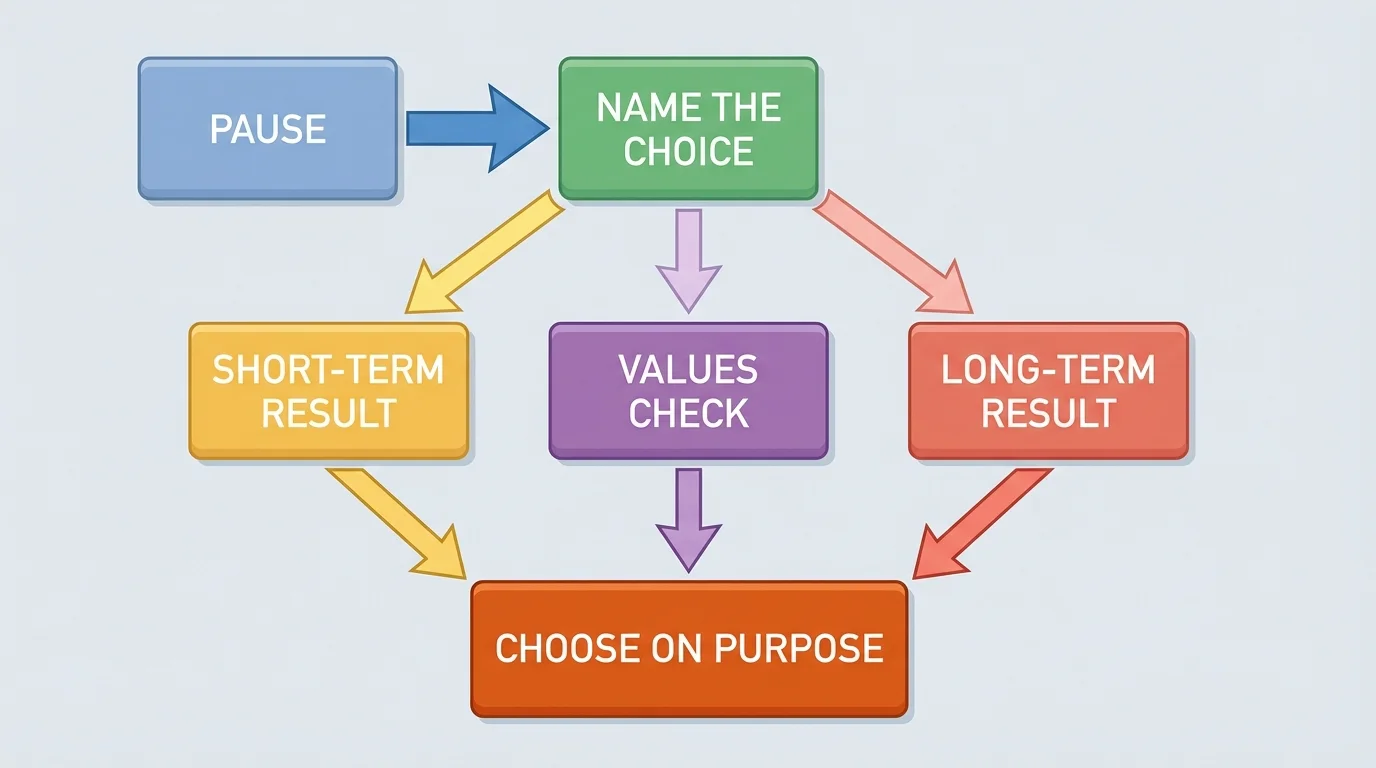
Here is how that can sound in your head:
Pause: "I do not have to answer right this second."
Name the choice: "My real choice is whether to finish this task now or delay it."
Look ahead: "If I delay it, what happens tonight? What happens tomorrow? What happens in a month if I keep doing this?"
Check your values: "Do I want to be reliable, honest, and prepared?"
Choose on purpose: "What action matches the future I want?"
Real-life example: choosing how to spend your evening
Step 1: Name the choice.
You have a quiz tomorrow and a friend invites you to play online for two hours.
Step 2: Compare short-term and long-term results.
Playing now may feel fun immediately. Studying now may feel less fun, but it lowers tomorrow's stress and helps your performance.
Step 3: Choose a balanced action.
You might study for 45 minutes, then play for 45 minutes. The exact time is less important than choosing on purpose instead of avoiding the task.
This kind of choice supports both your responsibilities and your free time.
You will not always choose perfectly. The goal is not perfection. The goal is becoming someone who notices that today and tomorrow are connected.
Your learning habits affect future opportunities in a major way. In online school, nobody is standing next to you reminding you to stay on task. That means your routines matter even more. Logging in on time, checking instructions carefully, asking for help early, and finishing work when it is due all build skills beyond academics. They build independence.
Independence is valuable because it makes adults more likely to trust you with responsibility. If you can manage your own schedule, follow through, and communicate clearly, you become the kind of person who can handle more advanced work, leadership roles, volunteer commitments, part-time jobs, and personal goals.
Skill-building choices also matter. If you spend time practicing writing, coding, editing videos, cooking, drawing, repairing things, or speaking confidently, you are investing in yourself. Those skills can become future opportunities. A student who learns basic photo editing might help a family member's small business. A student who learns how to organize tasks might be ready for freelance work sooner. A student who develops strong communication habits often has an advantage in interviews and teamwork.
On the other hand, procrastination can shrink your options. Procrastination is delaying something you know needs to be done. It often creates a false feeling of relief. You avoid stress for a little while, but the stress usually returns bigger than before. Delayed tasks pile up, your work quality drops, and you may lose confidence because you know you are capable of better.
A helpful question is: What skill am I building by repeating this choice? If you repeatedly avoid tasks, you are practicing avoidance. If you repeatedly start tasks even when you do not feel like it, you are practicing self-management.
"You do not rise to the level of your goals. You fall to the level of your systems."
— James Clear
That idea matters because goals are important, but systems are what carry you there. Wanting good results is not enough. Your daily actions need to support what you want.
Money decisions are a clear example of how the present affects the future. Small money habits grow into bigger advantages or bigger problems over time. You do not need a lot of money to start learning this. Even a small allowance, gift money, or earnings from helping with tasks can teach you how choice creates freedom.
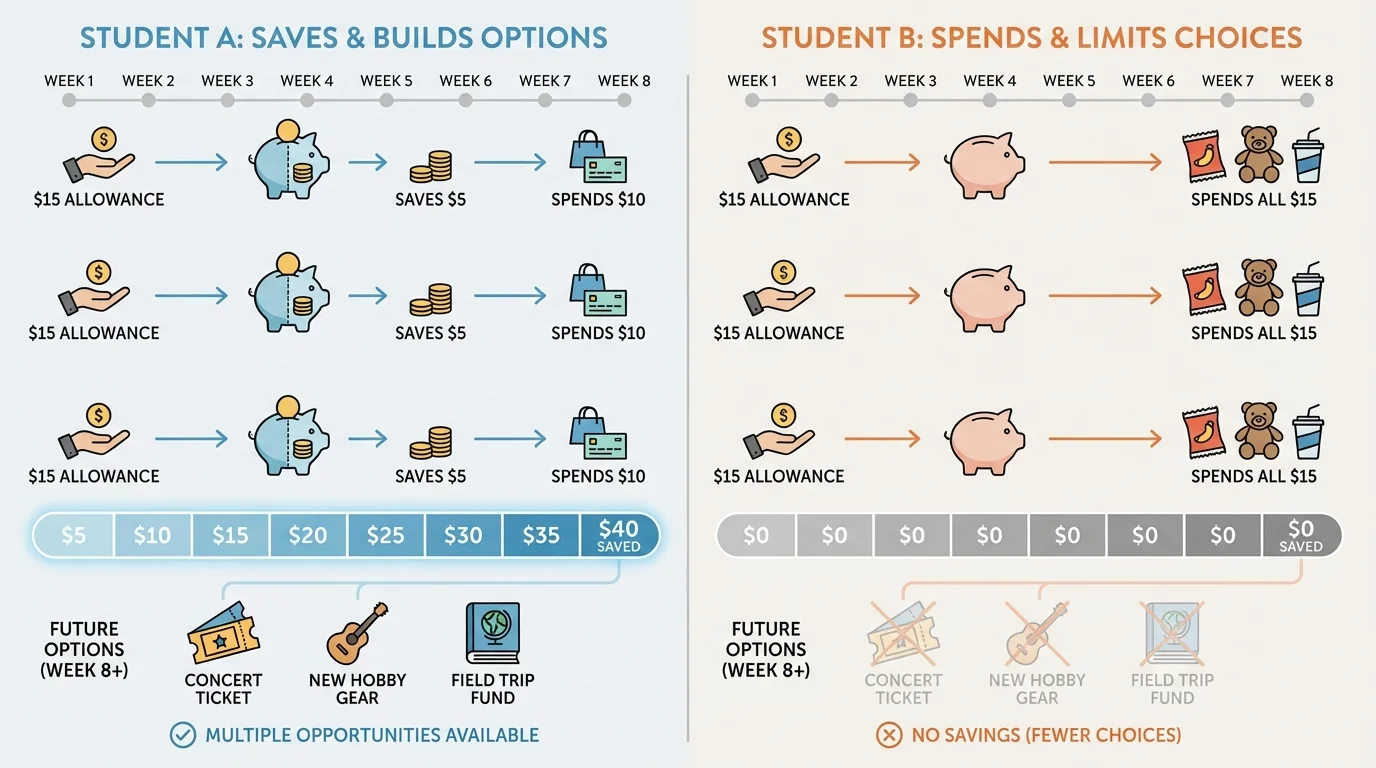
[Figure 2] helps compare two different money habits over time. If you spend every dollar as soon as you get it, you may have fun in the moment but no flexibility later. If you save part of what you receive, you create options. Savings can help you buy something important, handle a surprise expense, or work toward a bigger goal without panic.
For example, suppose you get $20 each week. If you save $5 each week for eight weeks, you would have saved \(5 \times 8 = 40\) dollars. That $40 can give you choices later. If you spend the full $20 every week, the amount saved is \(0 \times 8 = 0\). The difference is not only money. The difference is future freedom.
Subscriptions, in-app purchases, and impulse buys are common traps because each one feels small. But repeated spending adds up. Four $6 purchases in a month cost \(4 \times 6 = 24\) dollars. That might not sound huge, but over time it can take away money you could have used for something more meaningful.
Good money choices do not mean never spending. They mean spending with purpose. A simple plan is to divide what you get into three parts: spend, save, and give. Even if the amounts are small, the habit is powerful.
| Choice Today | Short-Term Result | Long-Term Result |
|---|---|---|
| Spend all your money immediately | Instant satisfaction | Less flexibility later |
| Save part of your money regularly | Slower rewards | More options and less stress |
| Track purchases | Takes a little effort | Better control and smarter decisions |
Table 1. How money habits affect future choices and flexibility.
Money habits also teach self-control. If you can pause before buying something, compare needs and wants, and think ahead, you are practicing a skill that will help you for years.
Opportunity cost is what you give up when you choose one option instead of another. If you spend $15 on something random today, the opportunity cost might be not having that same $15 for a book, supplies, savings, or a future event you care about.
This is not about guilt. It is about awareness. Every "yes" to one thing is usually a "no" to something else.
People decide whether to trust you based on patterns. Your reputation is built from repeated choices: what you say, what you post, whether you keep your word, and how you treat others. This affects future opportunities because trust often comes before responsibility.
[Figure 3] introduces how repeated actions shape trust and opportunity. If you are respectful in messages, honest when you mess up, and reliable about what you promise, people are more likely to include you, recommend you, or support your goals. If you are careless, rude, or dishonest, people may stop opening doors for you even if you have talent.
Your digital behavior matters too. A mean comment, an inappropriate post, or sharing private information can damage trust quickly. The internet remembers more than people expect. A digital footprint is the record of what you do online, including posts, comments, likes, shared photos, and messages. Even if something is deleted later, it may still affect how others see you.
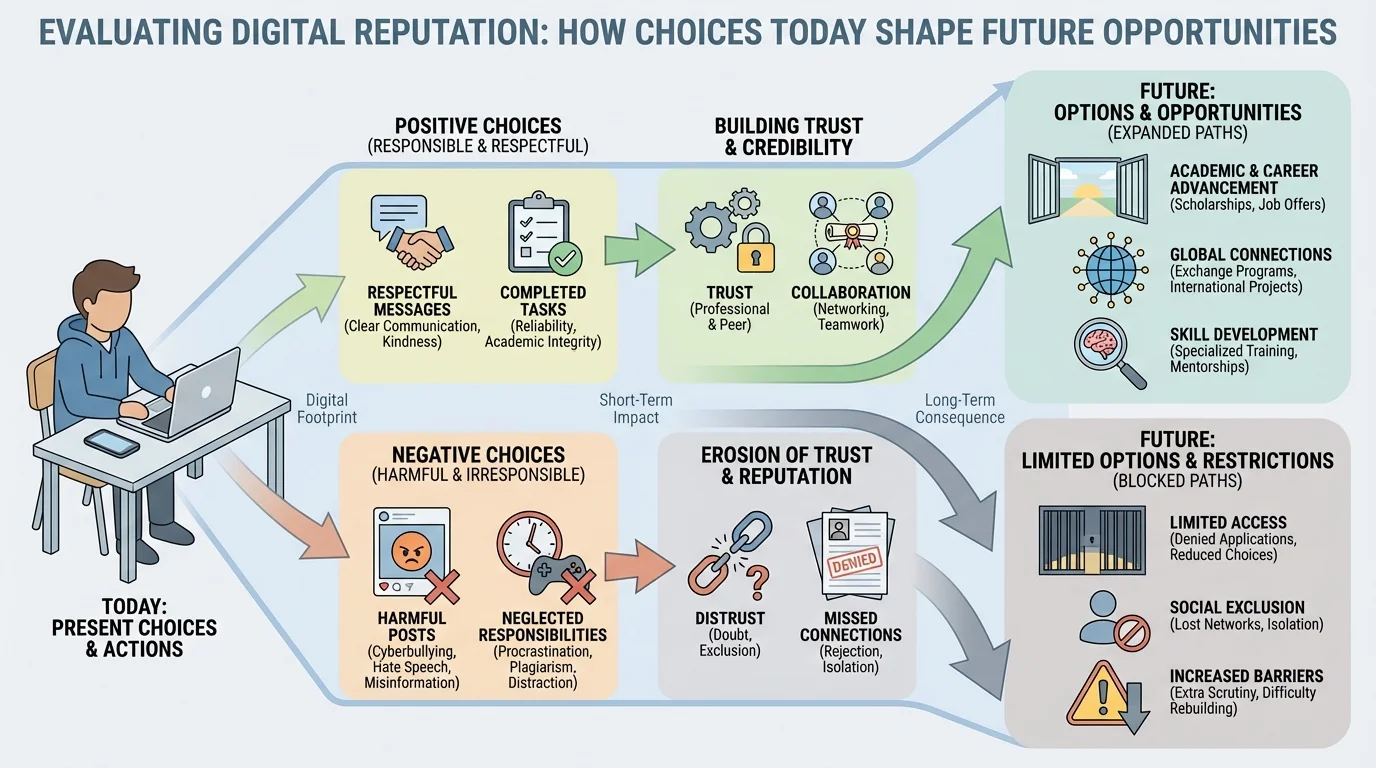
Think about two students applying for the same volunteer role in the community. One communicates politely, responds on time, and has a history of following through. The other ignores messages, posts hurtful jokes online, and forgets commitments. Who is more likely to be chosen? Usually, the difference is not just talent. It is trust.
This also works positively. If you make a habit of encouraging others, apologizing sincerely, and being dependable, your relationships get stronger. Strong relationships create support, and support creates opportunities. Sometimes the future help you need comes from people who remember how you treated them.
Real-life example: protecting your digital reputation
Step 1: Pause before posting.
Ask: "Would I be okay with a parent, coach, employer, or future teammate seeing this?"
Step 2: Check the purpose.
Is this post helpful, honest, kind, creative, or necessary? Or is it just reacting in anger or trying to get attention?
Step 3: Choose the version of yourself you want to build.
Each post adds to your pattern. Over time, that pattern becomes your reputation.
Later on, the same pattern affects not only social situations but also jobs, teamwork, leadership, and references. Character travels with you.
Your future options depend on your energy, focus, and safety. That means health choices matter. Sleep, movement, food, stress management, and screen habits all affect what you are able to do.
If you regularly sleep too little, your concentration, patience, and mood can suffer. If you spend hours scrolling when you meant to work, your time disappears and your goals get pushed back. If you ignore stress until it spills over, small problems can feel huge. But when you build routines that support your body and mind, you can think more clearly and respond better.
Self-control does not mean you never want fun, comfort, or rest. It means you can guide yourself instead of being controlled by every feeling in the moment. It is the ability to say, "This is what I want right now, but that is not the best choice for the future I want."
Safety choices are part of this too. Whether it is wearing protective gear, being careful online, not sharing personal details with strangers, or avoiding dangerous stunts for attention, wise safety choices protect your future. A risky decision can bring consequences far bigger than the moment seemed to deserve.
You already know that habits become easier with repetition. The same is true for calming yourself down, managing your time, and pausing before risky choices. These are trainable skills, not fixed traits.
When emotions are strong, decision-making gets harder. That is why it helps to have a reset routine: step away, breathe slowly, drink water, write down the problem, and wait a few minutes before replying or acting. A calmer brain usually makes a smarter choice.
No one makes perfect choices all the time. You will make mistakes. A deadline will be missed, money will be wasted, trust may need repair, or a habit may slip. The important question is not "Did I mess up?" The better question is "What do I do next?"
A mistake only has to define you if you refuse to learn from it. Setbacks can become useful if they teach you what to change. If you spent too much money, make a better plan for next time. If you posted something unkind, apologize and remove it. If you ignored your work for a week, start with one small task today instead of giving up completely.
Recovery usually follows three steps: admit the problem, repair what you can, and change the system that led to it. For example, if you are always forgetting assignments, the real fix may be creating a daily checklist or using reminders. If you keep overspending, the real fix may be deciding in advance how much you can spend.
People who improve over time are often not the ones who never fail. They are the ones who notice mistakes quickly, take responsibility, and adjust their habits before the mistake becomes a pattern.
This is where goal setting helps. A goal gives direction, but your systems and choices create movement. If a goal matters to you, ask what habits support it and what habits fight against it.
You do not need to plan your entire life right now. You only need to get better at connecting today to tomorrow. Start with one goal that matters to you. It could be improving your grades, saving for something important, earning more trust at home, getting healthier, learning a new skill, or becoming more organized.
Then work backward. Ask yourself: What daily or weekly choices would make this more likely? If your goal is saving $60 in twelve weeks, you can divide the amount by the number of weeks: \(60 \div 12 = 5\). That means saving $5 each week. The math is simple, but the life skill is bigger: your future goal becomes a present action.
Create a simple future-ready plan
Step 1: Name one goal.
Example: "I want to be more reliable and less stressed."
Step 2: Choose one habit that supports it.
Example: "I will check my assignments every weekday at \(4{:}00\) p.m."
Step 3: Remove one obstacle.
Example: "I will put my phone on silent for \(30\) minutes while I start."
Step 4: Track progress.
Mark each day you follow through. A streak shows that your present choices are lining up with your future goal.
Here is a quick checklist you can use anytime you face a decision:
The more often you use questions like these, the stronger your judgment becomes. Over time, thoughtful choices become habits, and habits become your direction.
Your future is not something that suddenly appears one day. You are building it in ordinary moments: how you spend your time, how you treat people, how you manage your money, how you respond to mistakes, and what you do when nobody is forcing you. Every one of those choices is a vote for the kind of life you want.
