Many adults wish they had started planning earlier. Not because they needed to know their exact future at age 14, but because they needed a map. If you wait until the last minute to think about careers, classes, or skills, you can miss opportunities that were available all along. Starting now gives you something powerful: options.
Your future does not depend on having one perfect dream job right now. It depends on learning how to make smart choices, one step at a time. A strong career plan helps you choose classes with purpose, build useful skills, notice opportunities, and avoid drifting through high school without direction.
Ninth grade is a smart time to begin because this is when your school decisions start to build your academic record. The courses you choose, the habits you build, and the experiences you collect can open doors later. That does not mean every choice is permanent. It means your choices start to matter more.
Think of it like setting up a playlist. You can always change songs, but the first songs you add shape the mood. In the same way, your first year of high school helps shape your next steps. Planning now makes later decisions less stressful.
Students who connect school choices to real goals are often more motivated because they can see why their work matters beyond grades.
If you plan well, you are more likely to take useful courses, meet deadlines, build confidence, and find experiences that help you grow. If you do not plan, you may end up choosing classes randomly, missing application dates, or realizing too late that you needed a certain course or skill.
[Figure 1] A career-readiness plan is a personal guide for how you will prepare for future work and education. It connects your interests, possible careers, course choices, skill-building, and real opportunities. Early in this process, the point is not to pick one job forever. The point is to link what you care about now with actions you can take this year.
Your plan should include five main parts: what interests you, what careers you want to explore, what courses support those careers, what skills you need, and what opportunities can help you practice those skills. When these parts connect, your plan becomes useful instead of just being a list of ideas.
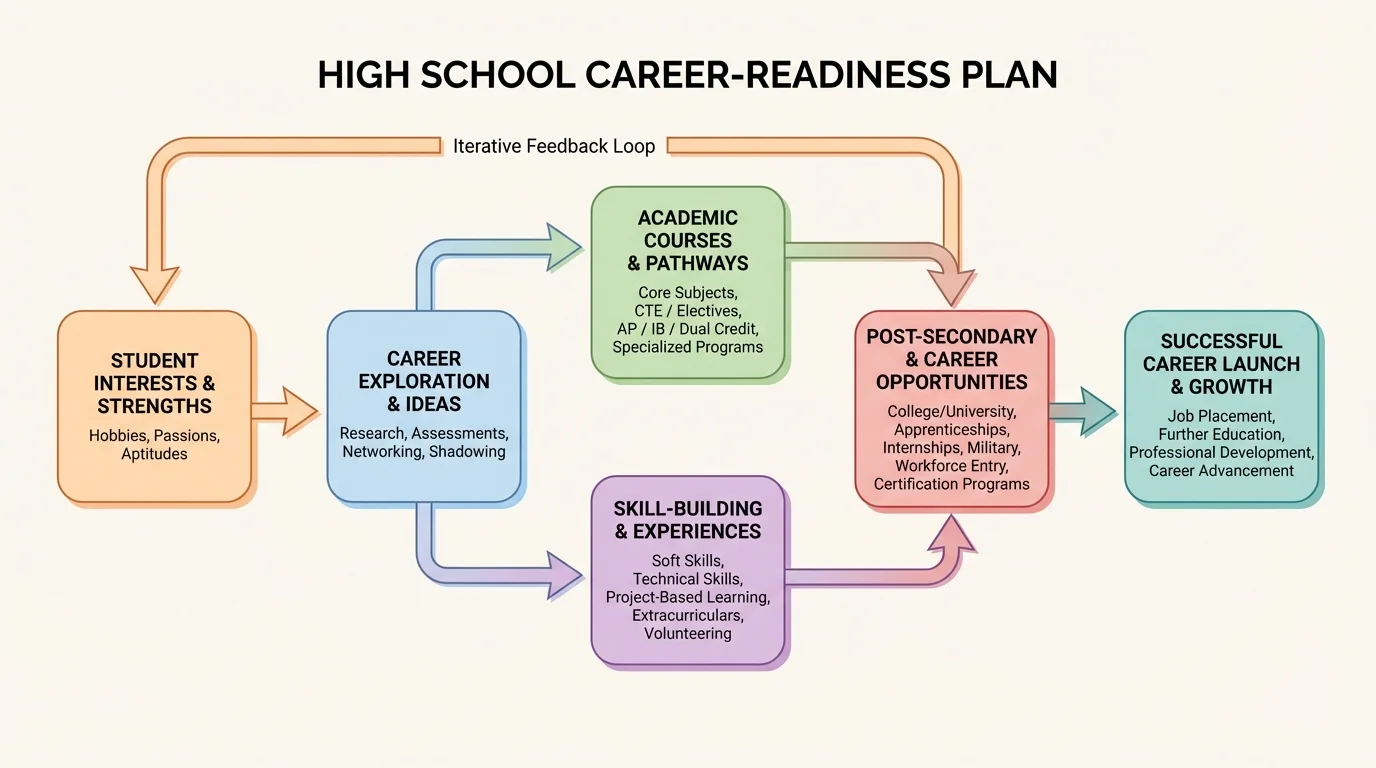
Career pathway means a possible route from where you are now to future work, including courses, training, experiences, and skills. Goal setting means deciding what you want to achieve and planning specific actions to get there.
A good plan is also flexible. Maybe you are interested in graphic design now, but later you become more interested in marketing or computer science. That is okay. The plan still helps because you are learning how to connect decisions to goals.
Before you look at careers, start with yourself. What do you enjoy? What are you curious about? What kinds of problems do you like solving? What environments feel right for you: quiet, active, creative, social, outdoors, tech-focused, hands-on?
You also need to think about your values. Values are the things that matter most to you in life and work. For example, one student may care most about helping people. Another may care about creativity. Another may want stability, independence, or strong income potential. None of those are wrong, but they lead to different choices.
Interests, strengths, and values work together. You might enjoy something but not want it as a career. You might be good at something but not love it. The best career exploration looks for overlap: work that matches what you like, what you do well, and what matters to you.
Your strengths matter too. Strengths are skills or qualities that help you do well. Maybe you explain ideas clearly, notice details, stay calm under pressure, learn software quickly, or stick with hard tasks. These clues help you find good career directions.
Try this: Open a notes app and make three short lists: "I enjoy...," "I'm good at...," and "I care about...." Put at least five items in each list. Look for patterns. If "helping," "science," and "staying calm" all appear, health careers might be worth exploring. If "design," "editing," and "social media" appear, digital media careers may fit.
A career cluster is a group of related jobs and industries. Thinking in clusters can make exploration easier. Instead of pressuring yourself to choose one exact job, you can explore a whole area such as health science, information technology, business, education, skilled trades, arts and media, or public service.
Research careers by asking simple questions: What does this person actually do each day? What skills do they need? What education or training comes after high school? What does the work setting look like? Is the field growing? What are the entry-level paths?
You can find this information through career websites, videos, employer pages, virtual job-shadow content, interviews with adults you know, or community organizations. Since you learn online, digital research is especially useful. You can also attend webinars, career panels, or virtual open houses offered by colleges, training programs, and companies.
Case study: exploring without pressure
Jordan likes drawing, video editing, and storytelling but is not sure about a future job.
Step 1: Jordan notices a pattern.
The interests point toward creative communication.
Step 2: Jordan explores a cluster.
Instead of choosing one exact job, Jordan researches arts, media, marketing, and digital design.
Step 3: Jordan compares roles.
Graphic designer, video editor, social media manager, and animator all use overlapping skills.
Step 4: Jordan chooses next actions.
Take a digital media course, build a small portfolio, and learn one editing program well.
Jordan still has choices, but now those choices are more informed.
As you continue researching, notice which careers need college degrees, certifications, apprenticeships, military training, or direct job experience. There is not just one "successful" path after high school. What matters is understanding the path clearly enough to prepare for it.
Later, when you narrow your options, the connected parts in [Figure 1] still matter. Your interests may shift, but you will still need aligned courses, skill-building, and opportunities.
[Figure 2] Your school courses matter because they can build knowledge, habits, and proof that you are preparing seriously. In this part of planning, a key idea is that different goals often lead to different course choices, even when students are the same age.
Core classes are important for everyone, but electives and course levels can help you explore specific pathways. For example, a student interested in engineering may want stronger math and technology courses. A student interested in healthcare may want biology, health science, and communication practice. A student interested in business may want technology, entrepreneurship, finance, or marketing-related classes if available.
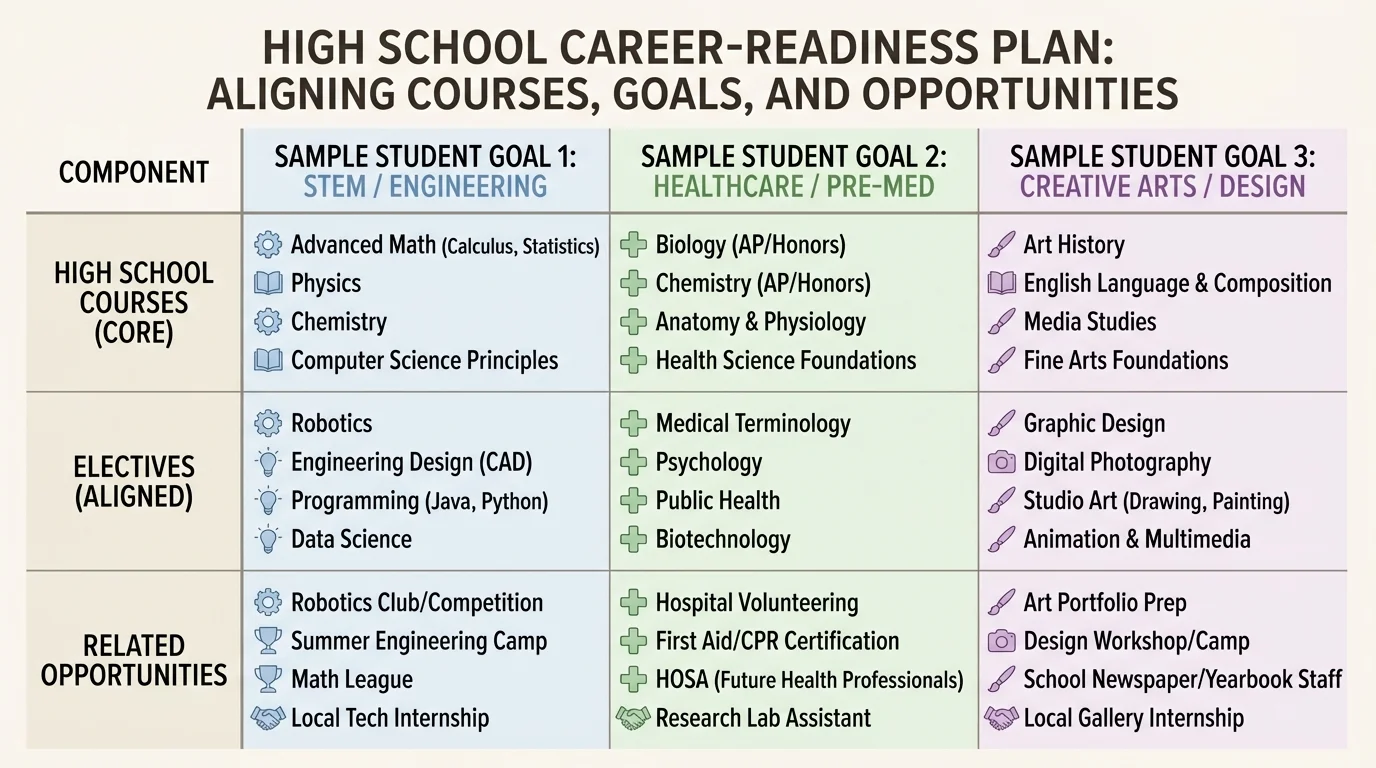
When choosing courses, ask: Does this class help me explore an interest? Does it build a skill I will need later? Does it keep future options open? Does it challenge me at a healthy level?
| Possible Goal Area | Helpful Course Choices | Helpful Opportunities |
|---|---|---|
| Health careers | Biology, health, psychology, strong writing | Volunteer service, first aid training, health career research |
| Technology | Computer science, algebra, digital tools, problem-solving classes | Coding projects, online certifications, tech clubs |
| Business | Business, economics, communication, spreadsheets, writing | Student-run projects, entrepreneurship events, customer service experience |
| Skilled trades | Career-tech courses, applied math, safety training, technical reading | Job shadowing, hands-on workshops, apprenticeships later on |
| Arts and media | Digital design, art, writing, media production | Portfolio building, freelance practice, community projects |
Table 1. Examples of how goal areas can connect to courses and opportunities.
You do not need the "perfect" class list. You need a smart one. If your school offers fewer electives, you can still align your plan by using online resources, community programs, and independent projects.
Good planning does not mean overloading yourself. Choose courses that challenge you and fit your current readiness. A plan works best when it is ambitious and sustainable.
Try this: Before course selection time, make a simple chart with three columns: "Required," "Interested In," and "Helps My Future Goal." If a course fits two or three columns, it is probably a strong choice.
Employers and training programs do not only look at classes. They also care about skills you can use in real situations. These include communication, teamwork, reliability, problem-solving, digital tools, time management, and professionalism.
This is where transferable skills become important. These are skills that can be used in many different jobs. For example, learning to answer emails clearly, show up on time for an online meeting, manage deadlines, or speak respectfully during a group call helps in almost any field.
Professionalism means acting in a responsible, respectful, and dependable way in work-related situations. It includes punctuality, appropriate communication, and follow-through.
You can build these skills through volunteering, community groups, part-time work, family responsibilities, online clubs, creative projects, sports, faith communities, or personal business ideas. A student who manages a small pet-sitting service is learning scheduling, customer communication, and responsibility. A student who edits videos for a local group is building technical skill and a portfolio.
A portfolio is a collection of work that shows your skills. This can include art, writing, coding projects, videos, designs, photography, certifications, or project summaries. Even in 9th grade, you can start a simple digital portfolio folder.
You can also start a basic resume. At your age, it may not be long, and that is fine. Include volunteer work, projects, awards, skills, certifications, and responsibilities. A resume helps you notice that you are already building a story about what you can do.
Real-world example: turning an interest into experience
Maya thinks she might want to work in technology, but she has never had a job.
Step 1: She takes a free beginner coding course online.
Step 2: She creates two small projects, including a simple webpage.
Step 3: She saves screenshots and short explanations in a portfolio folder.
Step 4: She adds the course and projects to her resume.
Maya still has a lot to learn, but now she has proof that she started.
That kind of evidence matters. Many opportunities go to students who can show effort, not just interest.
[Figure 3] A good plan becomes real when it includes actions and deadlines. At this stage, a simple 9th-grade timeline includes four steps: explore, choose, build, and reflect. You do not need to plan your entire life. You just need to know your next useful steps.
Your action plan should answer four questions: What am I exploring? What courses am I choosing? What skills am I building? What opportunities am I looking for this year?
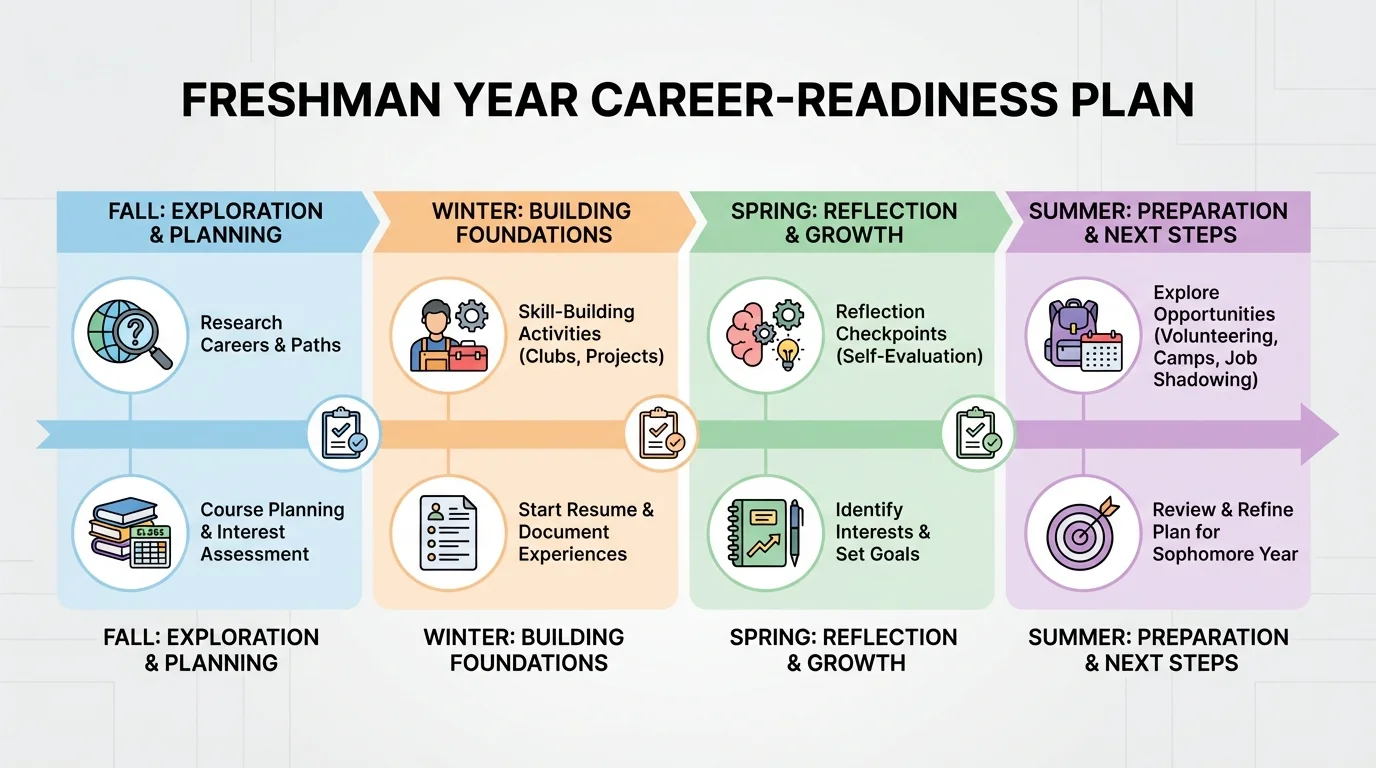
A strong plan uses small deadlines. Big goals can feel overwhelming. Smaller checkpoints make progress visible. For example, "research three careers by October" is easier to act on than "figure out my future."
Here is a practical format you can use:
Part 1: Goal area. Choose one to three fields you want to explore, such as healthcare, business, or digital media.
Part 2: Course connection. List the classes you are taking now and the ones you may want next year that support those fields.
Part 3: Skill target. Pick two or three skills to build, such as writing professional emails, using spreadsheets, public speaking, editing video, or managing deadlines.
Part 4: Opportunity list. Add specific experiences to look for, such as volunteering, an online workshop, a job-shadow video series, a community mentor, a personal project, or a short certification.
You can turn this into a simple schedule. For example: by month 1, research three careers; by month 2, interview one adult or watch two career videos; by month 3, begin a portfolio folder; by month 4, update your resume; by month 5, review course choices; by month 6, reflect on what still feels interesting.
Try this: Put one checkpoint in your phone calendar for the first week of each month. Label it "Future Plan Check." A reminder that appears regularly can keep your plan from fading from view.
[Figure 4] Career planning is not a one-time decision. It is a cycle: plan, take action, reflect, revise, and repeat. That is how adults make career decisions too.
Maybe you thought you would love a certain career, but research shows the daily tasks do not fit you. That is useful information, not failure. Maybe you discover a new strength through volunteering or an online class. That is also useful. Good planning means paying attention and adjusting.
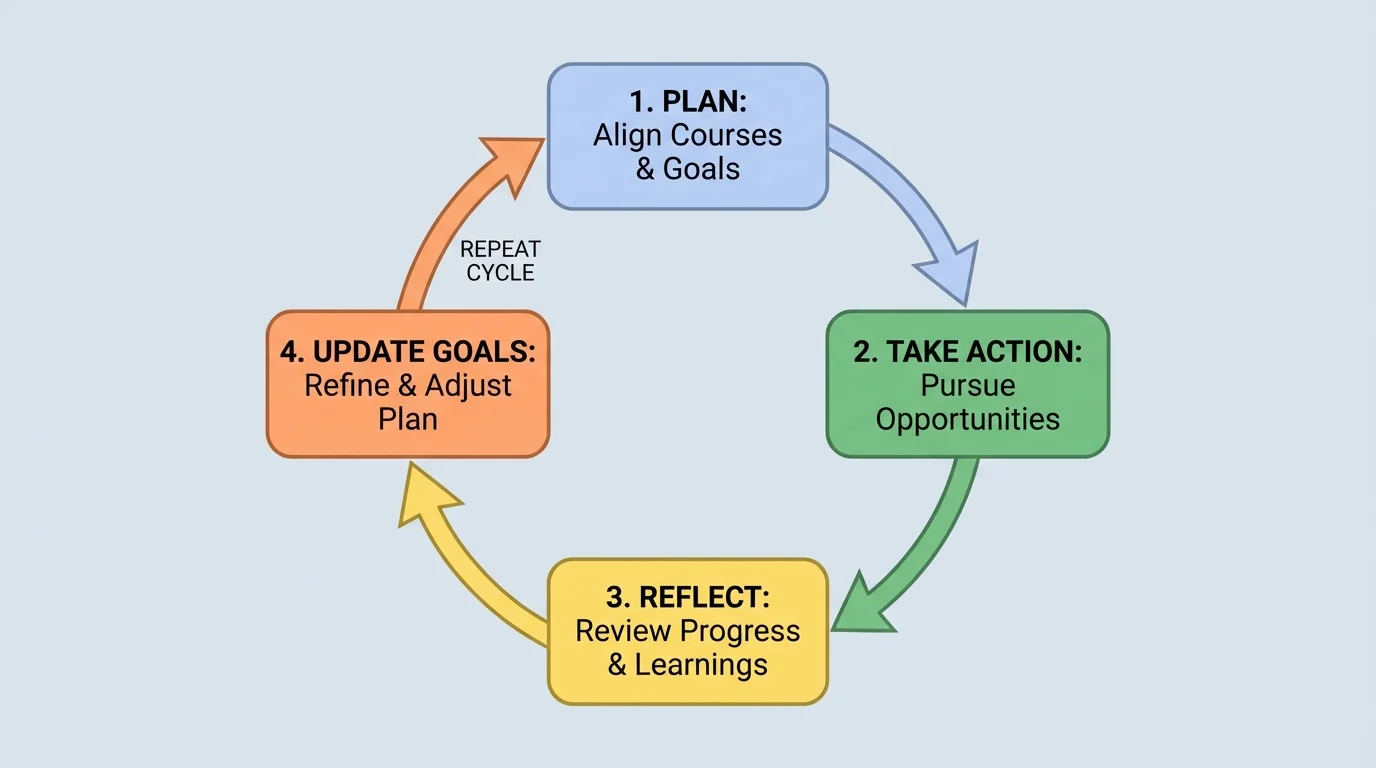
Set a review point at least twice a year. Ask yourself: What did I learn about my interests? What skills did I improve? What opportunities did I miss? What should I change next?
"You do not have to see the whole staircase, just take the first step."
— Martin Luther King Jr.
As your plan changes, keep the basics steady. Continue building strong habits, communicating well, meeting deadlines, and exploring thoughtfully. Those choices help in nearly any path.
When you revisit earlier work, that cycle reminds you that changing direction is normal. Revising your plan is a sign that you are learning, not that you failed to choose correctly.
One common mistake is thinking you must choose your forever career right now. You do not. A better goal is to choose smart next steps.
Another mistake is picking classes based only on what seems easy or what other people want for you. Advice can help, but your plan should still reflect your interests, strengths, and values.
A third mistake is ignoring opportunities because they seem small. A short volunteer role, a digital project, or a basic certification may not seem huge, but these experiences build confidence and evidence.
A fourth mistake is doing research but never acting. Reading about careers helps, but your plan becomes stronger when you create, volunteer, ask questions, practice, and reflect.
Quick comparison: drifting vs planning
Student A chooses classes randomly, misses a webinar deadline, and has no record of projects by the end of the year.
Student B explores two career clusters, chooses one helpful elective, keeps a resume, and completes one community project.
By the end of 9th grade, Student B has more clarity, more confidence, and more useful evidence of readiness.
Even small moves count. If you are consistent, your plan will grow stronger every few months.
Here is a simple sample:
Name: Elena
Possible goal areas: healthcare, psychology, education
Current strengths: listening, organization, writing
Values: helping people, stability, meaningful work
Helpful courses: biology, strong English courses, psychology if available, health-related elective
Skills to build: speaking confidently, note-taking, digital organization, professional communication
Opportunities: volunteer with children, complete a basic first aid course, attend a virtual health careers event, start a resume
Checkpoints: research by September, resume by November, course planning by January, reflection by May
This sample is not fancy, but it is useful. That is the goal. Your plan should help you make decisions, not impress people with complicated wording.
