People often think teamwork is mostly about being friendly. It is not. Often, collaboration comes down to smaller habits that are easy to overlook: doing what you said you would do, joining a call prepared, asking a clear question instead of staying confused, and admitting a problem before it turns into a bigger one. Those habits can make the difference between being the person others want on their team and the person they worry about depending on.
As a student learning online, you already collaborate in ways that matter in adult life. You may work with classmates in shared documents, communicate with teachers through messages or video meetings, coordinate with a coach or club leader, help family members plan something, or volunteer in your community. The skills that help in those settings are not separate. They connect. If you can build strong collaboration habits now, you will use them in school, part-time jobs, internships, volunteer work, and future careers.
Collaboration means working with other people toward a shared goal. That goal might be finishing a group presentation, helping at a community food drive, completing tasks during a job placement, or planning an event with a youth group. Good collaboration saves time, reduces stress, and leads to better results. Poor collaboration creates confusion, resentment, and missed opportunities.
Think about two different situations. In the first, a team member goes silent for two days, misses a deadline, and then says, "I forgot." In the second, a team member realizes early that they are behind, sends a message, asks for help, and adjusts the plan with the group. Both situations involve a problem, but only one protects the team. People do not expect perfection. They do expect communication, effort, and honesty.
Strong collaboration also affects your reputation. In school and work-based learning, people notice who is reliable, respectful, and solution-focused. In community settings, those same traits lead to trust. Trust often leads to more responsibility, stronger references, and more chances to lead.
Shared goal means the result a group is trying to reach together.
Responsibility means taking ownership of your actions, tasks, and choices.
Initiative means acting without waiting to be told every step.
Accountability means being answerable for what you said you would do.
These ideas matter because collaboration is not just "working near people." It is making your effort useful to the group. That requires both personal responsibility and awareness of how your actions affect others.
Real teamwork includes five basic parts: a clear goal, clear roles, respectful communication, follow-through, and problem-solving. If even one of these is weak, the group can struggle. For example, if everyone is nice but nobody knows who is doing what, work can pile up unevenly. If roles are clear but communication is rude or vague, the team may still fail.
You do not need to be loud or naturally outgoing to collaborate well. Quiet people can be excellent teammates because they notice details, listen carefully, and do solid work. Collaboration is less about personality and more about behavior. It is about what you actually do, especially when things get messy.
A useful way to think about teamwork is this: make the next step easier for other people. If you send a complete update, your teammates can respond faster. If you label a file clearly, no one wastes time hunting for it. If you ask a thoughtful question, the whole group gets clearer direction.
Many employers rank communication, dependability, and teamwork as highly as technical ability for entry-level workers. A person can learn tasks more easily than they can repair a reputation for being unreliable.
That is why collaboration is closely tied to leadership. You do not need a title to lead. When you reduce confusion, support the group, and keep the goal moving forward, you are already leading.
Trust grows from repeatable actions. If you want people to see you as dependable, start with habits that are simple and visible.
[Figure 1] First, commit carefully. Do not say yes to everything automatically. If you agree to do something, make sure you understand what is expected and when it is due. A responsible teammate does not overpromise just to sound helpful.
Second, prepare before meetings or calls. If you join a video call without reading the instructions, checking the shared document, or thinking about your update, you waste group time. Even five minutes of preparation can make your contribution more useful.
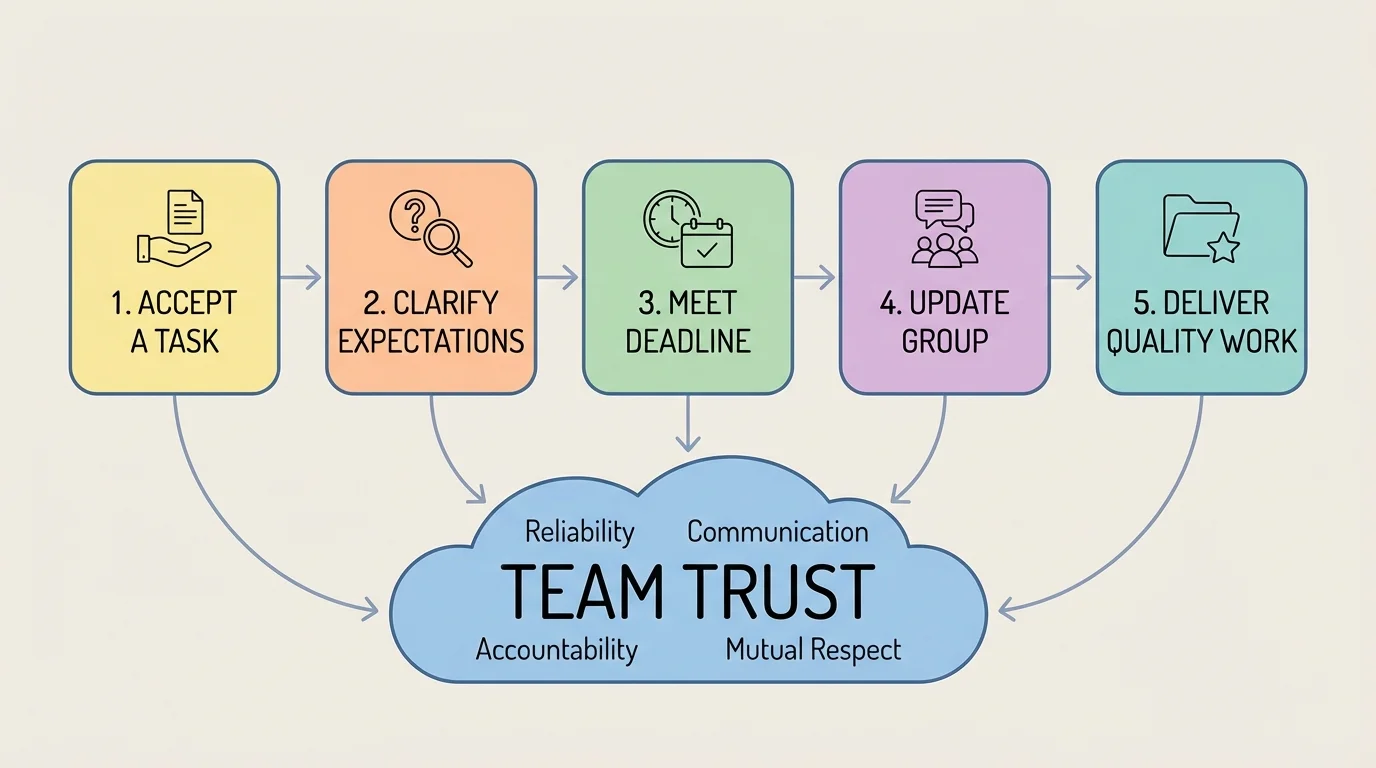
Third, meet deadlines or warn people early. Missing a deadline without warning damages trust fast. Sometimes problems happen, but a quick message such as "I am not going to finish by tonight; I can send my draft by 8 p.m. tomorrow" gives the team a chance to adjust.
Fourth, do quality work. Finishing is not enough if the work is rushed, incomplete, or careless. Collaboration is stronger when your part is usable. Before submitting something, check: Is it accurate? Is it complete? Is it in the correct format? Is it understandable to someone else?
Fifth, be honest. If you are confused, ask. If you made a mistake, say so. If you forgot something, admit it and move into problem-solving. People trust honest teammates more than defensive ones.
As you saw in [Figure 1], trust is usually built in a chain. One good action helps the next one happen. Clarity leads to better timing, better timing supports better quality, and better quality makes future teamwork smoother.
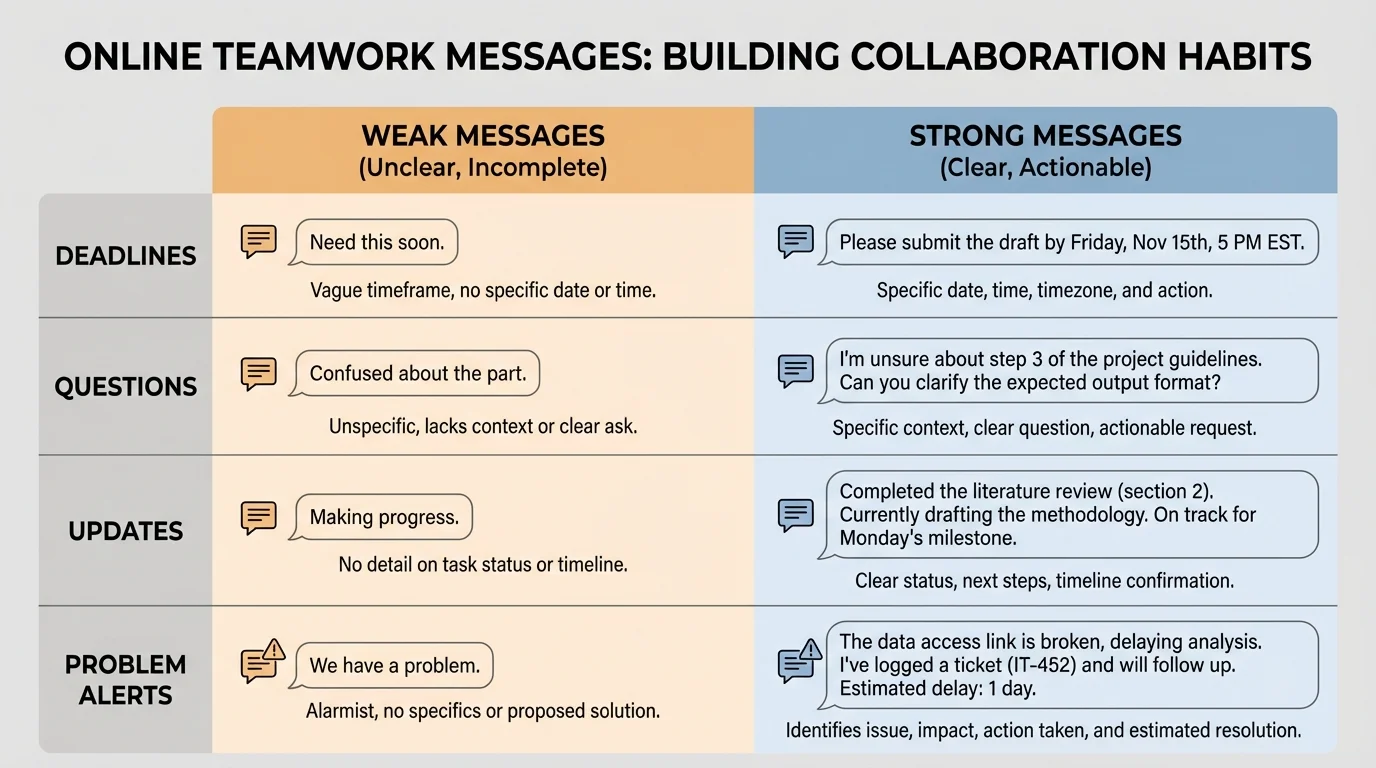
The words you choose can either reduce confusion or create it, and [Figure 2] makes that difference clear by comparing weak messages with useful ones. Since much of your school communication happens online, it is especially important to be direct, respectful, and specific.
Vague messages slow teams down. Compare these examples: "I don't get it" versus "I understand the first two questions, but I am confused about what source we are supposed to use for question three." The second message gives people something they can answer. Specific questions are easier to solve.
Clear communication usually includes four things: what you are talking about, what you need, when you need it, and what you have already done. For example: "I finished the slide images, but I need someone to review the text by 6 p.m. so I can submit the final file tonight." That message helps the team act quickly.
Tone matters too. Online messages can sound colder than you intend. Short replies like "fine" or "whatever" may come across as annoyed, even if you are just busy. You do not need to sound fake or overly cheerful, but simple phrases such as "Thanks," "Can you clarify," or "I can take that part" help keep communication respectful.
Listening is part of communication. On video calls, that means not interrupting, paying attention, and responding to what people actually said rather than what you assumed. In text-based communication, listening means reading fully before replying, checking for instructions, and not jumping to conclusions.
Another useful habit is the check-in. A check-in is a short update that lets the group know your status. It might be as simple as: "I started the research and have two sources. I still need one more source and can finish tonight." This prevents silence from being mistaken for inaction.
Useful message examples
Step 1: Weak update
"I'm working on it."
Step 2: Stronger update
"I finished the outline and added three examples. I still need to proofread, and I can upload the final version by 7 p.m."
Step 3: Problem alert
"My internet has been unstable this afternoon. If I disconnect during the call, I will rejoin by phone and send my notes in the chat."
Later, when you are in a workplace, these same communication habits matter even more. Supervisors and coworkers need updates they can act on. As [Figure 2] suggests, clear messages are not about sounding impressive. They are about making teamwork smoother.
A team works better when tasks are divided clearly. If roles are unclear, one person may do too much while another does too little. When you start a project, ask practical questions: Who is doing which part? What does "done" look like? When are mini-deadlines before the final deadline? Where will files and updates be shared?
This is where role clarity matters. Role clarity means each person understands their job and how it connects to the whole task. It does not have to be formal. Even a simple list in a shared document can help.
Doing your part also means avoiding two extremes. One extreme is doing too little and leaving the group to carry you. The other extreme is taking over everything because you do not trust anyone else. Both hurt collaboration. Strong teammates contribute fully while still leaving room for others.
If you finish your own task early, you can support the team by reviewing, asking what still needs to be done, or helping solve a problem. That shows initiative. But ask before changing someone else's work in a major way. Helping should not turn into controlling.
| Team habit | What it looks like | Likely result |
|---|---|---|
| Clarifying tasks | Confirming what you are responsible for | Less confusion and overlap |
| Mini-deadlines | Breaking one due date into smaller checkpoints | Fewer last-minute problems |
| Quality check | Reviewing your work before sharing it | Better final product |
| Offering support | Asking where the team is stuck | Stronger group progress |
Table 1. Everyday habits that improve team performance and reduce avoidable mistakes.
Sometimes people think responsibility means only finishing their own part. In reality, it also means staying aware of the team's progress. If your section depends on someone else's part, check in early rather than waiting until the last minute to discover a problem.
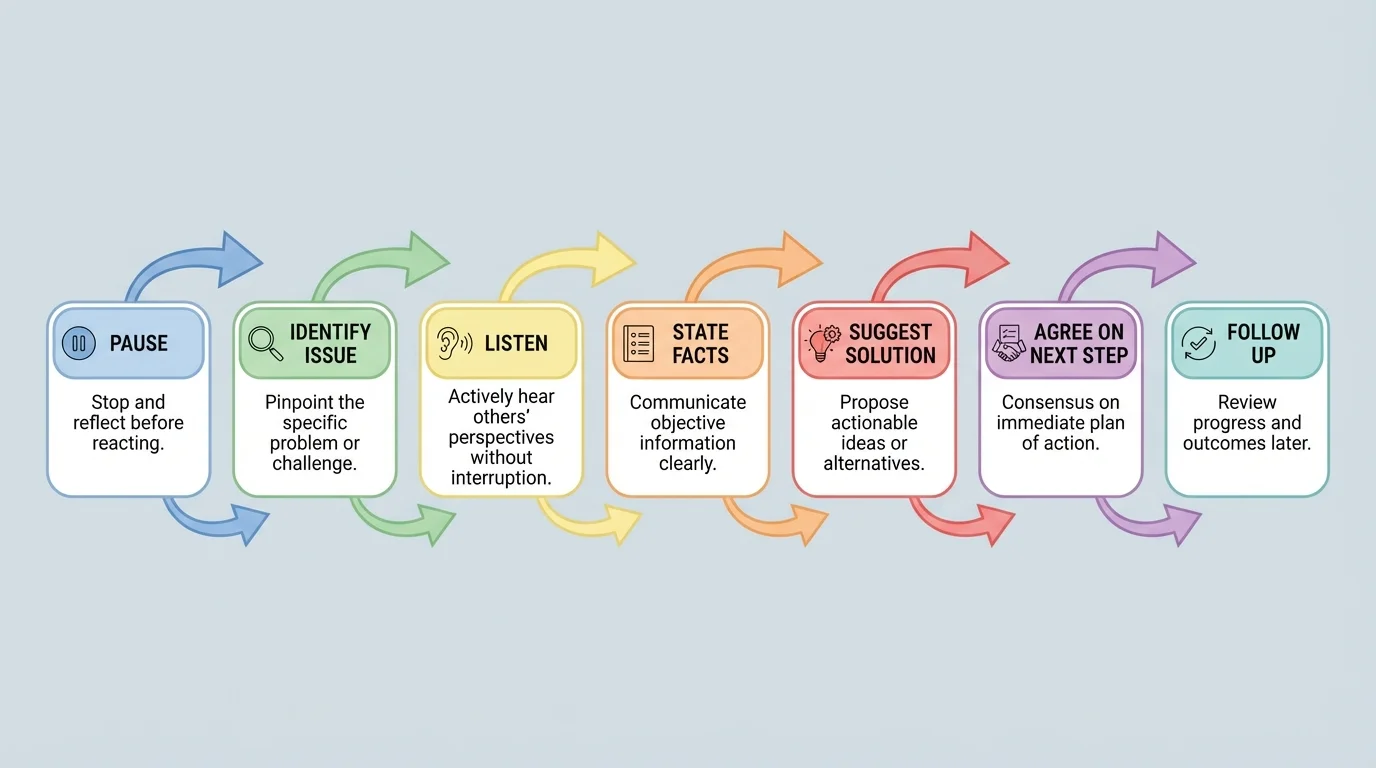
Disagreements happen in every group. What matters is how you respond, and [Figure 3] lays out a calm path for dealing with tension without making it worse. Avoiding conflict completely is not a real solution. It often lets frustration build until people snap.
When a problem comes up, start by slowing down. If you are upset, do not fire off the first message that comes to mind. Instead, identify the real issue. Is it a missed deadline? A misunderstanding? Unequal effort? A rude comment? Naming the actual problem helps you respond more clearly.
Then use facts, not attacks. Compare: "You never do anything" with "The notes were due yesterday, and we still do not have them. What is the plan for finishing them today?" The second response stays focused on behavior and next steps.
Feedback is part of teamwork too. Constructive feedback is feedback meant to improve the work, not embarrass the person. Good feedback is specific, respectful, and useful. For example: "The idea is strong, but the main point is hard to find. Could you move it to the first sentence?"
If you are the one who made the mistake, do not hide, blame, or make excuses. Repair the situation. A strong repair often sounds like this: "I missed the deadline. That affected the team. I can send a complete draft by 5 p.m., and I will check in at 3 p.m. to confirm progress." That response shows accountability.
"The problem is the problem. The person is not the problem."
— A useful teamwork principle
Sometimes the best solution is compromise. Other times it is division of tasks, clearer expectations, or a reset of the timeline. As shown earlier in [Figure 3], the goal is not to win the argument. The goal is to move the team forward in a fair way.
Work-based learning includes experiences like job shadowing, internships, volunteer placements, apprenticeships, or part-time jobs. In these settings, collaboration becomes more professional. People expect you to be on time, respond appropriately, follow instructions, and work respectfully with people of different ages and backgrounds.
You may hear the word professionalism. In simple terms, professionalism means behaving in a responsible, respectful, work-ready way. It includes how you communicate, how you manage your time, how you handle mistakes, and how you treat others.
For example, if a supervisor gives you a task and you are unsure how to do it, do not just guess and hope. Ask one or two focused questions, repeat back the important details, and confirm the deadline. That shows responsibility, not weakness.
If you work with customers, clients, or community members, your teamwork affects them too. A disorganized team can create delays, confusion, and poor service. A coordinated team makes people feel respected and supported. That is one reason collaboration is a real employability skill, not just a school skill.
Workplace collaboration example
You are helping at a community center after school. Your supervisor asks you to set up materials for a youth program while another volunteer handles sign-in.
Step 1: Clarify the task
Ask what materials are needed, where they go, and what time setup must be finished.
Step 2: Coordinate
Check with the other volunteer so your setup matches the sign-in flow and people can move easily through the space.
Step 3: Communicate problems early
If supplies are missing, tell the supervisor before the program starts instead of waiting until participants arrive.
Step 4: Follow through
Complete the setup, double-check the area, and let the supervisor know it is ready.
That kind of steady teamwork makes you more likely to be trusted with future responsibilities, stronger references, and leadership opportunities.
Community settings can include sports teams, faith groups, clubs, neighborhood projects, local events, activism, mentoring programs, or volunteer organizations. These spaces often include people with different ages, abilities, and experience levels. That means you may need extra patience and flexibility.
In community work, collaboration is not only about efficiency. It is also about respect, inclusion, and service. If you are helping organize a cleanup, fundraiser, donation drive, or community event, people need to feel welcomed and informed. Small habits matter: greeting people, explaining tasks clearly, noticing when someone is left out, and adapting if plans change.
You may also need to work with people whose communication style is different from yours. Some are direct. Others are cautious. Some want a plan immediately. Others want more discussion first. Good collaborators adjust without losing their own standards. They stay respectful while still helping the group make decisions.
When working in your community, remember that your actions represent more than yourself. They affect the group's reputation. If volunteers are rude, unreliable, or disorganized, community trust can drop. If volunteers are helpful and consistent, more people will want to support the effort.
Inclusive collaboration means helping a group work well for everyone, not just the loudest or most confident people. This includes inviting quieter people to speak, making instructions understandable, sharing information openly, and treating each person with dignity.
That kind of teamwork is especially important in service settings because the goal is often bigger than the task itself. You are not just finishing a checklist. You are helping real people or improving a real place.
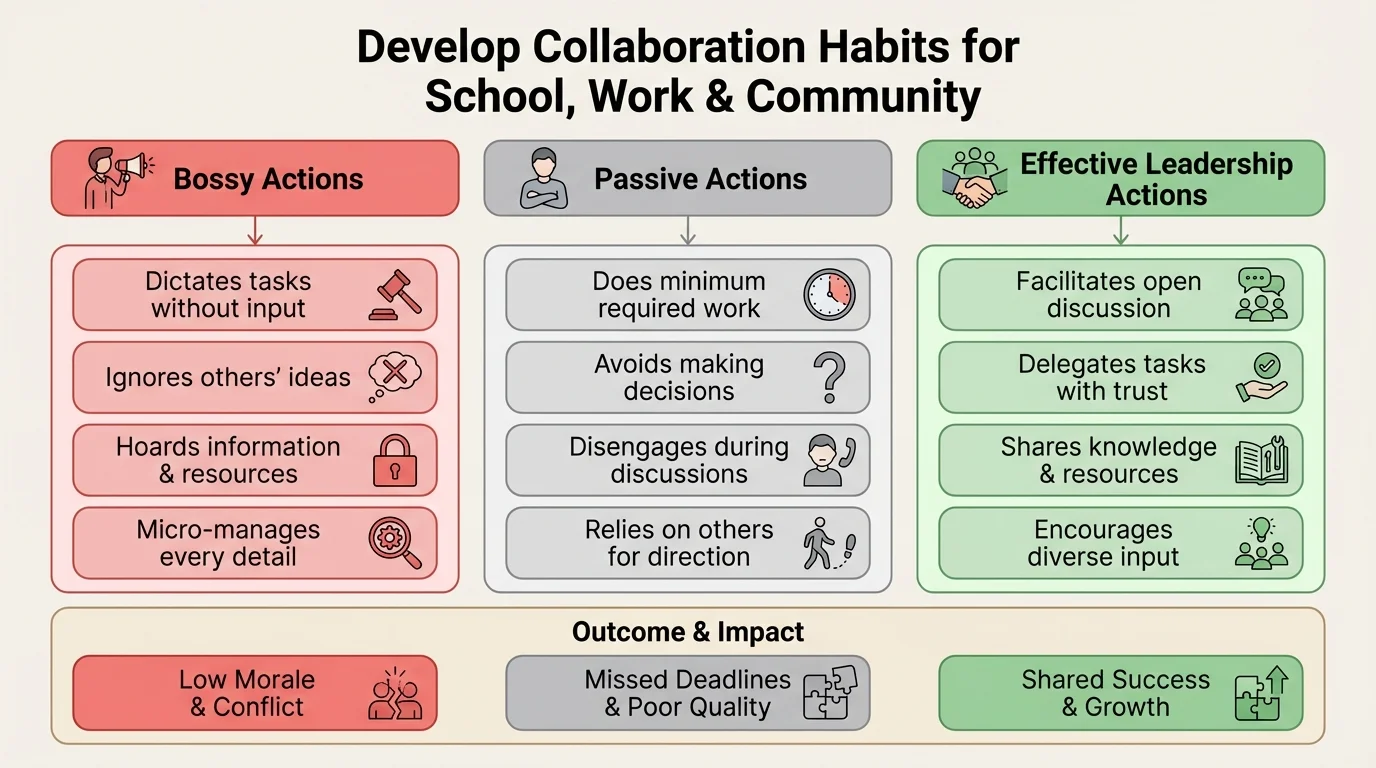
Leadership is not the same as controlling people, and [Figure 4] highlights the difference between bossy behavior, passive behavior, and effective leadership. In collaborative settings, leadership usually looks like noticing what needs to happen and helping it happen respectfully.
Initiative means you do not wait for perfect instructions before doing something helpful. You notice a missing step, ask if you can handle it, and move forward. Examples include creating a shared checklist, reminding the group about a deadline, offering to draft a first version, or organizing files so everyone can find them.
Strong leadership also includes self-control. If you constantly seek credit, interrupt others, or dismiss ideas quickly, people may stop wanting to work with you. Effective leaders create space for others. They guide, ask, support, and decide when needed, but they do not act like the team exists to serve them.
A practical leadership habit is to focus on the next useful action. Instead of saying, "Someone should do something," say, "I can make the checklist," or "I can contact the organizer and ask for the final details." Specific action moves the group forward.
Another leadership habit is giving credit. Thank people for their effort. Mention good ideas. Recognize improvement. Teams are stronger when people feel their contributions matter. As [Figure 4] shows, leadership works best when it combines confidence with respect.
You do not build collaboration habits in one day. You build them by repeating a few useful actions until they become normal. Use this checklist before, during, and after team tasks.
Before the task: Know the goal. Know your role. Know the deadline. Ask questions early. Gather what you need. Prepare for meetings or calls.
During the task: Send updates. Meet mini-deadlines. Keep your messages clear. Do your share. Ask for help if needed. Offer help when appropriate. Stay respectful even when stressed.
After the task: Submit on time. Check quality. Thank teammates. Notice what worked. Notice what caused problems. Choose one habit to improve next time.
If you want a quick self-rating, ask yourself these five questions: Did I communicate clearly? Did I follow through? Did I help the group, not just myself? Did I handle stress respectfully? Did people know they could count on me? Even answering honestly can help you grow.
Growth in life skills usually comes from repetition, reflection, and adjustment. You do not need to become a perfect teammate overnight. You need to keep practicing the habits that make other people's work easier and the group's goal more reachable.
That is what strong collaboration looks like across online school, work-based learning, and community settings. It is not flashy. It is dependable, clear, respectful, and active. Those habits make you more effective now and more trusted in the future.
