Have you ever heard someone say, "You are really good at that"? That is a clue about your strengths. Some children are great at helping. Some are great at building. Some are great at listening. Some are great at making others feel welcome. You have strengths too, and you can learn to name them.
A strength is something you do well or a good quality you show. A strength is not just about being fast or winning. A strength can also be being kind, careful, brave, calm, creative, or helpful.
Personal strengths are good things about how you think, feel, and act. They can show when you learn, help, play, solve problems, and care for others.
Your strengths may be different from someone else's strengths. That is a good thing. People do not all need the same gifts. One child may be a strong speaker. Another may be a strong listener. Another may be a strong problem-solver. All of these strengths matter.
You can notice a strength by asking simple questions. What feels good to do? What do you keep trying? What do grown-ups say you do well? What helps other people? These clues can help you see your strengths.
Strengths show on the inside and the outside. Some strengths are about actions, like cleaning up or sharing. Some strengths are about feelings and thinking, like staying calm, being curious, or trying again after a mistake.
Sometimes a strength is quiet. A child who waits, watches, and listens carefully is showing a strength. Sometimes a strength is active. A child who starts a game and invites others is showing a strength too.
[Figure 1] At home, you may have different jobs during learning time, and your strengths can show up in each one. If you listen when someone speaks during an online lesson, you may be a good listener. If you put away crayons and books, you may be responsible. If you speak up to answer, you may be brave.
You might help set up your learning space, bring supplies, mute and unmute when needed, or wave hello on a video call. These are small jobs, but they can show big strengths. A helper can be caring. A leader can be confident. A cleaner can be careful. A sharer can be kind.
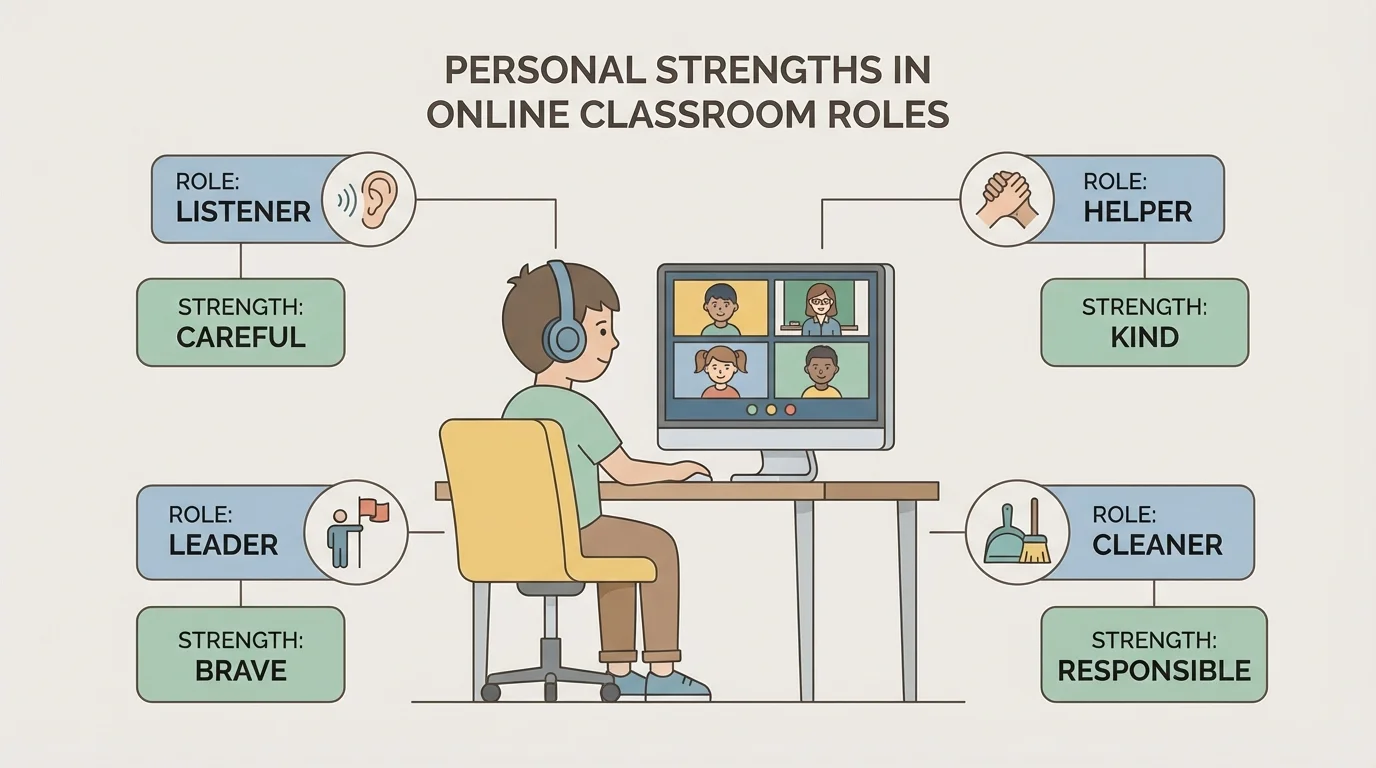
Here are some role-and-strength matches you might notice:
| Role | Strength You Might Show |
|---|---|
| Listener | Careful, calm |
| Helper | Kind, caring |
| Leader | Brave, confident |
| Cleaner | Responsible, organized |
| Sharer | Generous, friendly |
Table 1. Examples of simple roles and the strengths they can show.
When you think about your own roles, you do not need to pick only one strength. You might be both helpful and patient. You might be both creative and careful. As shown in [Figure 1], one role can connect to more than one strength.
Activities are another place where strengths shine. When you draw a picture, you may show creative thinking. When you finish a puzzle, you may show patience. When you keep trying to zip your coat or tie something, you may show persistence.
You can show strengths in many everyday things at home. If you help stir batter, match socks, water a plant, or feed a pet, you may be responsible. If you sing, dance, build with blocks, or make up stories, you may be imaginative. If you notice a problem and think of a fix, you are using your problem-solving strength.
Real-life examples
Step 1: Think about the activity.
You built a tall block tower.
Step 2: Name what you did well.
You kept trying after it fell down.
Step 3: Name the strength.
You showed persistence and problem-solving.
[Figure 2] Another example: if you color slowly and stay inside the lines, you may be careful. If you make a card for someone who is sad, you may be thoughtful. Strengths are not only about what you make. They are also about how you do it.
Play is a wonderful time to notice strengths. In pretend play, you may be imaginative. In a game, you may take turns and follow rules. When you invite a sibling, friend, or another child on a video call to join, you may be friendly and welcoming.
Play can also show a role. Maybe you are the builder, the storyteller, the peacemaker, or the one who remembers the rules. Each role can show a strength. A builder may be creative. A peacemaker may be kind and calm. A rule-reminder may be responsible and fair.
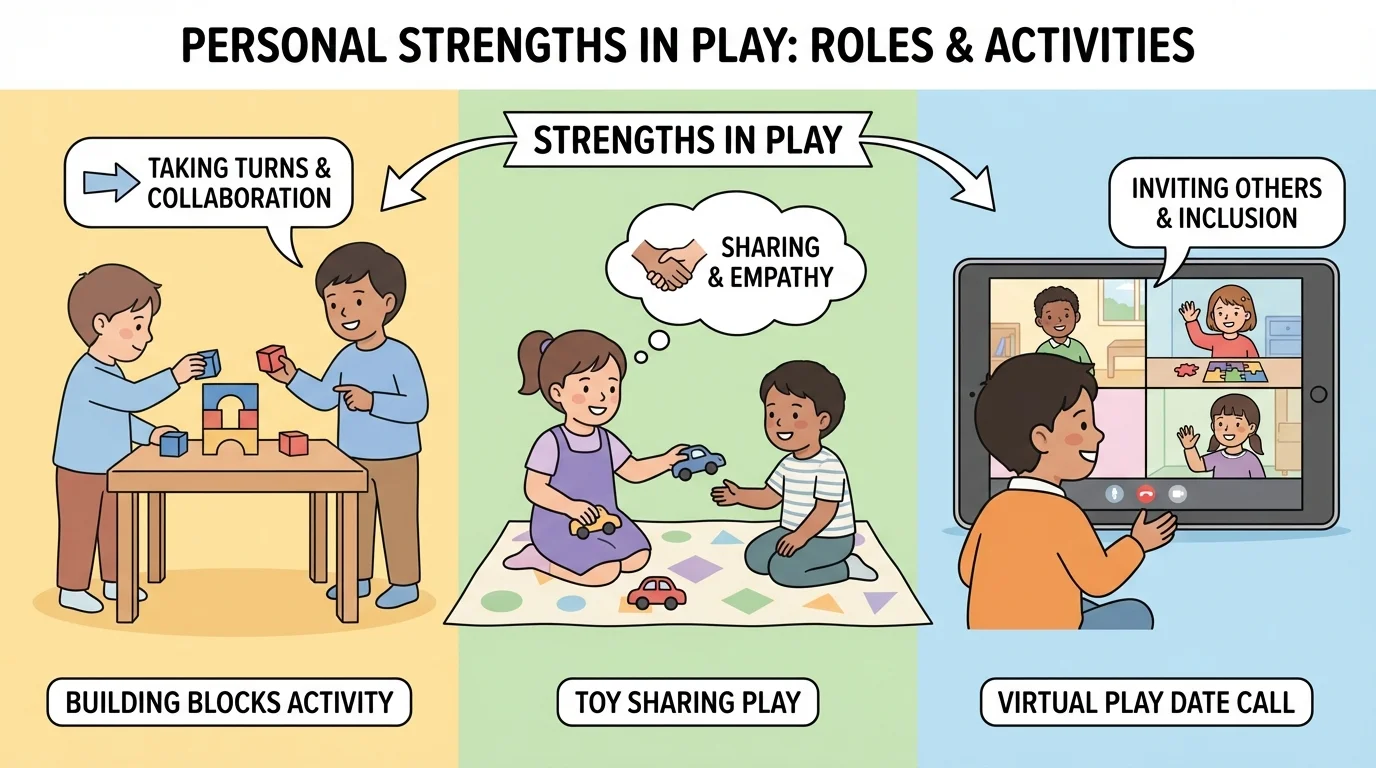
If a game feels hard and you still try again, that is a strength. If you lose and use calm words, that is a strength too. If you share space, toys, or ideas, you are showing care for others. Later, when you think back to play, you may remember that strengths are often seen in actions.
Many strengths are easy to miss because they look small. Waiting for your turn, using a gentle voice, or helping clean up after play are all important strengths.
Good things can happen when you know your strengths. You may feel proud, brave, and ready to try. If you do not notice your strengths, you may forget how much you can do. Naming strengths helps you believe in yourself.
You can learn to name your strengths with four simple moves. Look: What are you doing? Feel: What feels good or strong inside? Listen: What kind words do trusted grown-ups say about you? Say it: "I am helpful," or "I am a good listener."
You do not need fancy words. Short, true words are best. You can say, "I am kind." "I keep trying." "I am careful." "I share." "I help." "I build." "I think of ideas." These are all good ways to name a strength.
"I can notice the good things I do."
It is okay if naming your strengths feels a little strange at first. Some children are shy about saying nice things about themselves. But naming a strength is not bragging. It is telling the truth in a kind way.
You can use simple sentence starters. Try saying, "I am good at helping." "I am a good listener." "I showed kindness when I shared." "I was brave when I answered." "I was patient when I waited."
You can also notice strengths in others. You might say, "You were kind." "You were a good helper." "You kept trying." When people name strengths kindly, everyone learns to see the good in themselves and others.
Sometimes you have a strength, but it does not show every time. Maybe you are usually patient, but one day you feel upset. Maybe you are usually brave, but one day you feel nervous. That does not mean your strength is gone.
Strengths can grow. The more you practice a positive behavior, the stronger it becomes. Kindness grows when you use kind words. Responsibility grows when you finish small jobs. Confidence grows when you try again.
Mistakes are part of learning. If you grab a toy instead of waiting, you can fix it and try again. If you forget to help clean up, you can start now. Growing your strengths means practicing, not being perfect.
When you finish a day of learning, activities, or play, you can ask yourself one simple question: "What strength did I show today?" Your answer might be small, but it still counts. Small strengths are real strengths.
