Have you ever wanted something right now and had to wait? That can feel hard. Your body may want to grab, shout, or move fast. But you can learn to slow your body down. That is an important skill to learn. It helps at home, during play, in the community, and during online learning too.
Self-control means you stop, think, and choose what to do. You do not have to do the first thing your body feels like doing. You can make a safe and kind choice instead.
Self-control is using your body, voice, and choices in a calm way, even when you feel excited, upset, or impatient.
Directions are things someone asks you to do.
Turn-taking means one person goes, then another person goes.
When you use self-control, good things happen. People can understand you better. You get turns more easily. Activities go more smoothly. When self-control is missing, play can stop, people can feel upset, and you may miss directions.
Self-control does not mean being perfect. It means trying helpful tools. It can look like quiet hands, a calm voice, eyes looking, feet staying in place, or waiting before touching something. It can also look like asking, "Can I have a turn next?"
Sometimes self-control is tiny but powerful. You may take one deep breath. You may count slowly. You may hold your hands together so they do not grab. Those small actions help your brain get ready to make a good choice.
Your pause power
There is a small space between a feeling and an action. In that space, you can pause. When you pause, you can choose. That is how self-control grows stronger.
You can practice this at home every day, as [Figure 1] shows. The more you practice when things are calm, the easier it is to use when something feels hard.
Waiting is easier when you have a plan. A wait plan can be very simple: keep your hands to yourself, take a breath, and look at what you can do while you wait. If the adult caring for you is talking on the phone, you might sit with a book or soft toy until it is your turn to talk.
You can also use a timer. A timer helps you know that waiting will end. If you are waiting for a snack, for help with a game, or for your turn to speak on a video call, a timer can make waiting feel fair and clear.
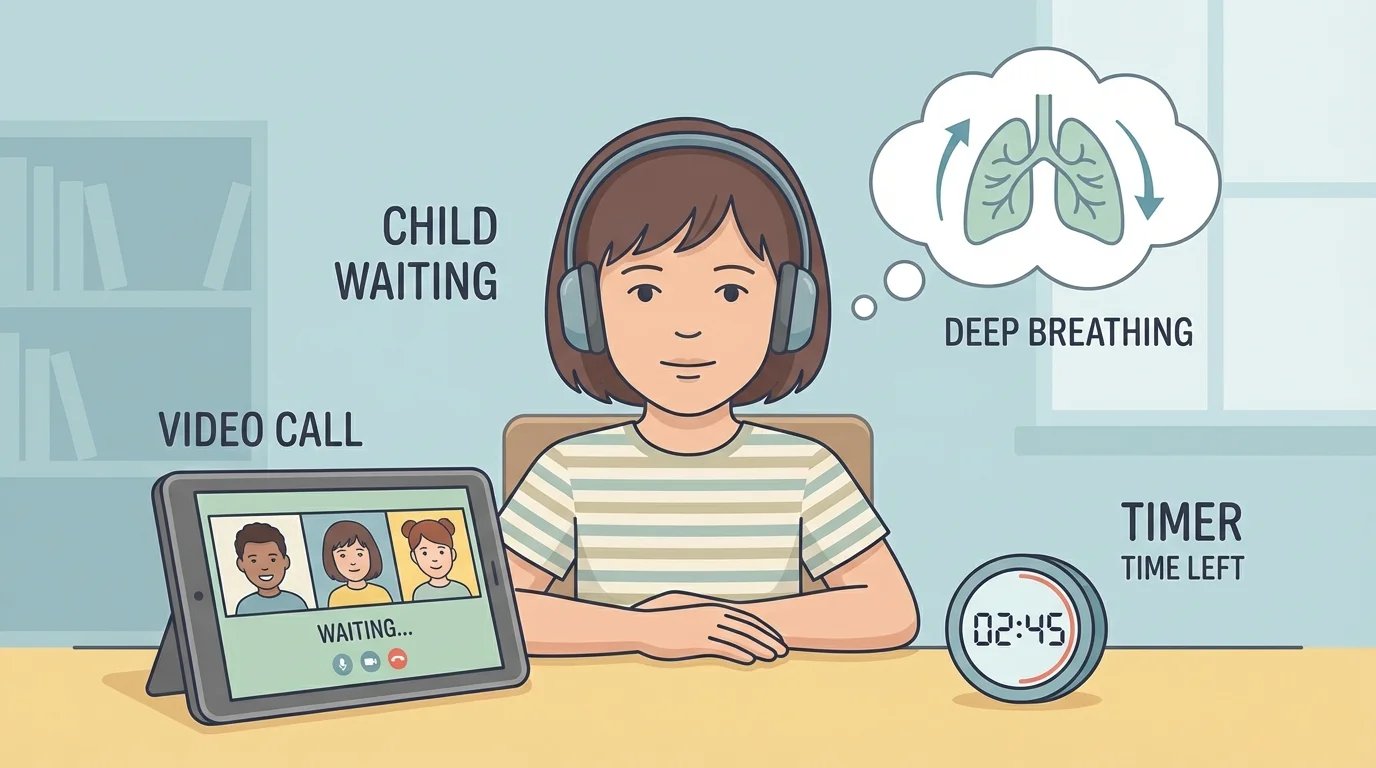
Here is a simple waiting routine: stop your body, breathe, and choose a quiet job. A quiet job might be hugging a pillow, counting to five, looking at a picture book, or putting your hands in your lap.
If waiting feels very hard, use words. You can say, "I am waiting." You can say, "Can you tell me when it is my turn?" You can say, "I need help waiting." Asking for help is a strong choice.
Example: Waiting for a turn to talk online
Step 1: Look at the screen and keep your voice quiet.
Step 2: Put your hand on your chest and take one slow breath.
Step 3: Wait until the other person is done talking.
Step 4: Say, "It is my turn to talk now," or raise your hand if the adult says to do that.
This helps everyone hear each other and feel respected.
Later, when you are waiting for a turn with a toy or a turn to speak, remember the calm body in [Figure 1]. Quiet hands and a waiting plan help your turn come faster because others can trust you.
Sharing does not always mean giving something away forever. Many times, sharing means turn-taking. One person uses the item, then the next person uses it. This works with crayons, blocks, a swing at the park, or even a tablet at home.
Sharing does not always mean giving something away forever. Many times, sharing means turn-taking. One person uses the item, then the next person uses it. This works with crayons, blocks, a swing at the park, or even a tablet at home.
Before you grab, use words first. Try, "Can I have a turn when you are done?" or "Do you want to trade?" or "We can share." Kind words help solve problems without pushing or crying.
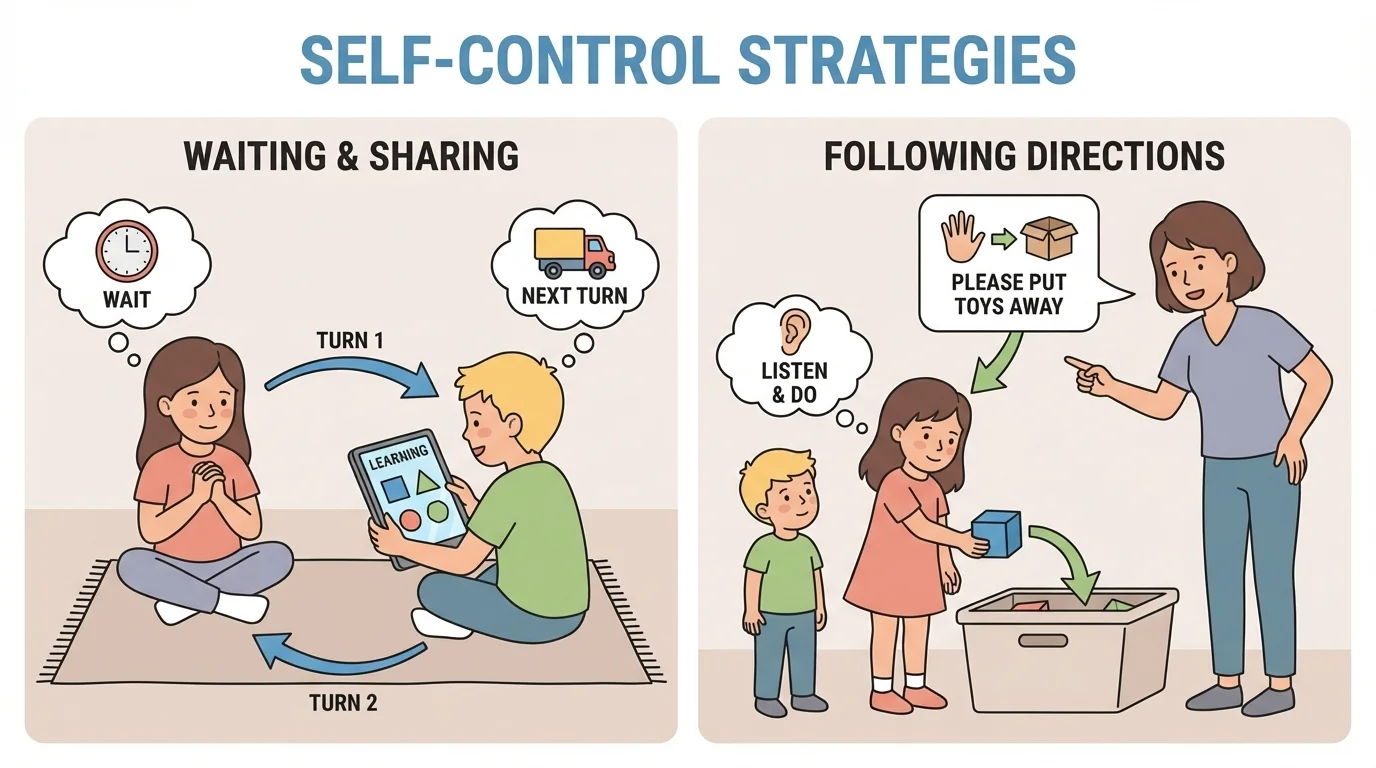
Sometimes sharing feels hard because you really like the object. That feeling is okay. The important part is what you do next. You can hold your feeling and still make a kind choice. You can ask for a turn, wait nearby, or choose something else for now.
If someone asks for your toy, you can practice a calm answer. You might say, "I am still using it. You can have a turn next." That is polite and clear. If it is time to share, you can hand it over gently.
Example: Sharing one box of markers
Step 1: Notice there is only one box.
Step 2: Use words: "Let's share the markers."
Step 3: Give some colors to the other person or take turns choosing colors.
Step 4: If a problem starts, stop and ask an adult for help instead of grabbing.
Sharing keeps play going and helps everyone feel included.
When you think about fairness, the turn order in [Figure 2] reminds you that both people matter. Sharing is not about winning. It is about making space for everyone.
Directions are easier to follow when you use a routine: look, listen, say it back, do it, check it. This can help when a parent says, "Put your shoes by the door," or when your online teacher says, "Get your paper and a pencil."
[Figure 3] Sometimes children miss directions because they start moving too fast. First, stop your body. Next, listen to the whole direction. Then say it back in simple words: "Paper and pencil." Saying it back helps your brain remember.
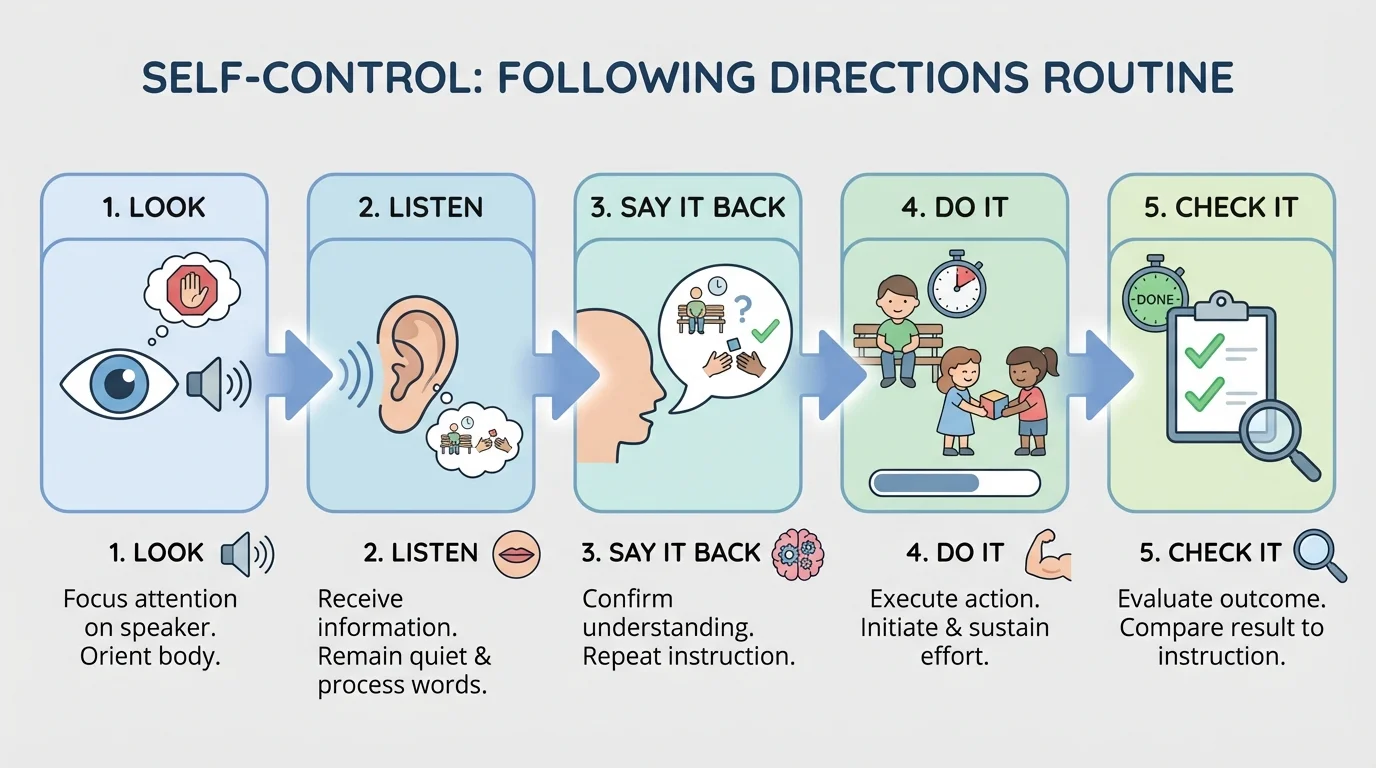
If there is more than one step, do one step at a time. For example: "Pick up your book, put it on the table, and sit down." Start with the first step only. Then do the next step. This keeps your brain from feeling too full.
If you do not understand, ask calmly. You can say, "Can you say it again?" or "What do I do first?" That is better than guessing and getting upset.
Example: Following a cleanup direction
Step 1: Hear the direction: "Put the blocks in the bin."
Step 2: Repeat it: "Blocks in the bin."
Step 3: Do the action with your body.
Step 4: Check: "Are the blocks all in?"
When you finish, you can say, "I did it."
Later in the day, the routine in [Figure 3] still helps. You can use it when getting ready to go outside, cleaning up, or joining an online activity.
Sometimes waiting, sharing, or following directions feels extra hard because your feelings get very big. Your face may get hot. Your voice may get loud. Your hands may want to snatch. This is the moment to use a calming tool.
Here are some helpful calming tools: take a belly breath, count slowly to five, squeeze your hands together, hug a stuffed animal, or ask for help. You can also move to a quiet spot with an adult if you need a short break.
Your brain gets better at self-control every time you practice a calm choice. Small calm choices today help make bigger calm choices tomorrow.
A calm choice does not make the hard feeling disappear right away. It helps you stay safe while the feeling gets smaller. That is real strength.
When you have to wait, put your hands in your lap and take one slow breath. When you want a toy, ask for a turn with words. When someone gives you a direction, stop and repeat the direction before you begin.
You do not need to do these perfectly. You are practicing. Each time you wait a little longer, share a little more kindly, or follow a direction a little faster, you are growing your self-control.
"Stop, breathe, and choose."
That short sentence can help you almost anywhere—at home, in the car, on a video call, at the store, or during play. The more you use it, the stronger your self-control becomes.
